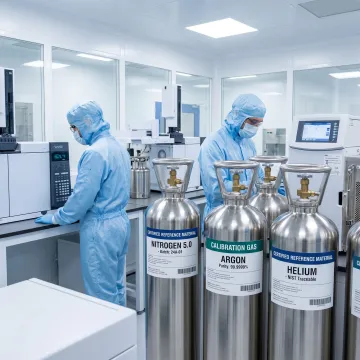
ISO Guide 34 was the former international guidance standard for the competence of reference material producers. It established requirements for quality systems, technical procedures, characterization, homogeneity, stability, and documentation. While it has largely been replaced by ISO 17034, many buyers still use the term when searching for certified reference material services and suppliers with strong traceability and production controls.
What is the ISO standard for certified reference materials?
The current primary standard for producers of certified reference materials is ISO 17034. It works alongside standards such as ISO/IEC 17025 for testing and calibration competence. Together, these frameworks help ensure reference materials are properly characterized, stable, traceable, and supported by clear documentation so laboratories can use them confidently in calibration, validation, and quality assurance programs.
What is a certified reference material ISO?
A certified reference material, or CRM, is a material with one or more property values established by a technically valid procedure and accompanied by documentation showing uncertainty and traceability. In ISO-related contexts, the term usually refers to materials produced under recognized quality and technical requirements, helping laboratories verify methods, calibrate instruments, and maintain reliable measurement results.
How are certified reference material gas mixtures used?
Certified reference material gas mixtures are used to calibrate analytical instruments, verify detector response, validate test methods, and support ongoing quality control. Common applications include gas chromatography, emissions monitoring, air quality testing, semiconductor manufacturing, and laboratory research. Accurate reference gases help reduce measurement drift, improve repeatability, and support documented compliance with internal or regulatory quality requirements.
What makes a calibration gas suitable as a reference material?
A calibration gas is suitable as a reference material when its composition is accurately prepared, stable over time, traceable to recognized standards, and supported by proper documentation. Important factors include blend accuracy, cylinder treatment, homogeneity, shelf life, uncertainty reporting, and compatibility with the intended instrument or method. Reactive gases especially require specialized handling to maintain dependable concentrations.
Can you produce custom certified reference material gas blends?
SpecGas Inc. produces custom specialty and calibration gas blends tailored to customer specifications for concentration, purity, balance gas, and cylinder type. This is especially valuable for laboratories and manufacturers with uncommon analytes, low ppm or ppb targets, or reactive gas requirements. Custom blending helps align the reference material more closely with the instrument range, method conditions, and application-specific performance needs.
Are your gas standards traceable to NIST?
Yes. SpecGas Inc. lists NIST Traceable Gas Standards among its certifications and core capabilities. NIST traceability helps establish a documented measurement chain back to recognized standards, which is important for calibration integrity, audit readiness, and quality system support. For many laboratories and industrial users, traceable standards are essential when validating instruments, maintaining records, and demonstrating measurement confidence.
What industries use specialty gas reference materials?
Specialty gas reference materials are used across university and research laboratories, air quality and emissions monitoring, electronics and semiconductor manufacturing, utilities, power generation, OEM manufacturing, process controls, laser applications, and medical sectors. These industries rely on precise gas standards to calibrate instruments, verify process performance, support product quality, and maintain dependable analytical measurements in critical operating environments.