A 1% relative error on a 1,000 ppm mixture means a 10 ppm deviation. That's enough to invalidate a calibration gas, fail a compliance audit, or corrupt months of research data. The stakes scale sharply as concentrations drop toward ppb levels.
This guide covers what gas mixing and blending actually involves: how the process is defined, which methods are used and why they differ in accuracy, what quality controls separate reliable mixtures from unreliable ones, and how to evaluate a specialty gas supplier for demanding applications.
Key Takeaways
- Gas blending is the controlled combination of two or more gases to a defined composition — expressed as mole fraction, volume percent, ppm, or ppb
- Gravimetric blending is the gold standard for NIST-traceable certified standards; partial pressure blending is faster but less precise
- Reactive gases (H₂S, NH₃, HCl, SO₂) require specialized cylinder treatment to prevent concentration drift
- NIST traceability requires a documented, unbroken calibration chain back to a primary standard — the label alone doesn't establish it
- Pre-blended certified cylinders are the right choice when measurement accuracy and regulatory compliance depend on verified, stable concentrations
What Is Gas Mixing and Blending?
Gas mixing — also called gas blending — is the controlled process of combining two or more pure gases to produce a mixture of specified composition. That composition is intentional, measurable, and typically expressed as mole fraction, volume percent, ppm (parts per million), or ppb (parts per billion).
Simple on-site mixing and precision specialty gas blending are not the same process. Combining two industrial gases at rough ratios for a welding application is very different from producing a certified 5 ppm hydrogen sulfide balance nitrogen mixture for calibrating a safety monitor. Certified blending requires:
- Calibrated equipment and verified procedures
- Post-blend analytical verification
- Documentation of composition and uncertainty
- Stability assurance over the cylinder's usable life
Two principles underpin almost every blending method and composition specification:
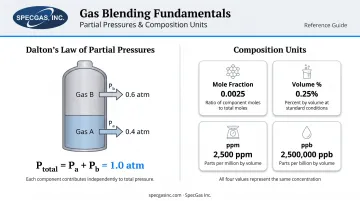
- Dalton's Law of Partial Pressures — Each gas contributes independently to total pressure; its partial pressure equals its mole fraction multiplied by total pressure. This is why pressure measurements drive most blending calculations, though real-gas behavior and temperature effects mean partial pressure alone isn't sufficient for high-accuracy certified work.
- Composition unit precision — IUPAC defines amount fraction (mole fraction) and volume fraction differently. A ppm or ppb value is only meaningful when the quantity basis — volume, mass, or molar — is explicitly stated.
Key Industrial Applications
Welding and Metal Fabrication
MIG and TIG welding processes use blended shielding gases to protect the weld pool from atmospheric contamination. The specific ratio directly affects weld quality. According to Lincoln Electric, 75% Ar / 25% CO₂ is the most common mixed shielding gas used in the US. Going above 80% argon can increase alloy recovery, tensile strength, and crack sensitivity in some flux-cored applications.
AWS A5.32 sets minimum purities — argon at 99.997% minimum, CO₂ at 99.8% — and requires that minor components in mixed gases remain within ±10% relative of nominal. Verifying that shielding gas cylinders meet these specs requires certified calibration gas standards, which is where precision blending becomes directly relevant to fabrication quality control.
Calibration and Emissions Monitoring
Calibration gas mixtures verify and set gas detectors, analyzers, and continuous emissions monitoring systems (CEMS). These must be certified to exact concentrations because any error propagates into every measurement the instrument makes.
Under 40 CFR Part 75 Appendix A, EPA Protocol gases must have producer-certified uncertainty not exceeding 2.0% of the certified concentration at 95% confidence. Part 75 also defines specific concentration ranges for each calibration level:
- Zero gas: 0–20% of span
- Low-level: 20–30% of span
- Mid-level: 50–60% of span
- Span gas: 80–100% of span
Research Labs and Semiconductor Manufacturing
That same demand for certified precision extends into research and semiconductor environments, where custom blends must meet tight compositional specs — often on short notice. Research labs need specific atmospheres for catalyst testing, controlled reaction studies, and instrument calibration across a wide range of analytes.
Semiconductor fabrication requires ultra-precise gas atmospheres in process chambers, with purities at 4N (99.99%) and above per SEMI standards.
Food and Beverage (Modified Atmosphere Packaging)
Modified Atmosphere Packaging (MAP) uses blends of CO₂, O₂, and N₂ to extend shelf life. The optimal blend depends on the product:
- High-O₂ atmospheres maintain red meat color stability
- CO₂ inhibits aerobic bacteria and mold growth
- N₂ displaces oxygen and prevents package collapse
Medical and Specialty Applications
Specialty lighting applications — noble gas fills in HID, fluorescent, and neon lamps — demand high purity and mixture stability because lamp performance depends directly on blend accuracy.
Specialty lighting applications — noble gas fills in HID, fluorescent, and neon lamps — demand high purity and mixture stability because lamp performance depends directly on blend accuracy.
Excimer laser gas mixtures (ArF 193 nm, KrF 248 nm, KrCl 222 nm, and XeCl 308 nm) serve semiconductor photolithography, display manufacturing, and medical laser applications including vision correction and dermatology. Each wavelength targets a specific application, and blend accuracy determines whether the laser performs within spec.
Gas Blending Methods: How the Process Works
Batch Blending Methods
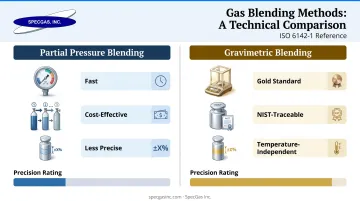
Partial pressure (manometric) blending introduces each gas sequentially into a cylinder, measuring each component's contribution by the pressure it adds at constant temperature. Because pressure is proportional to mole fraction under ideal gas assumptions, the ratio of partial pressures equals the desired mixture ratio.
It's straightforward to calculate and cost-effective, but LCGC describes it as the least precise manufacturing technique for calibration gas applications. Temperature equilibration after each fill is required for even approximate accuracy — a significant limitation in precision work.
Gravimetric blending is the recognized gold standard. Each component is weighed onto a calibrated scale as it's added, giving precise control over actual mass. ISO 6142-1:2015 covers gravimetric preparation of Class I calibration gas mixtures and requires uncertainty calculations for each component amount fraction. Because mass is independent of temperature fluctuations during filling, gravimetric blending is preferred for producing NIST-traceable calibration standards where certification uncertainty must be minimized.
SpecGas Inc. produces NIST-traceable gas standards using gravimetric blending with proprietary procedures developed over decades of specialty gas expertise — beginning with founder Alfred Boehm's R&D work at Messer Griesheims Industries in 1976.
Continuous Blending Methods
Mass flow controller (MFC) blending combines gas streams in real time at commanded ratios. MFCs measure mass flow rate rather than volumetric flow, making them less sensitive to ambient temperature and pressure fluctuations.
Accuracy degrades at low flows. Bronkhorst specifies EL-FLOW Select accuracy as ±0.5% of reading plus ±0.1% full scale — meaning at very low flows, the ±0.1% full-scale error term governs, not the percentage-of-reading term. Sizing each MFC to its operational range is critical.
Dynamic dilution generates calibration concentrations by controlled dilution of a certified high-level standard. EPA Method 205 requires measured values to be within ±2% of predicted values, with annual recalibration using NIST-traceable primary flow standards at 0.25% uncertainty or less. It is a verified system method suited to regulatory applications, not informal field use.
Subtractive methods (pressure swing adsorption, membrane separation) start with a gas mixture and selectively remove components. These work well for producing nitrogen or enriched oxygen streams, but they aren't suited to precision multi-component specialty gas blends.
Here's how the three continuous methods compare at a glance:
| Method | Best For | Key Limitation |
|---|---|---|
| MFC Blending | Real-time ratio control | Accuracy degrades at low flow |
| Dynamic Dilution | Regulatory calibration (EPA Method 205) | Requires certified high-level standard |
| Subtractive (PSA/Membrane) | N₂ or enriched O₂ production | Not suited for multi-component precision blends |
Accuracy and Quality Control
Why Low-Concentration Accuracy Is Hard
Blending errors that are negligible at percent-level concentrations become consequential at ppm and ppb levels. A 1% relative error on a 1,000 ppm mixture is a 10 ppm deviation — enough to render a calibration gas out of specification. At ppb levels, the margin shrinks further.
SpecGas produces stable calibration mixtures from 100 ppb (hydrogen cyanide) and 300 ppb (phosphine and hydrogen sulfide) up to 10% concentration, with the most common customer requests falling in the 1–100 ppm range for detector calibration and process monitoring.
NIST Traceability — What It Actually Means
NIST defines metrological traceability as a property of a measurement result related to a reference through a documented, unbroken chain of calibrations, each contributing to stated uncertainty. NIST is explicit on one point: measurement results are traceable — not instruments or laboratories.
For gas standards, the NIST framework includes:
- SRMs (Standard Reference Materials): Certified directly by NIST against primary gas standards
- NTRMs (NIST Traceable Reference Materials): Produced by specialty gas companies, analyzed against NIST standards, and audited by NIST
- EPA Protocol gases: Certified under the EPA Traceability Protocol with ≤2.0% uncertainty at 95% confidence
Cylinder Preparation and Homogeneity
Cylinder cleanliness directly affects blend accuracy. Residual moisture, hydrocarbons, or reactive surface sites will interact with target components — particularly at low concentrations. Preparation includes purging and evacuation; reactive gas cylinders also require heating to eliminate surface adsorption sites.
After filling, multi-component mixtures may require rolling or inversion to ensure homogeneous distribution before the post-blend analysis that precedes cylinder certification.
Gas Analysis and Verification
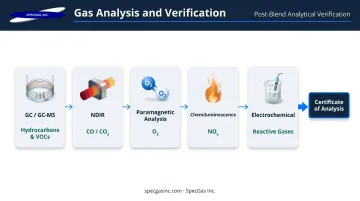
Once a cylinder is prepared and filled, analytical verification confirms the blend meets specification before release. Common techniques include:
- Gas chromatography (GC/GC-MS): Hydrocarbons, multi-component mixtures
- NDIR (non-dispersive infrared): CO, CO₂
- Paramagnetic analysis: O₂
- Chemiluminescence: NOₓ (per EPA Method 7E)
- Electrochemical methods: Reactive gases
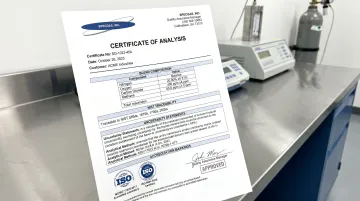
Every cylinder ships with a certificate of analysis documenting composition, uncertainty, and the analytical method used — the paper trail that makes traceability meaningful in practice.
Reactive Gas Mixtures and Calibration Gases
Why Reactive Gases Are Uniquely Difficult
Reactive gases — H₂S, NH₃, HCl, SO₂, NO, Cl₂, HCN, PH₃, and similar compounds — interact with cylinder walls, valve materials, and other blend components. The result is concentration drift: the cylinder ships at the certified value but falls out of specification before it should.
EPA Protocol guidance is specific about this. Reactive mixtures including NH₃, HCl, H₂S, NO, and SO₂ require assays on at least two dates separated by 7 days, with stability confirmed when mean concentrations differ by 1.0% or less. Newly prepared candidate standards require a minimum 4-day incubation before initial assay.
Maximum certification periods in passivated aluminum cylinders (per EPA Protocol guidance):
- NH₃ and HCl: 2 years
- H₂S: 3 years
- SO₂ at 1–50 ppm: 4 years
- NO in oxygen-free N₂ at 0.5–20 ppm: 3 years
SpecGas Inc. has developed a proprietary internal cylinder treatment process for reactive gas mixtures, rooted in R&D work Alfred Boehm began at Messer Griesheims Industries in Germany and continued after his transfer to the US in 1991. Backed by the SpecGas Stability Guarantee, this treatment enables stable reactive blends with extended shelf life for gases including H₂S (300 ppb to 10%), HCN (100 ppb to 10%), HCl, NH₃, SO₂, PH₃ (300 ppb to 5%), and NO.
Span Gas vs. Zero Gas
Stable reactive blends only deliver their value when paired with properly selected calibration standards. Any calibrated analyzer requires two reference gases:
- Span gas: A certified mixture at a known concentration of the target analyte, used to set the upper calibration point
- Zero gas: A clean, analyte-free gas matching the sample matrix, used to establish the baseline
- Traceability for both: Each must carry NIST-traceable certification with documented compositional accuracy
Errors in either propagate through every measurement the instrument produces.
How to Choose the Right Gas Blending Partner
Key Evaluation Criteria
| Criterion | What to Look For |
|---|---|
| Traceability | Documented calibration chain with stated uncertainty — not just "NIST traceable" labeling |
| EPA Protocol capability | PGVP participation and ≤2.0% uncertainty at 95% confidence for CEMS gases |
| In-house blending | Avoids subcontracting delays and inconsistent results |
| Reactive gas experience | Stability assay documentation, cylinder treatment process, certified periods |
| Accreditation | ISO/IEC 17025 for testing/calibration; ISO 17034 for reference material producers |
| Lead times | Larger distributors often subcontract difficult blends, extending turnaround significantly |
Pre-Blended Cylinders vs. On-Site Blending
Choose certified pre-blended cylinders when:
- Compliance traceability is required (CEMS, EPA audits, regulatory submissions)
- Mixture contains reactive or trace-level components
- Concentration stability over months matters
- Documentation and uncertainty statements are required
Consider on-site MFC blending when:
- High-volume, continuous industrial processes need real-time ratio adjustment
- Tight concentration certification is not required
- A validated dilution system (meeting Method 205 requirements) is in place
Questions to Ask Before Ordering
Once you've determined whether pre-blended or on-site blending fits your process, these questions help you lock in the right supplier and spec:
- Confirm the required purity grade for each component gas
- Identify whether the target gas is reactive, corrosive, or flammable
- What concentration range and acceptable uncertainty are needed?
- Is NIST traceability or EPA Protocol certification required?
- What cylinder size, pressure, and expected shelf life are needed?
- Does the supplier have documented experience with this specific mixture — not just the individual component gases?
For example, SpecGas Inc. blends all mixtures in-house from its Pennsylvania facility — an arrangement that supports faster turnaround, consistent quality, and a cylinder deposit program rather than the recurring rental fees common at larger distributors. Rush service is available for time-sensitive orders.
Frequently Asked Questions
What is gas mixing?
Gas mixing (or gas blending) is the controlled combination of two or more gases to produce a mixture of defined composition. It's used across industries including calibration and emissions monitoring, semiconductor manufacturing, laboratory research, workplace safety, and food packaging.
What is the difference between partial pressure blending and gravimetric blending?
Partial pressure blending measures each gas contribution by the pressure it adds at constant temperature — fast and computationally simple, but less accurate for certified trace-level mixtures. Gravimetric blending weighs each constituent on a precision scale, making it the preferred method for NIST-traceable calibration gas standards where uncertainty must be minimized.
What is a NIST-traceable gas standard?
A NIST-traceable gas standard is a certified mixture whose composition has been verified through a documented, unbroken chain of measurements linked to national standards maintained by NIST. It's required by regulatory agencies, calibration labs, and emissions monitoring programs to ensure instrument accuracy.
How are specialty gas mixtures verified for accuracy after blending?
After blending, mixtures are analyzed using instruments matched to the target components — gas chromatographs for hydrocarbons, NDIR for CO/CO₂, paramagnetic analyzers for O₂, and chemiluminescence for NOₓ. Results must fall within the stated uncertainty range before the lab certifies and releases the cylinder.
What makes reactive gas mixtures difficult to blend and store?
Reactive gases interact with cylinder walls, valve materials, and sometimes other blend components — causing concentration drift over time. Producing stable reactive mixtures requires specialized cylinder preparation, passivation treatments, compatible materials, and stability verification across multiple time points.
How long does a specialty gas mixture remain stable in a cylinder?
Shelf life varies by composition and cylinder treatment. Inert blends typically hold certification for 2–5 years; reactive gases have shorter windows — EPA Protocol guidance, for example, lists H₂S at 3 years and SO₂ at 4 years in passivated aluminum. Always verify the certificate of analysis expiration date; suppliers with proprietary cylinder passivation processes, like SpecGas's Stability Guarantee, can extend usable life for reactive mixtures.