This article walks through a complete analysis of a gas mixture containing 1.25 g of N₂ and 0.85 g of O₂. By the end, you'll have moles, mole fractions, partial pressures at 1.00 atm, and mass percentages — plus a clear picture of why those last two differ.
Key Takeaways
- Convert each component's mass to moles using its molar mass (N₂ = 28.014 g/mol; O₂ = 32.00 g/mol)
- Mole fractions show proportional composition: N₂ ≈ 0.627, O₂ ≈ 0.373
- Partial pressures follow from mole fractions × total pressure: P_N₂ ≈ 0.627 atm, P_O₂ ≈ 0.373 atm
- Mass percent (N₂ ≈ 59.5%, O₂ ≈ 40.5%) differs from mole percent; mass fraction cannot be substituted into Dalton's Law
- Precise gas composition calculations are essential for calibration gas standards, emissions monitoring compliance, and reproducible analytical results
What Is Gas Mixture Analysis?
Gas mixture analysis determines the quantitative composition of a gas blend. That means establishing how many moles of each component are present, their proportional contributions (mole fractions), and the partial pressure each one contributes to the total.
It applies across a wide range of settings:
- Calibration gas preparation — verifying certified component concentrations before use
- Air quality and emissions monitoring — confirming that analyzer calibration gases meet regulatory accuracy requirements
- Industrial process control — ensuring feed gas compositions meet spec
- Combustion research — characterizing O₂/N₂ atmospheres for experimental repeatability
- Laboratory research — reproducing gas environments across experiments
Regardless of the application, the analytical method follows one of two paths. Gravimetric analysis starts from known component masses — the approach this example walks through. Pressure-based analysis works backward from measured partial pressures. Both express composition as mole fraction, which IUPAC defines as the amount of a constituent divided by the total amount of all constituents in the mixture.
The N₂/O₂ example below illustrates the gravimetric path from start to finish — converting component masses into moles, mole fractions, and partial pressures step by step.
Why Gas Mixture Composition Matters
Getting the composition wrong has real consequences. Under EPA regulations governing continuous emissions monitoring systems (CEMS), calibration gases must be certified with analytical uncertainty no greater than ±2.0% of certified concentration at a 95% confidence interval. When a monitor fails a calibration error test, its emissions data becomes invalid — a direct regulatory and operational problem.
Proper gas mixture analysis enables:
- Calibration gases that meet certified concentration requirements
- Accurate partial pressure calculations for thermodynamic and process modeling
- Regulatory compliance for emissions and air quality monitoring
- Reproducible experimental conditions across research trials
- Blend verification before deployment, avoiding downstream errors
The N₂/O₂ pairing in this example reflects real, common applications across industry and research:
- Synthetic zero air for ambient analyzer calibration
- Modified atmosphere packaging for controlled-environment storage
- Combustion research using defined O₂/N₂ ratios
- OSHA-defined oxygen threshold monitoring in confined spaces (oxygen-deficient below 19.5% by volume; oxygen-enriched above 23.5%)
How to Analyze a Gas Mixture: Step by Step
The five stages below build sequentially. The most common errors happen when students skip unit conversions or apply mass percent where mole fraction belongs.
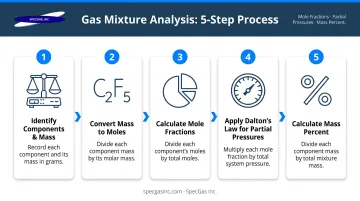
Step 1 – Identify Components and Collect Mass Data
Record the identity and mass of each component. Here: 1.25 g N₂ and 0.85 g O₂.
Confirm the correct molar masses. Both nitrogen and oxygen exist as diatomic molecules under standard conditions, so you use molecular mass — not atomic mass:
- N₂: 28.014 g/mol (NIST WebBook value: 28.0134)
- O₂: 32.00 g/mol (NIST WebBook value: 31.9988)
Using atomic mass (14 g/mol for N, 16 g/mol for O) is a common and costly mistake.
Step 2 – Convert Mass to Moles
Apply n = mass ÷ molar mass. Grams divided by grams-per-mole yields moles. Keeping units straight here prevents every downstream error.
For this mixture:
- n(N₂) = 1.25 g ÷ 28.014 g/mol = 0.04462 mol
- n(O₂) = 0.85 g ÷ 32.00 g/mol = 0.02656 mol
Step 3 – Calculate Total Moles and Mole Fractions
Sum the component moles, then divide each by the total to get its mole fraction (χ):
- Total moles = 0.04462 + 0.02656 = 0.07118 mol
- χ(N₂) = 0.04462 ÷ 0.07118 = 0.6268
- χ(O₂) = 0.02656 ÷ 0.07118 = 0.3732
The mole fractions must sum to exactly 1.00 — a built-in check on your arithmetic. Here: 0.6268 + 0.3732 = 1.0000 ✓
Step 4 – Apply Dalton's Law for Partial Pressures
Dalton's Law states that total pressure equals the sum of all partial pressures. Each partial pressure is:
P_component = χ_component × P_total
This example uses 1.00 atm total pressure:
- P(N₂) = 0.6268 × 1.00 atm = 0.627 atm
- P(O₂) = 0.3732 × 1.00 atm = 0.373 atm
Step 5 – Calculate Mass Percent
Mass percent = (mass of component ÷ total mass) × 100
Total mass = 1.25 + 0.85 = 2.10 g
- Mass% N₂ = (1.25 ÷ 2.10) × 100 = 59.5%
- Mass% O₂ = (0.85 ÷ 2.10) × 100 = 40.5%
Mass percent is useful for weight-based reporting, but it is not equivalent to mole fraction. When components have different molar masses — as N₂ and O₂ do — the two metrics give different numbers. Only mole fraction connects to Dalton's Law.
With all five steps complete, you now have the moles, mole fractions, partial pressures, and mass percentages for this mixture — the full composition picture needed for most gas analysis applications.
Worked Example: 1.25 g N₂ and 0.85 g O₂
Problem: A sealed container holds 1.25 g of N₂ and 0.85 g of O₂. Find the moles of each gas, mole fractions, partial pressures at 1.00 atm total pressure, and mass percentages.
Moles of Each Component
| Component | Mass | Molar Mass | Moles |
|---|---|---|---|
| N₂ | 1.25 g | 28.014 g/mol | 0.04462 mol (44.6 mmol) |
| O₂ | 0.85 g | 32.00 g/mol | 0.02656 mol (26.6 mmol) |
| Total | 2.10 g | — | 0.07118 mol |
The 1.25 g of N₂ equals approximately 44.6 millimoles. To convert, multiply moles by 1,000: 0.04462 × 1,000 = 44.62 mmol.
Mole Fractions
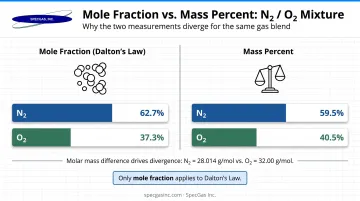
- χ_N₂ = 0.04462 ÷ 0.07118 = 0.6268 (62.7%)
- χ_O₂ = 0.02656 ÷ 0.07118 = 0.3732 (37.3%)
- Sum = 1.0000 ✓
Partial Pressures at 1.00 atm
Multiplying each mole fraction by the total pressure:
- P_N₂ = 0.6268 × 1.00 atm = 0.627 atm
- P_O₂ = 0.3732 × 1.00 atm = 0.373 atm
Physically, each value represents the pressure that gas would exert if it alone occupied the container at the same temperature and volume.
Mass Percent
| Component | Mass | Total Mass | Mass Percent |
|---|---|---|---|
| N₂ | 1.25 g | 2.10 g | 59.5% |
| O₂ | 0.85 g | 2.10 g | 40.5% |
N₂ accounts for 62.7% of the mixture by moles but only 59.5% by mass. O₂ shows the reverse shift — from 37.3% mole fraction to 40.5% mass percent — because its higher molecular weight (32.00 vs. 28.014 g/mol) gives it a proportionally larger mass contribution. Mass percent cannot substitute for mole fraction in Dalton's Law: gas pressure depends on the count of molecules present, not their mass.
The 1.25 g of N₂ equals approximately 44.6 millimoles. To convert
How SpecGas Inc. Supports Precise Gas Mixture Work
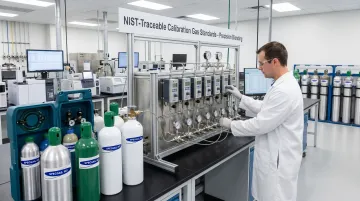
The compositional analysis demonstrated above — converting masses to moles, calculating mole fractions, confirming partial pressures — is the same framework applied when producing NIST Traceable Gas Standards for calibration use.
SpecGas Inc. is a Pennsylvania-based specialty gas blender founded in 2001 by research chemist Alfred Boehm, whose background in reactive gas R&D stretches back to 1976 at Messer Griesheims Industries in Germany. SpecGas produces precisely characterized N₂/O₂ blends and a broad range of custom calibration gas mixtures using gravimetric blending with proprietary techniques, the same mass-based approach that underlies the worked example in this article.
Every mixture is blended in-house, with analytical instruments calibrated before each use to maintain NIST traceability throughout the production process. A mislabeled or off-spec calibration gas creates systematic errors in every instrument it calibrates — making traceability a production requirement, not a checkbox.
For reactive and toxic gas mixtures, SpecGas's proprietary internal cylinder treatment process extends composition stability beyond standard industry practices, backed by the SpecGas Stability Guarantee. Accurate composition means nothing if the mixture drifts before the cylinder's service life ends — particularly for low-ppm reactive standards where wall interactions can shift concentrations measurably over time.
SpecGas serves customers across North America where precision gas composition is non-negotiable:
- Research and university labs requiring NIST-traceable analytical standards
- Calibration facilities producing certified reference materials
- Emissions monitoring and CEMS programs operating under EPA reference methods
- Industrial operations where N₂ and O₂ function as balance gases, matrix components, or primary analytes
Frequently Asked Questions
How many millimoles of N₂ are in 1.25 g of N₂?
Using n = 1.25 ÷ 28.014 = 0.04462 mol. Multiplying by 1,000 gives approximately 44.6 millimoles.
What is the mole fraction of O₂ in this mixture?
O₂ contributes 0.02656 mol out of 0.07118 mol total, giving a mole fraction of approximately 0.373. This means O₂ accounts for about 37.3% of the mixture on a mole basis.
How does mole fraction differ from mass percent in a gas mixture?
Mole fraction is based on number of moles relative to total moles; mass percent is based on mass relative to total mass. They differ whenever components have different molar masses — as N₂ (28.014 g/mol) and O₂ (32.00 g/mol) do. Only mole fraction applies to Dalton's Law.
What is Dalton's Law and how is it used here?
Dalton's Law states that total pressure equals the sum of all partial pressures. Each partial pressure equals the component's mole fraction multiplied by total pressure. At 1.00 atm: P_N₂ ≈ 0.627 atm and P_O₂ ≈ 0.373 atm.
Why is mole fraction used instead of mass fraction for partial pressures?
Gas pressure depends on the number of molecules (moles), not their mass. A heavier molecule does not exert more pressure than a lighter one at the same mole count. Mole fraction captures molecular count directly; mass fraction does not.
What real-world applications require knowing the N₂/O₂ composition?
Defined N₂/O₂ compositions are used across several fields:
- Ambient air quality analyzer calibration standards
- Modified atmosphere packaging for food preservation
- Combustion research with controlled O₂/N₂ atmospheres
- Confined space oxygen monitoring (OSHA thresholds: 19.5%–23.5% O₂ by volume)
- CEMS calibration for emissions compliance programs