The issue is not standard disposable calibration gas. For a quad-gas CO/H₂S/O₂/LEL cylinder, Linde's distribution network works well enough. The gap appears when buyers need something harder: a reactive gas at 500 ppb, a seven-component emissions standard, or a custom formaldehyde blend that most suppliers simply won't attempt. That's where independent specialty blenders enter the picture — and where the comparison gets interesting.
Switching certified calibration gas suppliers is not trivial. NIST traceability, mixture stability, and documentation quality must transfer without gaps. This article evaluates five alternatives to Praxair/Linde for certified custom blends, outlines what to verify before switching, and explains why independent manufacturers often outperform large-scale distributors for technically complex work.
Key Takeaways
- The Praxair/Linde merger formed a US duopoly with Air Liquide, limiting supply chain options for custom blend buyers
- Independent specialty gas manufacturers produce NIST-traceable custom blends faster, at lower cost, and with greater flexibility for reactive and low ppm/ppb mixtures
- Compliance is determined by documentation quality, not supplier brand — a proper NIST-traceable CoA satisfies EPA, OSHA, and ISO requirements
- Cylinder treatment capability is the critical differentiator for reactive gas stability; most large distributors lack it
- Switching suppliers preserves compliance as long as the new CoA documents traceability, analytical results, and certified concentration
Why Buyers Are Looking Beyond Praxair/Linde for Custom Calibration Gas
The Consolidation Context
When Praxair and Linde AG completed their $80 billion merger of equals in October 2018, the FTC required divestitures across nine US industrial gas markets before approving the deal. The combined Linde plc — with 2017 pro forma revenue of approximately $27 billion and around 80,000 employees — became the world's largest industrial gas supplier and holds the top US market share, according to IBISWorld.
Alongside Air Liquide — which acquired Airgas in 2016 and absorbed Scott Specialty Gases in 2007 — these two groups effectively control the commodity and specialty gas supply chain in the United States. A handful of large players dominate the market, and that concentration shapes how custom calibration gas orders get handled.
Where the Gap Appears for Custom Blends
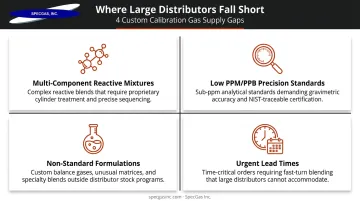
For standard calibration gas, large distributor networks function adequately. The real gap shows up with:
- Multi-component reactive mixtures routed through distributor layers instead of a direct blending facility — adding handling steps that affect stability
- Low ppm or ppb precision standards that require specialized cylinder treatment not available at every production site
- Non-standard formulations that fall outside catalog pricing and require direct technical engagement to quote and produce
- Urgent or project-critical orders where corporate lead times create real compliance exposure
Corporate overhead, cylinder rental programs, and tiered distributor structures add cost and lead time that direct blenders don't carry. For buyers with specialized requirements, the economics and turnaround of an in-house blender are measurably better.
Top Alternatives to Praxair/Linde for Certified Custom Calibration Gas Blends
The five suppliers below have established track records in NIST-traceable certified custom calibration gas production. They are compared on technical capability, custom blend specialization, documentation quality, and flexibility for reactive or difficult mixtures.
SpecGas Inc.
Founded in 2001 by Alfred Boehm, a research chemist who advanced to director-level roles at Messer Griesheims Industries — one of the world's largest specialty gas manufacturers — SpecGas brings technical depth that is rare outside of major industrial players.
In 1991, Boehm transferred to the US to continue R&D in specialty gas, including internal cylinder treatment for reactive gas mixtures. That work became the foundation of SpecGas's most important differentiator.
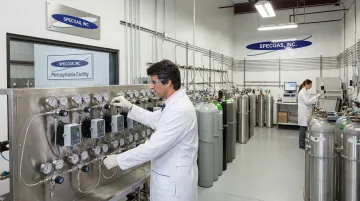
SpecGas blends every mixture in-house from its Pennsylvania facility. The proprietary internal cylinder treatment process addresses reactive gas families that degrade through adsorption to cylinder walls or reaction with trace moisture:
- H₂S, HCl, NH₃, SO₂, NO/NOx, Cl₂, HCN, PH₃, and formaldehyde
SpecGas is one of the few providers that can reliably produce stable formaldehyde gas mixtures — a blend most suppliers decline entirely.
The company produces stable low ppm and ppb precision standards, fills disposable cylinders (17–103 liters, including aluminum cylinders specifically designed for reactive gases) and refillable cylinders up to 250 ft³, and offers nickel-plated cylinders for corrosive applications. The cylinder deposit program — rather than a rental model — is a recurring point in customer feedback, cited as more cost-effective than rental arrangements from large distributors.
| Attribute | Details |
|---|---|
| Certifications / Standards | NIST Traceable Gas Standards; proprietary blending procedures for certified precision mixtures |
| Key Differentiator | Proprietary internal cylinder treatment for reactive gas stability; SpecGas Stability Guarantee; rush service; in-house blending for full quality control |
| Best For | Research labs, air quality monitoring, OEM manufacturing, emissions monitoring, semiconductor manufacturing, and any application requiring reactive or sub-ppm/ppb custom blends |
Matheson Tri-Gas (Nippon Sanso Matheson)
Matheson is one of the largest independent specialty gas companies in the United States. The company became fully owned by Nippon Sanso Corporation of Tokyo in 1989 and operates today as Nippon Sanso Matheson. It is not a small independent — its scale is comparable to the major industrial gas players — but it is structurally distinct from the Linde/Air Liquide duopoly.
Matheson's EPA Protocol catalog covers CO₂, CO, H₂S, methane, NO, NO₂, oxygen, and propane, alongside custom specialty gas supply for petrochemical customers. A verified certificate-scope PDF confirms ISO/IEC 17025:2017 accreditation.
Matheson operates laboratory and specialty gas segments alongside its bulk gas business. Its national distribution footprint gives it reach comparable to Linde for buyers who need broad geographic coverage.
| Attribute | Details |
|---|---|
| Certifications / Standards | ISO/IEC 17025:2017 accreditation confirmed; NIST traceability; EPA Protocol gas capability |
| Key Differentiator | National distribution footprint; broad product range from pure gases to complex certified reference mixtures; established technical support infrastructure |
| Best For | Buyers seeking a large, established alternative to Linde with demonstrated accreditation and a wide catalog of EPA Protocol and custom specialty gases |
Airgas Specialty Products (Scott Specialty Gases)
Airgas Specialty Products — operating under the Air Liquide corporate umbrella and incorporating the legacy Scott Specialty Gases brand — is the other large-scale option in the US market. Buyers should understand what this means structurally: Airgas was acquired by Air Liquide in 2016, and Scott Specialty Gases was absorbed into Air Liquide through a 100% Air Liquide affiliate in 2007. Buyers seeking independence from major conglomerates should weigh this before proceeding.
That said, Airgas has the strongest publicly disclosed certification profile of any supplier in this comparison. Airgas states it operates 11 A2LA-accredited ISO 17025 sites, 1 A2LA-accredited ISO 17034 site, 1 A2LA-accredited ISO 17043 site, and 81 NSF-registered ISO 9001 sites. Scott Specialty Gases built a long history in certified reference gas production before the Air Liquide acquisition, and that capability base remains intact within the Airgas network.
| Attribute | Details |
|---|---|
| Certifications / Standards | ISO 17025: 11 A2LA-accredited sites; ISO 17034: 1 A2LA-accredited site; ISO 9001: 81 NSF-registered sites; EPA Protocol gas capability |
| Key Differentiator | Strongest public certification disclosure of any named alternative; large national footprint; Scott Specialty Gases heritage in certified reference material production |
| Best For | Buyers who need documented large-scale accreditation and are comfortable with a corporate Air Liquide–owned structure; not a solution for buyers seeking independence from major conglomerate suppliers |
Mesa Specialty Gases
Mesa Specialty Gases & Equipment is a US-based independent manufacturer with a facility in Santa Ana, California. Mesa produces custom calibration gas standards, EPA Protocol Gas, and refillable cylinders from 10 SCF to 300 SCF, with confirmed capabilities across Primary, Certified, and Gravimetric standards. Its 2024 announcement of an ultra-stable 1 ppm nitrogen dioxide standard — a notoriously difficult reactive blend — demonstrates active technical development at the low-concentration end of the market.
One important note: ISO 17025, ISO 17034, and PGVP participation were not confirmed from authoritative sources during research for this article. Buyers using Mesa for regulated applications should request and verify current accreditation certificates directly before purchase.
| Attribute | Details |
|---|---|
| Certifications / Standards | EPA Protocol Gas; NIST traceability; Primary, Certified, and Gravimetric standards — ISO/A2LA accreditation status should be verified directly with Mesa |
| Key Differentiator | Independent US manufacturer; demonstrated capability in reactive and low-ppm gas standards; broad cylinder format options |
| Best For | Environmental monitoring, energy sector calibration, and applications requiring EPA Protocol Gas from an independent US manufacturer |
Concorde Specialty Gases
Concorde Specialty Gases, based in Eatontown, New Jersey, is a US independent specialty gas manufacturer with a notable concentration in SF6 — sulfur hexafluoride, recycled SF6, and custom SF6 blends for electrical equipment applications. All specialty gas blending is performed in-house at the Eatontown facility using a high-precision gravimetric scale and blending system, distinguishing Concorde from repackagers.
For buyers in regulated calibration applications: no authoritative ISO 17025, ISO 17034, NIST NTRM, or EPA PGVP participation confirmation was located during research for this article. Concorde is best evaluated for custom blend work where those certifications are not mandated, or where buyers can verify current accreditation documentation directly.
| Attribute | Details |
|---|---|
| Certifications / Standards | In-house gravimetric blending confirmed; ISO and EPA accreditation status should be verified directly with Concorde |
| Key Differentiator | Independent US blender; strong SF6 and custom specialty gas specialization; all blending performed in-house |
| Best For | SF6 applications, custom specialty gas blends, and buyers who can verify current accreditation status for their specific compliance requirements |
What to Look for When Choosing an Alternative to Praxair/Linde
The most common mistake when switching calibration gas suppliers is optimizing for price or proximity while underweighting documentation quality. For certified custom blends used in regulated applications, the CoA is the compliance instrument. A weak CoA creates risk regardless of how good the gas itself is.
What a Complete CoA Must Include
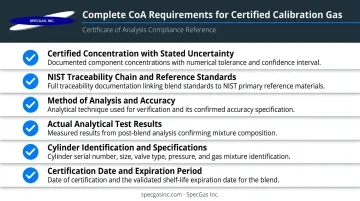
A CoA for a certified custom calibration gas blend should document:
- Certified concentration with stated uncertainty
- NIST traceability chain and reference standards used for value assignment
- Method of analysis and accuracy of analysis
- Actual analytical test results (not just nominal values)
- Cylinder identification and specifications
- Certification date and expiration/recertification period
If a supplier cannot produce a CoA with all of these elements, the gas cannot be reliably used in EPA-regulated, OSHA-compliance, or ISO-audited applications — regardless of the supplier's brand recognition.
Key Evaluation Factors
CoA documentation tells you what a supplier produces. These five factors tell you whether they can produce what you need.
When comparing alternatives to Praxair/Linde, prioritize:
- NIST traceability: Verify the full traceability chain, not just a claim on the label — this is required for EPA, OSHA, and ISO-audited applications
- In-house blending: Repackagers cannot control what they didn't produce; a supplier that blends in-house is the only supplier with real quality control over the finished product
- Cylinder treatment for reactive gases: Critical for H₂S, HCl, SO₂, NO₂, Cl₂, NH₃, and similar compounds — ask what treatment process is used and what stability it guarantees
- Get specific lead time windows in writing, including whether rush service is available for urgent needs
- For non-standard or one-of-a-kind mixtures, a supplier's willingness to engage technically before order placement is a reliable signal of whether they can actually deliver
Independent specialty blenders often outperform large corporate suppliers on custom work precisely because their business is built around technical complexity. Ask prospective suppliers directly: Is this blend produced in-house? What does the stability guarantee cover? Can you provide a sample CoA for a similar mixture?
Frequently Asked Questions
Is span gas the same as calibration gas?
Span gas is a type of calibration gas used to set the upper measurement range of an analyzer at a known concentration. Calibration gas is the broader term, covering zero gas, single-component standards, and multi-component span mixtures. All span gas is calibration gas, but not all calibration gas is span gas.
What should be done with expired calibration gas cylinders?
Expired cylinders should not be used for instrument calibration — concentration accuracy can no longer be guaranteed past the certified expiration date. Contact your gas supplier for proper disposal guidance, as compressed gas cylinders are regulated under DOT 49 CFR 173.301 and cannot be disposed of as regular waste.
Can I switch from Praxair/Linde to an independent supplier without affecting my certifications or compliance?
Yes. Regulatory compliance is based on documented gas concentration accuracy and NIST traceability — not supplier brand. Switching to an independent supplier that produces proper NIST-traceable CoAs with equivalent mixture accuracy does not affect ISO, OSHA, or EPA compliance. Update your approved supplier documentation to reflect the new source.
What is NIST traceability and why does it matter for custom calibration gas blends?
NIST traceability means the certified gas concentrations are linked through an unbroken chain of measurements to national standards maintained by the National Institute of Standards and Technology. For custom blends used in emissions monitoring, air quality testing, or occupational safety, this documented chain is what validates instrument accuracy under regulatory scrutiny.
How long does it take to receive custom calibration gas blends from an independent supplier compared to Praxair/Linde?
Lead times vary by supplier and blend complexity. Large corporate distributors often route non-standard mixtures through multiple fulfillment layers before production begins. Independent blenders like SpecGas that handle everything in-house typically deliver faster, with rush service available for urgent requirements.
What makes reactive gas mixtures harder to produce and store than standard calibration gas?
Reactive gases such as H₂S, SO₂, NO₂, HCl, and Cl₂ can degrade by adsorbing onto cylinder walls or reacting with trace moisture inside the cylinder. NIST SP 260-126 specifically notes that reactive gas mixtures require chemically inert cylinder walls and valves to maintain certified concentrations. Not all suppliers have the cylinder treatment infrastructure to reliably handle these gas families.
Praxair/Linde and other large-volume industrial gas distributors remain a workable default for commodity calibration gas. Buyers with genuine custom blend requirements — reactive mixtures, low ppm/ppb precision standards, unusual gas combinations, or tight lead times — will often find better outcomes with specialized independent manufacturers who have purpose-built technical capabilities for difficult blends.
SpecGas Inc. has been producing NIST-traceable custom calibration gas blends for over two decades, with proprietary blending and cylinder treatment techniques developed by a team of specialty gas veterans. Contact SpecGas at (215) 443-2600 or website-inquiries@specgasinc.com to discuss your custom blend requirements, request a quote, or ask about rush service availability.