Introduction
Gas lasers have driven scientific and industrial progress for over six decades. The first helium-neon laser fired at Bell Labs in December 1960. Today, multi-kilowatt CO2 systems cut metal on factory floors and ArF excimer lasers pattern semiconductor chips at 193 nm — applications that span manufacturing, medicine, and precision measurement.
What makes gas lasers work comes down to what's inside them — the gas itself. Gain medium composition, mixture ratios, and purity levels directly determine whether a laser hits its output specifications or underperforms.
This article walks through what gas lasers are, how they work, the major types and the gases they rely on, and why gas quality directly affects laser output across every application.
Key Takeaways
- Gas lasers use a gaseous gain medium — helium-neon, CO2, argon, or excimer blends — excited by electric discharge to produce coherent light.
- Gas lasers fall into four categories: neutral atom, ion, molecular, and excimer — each producing different wavelengths and power levels.
- Key applications include semiconductor photolithography, LASIK surgery, industrial cutting, scientific metrology, and display manufacturing.
- Gas purity and precise mixture composition directly determine output power, wavelength stability, and tube life.
What Is a Gas Laser?
A gas laser is a device in which an electric current is discharged through a gas or gas mixture to produce a coherent beam of light. The gas acts as the gain medium — the material where stimulated emission occurs.
According to RP Photonics, active particles in gas lasers can be atoms, ions, or molecules, typically within a plasma generated by electric discharge. The basic hardware hasn't changed much since the first continuous-wave gas laser — a helium-neon device — was demonstrated at Bell Labs on 12 December 1960 by Ali Javan, William Bennett Jr., and Donald Herriott.
Core Structure
Every gas laser shares the same fundamental architecture:
- Gas-filled tube or chamber — the gain medium
- High-voltage power supply — creates the electric discharge that excites the gas
- Optical resonator — two mirrors (one fully reflective, one partially transmissive) that bounce photons back and forth, amplifying the beam before it exits
How Gas Lasers Differ from Other Types
That hardware sits inside a fundamentally different kind of active medium: a low-density gas or plasma rather than a crystal, glass, or semiconductor. That distinction shapes both the strengths and the constraints of gas lasers.
Compared to solid-state or diode lasers, gas lasers typically offer:
- Broader wavelength coverage across UV, visible, and infrared ranges
- Superior beam quality at high continuous-wave power
- Larger physical footprint and lower wall-plug efficiency
- Higher sensitivity to gas composition, purity, and mixture stability
Types of Gas Lasers
Gas lasers are grouped by the nature of their laser-active species: neutral atoms, ions, molecules, or excimers. Each category produces distinct wavelengths, power levels, and operating characteristics.
Neutral Atom Gas Lasers: He-Ne
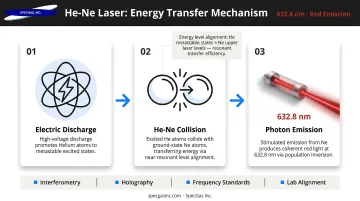
The helium-neon laser is the most familiar example. It uses a mixture of helium and neon gas: the electric discharge excites helium atoms to a metastable state, and those excited helium atoms then collide with neon atoms, transferring energy that creates a population inversion in neon.
The result is emission most commonly at 632.8 nm (red), though cavity optics can be adjusted to produce other lines including 543.5 nm (green) and 594.1 nm (yellow). Output power is modest, typically a few milliwatts in continuous-wave mode, but beam quality is excellent, approaching the diffraction limit.
He-Ne lasers are well-suited for:
- Interferometry and optical metrology (NIST lists the adopted vacuum wavelength at 632.9908 nm for length measurement)
- Holography
- Optical frequency standards
- Laboratory alignment
Molecular Gas Lasers: CO2
CO2 lasers are the most industrially significant molecular gas laser. They use a ternary mixture of CO2, nitrogen (N2), and helium (He). Nitrogen is first excited by the discharge and transfers vibrational energy to CO2 molecules, which then emit infrared radiation primarily at 10.6 µm.
Key performance figures, per RP Photonics:
- Wall-plug efficiency: 10–20%
- Output power range: tens of watts to multiple kilowatts (TRUMPF's TruFlow line ranges from 2 kW to 20 kW)
- Helium's role: helps depopulate the lower laser level and remove heat
CO2 lasers dominate industrial cutting, welding, and marking of metals and non-metals. A related variant, the CO laser, reaches efficiencies up to ~40% and emits between 4.8–8.3 µm, used mainly in laser absorption spectroscopy.
Ion Lasers: Argon and Krypton
Ion lasers use a high-current discharge to heavily ionize the gas, producing visible and UV emission. Argon-ion lasers emit strongly at 488.0 nm and 514.5 nm and can deliver over 20 W of continuous visible output — but at significant cost. A typical unit produces 10 W from 20 kW of electrical input and requires 6–8 gallons per minute of cooling water.
Krypton-ion lasers operate similarly and provide red output at 647.1 nm, useful when that wavelength is specifically required.
Ion lasers have been largely displaced by diode-pumped solid-state (DPSS) lasers due to their high operating costs and limited tube lifetimes. Still, they retain a foothold in specific research and pumping applications where their wavelengths or beam characteristics are hard to replicate.
Excimer Lasers
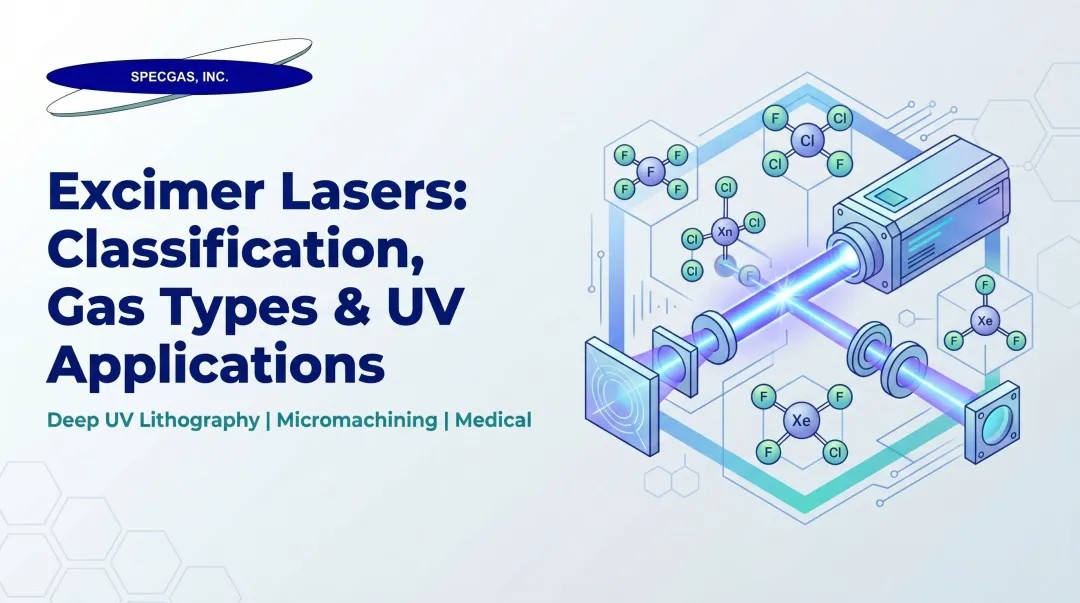
Excimer lasers use reactive rare gas halide mixtures to produce intense ultraviolet pulses. A pulsed electric discharge creates short-lived excited dimer molecules that emit UV photons when they dissociate — a mechanism that naturally prevents reabsorption and allows efficient pulsed operation.
| Gas Mixture | Wavelength | Primary Application |
|---|---|---|
| ArF (argon fluoride) | 193 nm | Semiconductor photolithography, LASIK |
| KrF (krypton fluoride) | 248 nm | DUV lithography, annealing |
| XeCl (xenon chloride) | 308 nm | Dermatology, materials processing |
ArF at 193 nm is the foundation of deep-UV (DUV) immersion lithography. ASML's NXT immersion platform accounts for approximately 80% of more than 1,100 immersion systems shipped to date. The same 193 nm wavelength drives LASIK and PRK refractive eye surgery, where the FDA has approved multiple excimer laser systems for corneal reshaping.
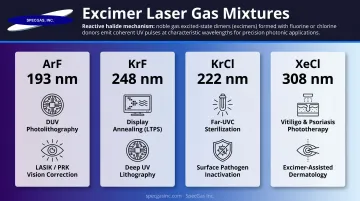
Because these gas mixtures contain reactive halogens, composition accuracy and cylinder preparation directly determine whether the laser operates. Tolerance errors don't degrade performance gradually — they cause failure. SpecGas supplies ArF (193 nm), KrF (248 nm), KrCl (222 nm), and XeCl (308 nm) excimer laser gas mixtures for photolithography, vision correction, and dermatology applications, with proprietary cylinder treatment that maintains reactive gas stability through the full shelf life.
How Gas Lasers Work: Excitation and Energy Transfer
Creating Population Inversion
To produce laser light, the gas must reach a state of population inversion — more atoms or molecules in an excited energy state than in the ground state. The most common method is electric discharge: electrons accelerated through the gas collide with atoms or molecules and transfer energy to them.
In a He-Ne laser, excited helium atoms transfer energy to neon atoms through collisions. The near-coincidental match between helium's metastable energy levels and neon's upper laser levels is what makes the mixture so effective — the energy level alignment is precise enough that efficient transfer occurs at every collision.
In CO2 lasers, nitrogen plays the same intermediary role — absorbing discharge energy and transferring vibrational excitation to CO2 molecules before emission occurs.
Stimulated Emission and Resonator Amplification
Once population inversion is achieved, stimulated emission takes over. An incoming photon of the right energy encounters an already-excited atom and triggers the release of a second photon with identical phase, direction, and wavelength. This cascading release is what generates coherent light.
The optical resonator (mirrors at each end of the tube) reflects these photons back and forth through the gas, multiplying them with each pass. A portion exits through the partially reflective output mirror as the usable laser beam.
Cooling and Gas Degradation
High-power CO2 and ion lasers generate substantial waste heat. Smaller systems diffuse heat through tube walls (helium's high thermal conductivity aids this in CO2 lasers), while high-power systems circulate gas through external heat exchangers.
Gas degradation over time is a practical concern:
- CO2 can dissociate into CO and O2 during operation, producing thousands of ppm of byproducts that reduce output and beam stability
- Electrode sputtering introduces metallic particles that contaminate the gas mixture
- Tube walls can absorb gas molecules over time, shifting blend concentrations
- Trace moisture and hydrocarbons reduce laser gain in sealed systems, even at sub-ppm levels
Sealed CO2 laser systems may use gold-based catalyst additives to reverse CO2 decomposition. For reactive excimer mixtures, degradation in storage is an additional concern: cylinder preparation before filling matters as much as the blend composition itself.
Applications Across Industries
Industrial Manufacturing
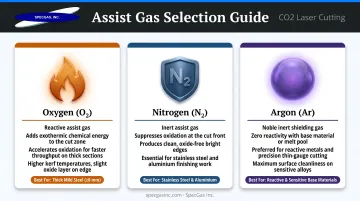
CO2 lasers are workhorses for cutting, welding, and marking metals, plastics, and composites. The choice of assist gas during cutting affects edge quality and speed:
- Oxygen: Reactive; adds chemical energy during cutting, suited for thick mild steel
- Nitrogen: Non-reactive; produces clean, oxide-free cut edges
- Argon: Non-reactive shielding gas for sensitive or reactive base materials
Semiconductor and Electronics Manufacturing
ArF excimer lasers at 193 nm are used for DUV photolithography to pattern critical IC layers. KrF lasers at 248 nm support annealing and thin-film processes. In these environments, even trace contamination in the gas mixture affects process yield — precise, stable compositions aren't optional.
Medical Applications
ArF excimer lasers are the established tool for LASIK and PRK corneal reshaping procedures. According to the American Academy of Ophthalmology, approximately 90% of LASIK patients achieve vision between 20/20 and 20/40 without corrective lenses. UV excimer wavelengths are also used in dermatology for phototherapy treatments.
Scientific Research and Metrology
He-Ne lasers underpin interferometers, holography setups, optical frequency standards, and laboratory alignment systems. Their stable, single-frequency output depends entirely on consistent gas mixture composition; small ratio shifts translate directly to performance variation. University and independent research facilities often need small-volume, custom blends that larger commodity suppliers won't produce — SpecGas Inc. specializes in exactly these limited-quantity specialty gas orders for laser and research applications.
Why Gas Purity and Composition Matter
Gas laser performance is unusually sensitive to what's in the tube. Unlike many industrial processes where minor input variations are absorbed without consequence, gas lasers amplify those variations into measurable output degradation.
What Goes Wrong with Impure or Off-Ratio Gas
- Shifted emission wavelength
- Reduced output power
- Shortened tube or optics life
- Inconsistent beam quality
- Complete laser failure in severe cases
For reactive excimer mixtures, the challenge extends into storage. Halogen-containing gases interact with cylinder walls over time, degrading the blend before it ever reaches the laser. How the cylinder is prepared before filling determines whether the blend remains stable through its service life.
SpecGas's Approach to Laser Gas Quality
SpecGas produces excimer laser gas mixtures (ArF 193 nm, KrF 248 nm, KrCl 222 nm, and XeCl 308 nm) using a proprietary internal cylinder treatment process developed from founder Alfred Boehm's decades of specialty gas R&D at Messer Griesheims Industries. That hands-on background in reactive gas mixture stability shaped SpecGas's cylinder treatment methodology from the ground up.
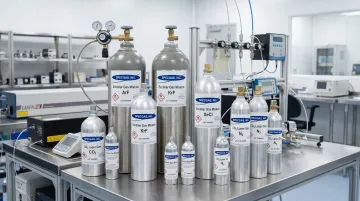
The result is the SpecGas Stability Guarantee for reactive gas mixtures — a documented commitment to the shelf life consistency that photolithography, vision correction, and research applications demand. All blends are produced using gravimetric methods with NIST-traceable calibration standards.
SpecGas also supplies:
- He-Ne laser blends and CO2/N2/He mixtures
- Noble gases (He, Ne, Ar, Kr, Xe) at high-purity grades
- Custom formulations for OEM manufacturers, university research labs, and lighting and display manufacturers
Cylinders range from 17-liter disposable units to 250 ft³ refillable configurations, with fast turnaround on custom orders.
Research labs, OEM manufacturers, and industrial operators needing reliable specialty gas blends can contact SpecGas for custom formulations with documented NIST traceability.
Frequently Asked Questions
What is a gas laser?
A gas laser uses a gas or gas mixture as its gain medium, with electric discharge exciting the gas to produce coherent light via stimulated emission. It was the first type of continuous laser, dating to the Bell Labs helium-neon demonstration on 12 December 1960.
What gases are used in gas lasers?
Main gases include helium and neon (He-Ne lasers), CO2 mixed with nitrogen and helium (CO2 lasers), argon (argon-ion lasers), and reactive halide mixtures like argon fluoride or krypton fluoride (excimer lasers). Exact composition varies by laser type and target wavelength.
What gas is used for laser cutting?
CO2 is the gain medium in CO2 laser cutters. During the cutting process, assist gases — nitrogen, oxygen, or argon — blow molten material from the kerf. The choice of assist gas affects edge oxidation, cut quality, and speed depending on the material being cut.
What is the difference between a gas laser and a solid-state laser?
Gas lasers use a gaseous gain medium excited by electric discharge; solid-state lasers use a doped crystal or glass pumped by light. Gas lasers offer superior beam quality and broader wavelength coverage, while solid-state lasers are more compact and energy-efficient.
Are gas lasers still used today?
Yes. CO2 lasers remain essential in industrial cutting and welding, ArF excimer lasers are critical for semiconductor lithography and LASIK surgery, and He-Ne lasers continue to serve scientific instruments and precision alignment systems.
Why does gas purity matter for laser performance?
Impurities or incorrect gas ratios reduce output power, shift emission wavelength, shorten tube life, and degrade beam quality. For reactive excimer mixtures, gas stability during storage is an additional variable — cylinder preparation and blend accuracy both directly determine whether the mixture performs at spec.