Introduction
On January 23, 2010, a transfer hose at DuPont's Belle, West Virginia facility ruptured, spraying a worker with liquid phosgene. He died the following day. The U.S. Chemical Safety Board's investigation found corroded hose materials, unreported near-misses, and a hazard analysis that failed to account for thermal expansion of trapped liquid phosgene. Each contributing factor had been identifiable — and correctable — before anyone was harmed.
Phosgene is not a hazard confined to large chemical plants. It forms in ordinary workplaces when chlorinated solvents, refrigerants, or plastics get exposed to heat or flame. Welders, HVAC technicians, and first responders encounter this risk regularly — often without realizing it.
What makes phosgene particularly unforgiving is timing. A worker can inhale a dangerous dose, feel mild irritation, and then feel nothing for hours — while lung damage quietly progresses. By the time symptoms become unmistakable, the critical window for intervention may be closing.
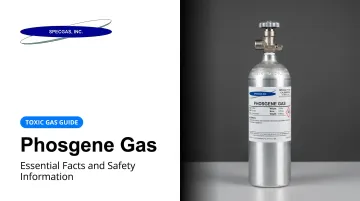
This guide covers what phosgene is, where it comes from, how to recognize exposure, and what detection and response protocols actually look like in practice.
Key Takeaways
- Phosgene (COCl₂) is a colorless gas — smell alone cannot reliably warn you of dangerous exposure
- It forms inadvertently when chlorinated solvents or refrigerants (like Freon) contact heat or flame
- Lung damage can develop 30 minutes to 48 hours after exposure, even when someone initially feels fine
- OSHA PEL: 0.1 ppm (8-hour TWA); IDLH: 2 ppm, which requires immediate evacuation
- No antidote exists; anyone potentially exposed needs hospital observation, not a wait-and-see approach
- Calibrate gas detectors regularly against certified reference standards — unreliable readings can fail to warn of dangerous phosgene levels
What Makes Phosgene Gas So Dangerous
Physical Properties That Work Against You
Phosgene is a colorless, nonflammable gas at room temperature. Its vapor density is approximately 3.48 times that of air, meaning it sinks and accumulates in low-lying spaces — basements, trenches, confined spaces, floor-level work areas. During World War I, this sinking behavior made it devastatingly effective as a weapon. In modern workplaces, it means a dangerous concentration can pool exactly where workers are standing or crouching.
The odor problem compounds this. Phosgene smells faintly of freshly cut hay or green corn — but only at concentrations well above the safe limit. According to NCBI's Acute Exposure Guideline Levels data, the odor detection threshold ranges from approximately 0.4 to 1.5 ppm. The OSHA permissible exposure limit is 0.1 ppm. That gap means a worker can already be at four times the safe exposure level before detecting any smell. "I don't smell anything" is not a safety clearance.
How Phosgene Damages Lungs
Phosgene reacts with proteins, amino groups, and cell membranes in the lung's air sacs. This triggers a cascade of damage:
- Disrupts the barrier between blood and air
- Causes fluid to leak into the lungs (pulmonary edema)
- Worsens with cumulative inhaled dose — concentration multiplied by duration
A lower concentration over a longer period can be as dangerous as a brief high-concentration exposure.
The Delayed Onset Problem
After a significant exposure, a person may experience only mild eye irritation or a brief cough — then feel essentially normal for hours. This delayed response is the defining hazard. ATSDR's Medical Management Guidelines document a latent period of 30 minutes to 48 hours before respiratory damage becomes apparent. Serious fluid accumulation in the lungs, respiratory distress, and in severe cases cardiovascular collapse can emerge well after the person has left the exposure site.
A documented case illustrates this exactly: a 49-year-old refrigerator technician used a welding torch to solder a coil containing residual Freon. He developed burning throat, severe shortness of breath, wheezing, and a heart rate of 140 bpm.
Exhaled phosgene was detected at greater than 1 ppm for approximately five hours. He required ICU observation before improving enough for discharge within 48 hours.
Regulatory Thresholds at a Glance
| Limit | Value | Authority |
|---|---|---|
| Permissible Exposure Limit (TWA) | 0.1 ppm (8-hour) | OSHA |
| Recommended Exposure Limit (TWA) | 0.1 ppm | NIOSH |
| Ceiling Limit | 0.2 ppm (15-minute) | NIOSH |
| IDLH (Immediately Dangerous to Life or Health) | 2 ppm | NIOSH |
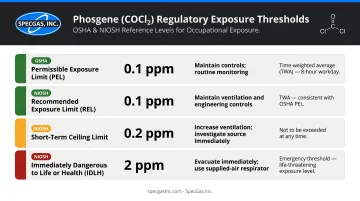
At or above 2 ppm, immediate evacuation is required. There is no safe threshold for extended unprotected exposure.
Where Phosgene Exposure Occurs
Intentional Industrial Use
Phosgene is a feedstock chemical in manufacturing isocyanates (used in polyurethane foams and coatings), polycarbonates, pharmaceuticals, pesticide precursors, and dyes. Classified as a Schedule 3 chemical under the Chemical Weapons Convention, most producers generate and consume phosgene on-site to avoid transportation and storage risk. Workers in these facilities typically operate under formal phosgene safety programs with ongoing exposure controls.
Inadvertent Generation — The Underappreciated Risk
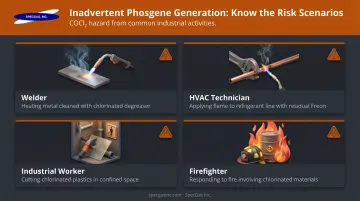
OSHA documents that phosgene forms when chlorinated hydrocarbons — chloroform, carbon tetrachloride, trichloroethylene, perchloroethylene, methylene chloride, and Freons — are heated in the presence of oxygen. This happens routinely in trades that don't consider themselves "chemical workers":
- A welder cutting or heating metal that was previously cleaned with a chlorinated degreaser
- An HVAC or refrigeration technician applying heat or flame to a line containing residual Freon
- Workers in poorly ventilated spaces burning or thermally cutting chlorinated plastics
Burning chlorinated materials in fires also releases phosgene. The EPA confirmed that vinyl chloride combustion produces phosgene, which became a public concern following the 2023 East Palestine, Ohio train derailment and subsequent controlled burn. First responders at fires involving chlorinated plastics or chemical storage face this hazard acutely.
These scenarios span both industrial settings and emergency response — making phosgene exposure a cross-industry concern, not just a chemical plant issue.
Who Is Most at Risk
- Welders and metalworkers using chlorinated degreasers
- Refrigeration and HVAC technicians
- Chemical plant workers handling isocyanates or polycarbonates
- Synthetic and industrial chemists
- Firefighters responding to chemical or industrial fires
- Workers in confined spaces where chlorinated compounds are stored or used
Essential Safety Precautions for Phosgene Environments
General Controls and Respiratory Protection
Engineering controls come first — they are not optional backups to respirator use. Effective controls include:
- Enclosed process systems that prevent atmospheric release
- Local exhaust ventilation positioned at phosgene generation points
- Ensuring welding or heating of any chlorinated material occurs outdoors or in fully ventilated spaces
- Purging refrigeration or process lines of chlorinated compounds before applying heat or flame — this single step would have prevented the refrigerator technician's exposure
For respiratory protection, NIOSH guidance specifies supplied-air respirators (SARs) at lower concentrations and full-facepiece SCBA at concentrations approaching the IDLH. Standard chemical cartridge half-face respirators are not appropriate in environments where phosgene concentrations are unknown or potentially elevated. Cartridge selection matters, but no respirator substitutes for proper engineering controls.
Monitoring and Detection
Personal dosimeters are worn in the breathing zone and measure cumulative dose over time. They provide the earliest actionable warning in environments where phosgene is intentionally used or suspected.
Fixed gas detectors provide continuous real-time readings and can trigger evacuation alarms at preset thresholds. However, a detector is only as reliable as its last calibration. Instruments that haven't been verified against certified reference standards can read low — or fail to alarm — at dangerous concentrations.
This is where calibration gas quality becomes operationally critical. SpecGas produces NIST-traceable phosgene calibration gas mixtures specifically for verifying that fixed detectors and personal monitoring instruments give accurate readings.
SpecGas's proprietary cylinder treatment process ensures reactive gases like phosgene remain stable at low PPM and PPB concentrations throughout shelf life. Phosgene is chemically reactive, and concentration drift in poorly prepared cylinders undermines detector reliability in ways that may not be obvious until a real exposure event occurs.
Action level protocols should define:
- Who is notified when a detector triggers at any threshold
- At what reading evacuation is mandatory
- Who verifies atmospheric safety before re-entry is permitted
Emergency Response: What to Do After Phosgene Exposure
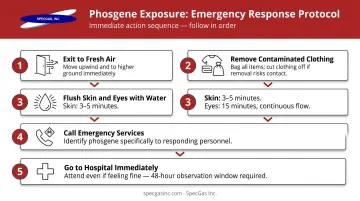
Act immediately. Follow every step:
- Exit the area — move to fresh air without delay; if outdoors, go upwind and to higher ground (phosgene concentrates at low elevations); if indoors, evacuate the entire building
- Remove contaminated clothing — if garments must come over the head, cut them off rather than pulling them across the face; seal contaminated items in doubled plastic bags for hazmat disposal
- Wash exposed skin — flush with plain water for 3–5 minutes, then wash with soap and water; flush exposed eyes with clean water for at least 15 minutes
- Call emergency services — do not drive yourself; report phosgene as the specific hazard
- Go to the hospital — even if feeling fine — the 48-hour observation window is not optional; tell the receiving physician the specific chemical involved so chest X-ray and monitoring begin immediately
There is no antidote — treatment is supportive: oxygen, positive pressure ventilation if needed, and close monitoring for pulmonary edema. That monitoring window is non-negotiable precisely because of the latent period: a worker who feels fine two hours after exposure may be in serious danger by hour four.
Common Phosgene Safety Mistakes to Avoid
Relying on smell as a warning system. Because the odor threshold is four or more times higher than the safe exposure limit, waiting to smell something before taking precautions means waiting until overexposure has likely already occurred. Safety procedures cannot depend on sensory detection.
Dismissing mild early symptoms. Throat irritation, watery eyes, or a brief cough after suspected phosgene contact are not reassurances — they are reasons to seek medical observation immediately. Multiple documented fatalities occurred because workers left work feeling "not too bad," then deteriorated at home hours later.
Skipping the purge step before applying heat. Welders and refrigeration technicians who don't clear chlorinated solvents or refrigerants from lines and components before heating them are the most common non-industrial exposure victims. The step is well-documented, and it's consistently skipped with serious consequences.
Trusting uncalibrated detection equipment. A phosgene detector with outdated calibration may read low or fail to alarm at hazardous concentrations. Teams that rely on instruments without documented, up-to-date calibration against certified reference gas are operating blind to actual hazard levels. Calibration checks should be scheduled, performed, and recorded. Assuming they're current is not a substitute for documentation.
Frequently Asked Questions
What is phosgene gas used for today?
Phosgene is primarily used to manufacture isocyanates (the backbone of polyurethane foams and coatings), polycarbonates, pharmaceuticals, pesticide precursors, and dyes. Most industrial production occurs in closed-loop facilities where phosgene is generated and consumed on-site to minimize storage and transport risk.
Can you smell phosgene gas?
Phosgene has a faint odor described as freshly cut hay or green corn. However, its odor detection threshold — approximately 0.4 to 1.5 ppm — is well above the OSHA PEL of 0.1 ppm. A dangerous concentration can be present before any smell is detectable.
What should you do if you inhale phosgene gas?
Move immediately to fresh air, remove and bag contaminated clothing, call emergency services, and go to a hospital — even if you feel fine. Symptoms can be delayed up to 48 hours, and there is no antidote. Hospital observation for at least 48 hours is required.
What are the symptoms of phosgene gas exposure?
Immediate symptoms include eye and throat irritation, coughing, and watery eyes. After a latent period of 30 minutes to 48 hours, you may develop:
- Worsening shortness of breath
- Fluid in the lungs (pulmonary edema)
- Low blood pressure
- Cardiovascular collapse or death in severe cases
Is there an antidote for phosgene poisoning?
No. Treatment is entirely supportive — oxygen therapy, mechanical ventilation in severe cases, and intravenous fluids. Anyone with suspected phosgene exposure should be observed in a hospital setting for at least 48 hours regardless of current symptoms.
What is the OSHA permissible exposure limit for phosgene?
The OSHA PEL is 0.1 ppm as an 8-hour time-weighted average. NIOSH recommends a ceiling of 0.2 ppm for any 15-minute period. The IDLH — the concentration requiring immediate evacuation — is 2 ppm.