Introduction
Compressed gas cylinders cause serious workplace injuries every year. In 2016 alone, the Bureau of Labor Statistics documented 10 fatalities and 3,920 injuries related to pressurized containers. The Compressed Gas Association warns that every compressed gas cylinder should be treated as a "potential high energy projectile"—and OSHA accident records document severe incidents, including a 2009 case where a compressed oxygen cylinder ruptured at 2,350 psi, resulting in a worker's double leg amputation.
Helium is non-toxic and non-flammable, but that's where the reassurance ends. Cylinders are pressurized to 2,000–3,000 psi, creating serious physical hazards. A sheared valve can transform a cylinder into an unguided projectile with enough force to penetrate walls. In enclosed spaces, even moderate leaks rapidly displace oxygen—helium is odorless and colorless, so there's no sensory warning before asphyxiation sets in.
These risks are manageable—but only with the right protocols in place. This guide covers the complete safety picture for lab managers, industrial operators, procurement teams, and safety professionals: storage requirements, handling protocols, transport rules, and the most common mistakes to avoid.
Key Takeaways
- Treat helium cylinders as high-pressure hazards: projectile and asphyxiation risks are real, even though helium itself is inert
- Store cylinders upright with two-point restraints, in ventilated areas below 125°F, away from incompatible materials
- Use hand trucks for all movement; keep valve caps on when not in use
- Check for leaks with soapy water before every use; maintain clear emergency procedures
- Only trained, authorized personnel should handle or connect cylinders
Understanding the Real Risks of Helium Gas Cylinders
Why Helium's "Safe" Reputation Creates Complacency
Helium's non-toxic, non-flammable reputation leads to dangerous complacency. At 2,000–3,000 psi storage pressure, a sheared valve or cylinder rupture converts stored pressure energy into kinetic force. The cylinder becomes an unguided projectile capable of striking employees or penetrating structural barriers—OSHA citations document incidents where dragging or tipping cylinders caused valve shear failures.
Compressed gas stores tremendous energy. A valve failure releases that energy uncontrollably, accelerating the cylinder in the opposite direction with enough force to cause fatalities.
The physical hazard is only half the picture. Helium also poses a serious physiological risk that's easy to overlook precisely because there's nothing to see or smell.
The Invisible Asphyxiation Hazard
Helium is a simple asphyxiant that displaces oxygen. Because it's completely colorless, odorless, and tasteless, there's no sensory warning when oxygen levels drop. In confined or poorly ventilated spaces (lab rooms, storage closets, manufacturing bays), even moderate leaks can reduce oxygen concentration rapidly.
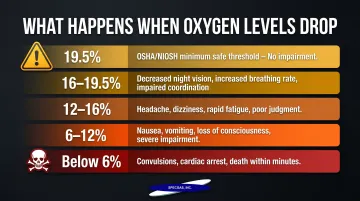
OSHA and NIOSH define oxygen-deficient atmosphere as below 19.5% O₂. Serious cognitive impairment begins at 16%, and consciousness loss occurs at 6–10% oxygen concentration. Facilities storing helium in enclosed areas must implement active oxygen monitoring to detect dangerous conditions before personnel enter.
| Oxygen Level | Physiological Effect |
|---|---|
| Below 19.5% | OSHA/NIOSH oxygen-deficient threshold |
| 12–16% | Impaired judgment, vision loss, disturbed coordination |
| 10–14% | Emotional upset, abnormal fatigue, respiratory disturbance |
| 6–10% | Nausea, collapse, loss of consciousness without warning |
| Below 6% | Convulsions, respiratory failure, death |
Regulatory Framework
Helium cylinder safety is governed by overlapping federal regulations and industry consensus standards:
- OSHA 29 CFR 1910.101 covers compressed gases in general industry and incorporates CGA Pamphlet P-1 by reference for handling, storage, and use
- DOT 49 CFR Parts 173, 178, 180 regulate cylinder specifications, transport, and hydrostatic testing
- CGA P-1 is the primary industry standard for safe compressed gas handling
- NFPA 55 governs installation, storage, and use to mitigate explosion and physiological hazards
Understanding which standard applies to your facility's specific operations—storage, transport, or use—determines which inspection and documentation requirements your team must meet.
How to Safely Store Helium Gas Cylinders
Improper storage is the most common source of preventable incidents. Every other safety practice depends on cylinders being maintained correctly when not in use.
Location and Environmental Requirements
Store helium cylinders in well-ventilated areas that prevent gas accumulation during slow leaks. The space must be dry—moisture causes corrosion that weakens cylinder walls and valves over time. Keep cylinders cool and away from heat sources; the maximum allowable temperature is 125°F (52°C), strictly enforced by CGA P-1 and NFPA 55. Heat accelerates internal pressure buildup and increases rupture risk. Cylinders stored outdoors must be shielded from direct sunlight when ambient temperatures approach this limit.
Never store cylinders in:
- Corridors or areas near emergency exits
- Stairways or gangways
- Unventilated enclosures, lockers, or cupboards
- Cold rooms without proper ventilation controls
While helium is inert, regulations require separation from flammable and oxidizing gases by at least 20 feet—or by a fire-rated noncombustible partition with minimum ½-hour fire resistance.
Securing and Positioning Cylinders
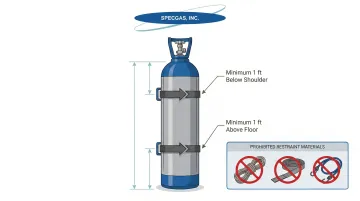
OSHA 1926.350(a)(9) and CGA P-1 require cylinders to be stored upright and secured against tipping or rolling. Use non-combustible restraints—chains or metal straps—anchored to fixed structural supports.
Position restraints at:
- First restraint: One-third up from the cylinder base
- Second restraint: Two-thirds up from the cylinder base
- Minimum one foot below the cylinder shoulder for upper restraint
- Minimum one foot above the floor for lower restraint
Avoid these restraint materials entirely:
- Combustible materials (nylon webbing, rope)
- Insufficient materials (string, elastic cords)
- Temporary bench C-clamps (use only as a last resort, not for permanent storage)
Store full and empty cylinders separately with clear labels. Mixing them creates operational errors—connecting an empty cylinder to a pressurized system can cause suck-back. Keep valve protection caps on all cylinders not actively in use.
Cylinder Inspection and Inventory Management
Inspect cylinders regularly for signs that require immediate removal from service:
- Dents or bulging
- Corrosion or pitting
- Cracked or abraded areas
- Leakage signs
- Thermal damage (arc burns, overheating marks)
Any cylinder showing these signs must be removed from service immediately and returned to the supplier. Do not attempt repairs—only qualified facilities may recondition cylinders.
DOT-3A and DOT-3AA cylinders require hydrostatic requalification every 5 years under 49 CFR 180.209. A 10-year interval applies to cylinders used exclusively for inert gases like helium, provided they display a five-pointed star stamp immediately following the test date.
Test dates are stamped on the cylinder neck. Federal regulations explicitly prohibit filling cylinders past their requalification date—never use overdue cylinders.
Rotate stock first-in, first-out and return empties promptly to avoid accumulation. Specialty helium blends carry shelf-life considerations tied to gas composition integrity—documented blend dates matter. Suppliers like SpecGas provide NIST-traceable cylinders with verified blend dates and gas composition certificates, giving labs and monitoring facilities the traceability records they need for both safety compliance and measurement confidence.
Safe Handling and Operation of Helium Gas Cylinders
The majority of handling-related incidents occur during movement, connection, or improper operation—not during normal use.
General Handling and Movement Precautions
Minimum PPE for pressurized cylinder work:
- Safety glasses or goggles when working with pressurized connections
- Gloves in environments with temperature extremes or contamination risk
- Safety footwear to prevent crush injuries
Moving cylinders safely requires more than caution — it requires the right equipment. Follow these rules without exception:
- Use a hand truck or cylinder cart even for short distances, with the cylinder secured
- Never roll, drag, carry horizontally, or use cylinders as rollers or supports
- Keep the valve protection cap on until the cylinder is secured at its point of use
- Never lift a cylinder by its valve or cap
- Never stand directly in front of a valve opening when connecting or disconnecting equipment
Connecting Regulators and Equipment
Helium requires a CGA-580 connection regulator rated for inert gases at pressures up to 3,000 psi. Regulators are not interchangeable across gas types — using an incorrect or adapter-fitted regulator is a serious hazard. Never force connections that don't fit naturally.
Each cylinder must have its own dedicated regulator. Shared or worn regulators are a leading cause of pressurized connection failures.
Once the regulator is in place, follow this valve opening sequence:
- Stand to the side — never in front of the valve outlet
- Open the valve slowly
- Verify the regulator is properly seated before increasing flow
- Close the valve when the system is not in active use, even briefly
Proper connections are your first line of defense against leaks — but even correctly fitted regulators can develop seepage over time.
Leak Detection and Emergency Response
Apply soapy water or approved leak detection fluid to valve connections and fittings. Bubbling indicates a leak. Never use an open flame for leak detection. Helium's small molecular size (kinetic diameter 0.26 nm) makes it more prone to seepage through elastomer seals than nitrogen or argon.
If a leak cannot be stopped by tightening the valve gland:
- Evacuate the immediate area
- Increase ventilation (open doors, activate exhaust fans)
- Contact the gas supplier for removal guidance
If the leak occurs in an enclosed or confined space, treat it as an oxygen-deficiency emergency and follow site evacuation protocols immediately.
Transporting Helium Gas Cylinders Safely
Ground Transport Requirements
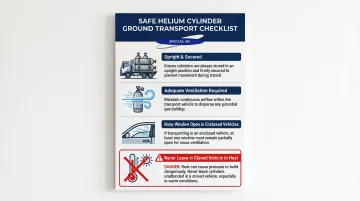
Cylinders must be transported upright and secured to prevent tipping or rolling. Under DOT 49 CFR 177.840, cylinders must be restrained in racks or packed in boxes/crates to prevent shifting or ejection from the vehicle.
Key ventilation and temperature rules during ground transport:
- Use vehicles with adequate ventilation at all times
- Keep a window partially open in enclosed vehicles to prevent accidental gas buildup
- Never leave a cylinder in a closed vehicle in warm conditions — rising temperatures increase internal pressure
Air Transport Restrictions
Helium (UN1046) is permitted on aircraft but strictly limited. IATA Dangerous Goods Regulations cap shipments at 75 kg per package on passenger aircraft and 150 kg on cargo aircraft. Most institutional and commercial applications cannot air-transport helium cylinders because of these weight restrictions.
Institutional and Campus Restrictions
Within facilities, only transport cylinders inside the building where they were delivered. DOT regulations prohibit moving cylinders across public streets without proper hazmat transport authorization. For cross-building transfers, coordinate directly with your vendor.
Pre-Transport Checklist
- Verify valve protection cap is secured
- Remove regulator and inflator before transport
- Label cylinder with contents and status (full, in-use, or empty)
- Secure cylinder to hand truck or cart
Common Safety Mistakes to Avoid with Helium Cylinders
Even experienced handlers make avoidable errors with helium cylinders — often because helium's non-toxic reputation creates a false sense of security. These three mistakes account for a disproportionate share of incidents.
Mistake #1: Assuming Helium Is Safe Because It's Non-Toxic
This leads to skipping restraints, storing in non-ventilated areas, or leaving cylinders unsecured "just for a moment." Even brief tipping can shear a valve, resulting in a projectile cylinder or rapid oxygen displacement. Always secure cylinders immediately upon placement.
Mistake #2: Using Incorrect, Worn, or Shared Regulators
Using adapters to connect mismatched equipment is a leading cause of pressurized connection failures. To avoid regulator-related incidents:
- Use a properly rated, dedicated regulator for each gas type
- Inspect regulators at regular intervals for wear or damage
- Replace worn components before returning cylinders to service
- Never force incompatible connections
Mistake #3: Allowing Untrained Personnel to Handle Cylinders
Equipment errors are recoverable. Personnel errors often aren't. Unauthorized handling or improvised leak response can rapidly escalate minor issues into serious safety events. In labs and industrial facilities, training serves as both a regulatory requirement and a practical safeguard — only trained, authorized personnel should handle cylinders, connect equipment, or respond to leaks.
Conclusion
Helium's reputation as a non-toxic, non-flammable gas leads many facilities to underestimate its hazards. Proper storage, disciplined handling, correct equipment, and trained personnel all work together to prevent the incidents that reputation tends to obscure.
Effective safety doesn't happen in response to visible problems — it's embedded into daily workflow from the start. A quick checklist of the core practices covered in this guide:
- Store cylinders upright, secured, and away from heat sources or incompatible materials
- Use correct regulators and fittings; inspect connections before every use
- Ensure adequate ventilation in all storage and use areas to prevent oxygen displacement
- Train personnel on emergency response, including evacuation procedures for leaks
- Maintain current SDS documentation and cylinder inspection records
Supplier selection is part of the overall safety picture, too. Correct gas identification, cylinder documentation, and purity verification reduce handling errors before a cylinder ever reaches your facility. The NIST-traceable standards provided by SpecGas support both safety compliance and analytical accuracy — two goals that, in precision gas work, are rarely separable.
Frequently Asked Questions
How do you store helium gas cylinders?
Store helium cylinders upright and secured with two-point non-combustible restraints in a cool (below 125°F), dry, well-ventilated area. Separate from flammable or oxidizing gases by at least 20 feet. Keep valve protection caps on when not in use and label full and empty cylinders separately.
How do you transport helium gas cylinders?
Transport helium cylinders upright and secured to a hand truck in a ventilated vehicle with valve caps on. Avoid closed vehicles in warm conditions. Air transport is restricted in most institutional settings — weight limits cap at 75 kg (passenger) or 150 kg (cargo aircraft).
What temperature can helium gas cylinders be stored at?
The maximum safe storage temperature is 125°F (52°C) per CGA P-1 and NFPA 55 standards. Elevated temperatures increase internal cylinder pressure and raise rupture risk. Protect outdoor cylinders from direct sunlight if ambient temperatures approach this threshold.
Do helium tanks go bad over time?
Cylinders require hydrostatic retesting every 5–10 years (depending on star stamp designation). High-purity or specialty helium blends can degrade in quality over time. Cylinders showing corrosion, dents, or physical damage should be returned to the supplier immediately and removed from service.
Is helium gas dangerous to inhale?
Yes. Helium displaces oxygen in the lungs, causing rapid asphyxiation. Inhaling directly from a pressurized cylinder also causes immediate pulmonary barotrauma (lung rupture), making it acutely life-threatening — not just an asphyxiation risk.
How do you check a helium cylinder for leaks?
Apply soapy water or approved leak detection solution to valve connections and fittings. Bubbling indicates a leak. Never use an open flame. If a leak cannot be stopped by tightening connections, evacuate the area, increase ventilation, and contact your supplier for removal guidance.