Introduction
Helium and carbon dioxide sit at opposite ends of the gas reactivity spectrum. Helium is chemically inert, non-renewable, and increasingly scarce. CO₂ is reactive, abundant, and one of the most regulated gases in industrial monitoring. Yet both appear in the same calibration systems, specialty gas blends, and precision measurement environments—and both demand the same rigorous attention to purity, documentation, and sourcing.
For engineers, lab managers, and EHS professionals, understanding these gases isn't background knowledge. It's operational. Get either one wrong, and the consequences are concrete:
- Using the wrong purity grade invalidates calibration results
- Sourcing helium without a reliable supply chain creates production gaps
- Filling a CO₂ calibration cylinder without proper passivation causes analyte loss before the gas ever reaches an analyzer
This article breaks down the physical and chemical properties of each gas, their industrial applications, and the purity and sourcing decisions that determine whether your measurements hold up.
Key Takeaways
- Non-renewable and inert, helium is critical for cryogenics, GC carrier gas, leak detection, and calibration blends
- Regulated as an emissions gas, CO₂ sees broad use across CEMS calibration, food processing, and laser systems
- Purity grade selection directly determines application fitness—wrong grades cause measurement error or equipment damage
- CO₂ calibration standards for EPA CEMS must meet ±2.0% or better uncertainty per 40 CFR Part 75
- Helium supply is geographically concentrated; the US and Qatar alone account for about 76% of global production
Physical and Chemical Properties
Understanding where each gas excels—and where it creates problems—starts with the underlying properties.
Helium
Helium (He, atomic number 2) is a monatomic noble gas with properties that make it difficult to replace in precision applications:
- Boiling point: −268.93°C — the lowest of any element
- Density: ~0.164 g/L at room temperature (roughly one-seventh that of air)
- Thermal conductivity: ~0.156 W/m·K at 300 K, approximately six times higher than nitrogen
- Chemical stability: Forms no stable compounds under standard industrial conditions
- Water solubility: Very low — 0.86 mL per 100 mL water at 20°C
Helium's small atomic radius allows it to diffuse through materials roughly three times faster than air, which is why it's the standard tracer gas for leak detection in high-vacuum systems. That same property makes cylinder sealing critical for long-term storage.
Carbon Dioxide
CO₂ is a linear triatomic molecule (molecular weight 44 g/mol) with a very different profile:
- Density: ~1.98 g/L at STP — heavier than air (relative density 1.53)
- Sublimation point: −78.5°C at 1 atm (no liquid phase at atmospheric pressure)
- Flammability: Not flammable, but acts as an asphyxiant above 5,000 ppm (OSHA PEL) with an NIOSH IDLH of 40,000 ppm
- Moisture reactivity: Dissolves in water to form carbonic acid, creating acidic conditions that affect materials compatibility
That last point matters for calibration gas users. At trace concentration levels — single-digit ppm range — CO₂ reacts with residual moisture in cylinder walls. Without proper passivation, the analyte concentration drifts before the cylinder reaches its expiration date.
Comparative Behavior in Gas Mixtures
When helium serves as a balance gas, it contributes no chemical reactivity — which prevents analyte degradation and concentration drift at sub-ppm levels. Nitrogen is the more common and cost-effective balance gas for CO₂ calibration standards, but helium is the better choice when background reactivity must be eliminated.
In CO₂ laser mixtures, both gases appear together: CO₂ provides the lasing medium, while helium manages thermal load and stabilizes the electrical discharge. Common CO₂ laser resonator gas ratios run approximately CO₂:N₂:He at 1:1:8, though exact formulations vary by OEM design.
Industrial Applications
Helium Applications
According to the USGS Mineral Commodity Summaries 2026, U.S. helium end uses break down as follows:
| Application | U.S. Share |
|---|---|
| Analytical & laboratory | 22% |
| Semiconductor, fiber optics, controlled atmospheres | 17% |
| MRI / superconducting magnets | 15% |
| Aerospace (pressurizing & purging) | 9% |
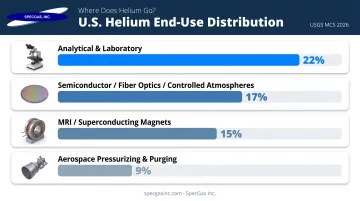
The analytical and laboratory segment reflects helium's role as a carrier gas in gas chromatography, where its high thermal conductivity and inertness deliver sharp, reproducible separations. Semiconductor photolithography requires ultra-high purity helium; sub-ppm impurity levels are enough to affect process yield.
Helium-neon laser systems use He:Ne mixtures typically in the 5:1 to 20:1 ratio range. SpecGas produces He-Ne laser gas mixtures for medical applications — including vision correction surgery and dermatological phototherapy — blended to customer specifications. Both disposable and refillable cylinder formats are available.
CO₂ Applications
Where helium's industrial use centers on purity and inertness, CO₂ operates across a broader and more heavily regulated footprint:
- Emissions monitoring: CO₂ is a regulated pollutant under 40 CFR Part 98 and covered by the EU Emissions Trading System. CEMS instruments monitoring CO₂ must be calibrated against certified standards
- EPA stack methods: Methods 3, 3A, and 3B govern CO₂ measurement at stationary sources; Method 3A specifically covers instrumental determination
- Calibration of gas analyzers: CO₂ NDIR analyzers in CEMS applications require calibration gases with ±2.0% or better uncertainty per 40 CFR Part 75 Appendix A
- Laser resonators use CO₂-containing mixtures; helium manages thermal dissipation in the discharge tube
- Food-grade CO₂ requires minimum 99.9% purity per ISBT guidance and is affirmed as GRAS under 21 CFR 184.1240
CO₂ is often both the target analyte and a challenge gas, depending on the application context. An environmental engineer running a CEMS might measure ambient CO₂ in stack gas while simultaneously depending on a CO₂ calibration standard to verify analyzer accuracy.
Specialty Gas Blends and Calibration Standards
This is where the individual properties of helium and CO₂ become system-critical parameters.
Calibration Gas Requirements for CO₂
For EPA CEMS applications, calibration gases must meet strict requirements:
- Certified concentration with uncertainty of ±2.0% or better (40 CFR Part 75)
- NIST-traceable documentation per the EPA Traceability Protocol for Assay and Certification of Gaseous Calibration Standards
- Certificate of Analysis identifying cylinder-specific concentration, balance gas, uncertainty statement, and traceability
- Participation in EPA's Protocol Gas Verification Program (PGVP) for Part 75 compliance gases
Small errors in the calibration gas translate directly into regulatory reporting inaccuracies. A CO₂ calibration standard that drifts 3% from its certified concentration doesn't just affect internal quality — it affects emissions data submitted to regulatory agencies.
Balance Gas Selection
For CO₂ calibration standards, nitrogen and zero air are the most common balance gases. Helium is the right choice when:
- Ultra-low background reactivity is required
- The analyte is particularly moisture-sensitive
- The detection method responds differently to nitrogen-matrix interference
Whichever balance gas applies to your application, the cylinder treatment approach matters as much as the blend chemistry itself. SpecGas produces NIST-traceable CO₂ calibration standards using gravimetric blending, with both nitrogen and helium balance options available. The internal cylinder treatment process, refined through decades of reactive gas R&D, targets the primary degradation risk directly: moisture-driven analyte loss in trace CO₂ mixtures.
For CO₂ at trace ppm levels, cylinder passivation is not optional. Untreated cylinder walls can adsorb or react with CO₂ analyte, causing concentration drift over the shelf life of the gas. SpecGas backs its reactive gas mixtures with the SpecGas Stability Guarantee.
Purity Grades and Validation
Helium Purity Grades
| Grade | Purity | Typical Use |
|---|---|---|
| Grade A | 99.995% | General industrial, welding shield |
| UHP | 99.999% | GC carrier gas, analytical lab |
| Research | 99.9999% | Semiconductor fab, sub-ppm calibration standards |
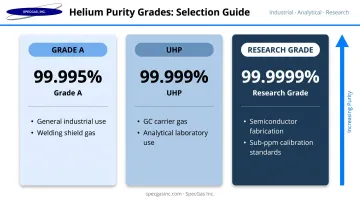
Selecting the wrong grade introduces background impurities that interfere with trace-level analyte detection. At sub-ppm analyte concentrations, the balance gas purity must exceed the analyte concentration by several orders of magnitude.
CO₂ Purity Grades
The same logic applies to CO₂. Industrial-grade CO₂ (99%–99.9%) may carry moisture, hydrocarbons, and other contaminants at levels that corrupt analyzer readings. Instrument-grade or calibration-grade CO₂ requires:
- Certified low moisture content
- Verified analyte concentration
- A Certificate of Analysis specific to the cylinder
The CGA commodity specifications G-9.1 (helium) and G-6.2 (CO₂) govern baseline purity requirements, though calibration gas applications typically exceed these minimums. Meeting those minimums is a starting point — confirming you actually received what the label states requires active verification.
Verification Methods
- Verify helium purity by gas chromatography or mass spectrometry for full impurity profiling
- Confirm CO₂ concentration in calibration standards using NDIR analysis or GC-TCD
- Run cylinder-to-cylinder checks on reactive gas mixtures — verify concentration at receipt, not solely from the CoA
The Helium Supply Landscape
Helium is non-renewable on human timescales. Once released to atmosphere, it escapes Earth's gravity. Commercial supply comes almost entirely from natural gas processing, and the geography is highly concentrated.
- Global production (2025): ~190 million m³
- US share: ~43% | Qatar: ~33% | Russia: ~9.5% | Algeria: ~6%
- US reserves: 8.5 billion m³ | Non-US world reserves: 31.3 billion m³
- Grade-A price: ~$12/m³
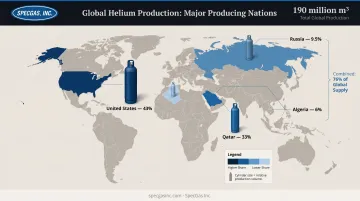
Supply disruptions have occurred before — infrastructure failures, geopolitical issues, and facility outages create volatility in a market with no substitution path for many applications. The 2016 discovery of a ~54 billion cubic foot helium resource in Tanzania's East African Rift offers some long-term supply diversification.
One connection between helium and CO₂ that rarely gets attention: certain natural gas reservoirs are CO₂-rich, and helium is extracted from those CO₂ streams. Air Products' Doe Canyon facility in Colorado recovers helium from a CO₂-dominated gas stream, designed for approximately 230 million standard cubic feet per year of helium output. CO₂ isn't just a companion gas here — it's the carrier medium.
For organizations that depend on helium-containing blends — calibration standards, laser gas mixtures, GC carrier gas — supplier reliability is as important as purity. SpecGas blends all mixtures in-house with the fastest lead times in the industry, providing a real buffer when longer supplier lead times leave customers exposed.
Frequently Asked Questions
What happens when you mix carbon dioxide and helium?
Helium and CO₂ form stable mixtures; helium's chemical inertness makes it a compatible balance gas for CO₂-containing calibration blends. At trace concentrations, CO₂ in any matrix — including helium balance — requires proper cylinder passivation to prevent analyte loss from moisture interaction over the cylinder's shelf life.
Is it true that helium is running out?
Helium is finite — once released to atmosphere, it escapes into space. Known reserves are substantial but geographically concentrated, and periodic shortages have resulted from infrastructure and supply chain constraints. Emerging sources, including the East African Rift and helium extracted from CO₂ streams, provide some supply diversification but have not eliminated scarcity risk.
What purity grade of helium is needed for calibration gas applications?
Precision calibration standards require instrument-grade helium (99.999% minimum). At sub-ppm analyte concentrations, research-grade helium (99.9999%) is necessary — background impurities in lower-purity grades introduce interference that invalidates the calibration result.
Why is CO₂ used as a calibration gas for emissions monitoring equipment?
CO₂ is a directly regulated emissions component, so CEMS instruments must be verified against certified standards of known concentration. Part 75 applications require CO₂ calibration gases with ±2.0% uncertainty and NIST traceability — both are mandatory for defensible regulatory reporting.
Can helium and CO₂ mixtures be used in laser applications?
CO₂ laser gas mixtures typically contain CO₂, nitrogen, and helium — helium manages thermal dissipation and stabilizes the electrical discharge in the resonator. Precise composition and verified purity are required; suppliers should provide certified blend ratios and a cylinder-specific certificate of analysis for every fill.
What is the difference between industrial-grade and instrument-grade CO₂?
Industrial-grade CO₂ (99%–99.9%) can contain moisture, hydrocarbons, and trace impurities at levels that corrupt analyzer readings. Instrument-grade CO₂ is produced to tighter specifications with certified low moisture, verified concentration, and a cylinder-specific certificate of analysis (CoA) — required for EPA Method compliance, CEMS audits, and any regulated measurement application.