Picking the right gas manufacturer isn't just a procurement decision. Purity standards, NIST traceability, lead times, and the ability to handle reactive or specialty gas mixtures all determine whether your operations run precisely or hit expensive delays.
This guide profiles 10 leading industrial gas manufacturers serving the U.S. market — what each does well, who they serve, and how to evaluate which type of supplier fits your specific application.
Key Takeaways
- Not all U.S. industrial gas suppliers are alike — supplier type determines what you can actually get, and when
- Top manufacturers include Linde, Air Products, Airgas, Messer, and Matheson alongside regional players
- Key selection criteria: purity standards, NIST traceability, lead times, and reactive gas handling capability
- Large companies excel at bulk supply; precision calibration and reactive gas standards typically require a specialty producer
- Match your supplier to your application — not just your volume
Overview of Industrial Gas Manufacturing in the USA
Industrial gases are gaseous materials manufactured for use across a wide range of industrial, scientific, and safety applications. The category includes:
- Atmospheric gases: oxygen, nitrogen, and argon
- Reactive and toxic gases: hydrogen, acetylene, and carbon dioxide
- Specialty and calibration gas mixtures at parts-per-billion concentrations
- Rare gases: helium, neon, krypton, and xenon
Supply formats range from bulk tonnage via pipeline to precision-blended standards in small cylinders.
The Compressed Gas Association represents over 165 member organizations in the U.S., ranging from multinational corporations to family-owned businesses. IBISWorld identifies Linde plc, L'Air Liquide (through Airgas), and Air Products and Chemicals as the dominant players in U.S. industrial gas production — though numerous regional and specialty producers serve niche applications that the large operators handle less efficiently.
Regional concentration is notable along the Gulf Coast, where Air Products operates a 600-mile hydrogen pipeline network — the largest of its kind in the world — supplying refineries, chemical plants, and industrial facilities across Texas and Louisiana. Midwestern manufacturing hubs and Northeastern industrial corridors also support significant production and distribution infrastructure.
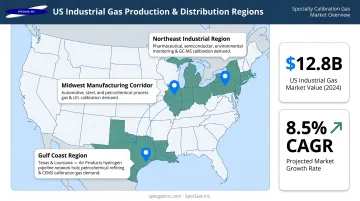
The manufacturers below represent a cross-section of that market. Whether you're sourcing bulk commodity gases or NIST-traceable calibration standards, the distinctions in gas type, purity grade, and volume requirements will determine which supplier fits your operation.
Top 10 Industrial Gas Manufacturers in the USA
These companies were selected based on U.S. market presence, product breadth, industry reputation, certifications, and the diversity of industries they serve.
1. Linde PLC (Linde Gas & Equipment, Inc.)
Linde is one of the world's largest industrial gas companies, operating in the U.S. through the combined Linde AG and Praxair network following their October 2018 merger. Their U.S. operations produce and distribute oxygen, nitrogen, argon, hydrogen, helium, acetylene, and specialty gases at scale.
Linde's engineering and procurement hub in Tonawanda, NY is among the largest in North America, supporting air separation, hydrogen, syngas plant engineering, and R&D. Linde Engineering has delivered more than 4,000 plants globally.
| Category | Detail |
|---|---|
| Product Range | Atmospheric gases, hydrogen, helium, specialty gases, gas mixtures, cryogenic liquids |
| Key Industries | Steel, electronics, healthcare, aerospace, chemicals, food & beverage |
| Key Differentiator | Largest U.S. industrial gas network; advanced cryogenic R&D capability |
2. Air Products & Chemicals, Inc.
Headquartered in Allentown, Pennsylvania, Air Products is a major U.S.-based industrial gas producer. Their portfolio spans hydrogen, helium, oxygen, nitrogen, and specialty gases for more than 30 industries.
Air Products is particularly strong in clean hydrogen and low-carbon energy initiatives, with a Gulf Coast hydrogen pipeline network it describes as the world's largest system of its kind. The company's Louisiana Clean Energy Complex produces low-carbon hydrogen and ammonia for Gulf Coast and global markets.
| Category | Detail |
|---|---|
| Product Range | Hydrogen, helium, nitrogen, oxygen, specialty gases, cryogenic equipment |
| Key Industries | Chemical production, refining, healthcare, electronics |
| Key Differentiator | U.S.-headquartered; leading position in clean hydrogen infrastructure |
3. Airgas USA, LLC
Airgas, an Air Liquide company since 2016, operates the largest U.S. distribution network in the packaged gas industry — more than 1,400 locations across all 50 states, including branches, fill plants, specialty gas labs, and production sites.
Their product portfolio covers industrial gases, specialty gases, hardgoods, safety products, and process chemicals. Gulf Coast and Great Lakes operations are particularly notable for heavy manufacturing and fabrication customers.
| Category | Detail |
|---|---|
| Product Range | Welding gases, oxygen, argon, nitrogen, CO₂, specialty gases, safety products |
| Key Industries | Metal fabrication, manufacturing, food & beverage, healthcare, aerospace |
| Key Differentiator | Nationwide U.S. distribution network backed by Air Liquide's global infrastructure |
4. Messer North America, Inc.
Messer is the world's largest privately held specialist for industrial, medical, and specialty gases. Their U.S. operations — Messer Americas — serve industrial, specialty, medical, and electronic gas customers across North America.
Messer's private ownership structure and European technical heritage give them depth in specialty gas applications while maintaining a sustainability-focused approach across chemical, electronics, and industrial markets.
| Category | Detail |
|---|---|
| Product Range | Industrial gases, specialty gases, medical gases, laser gases, electronic gases |
| Key Industries | Industrial manufacturing, chemicals, electronics, healthcare |
| Key Differentiator | World's largest privately held gas specialist; European-backed technical depth |
5. Matheson Tri-Gas, Inc. (Nippon Sanso Matheson)
Founded in North Bergen, NJ in 1927, Matheson is now part of Nippon Sanso Holdings Group — a parent with 300 group companies and approximately 20,000 staff worldwide. In the U.S., Matheson operates over 300 locations with more than 4,500 employees.
Matheson's standout capability is semiconductor-grade specialty gases. The company is an industry leader in production of high-purity electronic gases for semiconductor fabrication, research, and scientific applications.
| Category | Detail |
|---|---|
| Product Range | Industrial, specialty, medical, and electronic gases; hydrogen; onsite air separation |
| Key Industries | Semiconductor, electronics, scientific research, chemical manufacturing |
| Key Differentiator | Nearly 100-year U.S. history; leading position in electronic and specialty gases |

6. Norco, Inc.
Based in Boise, Idaho, Norco is one of the few large privately held industrial gas suppliers in the United States. With approximately 200 dedicated employees, they supply welding gases, safety products, medical gases, and industrial gases across the Western U.S.
Their regional focus translates into consistent service coverage across the Western U.S., making them a dependable option for industrial and medical customers who need a supplier with real local presence.
| Category | Detail |
|---|---|
| Product Range | Welding gases, medical gases, safety products, industrial gases |
| Key Industries | Welding & fabrication, healthcare, industrial operations |
| Key Differentiator | One of the few large privately held U.S. gas suppliers; strong Western regional service |
7. Universal Industrial Gases
U.S.-based Universal Industrial Gases produces, supplies, and distributes industrial gases — including oxygen, nitrogen, and argon — through a network of more than 400 operational plants. Their customized gas solutions are designed to maximize operational efficiency and uptime across complex industrial processes.
With 400+ plants distributed across the U.S., they can support manufacturers running multi-facility operations with consistent supply across locations.
| Category | Detail |
|---|---|
| Product Range | Oxygen, nitrogen, argon, critical process gases |
| Key Industries | Electronics, chemicals, glass, steel & metals, energy, petroleum |
| Key Differentiator | 400+ U.S. operational plants; customized solutions for complex industrial processes |
8. Holston Gases, Inc.
Headquartered in Knoxville, Tennessee, Holston Gases serves the U.S. Southeast with cylinder and bulk gases, industrial and welding supplies, and beverage-grade CO₂. With approximately 150 employees, they combine full-service supply with responsive regional support.
Small and mid-sized manufacturers, welding shops, and food & beverage producers in the Southeast will find Holston's local service model and full product range a practical fit.
| Category | Detail |
|---|---|
| Product Range | Cylinder gases, bulk gases, welding supplies, beverage-grade CO₂ |
| Key Industries | Manufacturing, welding & fabrication, food & beverage |
| Key Differentiator | Strong Southeast U.S. presence; full-service industrial and beverage gas supply |
9. Western International Gas & Cylinders, Inc.
Located in Bellville, Texas, Western International is a wholesale supplier of acetylene, compressed gases, and equipment for the South-Central U.S. With approximately 200 employees, they serve industrial customers — particularly welding and cutting operations — as an upstream supply source for distributors and end users alike.
| Category | Detail |
|---|---|
| Product Range | Acetylene, compressed gases, gas equipment and cylinders |
| Key Industries | Welding, cutting, industrial manufacturing |
| Key Differentiator | Wholesale-focused model; acetylene supply expertise in the South-Central U.S. |
10. Enterprise Products Operating, LLC
Based in Mont Belvieu, Texas, Enterprise Products Operating is a publicly traded midstream company with 500+ employees. Their pipeline network and gas processing infrastructure supply natural gas liquids, ethane, propane, and petrochemical gases to refineries and industrial facilities across the U.S.
| Category | Detail |
|---|---|
| Product Range | Natural gas, natural gas liquids, ethane, propane, petrochemical gases |
| Key Industries | Refining, petrochemicals, energy infrastructure, midstream |
| Key Differentiator | Integrated pipeline infrastructure; large-scale midstream and petrochemical gas supply |
How to Choose the Right Industrial Gas Supplier
The companies above were selected for U.S. market presence, product breadth, and industry reputation — not revenue alone. Buyers often default to the biggest brand name, which works fine for bulk atmospheric gases but creates real problems for specialty and calibration applications.
What to evaluate before choosing
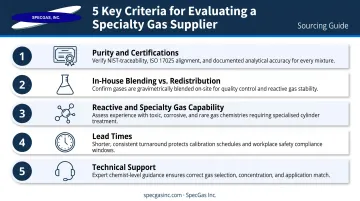
- Product purity and certifications — For calibration and emissions monitoring, NIST Traceable Gas Standards are non-negotiable. ISO 9001 and ISO/IEC 17025 lab accreditation are key quality indicators
- In-house blending vs. redistribution — Does the supplier actually blend your gas, or resell another company's product? That distinction directly affects lead times and flexibility
- Reactive and specialty gas capability — Can the supplier produce stable reactive mixtures at low PPM/PPB concentrations, or do they cap out at standard atmospheric blends?
- Lead times — Large manufacturers prioritize volume. For unusual mixtures or tight timelines, a dedicated specialty producer often outperforms the national chains
- Technical support — Does the supplier understand your application, or do they just fill cylinders?
Bulk vs. specialty: fundamentally different requirements
For bulk oxygen, nitrogen, or argon supply, scale and pipeline access matter most. Linde, Air Products, and Airgas have built decades of infrastructure to serve those needs efficiently.
Precision calibration gases, reactive toxic mixtures, and EPA Protocol-grade CEMS standards have a different set of requirements entirely:
- Dedicated blending expertise and rigorous analytical verification
- NIST traceability at low PPM/PPB concentrations
- Ability to produce difficult mixtures that large-scale producers can't prioritize
Specialty gas manufacturers are the practical choice for these applications — typically with faster lead times and more flexibility than the national chains.
Conclusion
The U.S. industrial gas market is served by a diverse mix of global manufacturers, regional distributors, and specialty producers. No single supplier is the best fit for every application. Bulk gas needs and precision specialty blending require fundamentally different capabilities — and choosing the wrong type of supplier creates purity problems, compliance gaps, and supply delays.
Evaluate any supplier against your actual requirements: application type, purity level, certification needs, delivery reliability, and technical support depth.
For calibration gas specifically — NIST-traceable standards, reactive gas mixtures, or custom specialty blends where large manufacturers often struggle with lead times or purity consistency — a dedicated specialty blender is the better fit. SpecGas Inc. has served research labs, distributors, and industrial clients since 2001. Founded by research chemist Alfred Boehm, whose specialty gas career began in Germany in 1976, SpecGas brings proprietary cylinder treatment technology and in-house blending expertise to produce stable reactive mixtures at concentrations from 300 PPB to 10%.
Reach out at (215) 443-2600 or website-inquiries@specgasinc.com for a quote or consultation.
Frequently Asked Questions
What is the difference between industrial gases and specialty gases?
Industrial gases like oxygen, nitrogen, and argon are produced in bulk for broad applications such as welding, manufacturing, and healthcare. Specialty gases are precision-blended, high-purity, or custom-formulated mixtures used in calibration, research, electronics, and specific processes where exact gas composition — often at parts-per-million or parts-per-billion levels — is critical.
Who is the largest industrial gas company in the United States?
Linde PLC — operating through its legacy Praxair and Linde Gas & Equipment network following their 2018 merger — holds the largest market position in the U.S. by production capacity and distribution reach. Air Products & Chemicals and Airgas (Air Liquide) follow closely behind.
What gases are most commonly produced by U.S. industrial gas manufacturers?
The principal gases are nitrogen, oxygen, argon, hydrogen, carbon dioxide, acetylene, and helium. Most major manufacturers also produce specialty and calibration gas mixtures for applications including emissions testing, semiconductor fabrication, and laboratory instrument analysis.
What certifications should I look for when choosing an industrial gas supplier?
For calibration applications, NIST Traceable Gas Standards are non-negotiable. ISO 9001 covers quality management, while ISO/IEC 17025 applies to testing and calibration laboratories. For emissions monitoring, EPA Protocol Gas certification and EPA PGVP compliance are critical, and DOT regulations (49 CFR 173.301) govern cylinder transport safety.
How do industrial gas companies ensure gas purity and quality?
Reputable producers use calibrated analytical instruments, gravimetric blending methods, rigorous accuracy verification, and certified reference standards to validate gas composition before delivery. For specialty and reactive mixtures, proprietary cylinder treatment processes also preserve mixture stability and extend shelf life.
Can a smaller specialty gas company serve needs that large industrial gas manufacturers cannot?
Yes. Large manufacturers prioritize volume and broad distribution, which often means longer lead times and limited flexibility for unusual mixtures or low-PPM reactive blends. Specialty producers with dedicated blending expertise can produce difficult-to-source calibration standards faster and with greater precision — and are often the only viable option for reactive gas mixtures at sub-PPM concentrations.