On March 25, 2026, EPA Administrator Lee Zeldin announced a nationwide emergency waiver allowing E15 fuel — gasoline blended with 15% ethanol — to be sold year-round starting May 1, 2026. With regular gasoline averaging $3.64 per gallon nationally in March 2026, the roughly 25-cent-per-gallon discount on E15 is genuinely tempting.
But whether that discount is a good deal depends entirely on what you drive.
This article covers what "gas dilution" actually means, why the EPA made this move, how E15 affects your engine and fuel economy, and which vehicles should never go near an Unleaded 88 pump.
TL;DR: Key Takeaways
- The EPA's emergency waiver allows nationwide E15 sales starting May 1, 2026
- E15 (sold as "Unleaded 88") typically costs 10–25 cents less per gallon than standard E10
- E15 is approved for model year 2001 and newer cars, trucks, and SUVs — and all flex-fuel vehicles
- E15 contains roughly 4–5% less energy than ethanol-free gasoline, so expect a slight MPG dip
- Never use E15 in motorcycles, boats, lawn mowers, chain saws, or pre-2001 vehicles
What Is Gas Dilution? Ethanol in Your Fuel Explained
"Gas dilution" sounds alarming, but it describes something that's been happening at every pump in America for decades. It's the deliberate blending of ethanol — an alcohol derived from corn — into conventional gasoline to extend fuel supply, reduce cost, and adjust octane rating. It is a regulated practice, not contamination.
Why Ethanol?
Ethanol is the dilutant of choice for a few practical reasons:
- Domestically produced — mostly from corn, reducing dependence on imported petroleum
- Oxygenate — helps fuel burn more completely, which reduces certain tailpipe emissions
- High octane — ethanol has a significantly higher octane rating than gasoline, so small additions raise the blend's overall rating without expensive refinery processes
The Ethanol Spectrum
Most drivers have only ever used ethanol-blended fuel without knowing it. The blend levels break down like this:
| Blend | Ethanol Content | Notes |
|---|---|---|
| E0 | 0% | Rare — more than 98% of U.S. gasoline contains ethanol |
| E10 | 10% | Current national standard at most pumps |
| E15 | 15% | What the 2026 waiver allows — sold as "Unleaded 88" |
| E85 | 85% | Only for flex-fuel vehicles |
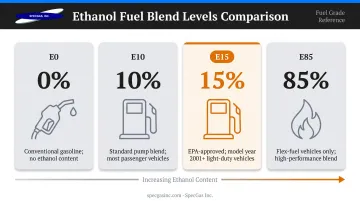
The jump from E10 to E15 is a modest 5-percentage-point increase, not a radical reformulation.
The Energy Trade-Off
Ethanol contains less energy per gallon than gasoline — and that difference is measurable at the pump. According to the EIA, E10 already delivers about 3% less energy than ethanol-free gasoline. E15 drops that to roughly 4–5% less, and that gap shows up directly in your fuel economy.
Ethanol also has material properties that matter beyond energy content:
- Hygroscopic — absorbs moisture from the air, which can promote corrosion in fuel systems
- Solvent action — slowly degrades rubber seals, O-rings, and certain plastics over time
- Compatibility gap — modern vehicles are engineered for ethanol blends; older engines and carbureted equipment are not
If your vehicle or equipment predates widespread E10 adoption, the move to E15 warrants a closer look at manufacturer guidance.
Why the EPA Is Allowing More Ethanol This Summer
The EPA's standard rules normally prohibit E15 sales from June 1 through September 15. The reason is chemistry: ethanol evaporates more readily than gasoline, and in summer heat, that extra volatility accelerates the formation of ground-level ozone (smog). Summer gasoline sold to consumers must meet Reid Vapor Pressure limits precisely to control this effect.
The 2026 emergency waiver suspends those summer restrictions entirely.
The Official Justification
EPA Administrator Zeldin acted under Clean Air Act authority, citing the need to fortify domestic fuel supply and provide relief at the pump. With regular gas at $3.64/gallon nationally in March 2026, expanding E15 availability creates a cheaper alternative fuel option at scale. The waiver also removes "boutique fuel" state requirements, establishing a single national fuel pool standard that simplifies distribution and reduces costs for retailers.
The Legislative Picture
This waiver is temporary, though it's part of a longer push toward permanent change. H.R. 1346, the Nationwide Consumer and Fuel Retailer Choice Act, passed the House and was received in the Senate on May 14, 2026. As of early June 2026, the bill remains pending in the Senate. If it passes, year-round E15 sales would become permanent law rather than a series of emergency waivers.
How E15 Affects Your Car's Performance and Fuel Economy
The MPG Math
The energy difference between E10 and E15 is real but modest. The Renewable Fuels Association puts E15 at about 1.5% less energy than E10 — meaning slightly more fill-ups to cover the same distance. At 25 cents per gallon cheaper, most drivers still come out ahead on cost, though the efficiency loss narrows that advantage.
The Octane Question
E15's 88 octane rating is genuine, but it only benefits you if your engine is tuned to use it. For a standard engine rated for 87-octane fuel, the engine management system won't take advantage of the extra octane — no power gain results. The bump matters only for high-compression or performance engines calibrated for premium fuel. For most drivers, the higher octane rating is irrelevant.
Fuel System Compatibility Over Time
For vehicles manufactured from 2001 onward, ethanol's solvent and hygroscopic properties are well-managed by fluoropolymer-lined fuel system components. These vehicles were designed and tested for ethanol-blended fuels, and the step from E10 to E15 is within their engineering tolerances.
Older vehicles — pre-2001 — lack these materials. Extended exposure to higher ethanol concentrations can gradually degrade fuel lines, O-rings, and carburetor components in these vehicles.
A Note for Emissions Testing Operations
E15 changes exhaust chemistry relative to E10, producing different profiles for CO, NOx, hydrocarbons, and oxygenated compounds. For fleet managers, emissions testing labs, and CEMS operators, a fuel composition shift at the fleet level is a reason to verify that your analyzers are properly calibrated. Following applicable calibration and verification procedures under 40 CFR Part 1065 — using NIST-traceable reference gas standards — ensures your measurements remain accurate when the fuel baseline changes.
SpecGas supplies NIST-traceable calibration gas mixtures for CO, CO₂, NOx, O₂, SO₂, hydrocarbons, and formaldehyde — available in disposable cylinders for field use and refillable high-pressure cylinders for lab applications. Our proprietary cylinder treatment process is especially relevant for reactive components like NO and SO₂, where long-term stability directly affects calibration accuracy.
Which Vehicles Should Avoid E15
The Clear "No" List
Per EPA guidance, these vehicle and equipment categories cannot use E15:
- All motorcycles (on-highway and off-road)
- All vehicles model year 2000 and older
- Heavy-duty engines — school buses, delivery trucks
- Nonroad equipment — lawn mowers, chain saws, leaf blowers, generators
- Nonroad vehicles — boats, personal watercraft, snowmobiles
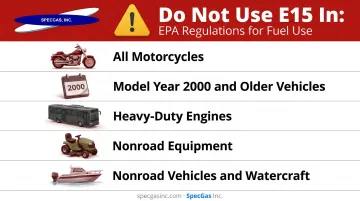
Carbureted engines and older fuel system materials cannot handle higher ethanol concentrations. Ethanol degrades seals and gums up carburetors — problems that show up as hard starting, rough idle, and accelerated wear.
The 2001 Cutoff and Why It Exists
The EPA's compatibility threshold isn't arbitrary. The agency conducted a fleet study that identified 2001 as the model year when fuel system materials and oxygen sensor capabilities consistently met the requirements for E15 use. Post-2001 vehicles have fluoropolymer-lined fuel systems and engine management systems capable of compensating for E15's different oxygen content.
Gray Areas Worth Checking
Even if your vehicle clears the 2001 threshold, check your owner's manual before filling up with Unleaded 88. Some manufacturers include explicit language limiting ethanol content to 10% maximum, regardless of EPA approval categories. Flex-fuel vehicles (FFVs) are the clear exception — they're engineered for blends up to E85 and have no compatibility concerns with E15.
What to Do at the Pump: Practical Guidance
Reading the Label
Unleaded 88 is E15. The "88" refers to its octane rating — not its ethanol percentage. Standard E10 is labeled 87. If you want to avoid E15, don't choose the 88 pump. Some stations also label it directly as "E15"; when in doubt, ask.
A Simple Decision Framework
Use E15 (Unleaded 88) if:
- Your vehicle is model year 2001 or newer
- Your owner's manual doesn't restrict ethanol above 10%
- You want to save money at the pump and accept a small MPG trade-off
Stick to E10 if:
- Your vehicle is model year 2000 or older
- You own a motorcycle, boat, or outdoor power equipment
- Your owner's manual specifies maximum 10% ethanol
Look for E0 if:
- You operate small engines regularly — some marinas and specialty stations carry ethanol-free gasoline for boats and outdoor equipment
The pump decisions above apply to drivers. For fleet managers and emissions compliance operations, the implications reach further. A fleet-wide shift to E15 changes the exhaust chemistry your analyzers are measuring — affecting CO, HC, and NOx readings at the sensor level. That's a practical reason to confirm your calibration and QA procedures are current, and that the reference gas standards you're using reflect the updated exhaust baseline your instruments will actually encounter.
Frequently Asked Questions
What is gas dilution?
Gas dilution is the intentional blending of a non-petroleum additive — most commonly ethanol — into conventional gasoline to extend fuel supply, reduce cost, and adjust octane rating. It is a regulated practice, not contamination or adulteration.
What does mixing 87 and 93 gas do?
Mixing 87-octane regular and 93-octane premium produces a blend with an intermediate octane rating proportional to the mix: a 50/50 blend yields approximately 90 octane. Harmless in most cases, but pointless unless your engine actually requires that octane level.
Is E15 safe for my car?
E15 is EPA-approved for conventional gasoline vehicles from model year 2001 and newer, and all flex-fuel vehicles. Older vehicles, motorcycles, and off-road equipment should not use it due to fuel system compatibility issues.
What is Unleaded 88?
Unleaded 88 is the pump label for E15. The "88" refers to its octane rating , not its ethanol content. It contains 15% ethanol and 85% gasoline, and is typically priced lower than standard 87-octane E10.
Does E15 actually save you money?
E15 is typically 10–25 cents cheaper per gallon than E10, but it contains less energy, so fuel economy drops slightly and you burn more gallons to cover the same distance. Whether it saves money depends on the price gap at your pump and your vehicle's actual efficiency loss.
Why does the EPA normally ban E15 in summer?
Ethanol evaporates more readily than gasoline, and in summer heat, the extra volatility in E15 accelerates ground-level ozone (smog) formation. The EPA's standard rule restricts E15 sales from June 1 through September 15 to limit this effect. The 2026 emergency waiver temporarily suspended that restriction.