Introduction
The MSA ALTAIR 4 series—comprising the Altair 4, 4X, 4XR, and io 4—represents a family of portable 4-gas monitors engineered to detect LEL (Lower Explosive Limit), carbon monoxide (CO), hydrogen sulfide (H2S), and oxygen (O2) in hazardous environments. These devices are deployed daily in confined spaces, industrial refineries, wastewater treatment plants, and petrochemical facilities where exposure to combustible gases, toxic vapors, or oxygen-deficient atmospheres poses life-threatening risks.
Electrochemical and catalytic sensors drift over time due to contaminant exposure, temperature fluctuations, humidity, and natural aging. Research shows electrochemical sensors can drift by up to 20% after just 9 months of continuous operation, making regular calibration essential to prevent false negatives or dangerous false alarms.
Skipping calibration—or using expired, incorrect, or non-NIST-traceable gas—puts workers at risk and puts your organization out of compliance with OSHA 29 CFR 1910.146 and standards like CSA C22.2 No. 152.
Key Takeaways
- MSA recommends calibration every 6 months minimum; high-risk sites need monthly or daily intervals
- Standard mix: 1.45% CH4 (LEL), 60 ppm CO, 20 ppm H2S, 15% O2 in nitrogen
- Full calibration requires both a zero (fresh air) and a span (known gas) step
- Bump tests check sensor response but do not substitute for full calibration
- Use fresh, NIST-traceable calibration gas in a clean environment every time
Why Calibrating Your MSA 4 Gas Monitor Matters
Gas detector sensors degrade predictably. Catalytic bead LEL sensors suffer poisoning from volatile silicones, halogenated hydrocarbons, and sulfide gases, while electrochemical cells drift due to temperature swings, humidity, and airborne particulates. An uncalibrated monitor may fail to alarm when gas concentrations exceed safe thresholds or trigger false alarms that disrupt operations and erode worker confidence in safety equipment.
The consequences of skipping calibration are well-documented. In 2022, two workers died in a sewer manhole after failing to conduct required atmospheric testing. When readings are off by even 10–15%, the gap between an early warning and a missed alarm can be seconds — enough to prevent evacuation or rescue.
Federal regulations reinforce this urgency. Key compliance requirements include:
- OSHA 29 CFR 1910.146 mandates "calibrated direct-reading instruments" for confined space entry
- The 2013 OSHA Safety and Health Information Bulletin recommends bump testing or calibration before each day's use
- Undocumented calibration records expose organizations to citations, fines, and liability during incident investigations
Beyond safety and compliance, scheduled calibration extends sensor life by catching degradation before field failure. That said, the calibration gas itself matters as much as the process. Incorrect or expired gas produces unreliable results regardless of how carefully you follow the procedure. NIST-traceable standards with verified concentration accuracy are the baseline requirement — a reason why safety teams sourcing reactive mixtures like H2S and CO often turn to specialty blenders like SpecGas Inc., whose proprietary cylinder treatment process is specifically designed to maintain stability in those gases over time.
Types of Calibration for the MSA 4 Gas Monitor
The MSA 4 Gas Monitor uses four distinct calibration procedures. Knowing which one to apply — and when — keeps your equipment compliant and your readings accurate.
Bump Test (Functional Check)
A bump test applies a brief exposure of calibration gas to verify that sensors respond and alarms trigger. It confirms the display updates, audible and vibration alarms activate, and gas is detected — but it does not adjust sensor span values. MSA and consensus standards like NFPA 350 recommend bump testing before each use, especially in high-risk or confined space applications.
Zero Calibration
Zero calibration resets the sensor baseline to fresh air (clean ambient air with approximately 20.9% O2 and no target gases). This step must be performed in a genuinely fresh-air environment, free of hazardous gases, dust, or vapors. It is always the first step in a full calibration sequence and establishes the sensor's "zero" reference point.
Span Calibration
Span calibration applies a known concentration of calibration gas to the sensor and adjusts the sensor's response curve to match the certified gas value. Upon completion, the device displays SPAN PASS or SPAN FAIL. A SPAN FAIL result means the sensor could not be corrected to within acceptable tolerance — requiring sensor replacement or service before the monitor is returned to service.
Full / Scheduled Calibration
A full calibration combines zero calibration and span calibration in sequence. This is the standard scheduled calibration required by MSA guidelines and most regulatory frameworks. Results should be logged with date, gas values, and pass/fail status for compliance documentation.
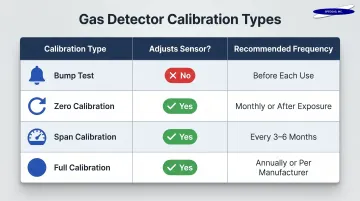
| Calibration Type | Adjusts Sensor? | Frequency |
|---|---|---|
| Bump Test | No | Before each use |
| Zero Calibration | Baseline only | Before span cal / as needed |
| Span Calibration | Yes | Per schedule or after exposure |
| Full Calibration | Yes (both steps) | Per MSA / regulatory schedule |
Step-by-Step Guide to Calibrating the MSA 4 Gas Monitor
Before starting, gather everything you need. A complete setup prevents interruptions mid-process and ensures each calibration phase runs cleanly.
Required Equipment:
- Calibration gas cylinder with certified gas mix: 1.45% CH4 (≈58% LEL on Pentane curve), 60 ppm CO, 20 ppm H2S, 15% O2 in nitrogen — sourced from a NIST-traceable supplier like SpecGas Inc. to confirm certified concentrations are accurate and shelf-stable
- Fixed-flow regulator set to 0.25 L/min (per the MSA Altair 4X R operator manual)
- Calibration adapter/cap compatible with the Altair 4 sensor port
- Tubing to connect regulator to calibration cap
Pre-Calibration Environment Check:
- Confirm you are in a fresh-air area with no hazardous gases, vapors, or contaminants present
- Turn the monitor on and allow it to complete its self-diagnostic routine
- Check the display for low battery or sensor error warnings before proceeding
Once the environment check passes and no errors appear, enter calibration mode. The steps differ slightly depending on your model.
Entering Calibration Mode:
- Altair 4/4X/4XR: Press and hold the UP arrow button for approximately 3 seconds until the ZERO CAL screen appears
- Altair io 4: Navigate to the calibration menu option using the device's menu-based interface
Zero Calibration Step:
- Confirm zero calibration is initiated in fresh air by pressing the center/confirm button
- Wait for ZERO PASS to appear before proceeding
- On the io 4, the O2 sensor is span-calibrated to approximately 20.8% during this phase
With zero calibration confirmed, the device will prompt you to begin span calibration — the step where calibration gas is applied.
Span Calibration Step:
- When the device prompts SPAN CAL?, attach the calibration cap securely to the front sensor port
- Connect tubing from the cap to the regulator
- Open the regulator valve to release gas at 0.25 L/min
- Monitor the screen as gas concentrations rise toward cylinder-labeled values
- Wait for SPAN PASS confirmation before closing the gas valve and removing the calibration cap
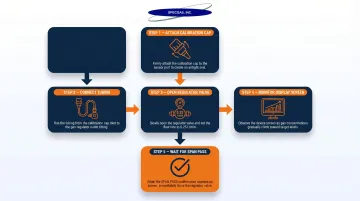
After SPAN PASS appears, complete the following steps to close out the calibration properly.
Post-Calibration Steps:
- Turn off the gas valve and detach the calibration cap
- Allow the monitor to return to normal reading mode
- Record the calibration date, gas values used, and pass/fail status in a calibration log
- Use the device's configurable CALDUE setting to schedule and track the next calibration date
MSA 4 Gas Monitor Calibration Schedule
Calibration frequency varies by jurisdiction, industry, and site-specific safety programs. MSA recommends calibration at least every six months, though many worksites and regulatory bodies require more frequent intervals.
The Altair 4X/4XR lets you configure the CALDUE interval anywhere from 1 to 180 days in device settings — useful for aligning the monitor's reminders with your site's actual requirements.
Calibration Frequency Reference:
- Before each use: Bump test in high-risk or confined space entry scenarios (recommended by OSHA, MSA, and NFPA 350)
- After sensor exposure: Full calibration after exposure to high gas concentrations or chemical contamination
- After physical damage or submersion: Full calibration required
- After long storage periods: Full calibration before returning to service
- Minimum every 6 months: Scheduled full calibration per MSA guidelines
How often you calibrate in practice depends on how frequently the monitor is deployed. Here's how the two main use patterns differ:
| Use Pattern | Bump Testing | Full Calibration |
|---|---|---|
| Continuous use (daily confined space work) | Daily | Monthly |
| Intermittent use (occasional deployment) | Before each use | Every 6 months |
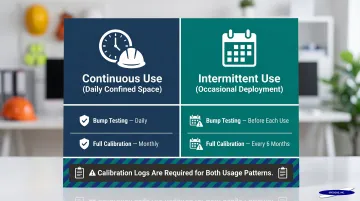
Calibration logs must be maintained regardless of frequency — regulators and site safety programs will expect documentation either way.
When Calibration Fails: What to Check
A SPAN FAIL result does not automatically mean the sensor has reached end-of-life. Common causes include:
- Check that the calibration gas cylinder has sufficient remaining pressure
- Confirm the cylinder hasn't passed its expiration date
- Reseat the calibration cap firmly to prevent gas leakage
- Match the gas concentration in the device's setup menu to the cylinder label exactly
- Move to a different location if background contamination may be affecting results
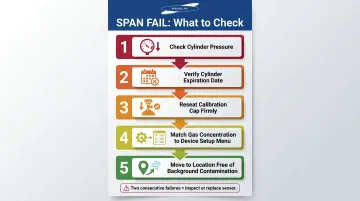
A failed zero calibration usually points to background gas contamination in the area or a sensor that has drifted beyond the adjustment range. Try a different location before concluding the sensor has failed.
If two consecutive calibrations fail on the same sensor, the MSA Altair io 4 will issue an end-of-sensor-life warning. On the Altair 4/4X/4XR, back-to-back failures should prompt you to inspect or replace the sensor using MSA's designated replacement part numbers.
Conclusion
Regular, properly performed calibration is not optional—it is the only way to ensure the MSA 4 Gas Monitor provides accurate, life-safety readings in the field. Calibration quality depends equally on the procedure and the calibration gas used. Accurate, stable, NIST-traceable calibration gas with verified concentrations is essential to every successful calibration.
That's where the calibration gas source matters. SpecGas Inc. produces precision multi-gas calibration blends with proven stability for reactive mixtures, backed by:
- Proprietary cylinder treatment that keeps H2S and CO stable at low ppm concentrations for longer shelf life
- NIST-traceable standards with verified concentrations for every blend
- Faster lead times than typical industry turnaround, including rush service when needed
- Cost-effective cylinder deposit program as an alternative to rental arrangements
For safety managers who need reliable results and regulatory compliance, the calibration gas is just as critical as the procedure itself.
Frequently Asked Questions
How often should an MSA Altair 4X/4XR 4-gas monitor be calibrated?
MSA recommends calibration at least every 6 months, but site safety programs, jurisdictional regulations, and high-risk environments often require more frequent calibration, monthly or daily in continuous-use confined space operations. A bump test is recommended before each use to confirm functionality.
What calibration gas should be used for the MSA Altair 4X/4XR?
The standard calibration gas mix is 1.45% CH4 (methane), 60 ppm CO, 20 ppm H2S, and 15% O2 balanced in nitrogen. The gas must match the certified values entered in the device's calibration setup and must be unexpired with verified NIST traceability.
How long is MSA calibration gas good for?
Calibration gas cylinders typically have a shelf life of 12–36 months depending on the gas mixture and cylinder type. Reactive gases like H2S degrade faster, often 19–24 months, while non-reactive gases like CH4 and CO can last up to 60 months. Check the expiration date on the cylinder label before every calibration.
What are the four types of calibration?
The four types relevant to gas detection are:
- Bump test — confirms sensors respond and alarms trigger
- Zero calibration — resets the sensor baseline in fresh air
- Span calibration — adjusts sensor response to a known gas concentration
- Full calibration — the complete zero-plus-span sequence performed on a scheduled basis
What is the difference between a bump test and a full calibration?
A bump test confirms the sensor responds and alarms function but does not adjust the sensor reading. A full calibration verifies and corrects sensor accuracy against a known gas concentration; both are required. OSHA recommends bump testing before each use and full calibration on a scheduled interval.
What should I do if my MSA Altair 4 fails calibration?
First, check the calibration gas cylinder for expiration, pressure, and correct mix. Verify the calibration cap is properly seated and the calibration environment is free of background gas. Retry the calibration. If failure persists after two attempts, inspect the sensor for damage or end-of-life condition and replace if necessary.