That assumption is where problems start.
For process operators, GC calibration technicians, and CEMS compliance teams, composition isn't incidental — it's the upstream variable that determines every downstream result. This article breaks down what natural gas actually contains, how and why it varies, which properties it governs, and what happens when composition drifts from specification.
Key Takeaways
- Natural gas is predominantly methane (87–97% by mole), with ethane, propane, CO₂, nitrogen, and trace gases forming the remainder
- Composition is not fixed — it varies by source basin, processing depth, and delivery point
- Heating value, Wobbe Index, specific gravity, and flammability limits are all direct functions of mixture composition
- Pipeline quality specifications set enforceable bounds on CO₂, H₂S, water, and oxygen content — tolerances that are far too wide for calibration use
- Treating pipeline average composition as a calibration reference introduces documented error and measurable compliance risk
What Mixture Composition Represents in Natural Gas
Natural gas mixture composition is the molar percentage of each component present in the gas stream. That percentage is both a design specification and a quality parameter — it determines how the gas behaves in every system it enters.
The primary components of pipeline-quality natural gas are:
- Methane (CH₄) — dominant hydrocarbon, primary energy source
- Ethane (C₂H₆) and propane (C₃H₈) — higher-alkane fractions that increase BTU content
- Butane (C₄H₁₀) — present in small quantities in pipeline gas
- Carbon dioxide (CO₂) and nitrogen (N₂) — inert diluents that reduce heating value
- Oxygen (O₂) and water vapor — controlled to prevent corrosion and hydrate formation
- Hydrogen sulfide (H₂S) and helium — trace components with specific regulatory limits
Why Small Shifts Matter
Composition functions as both an energy variable and a performance constraint. Methane drives base combustion output, while ethane and propane each carry significantly more BTU per cubic foot.
According to EIA data, methane yields approximately 1,010 Btu/cf, ethane 1,770 Btu/cf, and propane 2,516 Btu/cf. Inert components (N₂, CO₂) dilute that energy content proportionally.
A 2% shift in ethane fraction changes the gas's gross calorific value measurably. In BTU billing or CEMS calibration, that shift becomes a systematic error.
That variability extends upstream as well. Raw wellhead gas and pipeline-quality gas are compositionally different categories — processing removes water vapor, H₂S, and heavy hydrocarbons to meet transmission specifications. What arrives at a calibration lab or industrial facility has already passed through that processing, but its exact composition still varies by source, season, and supply routing.
Factors That Cause Natural Gas Composition to Vary
Source Basin Geology
The geological formation where gas originates determines its base C2+ (ethane-plus) fraction. A peer-reviewed national mapping study published in PMC found significant regional differences in produced gas:
| Basin | Methane (mol%) | Ethane (mol%) | Propane (mol%) |
|---|---|---|---|
| Appalachian Basin | 89.50 ± 0.12% | 5.32% | 1.21% |
| Gulf Coast Basin | 78.82 ± 0.71% | 11.21% | — |
| Southwestern Marcellus | 87.7% | 5.88% | 2.02% |
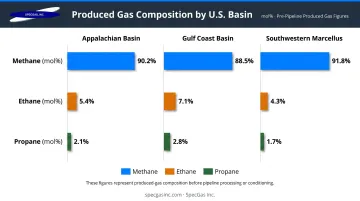
These are produced-gas figures — not delivered pipeline values. After processing, methane concentrations rise substantially. The EPA states pipeline-quality natural gas is 95–98% methane; the DOE characterizes it as more than 90% methane. The gap between wellhead and pipeline delivery reflects what processing removes.
Processing Depth and Ethane Rejection
NGL (natural gas liquids) extraction directly controls how much ethane remains in the pipeline stream. The EIA notes that plant operators can leave ethane in dry pipeline-quality gas when ethane prices are low relative to natural gas — a purely commercial decision that shifts the methane-to-ethane ratio with no change in geology.
The practical result: two cylinders labeled "pipeline natural gas" from different supply points in the same month can carry meaningfully different ethane fractions. For applications that depend on a fixed composition, this variability matters before the cylinder even leaves the processing plant. Key scenarios where ethane rejection affects downstream use include:
- BTU and Wobbe Index calculations — residual ethane raises heating value above assumed pipeline norms
- Hydrocarbon calibration standards — a fixed-composition RGA or BTU reference standard may not match the actual pipeline gas being measured
- Combustible gas detector calibration — LEL readings shift when the balance gas composition differs from the calibration gas blend
Compositional Ranges: Typical Values and Allowable Limits
Nominal Composition Under Pipeline Specification
Pipeline-quality natural gas falls within generally accepted component ranges for dry, processed gas at standard conditions (typically 60°F and 14.73 psia). While GPA 2145 and ASTM D1945 define the analytical framework, the operational benchmarks most commonly referenced are:
| Component | Typical Range (mol%) |
|---|---|
| Methane (CH₄) | 87–97% |
| Ethane (C₂H₆) | 1.5–7% |
| Propane (C₃H₈) | 0–1.5% |
| CO₂ | 0–1% |
| Nitrogen (N₂) | 0.5–2% |
| Butane, pentane, O₂, H₂O | Trace quantities |
These ranges describe processed, dry gas. Wet wellhead gas will show far higher C₂+ fractions and must be treated as a separate compositional category.
Allowable Tolerance and Boundary Limits
Pipeline quality specifications set enforceable upper limits on components that cause corrosion, hydrate formation, or combustion anomalies. Actual FERC tariff values from filed pipeline specifications include:
- CO₂: Maximum 2–3% by volume (Sierrita Gas Pipeline: 3.0%; NGPL: 2.0%; Tennessee Gas: 2.0% delivery / 3.0% receipt)
- H₂S: Maximum 0.25 grain/100 scf across multiple pipeline tariffs
- Water vapor: Maximum 7 lb/MMscf at standard conditions
- Oxygen: Maximum 0.2% by volume (some tariffs as low as 10 ppm)
- Minimum heating value: 950–967 Btu/ft³ depending on pipeline
Calibration vs. Pipeline Tolerance
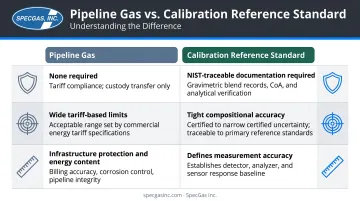
Pipeline specifications are designed to protect infrastructure and ensure commercial energy content — not to serve as precision calibration standards.
Certified reference gas mixtures used for GC calibration or CEMS verification require component concentrations traceable to NIST reference standards, with documented uncertainty values on each component. The tolerance window for a calibration reference mixture is far narrower than a pipeline tariff allows — because in calibration, the gas is the measurement standard, not just a fuel supply.
Key distinctions between pipeline gas and calibration reference standards:
- Traceability: Calibration mixtures require documented NIST-traceable uncertainty; pipeline tariffs do not
- Tolerance window: Calibration standards hold tighter compositional accuracy than pipeline specification limits
- Purpose: Pipeline specs protect infrastructure and energy content; calibration standards define measurement accuracy
Key Properties Governed by Natural Gas Composition
Natural gas composition directly governs three properties that affect everything from custody transfer metering to burner performance: heating value, specific gravity, and flammability limits.
Heating Value and Wobbe Index
Gross calorific value (GCV) is a direct function of component ratios. Because ethane and propane carry roughly 75% and 150% more BTU content per cubic foot than methane respectively, even modest shifts in C₂+ fractions change the energy content of the delivered gas stream.
The Wobbe Index — defined as heating value divided by the square root of specific gravity — is the critical interchangeability parameter for burner applications. It determines whether one gas mixture can substitute for another without re-tuning combustion equipment.
A composition shift that changes both heating value and specific gravity simultaneously can push the Wobbe Index outside acceptable interchangeability bounds, causing flame instability or incomplete combustion even when the gas otherwise meets pipeline quality specs.
GPA 2172-25 provides the calculation procedures for GCV, relative density, and compressibility from composition at defined base conditions — the standard method for deriving these values from a certified composition.
Specific Gravity and Density
Specific gravity is the molar-mass-weighted average of all components relative to air. Methane, with a specific gravity of approximately 0.554, is lighter than air. Heavier hydrocarbons (ethane ~1.038, propane ~1.522) increase the mixture's effective density.
This matters operationally because:
- Orifice metering (per API MPMS Chapter 14.3.3 / AGA Report No. 3) uses density as a direct input to flow calculations
- Compressor sizing assumes a design-basis specific gravity
- Pressure drop calculations through distribution piping are gravity-sensitive
A composition shift that increases specific gravity by even a few percent propagates into metering error without triggering any visible alarm.
Flammability Limits and Combustion Behavior
According to NOAA CAMEO data, pure methane has a lower explosive limit (LEL) of 5% and upper explosive limit (UEL) of 15%, with an autoignition temperature of 1,004°F.
For a natural gas mixture, these limits are composites of each component's individual limits:
- Adding CO₂ or N₂ (inerts) narrows the flammability range — the inerting effect is documented in NIST-referenced literature on flammability limits for methane with CO₂, N₂, and water vapor as diluents
- Adding higher hydrocarbons (ethane, propane) widens the flammable range and lowers autoignition temperatures
Ignition temperature, flame velocity, and the CO-to-CO₂ ratio in combustion products are all composition-dependent. For emissions monitoring, the combustion chemistry being measured reflects the actual gas composition — not what was assumed during calibration. This is why calibration gas standards for CEMS and stack emissions work must match the composition profile of the process gas being analyzed, not just a generic methane standard.
How Natural Gas Composition Is Specified, Measured, and Validated
Specification and Documentation Standards
Natural gas composition is formally characterized through a defined set of standards:
- ASTM D1945 — standard GC method for chemical composition analysis of natural gases
- GPA 2166-22 — sampling procedures for obtaining representative vapor-phase composition from flowing gas streams
- ISO 6974-1:2012 — guidelines for GC analysis and data processing for natural gas component determination
- GPA 2172-25 — calculation of gross heating value, relative density, and compressibility from composition
For certified reference gas mixtures, documentation must include a certificate of analysis with stated component concentrations, analytical uncertainty values, and traceability to NIST or equivalent national metrology standards.
Measurement and Verification Methods
Gas chromatography (GC) is the primary method for compositional analysis, both in field process GCs and laboratory bench instruments. Two detector types work in tandem to cover the full spectrum:
- Flame ionization detection (FID) — quantifies hydrocarbon components
- Thermal conductivity detection (TCD) — measures inerts such as nitrogen and CO₂
Together, they provide complete compositional coverage for pipeline gas applications.
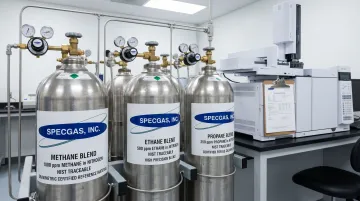
GC accuracy depends entirely on the quality of the calibration reference. Certified reference gas mixtures with NIST-traceable compositions (such as those produced by SpecGas Inc.) tie GC output to documented, defensible measurement uncertainty. SpecGas blends hydrocarbon calibration standards — including methane, ethane, and propane components — gravimetrically, with NIST traceability, and produces custom BTU and RGA (Refinery Gas Analysis) standards matched to specific application requirements.
The EPA's Protocol Gas Verification Program (PGVP) exists specifically to ensure that calibration gases used in 40 CFR Part 75 CEMS applications meet the accuracy requirements that make CEMS data legally defensible.
What Happens When Composition Deviates from Specification
The Propagation Problem
Because heating value, specific gravity, Wobbe Index, and flammability limits are all composition-dependent, any deviation from assumed composition propagates through every downstream calculation that depends on those properties. A single composition error reaches every measurement that relies on it.
Specific failure modes include:
- CEMS calibration error — an emissions monitoring system calibrated to a different composition than the actual process gas will systematically underreport or overreport CO₂, NOx, or methane concentrations
- BTU billing error — custody transfer meters calculate energy content from composition; a wrong assumed composition produces wrong invoices
- Flame instability — combustion systems optimized for a specific Wobbe Index experience incomplete combustion or flame blowout when the mixture shifts
- Metering error — orifice meters using an incorrect specific gravity assumption produce volumetric flow errors that compound over time
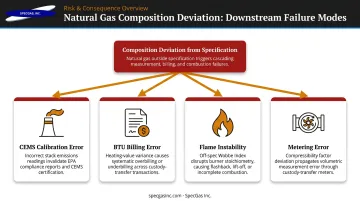
Each of these failure modes carries a compliance dimension that goes beyond instrument accuracy.
Compliance Implications
EPA Method 18 and 40 CFR Part 75 CEMS requirements mandate traceable reference standards. Using an incorrectly specified calibration gas (even one that otherwise meets nominal pipeline quality ranges) can constitute a compliance failure independent of instrument performance. The EPA's Protocol Gas Verification Program exists precisely because calibration gas quality is a documented compliance variable that regulators treat with the same rigor as instrument performance.
One common misinterpretation: treating published pipeline average composition data as a fixed, universal calibration reference. Pipeline averages are statistical composites across a distribution network — they vary by location, season, and supply routing. EIA data shows that 2023 Texas dry gas heat content averaged 1,018 Btu/cf, 1.7% below the national average of 1,036 Btu/cf. That gap is a systematic regional difference, not noise, and it matters when calibrating against an assumed national average.
A second error is dismissing sub-1% shifts in CO₂ or N₂ as analytically insignificant. Even small inert fraction changes alter heating value calculations and can push a Wobbe Index outside interchangeability tolerance. GPA 2172 is the standard calculation route for quantifying exactly how much.
Frequently Asked Questions
What is the mixture of natural gas?
Natural gas is predominantly methane — typically 87–97% by mole for pipeline-quality gas — with ethane, propane, butane, CO₂, nitrogen, and trace gases comprising the rest. Exact composition varies by source basin and processing method.
How does natural gas composition vary by source?
Different geological basins yield different C₂+ fractions and inert levels. Gulf Coast produced gas can carry over 11% ethane while Appalachian Basin gas runs closer to 5% — and processing depth or ethane rejection economics shift that further before it reaches the pipeline.
What is the typical methane content of pipeline natural gas?
The EPA characterizes pipeline-quality natural gas at 95–98% methane; the DOE states it is more than 90% methane. The spread reflects differences in processing depth, source basin, and regional pipeline specifications.
Why does composition matter for emissions monitoring?
Emissions monitoring equipment is calibrated against reference gas mixtures of known composition. If the actual process gas composition differs from the calibration reference, all measurements carry systematic error — which affects both data quality and regulatory compliance.
What is a NIST-traceable natural gas calibration gas mixture?
It is a precisely blended gas mixture with certified component concentrations traceable to NIST reference standards, used to calibrate gas chromatographs and combustion analyzers. Traceability makes measurement results defensible under EPA and other regulatory frameworks.
How is natural gas composition measured?
Gas chromatography per ASTM D1945 or ISO 6974 is the standard method, using FID for hydrocarbons and TCD for inerts. Results are validated by running certified reference gas standards through the same GC to verify instrument response against a known composition.