The global industrial gases market was valued at $94.03 billion in 2024 and is projected to reach $126.53 billion by 2030, growing at 5.1% annually. That scale reflects just how many industries depend on these materials.
This article covers what industrial gases are, the main types and their properties, and the key application areas where they're used—including some less obvious ones like calibration and emissions monitoring.
Key Takeaways
- Industrial gases span oxygen, nitrogen, argon, CO₂, hydrogen, helium, acetylene, and rare/specialty gases
- Major application areas include metal fabrication, healthcare, food processing, electronics, and environmental monitoring
- Purity and gas grade matter enormously—medical, food-contact, and semiconductor applications each require different specifications
- Calibration gases underpin regulatory compliance across workplace safety, emissions monitoring, and air quality
- NIST-traceable precision blends from specialty manufacturers like SpecGas meet the exact concentration and stability requirements that regulated industries demand
What Are Industrial Gases? Common Types and Examples
Industrial gases are manufactured and supplied at scale for use in industrial, commercial, and scientific processes. They differ from atmospheric air in that they're deliberately produced, separated, purified, or blended to defined specifications. Depending on the application, they're delivered as compressed gas in cylinders, as cryogenic liquids, or dissolved in solution.
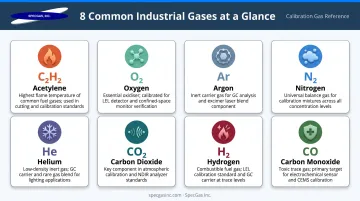
The European Industrial Gases Association (EIGA) classifies the main product families as air gases, rare gases, hydrogen, CO, CO₂, N₂O, chlorine, HCl, SO₂, acetylene, methane, and propane — the gases covered in the table below represent the most widely used across industry.
The Most Common Industrial Gases
| Gas | Symbol | Key Industrial Property |
|---|---|---|
| Oxygen | O₂ | Highly reactive; supports combustion and oxidation |
| Nitrogen | N₂ | Inert; displaces oxygen to prevent reactions |
| Argon | Ar | Chemically inactive; ideal shielding gas |
| Carbon Dioxide | CO₂ | Soluble in liquids; suppresses microbial growth |
| Hydrogen | H₂ | High energy density; reduces metal oxides |
| Helium | He | Extremely low boiling point (−268.93°C); inert |
| Acetylene | C₂H₂ | Burns at ~5,720°F—the hottest common fuel gas |
| Rare gases | Ne, Kr, Xe | Extremely inert; emit specific light wavelengths |
Hazard Categories to Know
Three broad hazard categories govern how industries handle these gases:
- Toxic gases (CO, H₂S, HCN) — dangerous at low concentrations; require continuous monitoring
- Corrosive gases (ammonia, HCl, Cl₂) — attack equipment, tissues, and cylinder materials
- Combustible gases (acetylene, propane, methane) — ignition risk in fabrication and processing environments
OSHA regulations cover compressed gas cylinders, portable tanks, rail tankcars, and cargo tanks, mandating inspection protocols and safe maintenance practices for each hazard category.
Manufacturing, Welding, and Metal Fabrication
Welding and metal cutting represent one of the largest end-uses of industrial gases globally. The specific gases used—and their purity levels—directly determine the quality of finished metal.
Shielding Gases in Welding
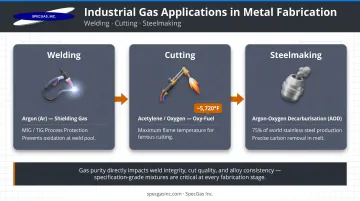
In MIG (GMAW) and TIG (GTAW) welding, argon serves as the primary shielding gas. It's chemically inactive, which means it protects the weld pool from atmospheric oxygen and nitrogen that would otherwise introduce porosity and weaken the joint. For TIG welding, argon is sometimes blended with helium for applications requiring deeper penetration.
Beyond shielding, gases also drive the cutting process itself:
- Oxygen supports the high-temperature combustion in oxy-fuel cutting, enabling clean cuts through thick steel sections
- Acetylene burns at approximately 5,720°F — roughly 600°F hotter than propane — making it the preferred fuel for cutting heavy plate in shipbuilding, construction, and automotive manufacturing
- Propane offers a lower-cost alternative for less demanding cutting applications where extreme heat isn't required
Nitrogen in Laser Cutting and Heat Treatment
Nitrogen's inertness makes it valuable in laser cutting and heat treatment. As an assist gas in laser cutting, nitrogen prevents oxidation of cut edges, producing cleaner surfaces that require less post-processing. In powder metallurgy and furnace heat treatment, nitrogen serves as the base atmosphere gas, often supplemented with hydrogen for specific reduction reactions.
Gases in Steel Production
These same atmospheric control principles extend into steelmaking, where gases operate at a much larger scale:
- Oxygen enrichment in blast furnaces increases combustion intensity and reduces coke consumption
- Argon-oxygen decarburization (AOD) is used to produce over 75% of the world's stainless steel, achieving carbon control down to 0.01% and desulfurization below 0.001%
Purity standards are non-negotiable across all these applications. Research in the International Journal of Industrial Engineering found that CO₂ shielding gas purity directly affects weld joint quality in metal active gas processes — contaminated shielding gas introduces defects that often go undetected until a part fails in service.
Healthcare and Medical Applications
Healthcare relies on several industrial gases, each held to strict purity standards that differ from industrial-grade specifications.
Oxygen and Common Clinical Gases
Medical oxygen is the most widely recognized healthcare gas, used in respiratory therapy, emergency medicine, and surgical anesthesia. The FDA references the USP monograph requirement: medical oxygen must contain not less than 99.0% O₂ by volume — a specification entirely separate from industrial-grade oxygen.
Other gases play equally specific roles in clinical settings:
- Helium — cools superconducting MRI magnets to approximately 4.2 K; traditional systems require several hundred to several thousand liters of liquid helium
- Carbon dioxide — used in laparoscopic surgery to insufflate body cavities at 10–15 mmHg, giving surgeons a clear operative field
Medical Laser Applications
Excimer laser gas mixtures serve several medical applications. The ablation process around the 200 nm wavelength range enables high-precision tissue removal with minimal thermal damage to surrounding tissue.
Clinical uses include:
- LASIK and PRK vision correction surgery (ArF at 193 nm)
- Dermatological phototherapy for conditions like vitiligo and psoriasis (KrF at 248 nm)
SpecGas produces KrF and ArF excimer laser gas mixtures specifically for these applications, with custom blends available for both surgical and phototherapy uses.
Food and Beverage Processing
Industrial gases enter the food supply chain at multiple points—from packaging lines to freezing tunnels—and food-contact applications carry strict purity requirements of their own.
Modified Atmosphere Packaging (MAP)
MAP is the formal technique behind nitrogen-flushed snack bags and CO₂-modified meat packaging. By replacing or adjusting the gas atmosphere inside sealed packaging, manufacturers slow respiration, inhibit microbial growth, and extend shelf life without preservatives.
Common MAP gas combinations:
- Nitrogen — displaces oxygen to prevent oxidation and rancidity in snacks and dry goods; affirmed as GRAS under 21 CFR 184.1540
- CO₂ — retards spoilage by inhibiting microbial activity; GRAS under 21 CFR 184.1240; also used to carbonate beverages
- Oxygen — maintained in red meat packaging to preserve myoglobin's bright red color
Liquid Nitrogen Freezing
Liquid nitrogen quick-freezing (IQF) outperforms conventional slow-freeze methods by forming smaller ice crystals that cause less cellular damage. The result is better texture, preserved nutritional value, and improved visual appearance in fruits, vegetables, seafood, and ready meals.
Food-grade gas certification is required for any gas that directly contacts product or packaging. Industrial-grade nitrogen or CO₂ cannot be substituted—proper food-grade certification and documentation are mandatory at every contact point.
Electronics, Semiconductors, and Advanced Research
Semiconductor fabrication requires some of the purest gases produced for any industrial application. Even trace contamination at the wrong stage can cause device failures invisible to the naked eye.
Semiconductor Fabrication Processes
Core gases used in chip manufacturing:
- Argon — plasma etching and PVD sputtering to deposit thin-film coatings
- Nitrogen — carrier gas, purge gas, and inert atmosphere throughout fabrication
- Helium — backside cooling during etch processes to stabilize substrate temperature
- Process gases — SF₆, NF₃, fluorocarbon mixtures for etch and CVD chamber cleaning; silane and dopant gases (phosphine, diborane) for deposition and doping
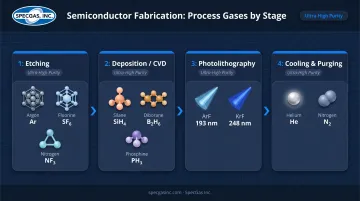
For photolithography—the process that patterns circuit features onto silicon—excimer lasers are essential. ASML confirms that KrF lasers produce 248 nm light and ArF lasers produce 193 nm light, enabling the feature sizes modern chips require. SpecGas supplies KrF and ArF excimer laser gas mixtures for DUV photolithography, as well as XeCl mixtures used in display annealing for high-resolution screens.
Specialty and Rare Gases in Research
For university and independent research laboratories, concentration accuracy matters as much as gas type. Common applications require mixtures accurate at the parts-per-million or parts-per-billion level, including:
- Carrier gases for GC and GC-MS analysis
- Reaction gases for chemical synthesis
- Blends for spectroscopic instruments and FTIR systems
At those concentrations, a result's validity comes down to whether the gas standard matches what the certificate says it is.
Most standard industrial gas suppliers don't produce precision low-ppb blends. SpecGas produces NIST-traceable specialty gas blends—including reactive mixtures like phosphine in hydrogen and diborane in hydrogen—with concentration ranges from 300 ppb to 10%, produced gravimetrically and certified to national standards.
Environmental Monitoring, Calibration, and Air Quality
Every gas detector, emissions analyzer, and air quality monitor needs a known reference point to verify its readings. That reference point is a calibration gas standard—and its accuracy is the foundation of regulatory compliance.
Why Calibration Gases Matter
Without accurate calibration gas standards, monitoring data is unreliable. This affects:
- CEMS (Continuous Emissions Monitoring Systems) at power plants, refineries, and manufacturing facilities
- Ambient air quality networks operating under 40 CFR Part 58
- Workplace safety detectors in confined spaces, where OSHA requires calibrated direct-reading instruments before entry—tested for oxygen, flammable gases, and toxic air contaminants in that order
- Process control instrumentation across utilities, solar manufacturing, and industrial operations
NIST-Traceable Standards and EPA Requirements
NIST-traceable calibration gases are certified reference mixtures whose concentration values trace back to the National Institute of Standards and Technology. Under 40 CFR Part 75, EPA Protocol gases must be prepared and analyzed according to the EPA Traceability Protocol—a requirement for CEMS used at power plants and large industrial emitters.
SpecGas produces EPA Protocol-grade calibration gas standards for CEMS applications, including SO₂, NOx, CO, CO₂, and HCl reference standards used for stack emissions compliance. All standards are produced using gravimetric blending and are NIST traceable.
The Reactive Gas Problem
Certain calibration gases are inherently unstable. H₂S, SO₂, NO, NO₂, HCl, and Cl₂ react with cylinder walls over time, degrading concentration until the gas in the cylinder no longer matches the certificate. When that happens, every instrument calibrated against it is giving inaccurate readings.
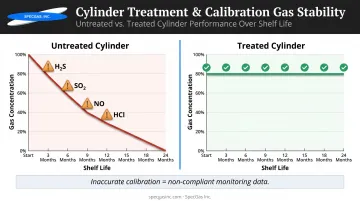
SpecGas addresses this with a proprietary internal cylinder treatment process developed through decades of R&D, including work by founder Alfred Boehm at Messer Griesheims Industries. Treating cylinder interiors before filling prevents reactive gas molecules from interacting with the cylinder wall materials (the primary cause of concentration drift).
The SpecGas Stability Guarantee applies to reactive blends including H₂S, SO₂, NO, HCl, NH₃, Cl₂, and formaldehyde, extending shelf life and ensuring the certified concentration remains accurate from first use to last.
Frequently Asked Questions
What are the applications of industrial gases?
Industrial gases are used across manufacturing (welding, cutting, heat treatment), healthcare (oxygen therapy, MRI, laparoscopy), food processing (MAP packaging, carbonation, freezing), electronics (semiconductor fabrication, photolithography), and environmental monitoring (CEMS calibration, air quality). Their use extends into nearly every sector that relies on controlled chemical or atmospheric conditions.
What are common types and examples of industrial gases?
The most widely used include:
- Oxygen — combustion support and medical therapy
- Nitrogen — inert blanketing, purging, and cryogenic cooling
- Argon — welding shielding and semiconductor processing
- CO₂ — carbonation, MAP packaging, and laser applications
- Hydrogen — refining and chemical synthesis
- Helium — chromatography carrier gas and cryogenic cooling
- Acetylene — high-temperature cutting and flame processes
Specialty blends and calibration-grade mixtures extend this list for analytical and advanced industrial use.
What is the difference between industrial gases and specialty gases?
Industrial gases are typically produced in large volumes for general-purpose processes—welding oxygen, bulk nitrogen, standard CO₂. Specialty gases are produced in smaller quantities to precise purity specifications for analytical, calibration, research, or high-tech applications where concentration accuracy at ppm or ppb levels is critical.
Which industrial gases are most commonly used in semiconductor manufacturing?
Nitrogen, argon, and helium form the bulk gas foundation, while process gases — silane, NF₃, SF₆, fluorocarbon etch gases, and dopants like phosphine and diborane — drive deposition and etching steps. Excimer laser gases (ArF at 193 nm, KrF at 248 nm) are essential for photolithography. Ultra-high purity and verified concentrations are required at every stage.
How are industrial gases used in environmental and emissions monitoring?
Calibration gas standards—certified reference mixtures of known concentration—are used to verify that gas analyzers and detectors read accurately. Without NIST-traceable reference gases, emissions monitoring equipment cannot reliably measure pollutants, and neither workplace safety nor regulatory compliance can be confirmed.