That independence is the core idea behind gas mixture chemistry. Whether you're working with atmospheric air, a deep-sea diving cylinder, a semiconductor process chamber, or a calibration gas standard, the same three concepts govern how the mixture behaves: partial pressure, Dalton's Law, and mole fraction.
Get these right, and you can predict, control, and verify gas blend composition with precision. Miss them, and measurement errors follow—sometimes with real compliance consequences.
Key Takeaways
- A gas mixture is a homogeneous blend of two or more gases, each retaining its own pressure and chemical identity.
- Partial pressure is the pressure each gas would exert if it alone occupied the entire volume.
- Dalton's Law states that total pressure equals the sum of all individual partial pressures.
- Mole fraction expresses each component's proportion and directly determines its partial pressure contribution.
- In calibration gas applications, even small mole fraction errors cause instrument measurement inaccuracies and potential compliance failures.
What Is a Gas Mixture?
A gas mixture is a homogeneous blend of two or more gaseous components occupying the same container at the same temperature. "Homogeneous" has a specific meaning here: the components are uniformly distributed at the molecular level, with no distinct layers or phases. Every sample pulled from that container has the same composition.
Reactive vs. Non-Reactive Mixtures
Not all gas mixtures behave the same way:
- Non-reactive — Gases that don't chemically interact, such as nitrogen and helium or argon and oxygen. These are stable and straightforward to blend and store.
- Reactive — Gases that can interact with each other or with the container itself, including hydrogen sulfide, chlorine, ammonia, and formaldehyde.
Reactive mixtures require specialized handling. Chlorine, for instance, readily adsorbs onto cylinder walls and tubing surfaces, causing measurable compositional drift over time. Cylinder material selection, surface pretreatment, and blending protocols all determine whether the labeled composition holds months after filling.
Dry Air as a Reference Point
Dry air is chemistry's most familiar gas mixture — and a useful anchor for understanding how mixture composition is expressed and calculated. Using NOAA's verified values:
| Component | Volume % in Dry Air |
|---|---|
| Nitrogen (N₂) | 78.084% |
| Oxygen (O₂) | 20.946% |
| Argon (Ar) | 0.934% |
| Other gases | ~0.036% |
These volume percentages are numerically equivalent to mole fractions for ideal gas behavior — which makes dry air a direct starting point for partial pressure calculations covered ahead.
Partial Pressure: How Each Gas Contributes to the Total
Partial pressure is the pressure a single component of a gas mixture would exert if it alone occupied the entire volume at the same temperature. Each gas acts as though the others aren't there.
The Connection to the Ideal Gas Law
This independence traces directly to PV = nRT. Since pressure is proportional to the number of moles:
P = nRT/V
The partial pressure of any gas depends only on its own mole count, the temperature, and the container volume. What other gases are present is irrelevant.
So if you double the number of moles of one component while holding everything else constant, its partial pressure doubles. The other gases are unaffected.
A Simple Conceptual Example
Imagine a sealed container holding two gases in equal molar amounts—say, 0.5 mol of gas A and 0.5 mol of gas B. At a given temperature and volume:
- Gas A exerts a pressure as if it were alone: P_A
- Gas B does the same: P_B
- Since the molar amounts are equal, P_A = P_B
- Total pressure = P_A + P_B
Neither gas "knows" about the other. The total pressure is the sum of two independent contributions.
Partial pressures are written as P₁, P₂, P₃ or labeled by gas symbol—P_N₂, P_O₂, P_Ar. They use the same units as total pressure: atm, kPa, torr, or mmHg.
Why This Matters Beyond Theory
Precise units matter because in gas calibration, partial pressure is exactly what an instrument responds to. A CO analyzer responds specifically to the partial pressure of CO at its sensor, not the bulk mixture composition. If that partial pressure is off because the mole fraction was blended incorrectly, every downstream reading carries a systematic error — one that can mean the difference between a passing compliance report and a missed overexposure event.
Dalton's Law of Partial Pressures
John Dalton first presented his work on mixed gases in 1801, with it published in 1802. The core statement remains unchanged: the total pressure of a gas mixture equals the sum of the partial pressures of each component.
P_tot = P₁ + P₂ + P₃ + …
Why It Works
Gas molecules in an ideal mixture don't interact with each other in any meaningful way—no significant attractions or repulsions between different species. Because each molecule contributes to pressure independently, the contributions simply add. The chemistry of the molecule doesn't change the math; only the count of molecules matters.
Worked Example: A Diving Gas Cylinder
A scuba cylinder filled with NOAA Nitrox 32 (32% oxygen, 68% nitrogen) pressurized to 200 atm total:
- Mole fraction of O₂: 0.32
- Partial pressure of O₂: 0.32 × 200 atm = 64 atm
- Mole fraction of N₂: 0.68
- Partial pressure of N₂: 0.68 × 200 atm = 136 atm
- Check: 64 + 136 = 200 atm ✓
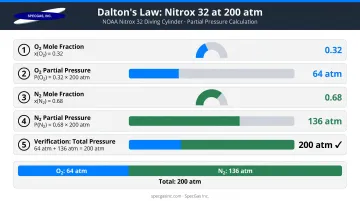
Divers care about these numbers because oxygen becomes toxic above a certain partial pressure threshold—regardless of what else is in the cylinder.
The Water Vapor Correction
When gas is collected over water in a laboratory, the container holds both the gas of interest and water vapor. Total measured pressure includes both:
P_tot = P_gas + P_H₂O
NIST Antoine data for water gives vapor pressures of approximately 2.339 kPa at 20°C and 3.170 kPa at 25°C. To find the true partial pressure of the collected gas, subtract the water vapor pressure from the total.
Skipping it means the reported gas pressure is slightly inflated—a small but real source of error in precise laboratory work.
Where Dalton's Law Has Limits
Dalton's Law is an ideal-gas model. At very high pressures or low temperatures, intermolecular attractions and molecular volume become significant enough to cause measurable deviations. Two conditions that push past the ideal-gas approximation:
- High pressure: molecular volume and repulsive forces become non-negligible
- Low temperature: intermolecular attractions slow molecules and reduce effective pressure contributions
High-pressure cylinders containing polar or reactive gases (such as HCl, NH₃, or SO₂) sometimes require real-gas corrections to accurately determine component pressures. For most calibration and environmental monitoring work at moderate pressures, the ideal-gas model holds well enough that Dalton's Law applies without adjustment.
Mole Fractions and Gas Mixture Composition
Mole fraction (χᵢ) is the ratio of the moles of one component to the total moles in the mixture:
χᵢ = nᵢ / n_total
It's dimensionless, ranges from 0 to 1, and all mole fractions in a mixture must sum to exactly 1.
Mole Fraction vs. Volume Percent
For ideal gases at constant temperature and pressure, mole fraction and volume fraction are numerically equivalent—volume is proportional to moles under those conditions. This is why air composition is commonly expressed as either "78.084% by volume" or "mole fraction 0.78084" interchangeably. At high pressure or low temperature, this equivalence breaks down, so mole fraction remains the more precise scientific expression for gas blend composition.
Connecting Mole Fraction to Partial Pressure
The relationship is direct:
Pᵢ = χᵢ × P_tot
Knowing the mixture's composition ratio is enough to calculate every component's pressure contribution from composition data alone.
Dry Air as a Practical Example
At standard atmospheric pressure (101.325 kPa), using NOAA's dry air composition:
| Component | Mole Fraction (χ) | Partial Pressure (kPa) |
|---|---|---|
| N₂ | 0.78084 | 79.12 |
| O₂ | 0.20946 | 21.22 |
| Ar | 0.00934 | 0.95 |
| Total | 1.00000 | 101.33 |
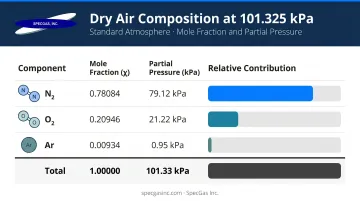
The totals confirm internal consistency — a useful cross-check when verifying whether a reported mixture composition is complete and accurate.
Precision Where It Counts
In calibration gas applications, mole fraction isn't just a theoretical construct: it's the specification on the cylinder certificate. EPA's Protocol Gas Verification Program uses a ±2.0% audit difference criterion for ambient air protocol gases under 40 CFR Part 75. A cylinder outside that window can produce failed quality assurance checks or inaccurate emissions data.
This is why producers like SpecGas Inc. use gravimetric blending with NIST-traceable standards and verify compositions analytically before cylinders ship. Tolerances can be adapted to customer requirements—but only when the blending process is precise enough to hold them consistently.
Real-World Applications of Gas Mixtures
Calibration and Emissions Monitoring
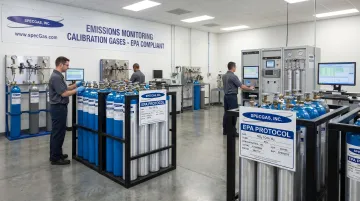
Every instrument that measures gas concentration in air—a CO analyzer, a stack emissions monitor, an ambient air quality sensor—must be calibrated against a reference gas of precisely known composition. That reference gas works because its mole fractions and partial pressures are certified.
Under 40 CFR Part 75, continuous emission monitoring systems for SO₂, NOₓ, CO₂, and related parameters must pass quality assurance checks against certified calibration gases. An incorrect certified value doesn't just affect one reading—it propagates through every measurement the instrument makes until recalibrated.
SpecGas produces EPA Protocol-grade calibration gases and supports EPA Method 320 for formaldehyde stack monitoring, among other reference methods. Formaldehyde calibration gases are available from 1 ppm to 100 ppm in balance air or nitrogen—precise enough to calibrate FTIR spectrometers and gas chromatographs used in compliance testing.
Semiconductor and Laser Applications
Excimer lasers used in semiconductor photolithography depend on tightly controlled gas mixtures. Linde identifies KrF lasers operating at 248 nm and ArF lasers at 193 nm as standard for electronics lithography, with gas mixtures of fluorine, rare gas, and buffer gas (neon or helium) forming the lasing medium.
Fluorine attacks seals and surfaces aggressively, and high-voltage discharge combined with deep UV makes gas chemistry management critical. If the mixture drifts from its specified composition, laser output stability and operational lifetime both suffer.
SpecGas produces ArF, KrF, KrCl, and XeCl excimer laser gas mixtures using gravimetric blending, with formulations custom-blended to customer specifications.
Reactive Gas Mixtures and Cylinder Treatment
Some of the most demanding gas mixture work involves gases that actively attack their containers. Several gases present stability challenges that standard cylinder materials cannot handle without treatment:
- Chlorine adsorbs onto metal surfaces, causing concentration loss over time
- Formaldehyde is difficult enough to stabilize that only a small number of producers worldwide can reliably blend it
- Hydrogen sulfide and ammonia both show measurable losses in untreated cylinders, as documented in SINTEF and Cranfield University stability studies
SpecGas addresses this through a proprietary internal cylinder treatment process developed from Alfred Boehm's research at Messer Griesheims Industries in Germany, beginning in 1976. Applied to aluminum, steel, and nickel-plated cylinders, the treatment is engineered specifically to minimize reactive gas interaction with cylinder walls.
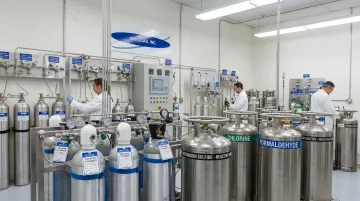
Every reactive gas mixture produced under this process is backed by the SpecGas Stability Guarantee, which includes a commitment to remake and reship any mixture that doesn't meet the stated composition.
Frequently Asked Questions
What is a gas mixture?
A gas mixture is a homogeneous blend of two or more gases occupying the same container, where each component retains its own pressure and chemical identity. Unless the blend is reactive, the components do not chemically interact with each other.
What is Dalton's Law of partial pressures?
Dalton's Law states that the total pressure of a gas mixture equals the sum of the partial pressures of all individual components. Each gas behaves independently, so their pressure contributions add together regardless of what other gases are present.
How is mole fraction different from percentage by volume?
Mole fraction is a ratio between 0 and 1 representing moles of one component to total moles, while volume percent expresses the same ratio as a percentage (multiply by 100). For ideal gases at the same temperature and pressure, the two are numerically equivalent—but mole fraction is what precision gas blend specifications require.
What is the difference between a reactive and a non-reactive gas mixture?
Non-reactive mixtures contain gases that don't chemically interact, such as nitrogen and argon. Reactive mixtures contain gases that can react with each other or with container surfaces—chlorine, H₂S, ammonia, and formaldehyde being common examples—requiring specialized cylinder materials and treatment to maintain compositional stability.
How are gas mixtures used in calibration and emissions monitoring?
Instruments measuring air quality or stack emissions are calibrated against reference gas blends of certified composition. The accuracy of those blends—expressed through verified partial pressures and mole fractions—determines instrument reliability and regulatory compliance.
What does NIST-traceable mean for a specialty gas mixture?
NIST traceability means the blend's composition has been verified through an unbroken documented chain of calibrations linking back to standards maintained by the National Institute of Standards and Technology. That documented chain gives end users a verifiable basis for instrument calibration and regulatory compliance.