For industrial buyers, research labs, and engineers specifying gas supplies, understanding what separates these two gases — and where their properties matter most — directly affects purchasing decisions, performance outcomes, and procurement risk.
This article covers the key properties of each gas, their primary applications, where they overlap in advanced fields, and what purity and blending requirements look like in practice.
Key Takeaways
- Krypton (
$1/L) and xenon ($60/L) are noble gases extracted from air via cryogenic fractional distillation; xenon is far scarcer and costlier - Krypton's main uses: halogen bulb fill gas, insulating window panes, retinal laser treatment, and KrF excimer laser mixtures
- Xenon's main uses: high-intensity cinema and automotive lighting, general anesthesia, MRI lung imaging, ion propulsion, and semiconductor dry etching
- Both gases appear in aerospace propulsion, nuclear treaty monitoring, and particle physics detectors
- Purity grades (4.0 to 5.0+) matter significantly: moisture, oxygen, hydrocarbons, and nitrogen are the primary contaminants of concern
What Are Krypton and Xenon?
Both gases occupy Group 18 of the periodic table alongside helium, neon, and argon. They share the defining traits of noble gases: chemical inertness, colorless and odorless appearance, and production via cryogenic fractional distillation of liquid air.
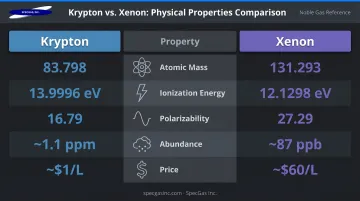
The scarcity gap between them is dramatic. Atmospheric measurements put krypton at 1.1074 ± 0.0083 ppmv and xenon at 87 ± 1 ppbv. A DOE/OSTI recovery economics report cites market price assumptions of approximately $1/L for krypton and $60/L for xenon — a 60x cost differential that shapes procurement strategy for any application where substitution is possible.
Physical Properties That Drive Different Applications
| Property | Krypton | Xenon |
|---|---|---|
| Atomic mass | 83.798 | 131.293 |
| First ionization energy | 13.9996 eV | 12.1298 eV |
| Thermal conductivity (25°C) | 10.0 mW/m·K | — |
| Atmospheric abundance | ~1.1 ppm | ~87 ppb |
Xenon's higher atomic mass makes it better for ion propulsion — heavier ions transfer more momentum. Its lower ionization energy means it ionizes more easily, which matters for lighting discharge lamps and plasma-based applications. Its higher polarizability (27.29 vs. 16.79 α/e²a₀³) also makes it more responsive to external electric fields, contributing to its optical and anesthetic properties.
Both gases glow under electrical excitation, but with distinct spectral signatures. Xenon produces a broad-spectrum, blue-white light that closely approximates noon sunlight (~6000 K), making it preferred wherever color accuracy matters. Krypton emits at multiple discrete wavelengths (531 nm, 568 nm, and 647 nm), characteristics that become clinically relevant in ophthalmological laser applications.
Uses of Krypton
Lighting and Energy-Efficient Windows
Krypton's most commercially widespread use is as a fill gas in halogen incandescent bulbs. Its heavier atomic weight slows tungsten filament evaporation compared to argon, allowing higher operating temperatures and longer lamp life. It costs more than argon but delivers measurably extended service life in applications where bulb replacement is disruptive or costly.
In window glazing, krypton's thermal performance is the differentiator. LBNL data shows thermal conductivity at 25°C of:
- 10.0 mW/m·K — krypton
- 17.7 mW/m·K — argon
- 25.7 mW/m·K — air
That lower conductivity makes krypton the preferred fill gas for premium double- and triple-pane windows where narrow glazing cavities (8–12 mm) limit argon's effectiveness. It's particularly relevant in high-performance residential and commercial construction targeting stringent U-factor specifications.
Medical and Ophthalmological Lasers
Krypton ion lasers produce wavelengths at 531 nm (green), 568 nm (yellow), and 647 nm (red), a combination that makes them clinically useful in ways argon lasers aren't. The red wavelength at 647 nm penetrates intraretinal hemorrhage and media opacity that blocks shorter wavelengths entirely.
This gives ophthalmologists a practical tool for treating patients where argon lasers fall short, including cases of:
- Retinal vein occlusion
- Retinal tears
- Glaucoma
- Macular degeneration
KrF (krypton fluoride) excimer lasers produce 248 nm UV radiation used in corneal ablation research and some refractive procedures, though 193 nm ArF remains the standard for modern LASIK; at 248 nm, the beam produces a wider thermal damage zone. KrF excimer mixtures are also central to semiconductor photolithography at older process nodes and remain in use for display annealing and dermatological treatments.
SpecGas produces KrF excimer laser gas mixtures — including formulations such as 0.1% fluorine / 1.85% helium / 2.78% krypton in neon balance — for photolithography, vision correction, and dermatology applications.
Calibration and Scientific Standards
Krypton's metrological history is precise: the 11th CGPM in 1960 defined the meter as 1,650,763.73 wavelengths in vacuum of a specified krypton-86 emission transition. While the SI definition has since moved to laser-based standards, krypton spectral lines remain reference points in calibration instrumentation.
Krypton-85 — a fission byproduct with a half-life of approximately 11 years — serves as a tracer gas in environmental monitoring and leak detection. Atmospheric Kr-85 monitoring is used to identify clandestine plutonium separation activities. Precision krypton calibration gas standards are required to calibrate the detection equipment used at nuclear reprocessing facilities, where environmental compliance depends on accurate measurement.
Uses of Xenon
Lighting: Cinema, Automotive, and Disinfection
Xenon's broadband emission spectrum, approximating natural daylight at ~6000 K, makes it the standard light source for IMAX and cinema projectors, solar simulators, and searchlights. Short-arc xenon lamps replaced carbon arc lamps in these applications due to longer operating life and more consistent spectral output.
In automotive applications, xenon HID headlights (such as OSRAM XENARC D1S, rated at 35W / 85V nominal) produce significantly more light per watt than halogen alternatives. Xenon strobe and flash lamps appear in high-speed photography and stroboscopes, where precise timing and broad spectral output both matter.
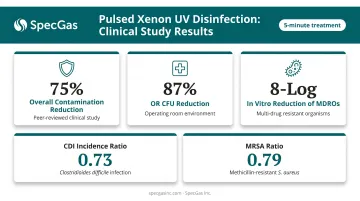
Pulsed xenon UV disinfection is a growing clinical application. A peer-reviewed study found pulsed xenon UV light achieved the following results in 5 minutes:
- 75% overall contamination reduction
- 87% OR CFU reduction
- 8-log in vitro reduction of multidrug-resistant organisms
A 2020 meta-analysis found CDI incidence rate ratios of 0.73 and MRSA of 0.79 following deployment.
Medical: Anesthesia and Lung Imaging
Xenon functions as a general anesthetic through NMDA receptor antagonism, with a minimum alveolar concentration of 71% — sufficient for surgical anesthesia while maintaining oxygenation. Unlike nitrous oxide, xenon is not a greenhouse gas and shows neuroprotective rather than neurotoxic effects. A 2016 systematic review of 43 RCTs confirmed faster emergence, though with higher postoperative nausea and vomiting rates (34.4% vs. 19.9%).
Cost limits broader adoption. A cost analysis found a 240-minute xenon anesthetic runs approximately $356, versus $52–$94 for nitrous oxide-based alternatives. For high-risk patients (particularly those undergoing cardiac surgery or with traumatic brain injury), the clinical profile can justify that premium.
In imaging, two xenon isotopes serve different imaging roles:
- Xenon-133 (inhaled radiopharmaceutical): Used in SPECT imaging to evaluate lung ventilation and blood flow; requires careful handling due to artifact risk from escaped gas
- Hyperpolarized Xenon-129 (Xenoview): FDA-approved on December 23, 2022 for MRI evaluation of lung ventilation in adults and pediatric patients 12 years and older; no ionizing radiation, with growing clinical adoption
Semiconductor Manufacturing
Xenon difluoride (XeF₂) is a dry, gas-phase, room-temperature silicon etchant used in MEMS fabrication. It etches silicon isotropically without plasma. Selectivity reaches >1000:1 relative to SiO₂, photoresist, aluminum, copper, gold, and most common MEMS structural materials — a ratio that makes it essential for delicate release steps where plasma damage would compromise the device.
Krypton and Xenon in Cutting-Edge Applications
Aerospace Ion Propulsion
Both gases serve as propellants in Hall-effect and gridded ion thrusters. The operational record for xenon is extensive:
- Deep Space 1 — first spacecraft to use ion propulsion as primary propulsion; accumulated 678 days of xenon thruster operation (JPL)
- Dawn — launched with 425 kg xenon propellant; visited both Vesta and Ceres
- ESA SMART-1 — PPS-1350G Hall thruster, 4,958 hours of accumulated operation
SpaceX's Starlink satellites use krypton Hall thrusters, making them the most prominent commercial deployment of krypton propulsion at scale. AIAA modeling found krypton delivers approximately 13.3% higher specific impulse but 19% lower thrust than xenon in comparable Hall thruster configurations.
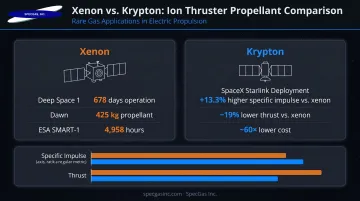
Xenon's higher atomic mass produces more momentum per ionized atom. Krypton's ~60x lower cost per liter makes it viable when high-power configurations can partially compensate for the thrust deficit.
Nuclear Industry and Treaty Monitoring
Both xenon and krypton isotopes play distinct roles in nuclear safety and treaty verification:
- Xe-135 (reactor control): A major neutron poison produced during fission; its buildup contributed to the reactivity conditions preceding the Chernobyl accident, as documented in IAEA INSAG-7. Continuous Xe-135 monitoring is fundamental to reactor control.
- Xe-133 and Xe-135 (treaty monitoring): The CTBTO's radionuclide monitoring network tracks four xenon isotopes as indicators of clandestine nuclear tests. Fission-product xenon seeps through rock and sediment, producing a detectable atmospheric signal even from underground detonations.
- Kr-85 (reprocessing detection): Released during spent nuclear fuel reprocessing, Kr-85 (half-life ~11 years) serves as an indicator for clandestine plutonium separation. Precision Kr-85 calibration standards are required to qualify detection equipment at reprocessing facilities and in wide-area environmental monitoring programs.
Particle Physics Detectors
Liquid xenon is the medium of choice for rare-event detection experiments. Three active programs illustrate the scale:
- XENONnT: 5.9 tonnes active liquid xenon; 3.5 tonne-year exposure published from 2021–2023 data
- LUX-ZEPLIN (LZ): ~7 active tonnes; targeting 1,000 live days
- PandaX-4T: 3.7 tonnes sensitive volume; reported first solar neutrino detection via coherent elastic scattering in 2024
Liquid xenon's high density provides target mass; outer xenon layers provide self-shielding against external backgrounds; and the dual scintillation/ionization signal (S1/S2) allows >99.7% electronic-recoil rejection at 50% nuclear-recoil acceptance. This combination of self-shielding and dual-signal discrimination is why experiments continue scaling toward 10+ tonne detectors rather than switching to alternative detection media.
Why Gas Purity and Blending Precision Matter
For performance-sensitive applications, nominal purity grades don't tell the full story. Linde's published datasheets illustrate what 5.0 grade actually means in practice:
| Grade | Purity | H₂O | O₂ | Hydrocarbons | N₂ |
|---|---|---|---|---|---|
| Krypton 4.0 | ≥99.99% | ≤5 ppm | ≤10 ppm | ≤5 ppm | ≤30 ppm |
| Krypton 5.0 | ≥99.999% | ≤5 ppm | ≤0.5 ppm | ≤0.5 ppm | ≤2 ppm |
| Xenon 5.0 | ≥99.999% | ≤2 ppm | ≤0.5 ppm | ≤0.5 ppm | ≤1 ppm |
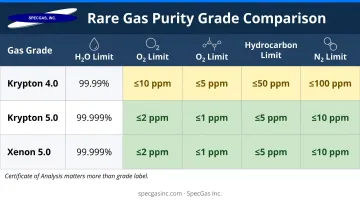
In excimer laser systems, trace moisture or oxygen quenches the laser medium and shortens component life. In xenon anesthesia delivery, hydrocarbon contamination creates safety concerns. Particle physics detectors are the most demanding case: electronegative impurities at sub-ppb levels absorb ionization electrons before they reach the anode, degrading the S2 signal that discriminates signal from background.
The certificate of analysis matters more than the grade label.
SpecGas produces NIST-traceable krypton and xenon specialty blends (including formulations like 70% Kr / 30% Xe, 50% Kr / 50% Ar, and 0.5% H₂ / 19.5% Ar / 80% Kr), with all blending done in-house using gravimetric methods and calibrated analytical instrumentation.
For customers needing low-ppm or ppb-level blends that larger commodity suppliers typically won't accommodate, SpecGas offers:
- Custom rare gas blending down to ppb-level concentrations
- Proprietary cylinder treatment process for mixture stability and extended shelf life
- NIST-traceable certificates of analysis with every order
- Faster lead times than standard rare gas procurement channels, with rush service available
Frequently Asked Questions
What is the main difference between krypton and xenon gas?
Both are chemically inert noble gases produced by fractional distillation of air, but xenon is roughly 12x rarer and ~60x more expensive per liter. Xenon's higher atomic mass, lower ionization energy, and higher polarizability make it preferred for ion propulsion, anesthesia, and high-intensity lighting; krypton is more commonly used for window insulation, halogen fill gas, and ophthalmological lasers.
What is krypton gas mainly used for?
Krypton's primary industrial applications are filling halogen incandescent bulbs to extend filament life and filling the cavities in premium double- and triple-pane window glass for thermal insulation. It also powers ion lasers used to treat retinal conditions and appears in KrF excimer laser mixtures used for corneal procedures and photolithography.
Why is xenon used as a spacecraft propellant?
Xenon's high atomic mass gives each ionized atom greater momentum, producing higher thrust efficiency in Hall-effect and gridded ion thrusters. Its low ionization energy means it ionizes easily at relatively low power input, and its chemical inertness prevents corrosion of thruster components.
How is xenon used in medicine?
Xenon serves three medical roles: inhaled general anesthesia (NMDA receptor antagonism with neuroprotective properties), radioactive Xe-133 for SPECT-based lung and blood flow imaging, and hyperpolarized Xe-129 (Xenoview). The FDA approved Xenoview in 2022 for MRI lung ventilation evaluation — no ionizing radiation required.
Why are krypton and xenon so expensive compared to other gases?
Both are extracted via energy-intensive cryogenic fractional distillation from air that contains only ~1.1 ppm krypton and ~87 ppb xenon — making production yields tiny relative to the infrastructure required. That scarcity drives costs far above abundant gases like argon (0.93% of atmosphere) or nitrogen (78%). Xenon's additional 12x rarity over krypton explains its steeper price premium.