Here's the short answer: mixing premium and regular gas is generally safe. The result is a blended octane level somewhere between the two grades, and for most modern vehicles, that's a non-issue. Whether it actually matters depends almost entirely on what your specific car requires.
This article covers how octane works, what blending does to your fuel, which vehicles are genuinely at risk, and what to do if you've already mixed.
TL;DR: What Happens If You Mix Premium and Regular Gas?
- Mixing creates a blended octane rating between the two grades — a 50/50 mix of 87 and 91 yields roughly 89 octane
- Most modern vehicles handle it fine; knock sensors and the ECU compensate for minor octane shifts
- Drop below a premium-required engine's minimum octane threshold, though, and you're looking at real risk
- One accidental fill-up won't cause lasting damage in most modern engines
- Putting premium in a regular-grade car wastes money — there's no performance benefit
What Is Octane Rating and Why Does It Matter?
Octane rating measures a fuel's resistance to pre-ignition — not its energy content or overall quality. Higher octane means the fuel can withstand more heat and cylinder pressure before igniting on its own.
The number at the pump is the Anti-Knock Index (AKI), calculated as (RON + MON) / 2 per EIA standards. U.S. grades break down as:
- Regular: 87 octane
- Mid-grade: 89–90 octane
- Premium: 91–94 octane
What Engine Knock Actually Is
Engine knock happens when the air-fuel mixture ignites before the spark plug fires. Two competing combustion events create excess cylinder pressure — and repeated knock can damage pistons, connecting rods, and bearings over time.
High-compression and turbocharged engines generate more cylinder pressure by design, which makes knock more likely if octane is too low. Standard-compression engines don't operate near those thresholds, so premium's extra knock resistance delivers no measurable benefit — which raises an obvious question about whether paying for it makes sense.
The Cost Reality
As of June 2026, AAA's national fuel price data shows regular averaging $4.29/gallon and premium at $5.17/gallon — a spread of $0.877 per gallon. Over a full year of driving, that spread adds up to $100–$200 in extra fuel costs — which makes understanding exactly what you're paying for worth a few minutes of your time.
What Actually Happens When You Mix Premium and Regular Gas
The blending math is straightforward. Blended octane equals the volume-weighted average of the two grades:
((Volume 1 × AKI 1) + (Volume 2 × AKI 2)) / Total Volume
Two practical examples:
| Mix Ratio | Regular (87) | Premium (91) | Blended Result |
|---|---|---|---|
| 50/50 | 5 gallons | 5 gallons | ~89 octane |
| 75/25 | 7.5 gallons | 2.5 gallons | ~88 octane |
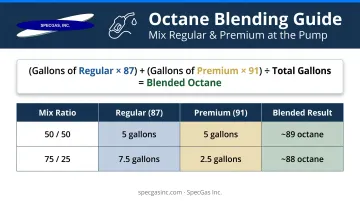
This formula is the same volume-weighted calculation the EIA uses in its gasoline octane cost analysis.
One Important Caveat
The math is approximate, not exact. Ethanol — present in most U.S. pump gas as E10 — affects octane differently depending on the base gasoline. API research found that ethanol's octane boost is less pronounced in premium base gasoline than in regular. The molecular interactions don't always produce a perfectly linear average.
That gap matters when accuracy is critical. SpecGas, a Pennsylvania-based calibration gas manufacturer, uses gravimetric blending — mixture ratios verified by weight — to produce NIST-traceable standards for emissions monitoring and industrial quality control. Consumer fuel mixing simply doesn't require that level of precision.
What Mixing Does NOT Do
- No chemical reactions or dangerous byproducts occur
- Your fuel system won't be contaminated
- Both grades share the same base components — just different concentrations
If the blended octane still meets your engine's requirement, you won't notice a difference. If it falls below that threshold, you may experience mild knock or a slight power reduction under load.
Putting Premium in a Regular Car
Mixing matters most when the blended result falls short — but the reverse scenario, running pure premium in a regular car, presents its own question. The engine simply cannot use the extra knock resistance. AAA's laboratory testing found no significant improvement in horsepower, fuel economy, or emissions when premium was used in vehicles designed for regular. The only outcome is a higher bill at the pump.
Does It Matter What Type of Car You Drive?
This is where the answer changes significantly depending on your vehicle.
"Required" vs. "Recommended" — Read Your Owner's Manual
The distinction matters more than most drivers realize:
- Premium required: The engine's compression ratio and timing are calibrated for high octane. Lower-octane fuel cannot be safely offset by the engine's compensation systems. Ford's official fuel documentation states that using gasoline below 91 AKI in applicable Mustang models invalidates the warranty and can cause severe mechanical damage.
- Premium recommended: The engine can adapt via knock sensors, but performance and fuel economy may dip slightly on regular. Consumer Reports testing found that regular fuel is generally acceptable in recommended-only vehicles — and their Acura TLX and Nissan Maxima tests showed identical 0-to-60 times on both grades.
How Knock Sensors Work
Modern knock sensors detect abnormal vibrations from pre-ignition and signal the ECU, which retards ignition timing to stop the knock. According to Edmunds, this protects the engine but typically reduces efficiency in the process. It's a workaround — effective for occasional octane variation, not a long-term substitute for the right fuel.
Older Vehicles
Older engines without knock sensors have fixed ignition timing and no feedback loop. They can't compensate. Running below-required octane in these vehicles carries real risk — audible knocking and progressive engine damage.
When Is Mixing Gas Risky vs. Safe?
Generally Safe
- Modern car, premium recommended (not required): The ECU adjusts timing, and the engine compensates with minimal impact. One mixed tank is a non-event.
- Regular 87-octane car: Accidentally adding premium causes no harm — only unnecessary spending.
Carries Real Risk
- Premium-required vehicle: Mixing in regular lowers octane below the engine's design threshold, which degrades performance and can cause lasting damage over time.
- High-performance or turbocharged engines under heavy load: Towing, highway passing, aggressive acceleration — these conditions demand full knock resistance. A lower-octane blend at these moments increases knock risk significantly.
- Older vehicles without knock sensors: AAA notes these engines could experience significant knock from regular/premium mixing, with no electronic compensation available.
What to Do If You've Already Mixed Fuel
If premium is recommended but not required: Drive normally. Avoid aggressive acceleration until the tank runs low, then refill with your standard grade. No lasting concern.
If your car requires premium:
- Avoid hard acceleration, highway passing maneuvers, and any towing
- Drive gently until the tank is nearly empty
- Fill with full premium — this dilutes the blend back toward an acceptable octane level
- Monitor for any knock, ping, or hesitation under load
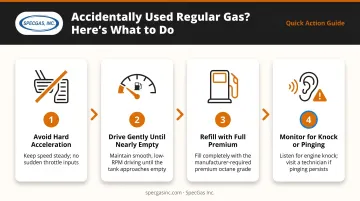
If you hear knocking or pinging: Back off the throttle immediately. Persistent knock means the ECU isn't fully compensating. Keep driving that way and you risk real engine damage. Get it checked.
Frequently Asked Questions
Is it okay to mix different octane grades of gas?
Generally yes — the result is a blended octane between the two grades. Whether that blend is sufficient depends entirely on what your specific vehicle requires. Check your owner's manual before assuming it's fine.
What octane rating do you get when you mix premium and regular gas?
Roughly the volume-weighted average of the two. A 50/50 mix of 87 and 91 octane yields approximately 89. Results can vary slightly due to ethanol content and fuel chemistry differences between batches.
Will mixing premium and regular gas damage my engine?
A single mixed tank is unlikely to cause lasting damage in most modern vehicles. Repeated use of below-required octane in premium-required or older engines without knock sensors is a separate concern — expect performance loss and eventual engine damage over time.
What should I do if I accidentally put regular gas in a premium car?
Drive gently, avoid heavy loads and hard acceleration, and refill with premium once the tank is low. Modern engines with knock sensors can handle one accidental tank. Older or premium-required engines with fixed timing need more caution.
Does putting premium gas in a regular car improve performance?
No. AAA's laboratory testing confirmed no meaningful improvement in horsepower, fuel economy, or emissions when premium is used in engines designed for regular. Engines built for regular fuel simply cannot use the higher octane rating.
Can I use mid-grade gas instead of premium?
Mid-grade (88–90 octane) sits between regular and premium. If premium is only recommended, mid-grade may be a reasonable compromise — but if premium is required, mid-grade falls below the minimum threshold and is not an adequate substitute.