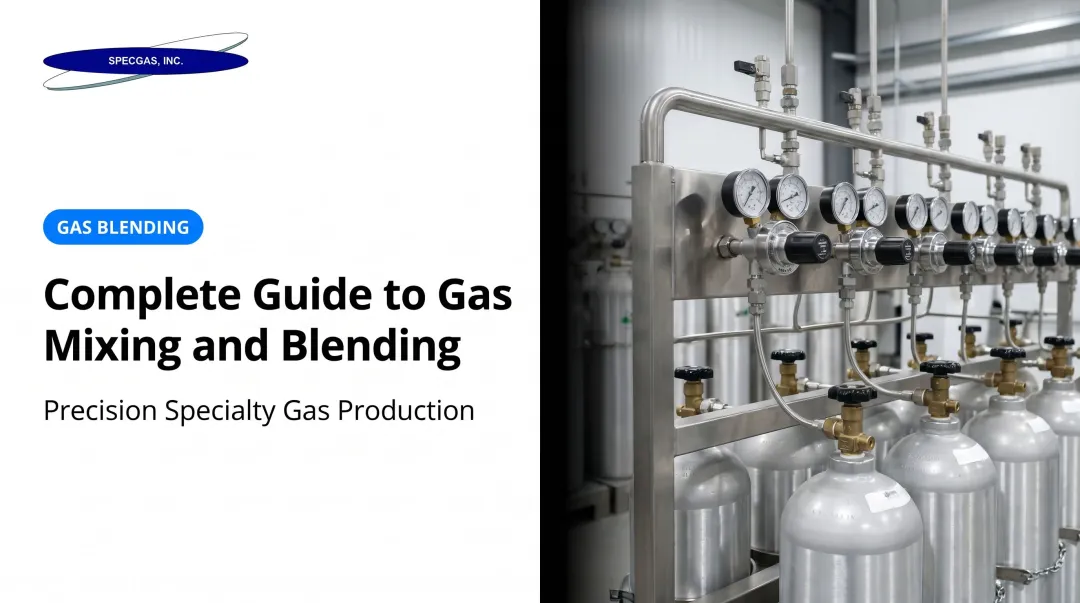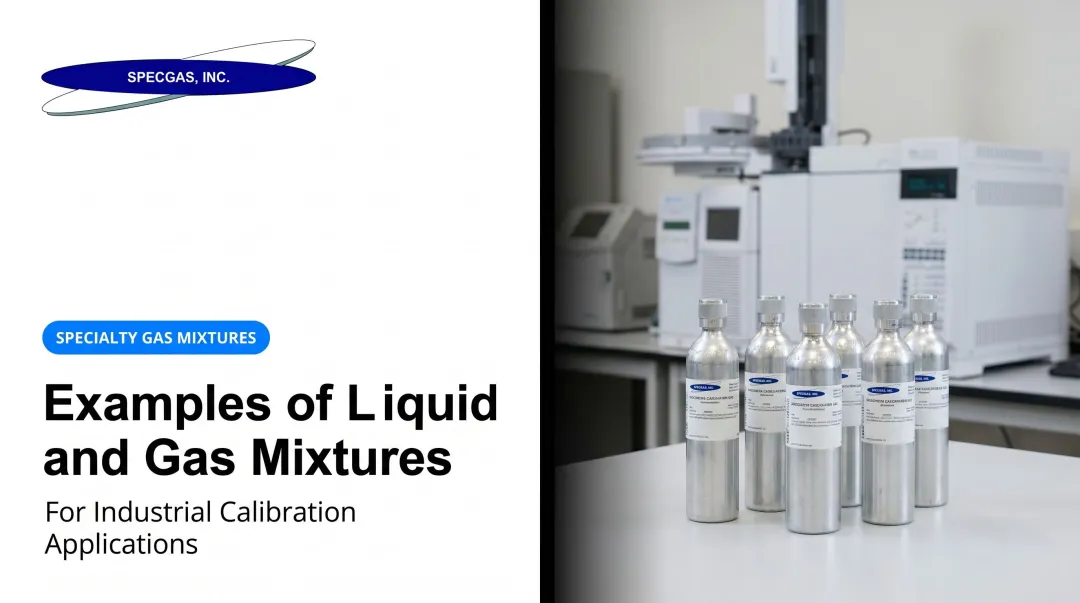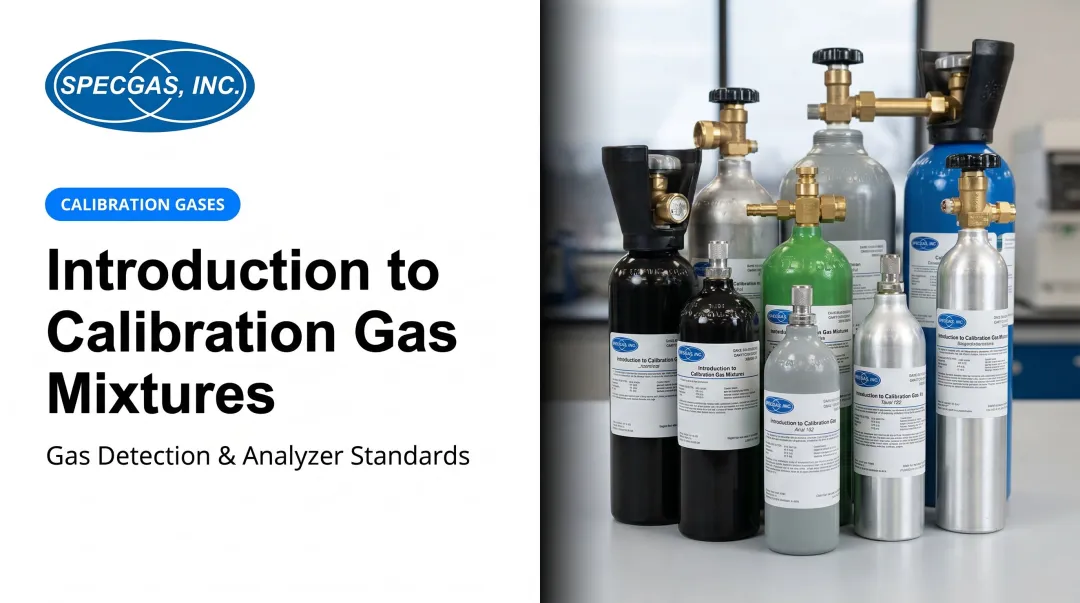
For anyone relying on gas mixtures for accurate measurements, process control, or safety-critical functions, understanding the governing laws, key properties, and certification requirements isn't optional. A miscalibrated emissions analyzer, a confined space monitor reading low, or a semiconductor process running on drifted reactant ratios all trace back to the same root cause: the gas mixture behaved differently than expected.
Key Takeaways
- A gas mixture is a physical combination of two or more gases that retain their individual identities and independently exert pressure within a shared container.
- Dalton's Law: total pressure equals the sum of all partial pressures — each component behaves as if it alone occupies the container.
- Mole fraction defines each component's share of the mixture and directly determines its partial pressure contribution.
- Composition accuracy and stability matter most for reactive trace-level mixtures at ppb and low-ppm concentrations.
- Calibration and compliance applications require NIST-traceable gas standards with documented certificates of analysis.
What Is a Gas Mixture and How Does It Behave?
A gas mixture is a physical — not chemical — combination of two or more gases occupying the same volume at the same temperature. Each component retains its own identity, exerts its own pressure, and follows the ideal gas law independently. Nothing about the mixture changes the molecular nature of the individual gases.
All components share the container's temperature and volume, but each contributes to total pressure in proportion to the number of moles it represents. That independence allows each gas to be treated as if it were the only occupant of the container — the foundation of every partial pressure calculation.
Non-Reactive vs. Reactive Mixtures
The practical divide in gas mixture behavior falls between non-reactive and reactive systems.
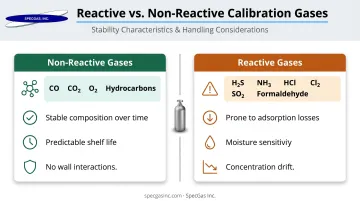
Non-reactive mixtures — nitrogen-balanced CO, CO₂, or hydrocarbon LEL standards, for example — behave close to ideal. The gases don't interact with each other or with cylinder walls in ways that alter composition over time.
Reactive mixtures are a different problem. Gases like H₂S, HCl, NH₃, SO₂, Cl₂, NO, and formaldehyde can adsorb onto cylinder walls, react with moisture or other components under pressure, or degrade in ways that shift the actual composition away from the labeled value. The key behavioral differences break down as follows:
- Non-reactive gases (CO, CO₂, O₂, hydrocarbons): stable composition over time, no wall interactions, predictable shelf life
- Reactive gases (H₂S, NH₃, HCl, Cl₂, SO₂, formaldehyde): prone to adsorption losses, moisture sensitivity, and concentration drift
- Cylinder treatment determines whether a reactive mixture holds its labeled value through its rated shelf life
Research published in Measurement Science and Technology documents adsorption losses of approximately 9% for methanol standards at 5 µmol/mol in cylinders — and identifies similar risks for ammonia, hydrogen sulfide, and benzene. SpecGas addresses this directly through a proprietary internal cylinder treatment process designed to stabilize reactive mixtures, including CO, CO₂, O₂, hydrocarbons, and hydrogen standards filled into steel disposable cylinders from 17 to 103 liters.
Chlorine is a clear example of what reactive behavior looks like in practice. It adsorbs onto virtually any surface it contacts, slowing instrument response times and shifting apparent concentration. Stainless steel or aluminum-based tubing and regulators are required for this reason — and cylinder treatment matters more for Cl₂ than for almost any other calibration species.
The Laws That Govern Gas Mixture Properties
Dalton's Law of Partial Pressures
Every gas in a mixture exerts pressure independently. The total pressure equals the sum of those individual contributions:
P_tot = P₁ + P₂ + ... + Pₙ
This holds because pressure in an ideal gas depends only on the number of moles present, not on the identity of the molecules. Each component's partial pressure (P_A) is the pressure it would exert if it alone occupied the same container at the same temperature.
Mole Fraction and Its Practical Role
Mole fraction (χ_A) is the ratio of moles of one component to total moles in the mixture:
χ_A = n_A / n_total
Key properties of mole fraction:
- Dimensionless, ranges from 0 to 1
- All mole fractions in a mixture must sum to exactly 1
- For ideal gases: χ_A = P_A / P_tot
This relationship is what connects a mixture's specified composition — stated as volume fraction, mol%, ppm, or ppb — directly to the pressure each component contributes. When a calibration gas certificate states 25 ppm H₂S in nitrogen, that ppm value is a mole fraction expressed in convenient units.
The Ideal Gas Law Applied to Mixtures
Each component in a mixture follows PV = nRT as if it were the only gas present. This lets you calculate partial pressures when moles and container conditions are known:
- Know the total cylinder pressure and mole fraction → calculate partial pressure of each component
- Know the partial pressures → sum them to get total pressure
Where real-gas deviations occur:
- High cylinder pressures (compressed gas standards are routinely filled to high pressures)
- Low storage temperatures
- Polar or reactive species that experience intermolecular attraction
For certified gas standards, NIST and ISO 6142-1 rely on gravimetric preparation (measuring by mass) rather than ideal-gas volume calculations. Volumetric calculations become unreliable at the pressures typical of filled cylinders.
Mixture Density and Average Molecular Weight
A gas mixture doesn't have a single molecular weight; it has a weighted average:
M_mix = Σ (χᵢ × Mᵢ)
This weighted average has direct consequences in several areas:
- Flow meter calibration: Most meters are set for a specific gas density; swapping to a denser mixture shifts readings without any change to the meter itself
- Buoyancy calculations: Mixture density determines how a released gas disperses relative to ambient air
- Dispersion modeling: Process safety models require accurate density inputs to predict gas behavior in confined spaces
Change the mixture composition and you change its density. A flow meter calibrated for pure nitrogen will read incorrectly when used with a heavy hydrocarbon mixture at the same nominal flow rate.
Key Physical and Chemical Properties of Gas Mixtures
Beyond total pressure and density, several properties define how a gas mixture performs across its service life — and these matter from the moment of manufacture through the last use.
Composition Accuracy and Stability Over Time
Composition accuracy is how closely the actual mole fractions match the labeled values. At low-ppm and ppb concentrations, small absolute deviations become large relative errors. A mixture labeled at 500 ppb H₂S that's actually 450 ppb is 10% off, enough to cause systematic under-reading in any instrument calibrated against it.
Mixture stability is whether that composition holds over time. The main drivers of instability in reactive mixtures:
- Reactive components bond to untreated metal surfaces, depleting gas-phase concentration over time (adsorption onto cylinder walls)
- Some species react with trace moisture, oxygen, or each other at elevated pressures
- Trace-level mixtures in the ppb range degrade faster than higher-concentration blends: the adsorption surface area stays constant while available molecules decrease
SpecGas addresses this through a proprietary internal cylinder treatment process developed by founder Alfred Boehm, whose cylinder treatment R&D dates to his time at Messer Griesheims in Germany. The process covers reactive species including H₂S, NH₃, HCl, NO, SO₂, Cl₂, and formaldehyde, with all treated mixtures backed by the SpecGas Stability Guarantee.
Cylinder selection is species-specific:
- HCN and PH₃: specially treated aluminum or nickel-plated canisters
- HCl: treated aluminum, steel, or nickel-plated cylinders
- SO₂, NH₃, Cl₂: treated steel or aluminum depending on concentration
Manufacturer shelf-life data reflects these stability challenges. Industrial Scientific's calibration gas guidance cites NO₂ at 4 months, HCl at 9 months, NH₃ at 14 months, and H₂S at 19 months. These figures are tied to specific cylinder types and treatment methods, not universal stability constants.
Vapor Pressure and Phase Separation
When a mixture component has a high vapor pressure or low boiling point, cold storage can push it toward the liquid phase, causing partial condensation and altering the gas-phase composition. Airgas's technical guidance defines the dew point vapor pressure limit (DP-VPL) as the highest pressure and lowest temperature at which a mixture stays entirely gaseous. Exceed that threshold and what comes out of the cylinder is no longer the mixture on the label.
The risk is highest for calibration gases containing SO₂, Cl₂, or NH₃ stored in cold environments or shipped through temperature extremes. For these species, verifying storage conditions against the DP-VPL before use is a straightforward check that prevents silent composition errors.
How Gas Mixtures Are Specified, Measured, and Certified
Specification and Documentation
A complete certified gas mixture specification includes:
- Component identities and concentration values (ppm, ppb, vol%, mol%)
- Balance gas identity
- Total cylinder pressure and volume
- Uncertainty ranges for each component
- Traceability statement linking the mixture to a national measurement standard
NIST defines a certified reference material (CRM) as a material accompanied by a certificate documenting the property value, associated uncertainty, and traceability statement. This means a certified concentration is not an exact point value — it is a value with a defined uncertainty range, and users must account for that range when interpreting calibration results or setting compliance thresholds.
NIST-Traceable Reference Materials (NTRMs) are produced by specialty gas companies to NIST technical specifications, with 100% of cylinders analyzed by the producer and 10% audited by NIST directly.
For regulated applications in emissions monitoring, semiconductor manufacturing, and analytical laboratories, that documented traceability chain is what makes a measurement legally and technically defensible. SpecGas produces NIST-traceable gas standards using gravimetric blending and issues certificates of analysis that satisfy these traceability requirements.
Measurement and Verification Methods
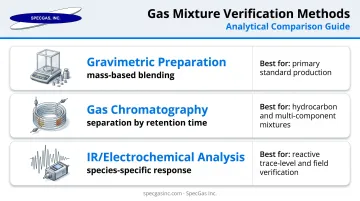
Three primary methods verify gas mixture composition:
| Method | Principle | Best For |
|---|---|---|
| Gravimetric preparation | Mass-based blending — component quantities weighed directly | Primary standard production; all concentration ranges |
| Gas chromatography (GC) | Separation and quantification by retention time | Hydrocarbon and multi-component mixtures |
| IR / electrochemical analysis | Species-specific absorption or electrochemical response | Reactive gases at trace levels; field verification |
Laboratory-prepared standards offer the lowest uncertainty because they're produced under controlled conditions and analytically verified before release. Field measurements add uncertainty from sampling equipment, transport, and ambient conditions — which is exactly why using a certified reference mixture to anchor field instrument calibration is more reliable than relying on field measurements alone.
What Happens When Mixture Composition Drifts
The consequences of off-spec calibration gas scale directly with the precision requirement of the application.
In emissions monitoring: EPA's 2011 Federal Register rule reported audit failure rates of 11% of gas components in 2003, 11% in 2009, and 10% in 2010 against Part 75 performance expectations — with the failure criterion set at a 2.2% absolute difference between audit and vendor values. Under 40 CFR Part 75, emissions data from a CEMS are invalidated from the hour of a failed calibration error test until a successful subsequent test is completed.
In confined space safety: OSHA states that inaccuracy from improper or irregular calibration can lead to exposure to toxic gases or oxygen-deficient atmospheres. A monitor calibrated against a drifted H₂S standard may alarm at the wrong threshold — or not alarm at all.
In semiconductor and process manufacturing: Reactant ratio shifts can propagate through process chemistry in ways that affect yield, product quality, or downstream contamination — often with no immediate observable signal.
The conditions that accelerate composition drift:
- Reactive trace-level components in untreated cylinders
- Temperature cycling during storage or transport
- Extended shelf time beyond the mixture's rated stability window
- High-pressure environments promoting non-ideal gas behavior
Each of these failure modes points to the same root cause. Proper cylinder treatment and controlled blending procedures are the primary mitigation — addressing the problem at the source, before a cylinder leaves the production floor.
Common Misunderstandings About Gas Mixture Properties
"The labeled concentration is exact." Every certified gas mixture has an associated uncertainty range. NIST is explicit: a CRM certificate gives a property value with associated uncertainty, not an exact absolute value. Using a 25 ppm CO standard as if it were exactly 25.000 ppm — when the certificate says ±2% — means you're ignoring up to 0.5 ppm of potential systematic error in every measurement anchored to it.
"Ideal gas equations cover all cases." For non-reactive gases at moderate pressures, ideal gas assumptions hold well. For reactive components at trace concentrations, or any gas at the pressures typical of compressed calibration cylinders, deviations are real. ISO 6142-1 and NIST gravimetric preparation methods exist precisely because volumetric ideal-gas calculations aren't sufficient for certified concentration work.
"One calibration gas mixture works across multiple instruments and applications." A 50 ppm H₂S mixture calibrated for one electrochemical sensor may produce systematic errors when used with a different sensor type, a different operating pressure, or a different response factor.
Response factors vary by instrument design. Applying a mixture outside its specified application range introduces errors that won't appear as obvious failures — they produce numbers that are wrong but look entirely plausible.
Conclusion
Gas mixtures are governed by well-defined physical laws — Dalton's Law, mole fraction relationships, and the ideal gas equation. But real-world performance depends on three things those equations don't fully capture: composition accuracy at the point of manufacture, stability across the mixture's service life, and proper certification that documents both.
For EPA CEMS compliance, OSHA confined space monitoring, trace-level semiconductor process control, or any analytical calibration where measurement validity matters, those three factors — composition, stability, and certification — determine whether measurements hold up under audit, equipment performs within spec, and compliance documentation survives scrutiny. The gas mixture is the fixed reference point for every instrument calibrated against it. Any drift in the mixture propagates directly into every downstream result.
Manufacturers like SpecGas address this directly through NIST-traceable gravimetric blending, proprietary cylinder treatment for reactive gas stability, and documented certification that follows the mixture from production through its full service life — so the reference stays accurate when it matters most.
Frequently Asked Questions
What is a mixture of gas called?
A mixture of gases is called a gas mixture or gaseous mixture. It is a homogeneous physical combination of two or more gases that retain their individual identities and properties without chemically reacting with one another.
What is an example of a gas mixture?
Common examples include air (nitrogen, oxygen, argon, and trace gases), natural gas (primarily methane with ethane and other hydrocarbons), and specialty calibration gases such as a certified blend of 25 ppm H₂S in nitrogen used to calibrate a confined space monitor.
What is Dalton's Law of Partial Pressures?
Dalton's Law states that the total pressure of a gas mixture equals the sum of the partial pressures of each individual component. Each component's partial pressure is the pressure it would exert if it alone occupied the same volume at the same temperature.
What is the mole fraction of a gas in a mixture?
Mole fraction is the ratio of moles of one component to the total moles of all components in the mixture. For ideal gases, it also equals the ratio of that component's partial pressure to the total mixture pressure.
How are specialty gas mixtures certified for accuracy?
Specialty gas mixtures are certified through gravimetric preparation by mass, analytical verification using methods such as gas chromatography or infrared analysis, and traceability to national measurement standards such as NIST. A certificate of analysis documents each component's concentration and associated uncertainty.
What causes a gas mixture to change composition over time?
The primary causes are adsorption of reactive trace components onto untreated cylinder walls, chemical reactions between components under pressure, and temperature-driven phase separation in vapor-pressure-limited mixtures. When evaluating a specialty gas supplier, ask specifically about their cylinder preparation process and whether reactive mixtures carry a documented stability guarantee.