Key Takeaways
- Non-reactive gases diffuse spontaneously into a uniform mixture, each contributing its own partial pressure — and that process is irreversible under normal conditions.
- Dalton's Law governs the outcome: total pressure equals the sum of each component's partial pressure.
- Three blending methods exist — partial pressure, gravimetric, and mass flow control — each suited to different accuracy requirements.
- Calibration, CEMS, and reactive gas applications require certified NIST-traceable blends to meet EPA and OSHA standards.
The Science of Gas Mixing: What Happens at the Molecular Level
When two non-reacting gases share a container, they don't stay separated. Molecular diffusion distributes both gases uniformly throughout the entire volume — spontaneously, without any external energy input. This is diffusion as defined by IUPAC: the spreading of gaseous material driven by concentration gradients until equilibrium is reached.
Why Mixing Is Irreversible
You can't simply "unmix" two gases after the fact — and the thermodynamics explain exactly why.
When two ideal gases mix at the same temperature and pressure, no enthalpy change occurs (ΔH = 0) — no heat released, no energy absorbed. What does change is entropy. The mixed state has higher disorder than the two separate gases, and nature favors that direction.
Entropy of mixing follows the expression ΔS_mix = −R Σ nᵢ ln xᵢ, which is always positive when mole fractions are less than 1. That entropy increase is what makes spontaneous separation impossible under normal conditions.
Mixing vs. Reacting: A Critical Distinction
Not all two-gas combinations behave the same way:
- Physical mixing only: Nitrogen and argon diffuse together without any chemical interaction — the mixture is stable indefinitely.
- Mixing with reaction: Hydrogen and oxygen mix just as readily, but introduce an ignition source and the result is combustion. The physical mixing happens first; the chemistry follows under the right conditions.
Identifying whether your two gases will react — and under what conditions — is the first decision in any gas mixing process.
Real Gas Deviations
At high pressures or with polar molecules, real gases deviate from ideal behavior — and those deviations have real consequences for precision blending. Ideal gas assumptions hold well at low pressures and moderate temperatures, but that range doesn't cover all applications.
Accurate gravimetric preparation of precision gas standards must account for these deviations using corrections such as virial coefficients. For high-pressure calibration gas cylinders, small compositional errors introduced by ignoring non-ideal behavior can compound into meaningful concentration inaccuracies.
Dalton's Law and Partial Pressures: The Governing Principles
Dalton's Law of Partial Pressures states that the total pressure of a gas mixture equals the sum of the partial pressures of each component. Each partial pressure is defined by IUPAC as pᵢ = xᵢ × P, where xᵢ is the mole fraction of the component and P is total pressure.
A Worked Example
Take a binary mixture of 75% nitrogen and 25% CO₂ at a total pressure of 1 atm:
- Nitrogen partial pressure: 0.75 × 1 atm = 0.75 atm
- CO₂ partial pressure: 0.25 × 1 atm = 0.25 atm
- Total: 0.75 + 0.25 = 1.00 atm ✓
The mole fraction directly determines each component's contribution to total pressure. This is what makes Dalton's Law practically useful: you can work backward from measured pressures to concentrations, or forward from target concentrations to required fill pressures.
Why This Matters in Practice
In analytical and monitoring applications, the partial pressure of a specific analyte gas — not total cylinder pressure — determines how an instrument responds. A sensor calibrated to detect 50 ppm CO doesn't "see" total pressure; it responds to the CO partial pressure contribution alone.
This dependency shows up across several critical use cases:
- Environmental monitoring and CEMS: Analyzer response ties directly to analyte partial pressure, not bulk cylinder fill
- Sensor calibration: Electrochemical and PID sensors respond to individual gas concentrations set by mole fraction
- EPA Protocol gas standards: The eCFR requires analytical uncertainty not exceed 2.0% of the certified concentration at a 95% confidence interval
Hitting that 2.0% uncertainty target requires controlling mole fraction — and therefore partial pressure — from the moment blending begins.
Methods Used to Mix Two Gases — and How to Do It Safely
The Three Primary Blending Methods
| Method | How It Works | Best For |
|---|---|---|
| Partial Pressure | Each gas is added sequentially to a cylinder; pressure readings confirm each component's contribution based on Dalton's Law | Field blending, moderate-accuracy applications |
| Gravimetric | Components are weighed as they are added; amount fractions calculated from masses and molar masses | Precision calibration gas standards; specified in ISO 6142-1:2015 |
| Mass Flow Control | Calibrated flow meters blend continuous gas streams in real time | Dynamic applications, online gas delivery systems |
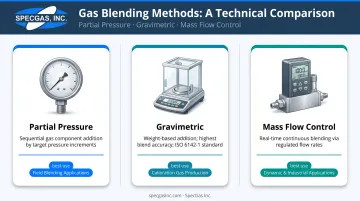
Of the three, gravimetric blending demands the most precision — and the most rigorous process controls.
Gravimetric blending, the method covered by ISO 6142-1:2015, offers the highest achievable accuracy for precision binary calibration gases. It involves transferring gas aliquots into an evacuated cylinder, adding the balance gas, then calculating composition from measured masses, molar masses, and known impurities. At higher pressures, virial coefficient adjustments are applied to correct for real-gas behavior.
Key Safety Principles
Before combining any two gases, confirm the following:
- Verify the two gases won't react at ambient conditions or in the presence of moisture, cylinder materials, or regulators.
- Know your flammability limits: hydrogen in air ignites from 4% to 75% by volume; in oxygen, that range extends to 4% to 94% for upward propagation. Mixtures near or within these ranges require explosion-proof environments, antistatic equipment, and regulatory compliance.
- Use containers rated for the intended fill pressure — never substitute an unrated vessel.
- Work in adequately ventilated spaces when handling toxic or asphyxiant gases.
- Match cylinder material to the gas: reactive or corrosive gases such as HCl, H₂S, and SO₂ require cylinders specifically compatible with those components, not general-purpose steel.
Common Two-Gas Mixtures and Their Industrial Applications
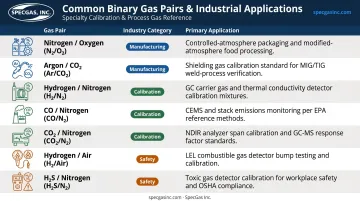
The most widely used binary gas combinations span a broad range of industries:
| Gas Pair | Typical Application |
|---|---|
| Nitrogen / Oxygen | Inert atmosphere control, combustion testing |
| Argon / CO₂ | MIG (GMAW) welding shielding; AWS A5.32 specifies minor component tolerances of ±10% relative |
| Hydrogen / Nitrogen | Leak detection, heat treating atmospheres |
| Helium / Oxygen (Heliox) | Commercial saturation diving; O₂ partial pressure managed to 0.40–1.25 bar depending on application |
| CO in Nitrogen | Calibration gas for CO monitors and CEMS |
| H₂S in Nitrogen | Gas detector calibration, petrochemical H₂S monitoring |
| SO₂ / NO in Nitrogen | Stack emissions CEMS calibration per EPA reference methods |
Ratio Selection Is Application-Specific
Welding applications prioritize arc stability and penetration depth — the argon/CO₂ ratio affects both. Calibration applications have entirely different priorities: concentration accuracy at ppm or ppb levels, with tolerances that can be single-digit percentages of the target value.
Those concentration requirements don't exist in isolation — some binary mixtures carry hard safety boundaries that constrain ratio selection entirely. A hydrogen/nitrogen mixture at 3.5% hydrogen sits safely below the LEL and is widely used for leak detection. That same mixture at 10% hydrogen crosses into flammable territory and requires segregated storage, specialized fittings, and different handling protocols. When the LEL is in play, the ratio determines the hazard classification.
When Precision Matters: Professional Specialty Gas Blending
Standard industrial gas blending typically carries tolerances of ±2–5%. For most fabrication or process heating applications, that's acceptable. For calibration gases used in EPA-regulated emissions monitoring, pharmaceutical analytical testing, or semiconductor process control, it isn't.
The Role of NIST-Traceable Standards
A two-gas calibration mixture is only as reliable as the documentation behind it. NIST defines metrological traceability as a documented, unbroken chain of calibrations linking a measurement result to specified reference standards, with each step contributing to measurement uncertainty. Without this chain, instrument calibration cannot be defended in regulatory audits, accreditation reviews, or compliance submissions.
For CEMS applications under 40 CFR Part 75, EPA Protocol gases must be certified against approved reference standards — NIST SRMs, NIST Traceable Reference Materials, or approved producer standards. The 2.0% analytical uncertainty ceiling at 95% confidence isn't a guideline; it's an enforceable requirement.
Reactive Gas Mixture Challenges
Binary blends involving reactive components — H₂S, SO₂, HCl, NO in nitrogen — face a challenge that pure gases don't: concentration drift. Reactive species can change their amount fraction over time through chemical reactions with cylinder walls or other mixture components. An H₂S/N₂ mixture that reads 50 ppm when filled may not read 50 ppm six months later in an untreated cylinder.
Cylinder passivation and specialized internal coatings prevent wall adsorption, maintaining certified concentration throughout the shelf life of the mixture. Without this treatment, low-ppm reactive blends are among the most common sources of calibration error in the field.
SpecGas Inc. for Demanding Binary Blend Requirements
SpecGas Inc. — founded by research chemist Alfred Boehm, whose specialty gas career began at Messer Griesheims Industries in Germany in 1976 — has spent over two decades focused specifically on the blending challenges that standard gas suppliers avoid. Alfred's early R&D work included internal cylinder treatment for reactive gas mixtures, knowledge that directly shaped SpecGas's current production process.
SpecGas produces NIST-traceable binary calibration gas mixtures using gravimetric blending. Key capabilities include:
- Concentration range: 300 ppb to 10% for reactive species including H₂S, SO₂, NO, NH₃, and CO
- Balance gases: Nitrogen and other carrier options available
- Cylinder options: Aluminum and nickel-plated cylinders with proprietary internal treatment
- Stability assurance: Backed by the SpecGas Stability Guarantee against concentration drift
- Turnaround: Standard and rush service for custom two-component blends
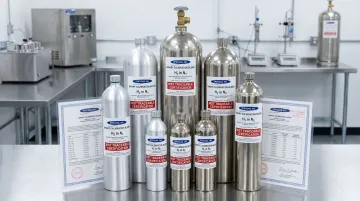
For CEMS operations, emissions monitoring labs, calibration facilities, and OEM manufacturers needing precise binary standards with documented traceability, SpecGas consistently delivers faster than typical industry lead times.
Frequently Asked Questions
What happens if you mix two gases?
Non-reactive gases diffuse spontaneously into a uniform mixture, with each gas retaining its own partial pressure. Total pressure equals the sum of individual partial pressures, entropy increases, and the mixing is effectively irreversible under normal conditions.
What is Dalton's Law of Partial Pressures?
Dalton's Law states that the total pressure of a gas mixture equals the sum of each component's partial pressure. Each partial pressure equals that gas's mole fraction multiplied by the total pressure, meaning a gas comprising 25% of a mixture contributes 25% of the total pressure.
Can all gases be safely mixed together?
No. Some combinations are flammable, explosive, or chemically reactive at ambient conditions. Compatibility must be verified before mixing; reactive or flammable blends require specialized equipment, safety protocols, and regulatory compliance before production or use.
What is the difference between a gas mixture and a gas blend?
The terms are often used interchangeably, but in the specialty gas industry, "blend" typically implies a precisely formulated, certified mixture with documented composition and uncertainty. A "mixture" can refer to any combined gas system, certified or not.
How are two-gas mixtures used in calibration?
A binary calibration gas at a known concentration — say, 50 ppm CO in nitrogen — serves as the reference to set or verify an analyzer's or sensor's response. Accuracy depends entirely on the mixture's certified concentration being NIST-traceable and within the stated tolerance.
What does NIST traceable mean for a gas mixture?
NIST traceability means the mixture's certified composition has been verified through an unbroken chain of calibrations linked to national measurement standards. That chain is required for regulated industries, accredited labs, and any application where calibration results must hold up under audit or compliance review.