Introduction
Most drivers pull up to the pump, choose their grade, and drive away without a second thought. What they don't see is that twice a year, the fuel itself quietly changes — same price sign, different chemistry.
The switch between winter and summer gasoline blends affects fuel economy, pump prices, engine performance, and air quality across every U.S. market. According to the EPA, gasoline vapor pressure is tightly regulated under the Clean Air Act because the wrong formulation in the wrong season creates measurable harm — either to engines or to the air.
For most drivers, this plays out as a puzzling price jump each spring and a slight MPG dip each winter. For fleet operators, environmental compliance teams, and emissions monitoring facilities, the seasonal chemistry shift has more direct operational implications.
Understanding what changes — and when — starts with one key property: Reid Vapor Pressure, the measure that drives every seasonal reformulation decision.
TL;DR
- Winter blend uses more butane, has higher vapor pressure, and costs less to produce — it exists to help engines start reliably in cold temperatures.
- Summer blend runs at lower vapor pressure with costlier additives, giving a modest fuel economy edge over winter gas.
- The EPA caps summer gasoline vapor pressure at 9.0 psi from June 1 through September 15 to limit smog-forming emissions.
- Drivers typically see prices drop $0.10–$0.30 per gallon when winter blend hits the market in fall.
- Neither blend is superior — each is engineered for its season.
Winter vs. Summer Gas Blends: Quick Comparison
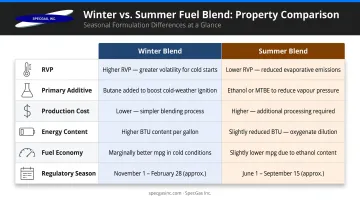
| Property | Winter Blend | Summer Blend |
|---|---|---|
| Reid Vapor Pressure | Higher (more volatile) | ≤9.0 psi federal; ≤7.0 psi in California |
| Primary additive | Higher butane concentration | Reduced butane; costlier alternatives like alkylate |
| Production cost | Lower | Several cents per gallon more expensive |
| Energy content per gallon | Slightly lower | Slightly higher |
| Fuel economy | Marginally lower MPG | Marginally better MPG |
| Regulatory season | September 15 – May 31 (retail) | June 1 – September 15 (retail) |
Reid Vapor Pressure: The Core Difference
Reid Vapor Pressure (RVP) is the measure of how readily a fuel evaporates at a standard temperature. This single metric drives most of the practical differences between the two blends.
- Winter blends run higher RVP so fuel vaporizes readily in cold air, ensuring reliable ignition when temperatures drop
- Summer blends cap RVP at a lower threshold to reduce fuel evaporation in heat, cutting the smog-forming volatile organic compounds (VOCs) that drive ozone regulations
The EIA notes that butane is the primary driver of winter blend's higher RVP. It's a low-cost, highly volatile component that refiners limit or remove in summer formulations, substituting more expensive alternatives like alkylate to maintain octane while keeping vapor pressure in check.
What Is Winter-Blend Gasoline?
What Is Winter-Blend Gasoline?
Winter-blend gasoline is a seasonally adjusted fuel formulation designed for cold-weather engine performance. It's the standard at U.S. pumps from approximately September 15 through late May in most regions.
How It Works
The core function is straightforward: cold air is dense, and fuel doesn't vaporize as readily at low temperatures. For an engine to start and run smoothly, the air-fuel mixture needs adequate fuel vapor to ignite. Winter blend achieves this through higher RVP (Reid Vapor Pressure), ensuring reliable vaporization even on sub-freezing mornings.
Butane is the key ingredient. It's inexpensive, highly volatile, and raises RVP efficiently, making it ideal for cold-start performance. The tradeoff is that the same volatility that helps engines at 10°F becomes a liability at 90°F, which is why refiners remove it before summer.
The Fuel Economy Tradeoff
Butane contains fewer energy units per gallon than the additives used in summer blend. The result is lower MPG during winter months. The gap is small enough that most drivers notice it only as a slight drop rather than a dramatic change, but it's consistent and measurable.
This isn't a quality issue. Winter blend meets the same industry and EPA standards as summer blend, just optimized for a different operating environment. Think of it as the same performance bar, calibrated for the season.
Where Winter Blend Matters Most
Winter blend's advantages are most apparent in specific situations:
- Fleet vehicles that sit overnight in unheated lots in northern states
- Daily drivers in regions with sustained sub-freezing temperatures
- Equipment that operates in cold outdoor environments — generators, agricultural machinery, and similar applications where reliable cold starts are non-negotiable
What Is Summer-Blend Gasoline?
Summer-blend gasoline is formulated to limit evaporative emissions during warm weather. Under Clean Air Act Section 211(h), the EPA caps gasoline RVP at 9.0 psi for the period running June 1 through September 15 at retail. Refiners and terminals face an earlier deadline of May 1 for the same period. California's standards are stricter, with CARB setting an RVP limit of 7.0 psi for oxygenated fuels.
Why the Regulation Exists
Heat accelerates fuel evaporation. Gasoline with high vapor pressure sitting in a hot tank — or moving through a hot fuel line — releases VOCs into the air. Those VOCs react with sunlight to form ground-level ozone and smog.
The EPA's RFG (Reformulated Gasoline) program, which includes low-RVP requirements, has contributed to cleaner air for an estimated 75 million people compared to pre-1995 air quality. Controlling fuel volatility during hot months is a direct mechanism for reducing that ozone burden.
Production Complexity and Cost
Summer blend costs refiners several cents per gallon more than winter blend to produce, according to EIA data. The reasons:
- Butane must be removed and replaced with costlier blending components
- The blending process is more involved
- Regional fuel specifications multiply significantly in summer, as states and metro areas enforce their own volatility requirements beyond the federal floor
- Gasoline yield per barrel of crude oil drops with lower-RVP formulations
This production cost flows through to pump prices, which is why spring brings higher gas prices in most U.S. markets.
Use Cases for Summer Blend
Summer blend carries the most significance in high-traffic urban areas where concentrated vehicle emissions and heat combine to accelerate ozone formation. The stricter RVP limits applied to cities like Los Angeles reflect the direct public health stakes of evaporative emissions in dense, warm environments.
For facilities monitoring ambient air quality and vehicle exhaust emissions, the seasonal fuel shift matters operationally. As fuel composition changes, so does the combustion byproduct profile — and instruments measuring those emissions need reference standards that reflect current conditions.
That's where calibration gas comes in. SpecGas Inc. produces NIST-traceable mixtures for NOx, VOCs, SO₂, CO, and formaldehyde monitoring, including standards supporting EPA Method 320 for stack emissions testing and CEMS calibration.
When and How Does the Seasonal Switch Happen?
The transition between blends follows a regulated schedule, and understanding the real-world mechanics helps explain why prices move the way they do.
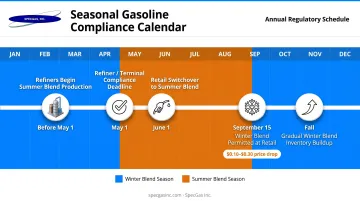
The Regulatory Timeline
| Date | Event |
|---|---|
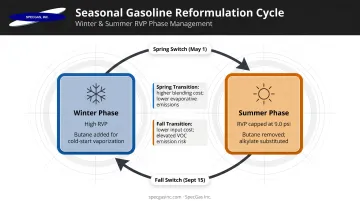
| Before May 1 | Refiners begin transitioning to summer-blend production |
| May 1 | Compliance deadline for refiners and bulk terminals |
| June 1 | Retail stations must switch to summer blend |
| September 15 | Retailers may begin selling winter blend again |
| Fall | Gradual transition back as winter-blend inventory builds |
Refiners typically start the production switch before the May 1 deadline to build inventory ahead of compliance. On the back end, stations hold summer blend until existing stock runs out before switching back in fall — which is why the transition rarely flips overnight.
Why Spring Gas Prices Spike
The transition period coincides with planned refinery maintenance — called "turnarounds" — which temporarily reduces supply. Combined with the higher production cost of summer blend, this creates the consistent spring price increase most drivers have noticed. According to AAA, drivers typically see prices drop by $0.10–$0.30 per gallon when winter blend becomes available after September 15, reflecting both lower production costs and reduced driving demand.
Emergency Waivers
The EPA has authority to issue emergency waivers suspending seasonal RVP requirements during supply disruptions. These have been issued when needed — including a nationwide low-volatility summertime gasoline waiver in 2020 and an Arizona-specific waiver in 2024. Fleet operators and fuel buyers in supply-constrained regions should factor in this flexibility when planning around seasonal transitions.
Winter vs. Summer Blend: Which Is Better for Your Vehicle?
Neither blend is universally better. The EPA's switchover schedule handles that decision automatically: the correct blend is at the pump when conditions require it.
Using the wrong blend creates real problems:
- Winter blend in summer: Higher evaporation in heat increases VOC emissions and raises the risk of vapor lock — where fuel vaporizes inside the fuel lines before reaching the engine, causing power loss or stalling
- Summer blend in winter: Lower volatility can cause hard starts and rough idling in very cold temperatures, particularly in northern states
Situational takeaways:
- Northern-state drivers benefit most from winter blend's cold-start performance — the formulation is doing meaningful work on those January mornings
- Warm-climate and urban drivers benefit most from summer blend's lower emission profile, though the 5–15 cents per gallon price premium reflects the added production cost
- Both groups benefit from understanding that seasonal price changes aren't arbitrary — they track the actual cost difference in refinery processing, additive sourcing, and regional distribution requirements
Frequently Asked Questions
What's the difference between summer blend and winter blend gasoline?
The core difference is Reid Vapor Pressure (RVP). Winter blend has higher RVP, achieved largely through added butane, which helps fuel vaporize in cold weather for reliable engine starts. Summer blend has lower RVP — capped at 9.0 psi federally — to prevent excess evaporation and the VOC emissions that contribute to smog in warm temperatures.
Do you get worse gas mileage with winter blend gas?
Yes, modestly. Butane contains fewer energy units per gallon than the components used in summer formulations, so winter blend delivers slightly less fuel economy. The difference is real but small — most drivers see it as a gradual MPG dip when the blend switches.
When does the switch from summer to winter blend occur?
Retail stations are permitted to begin selling winter blend on September 15 under EPA rules, though most transition once their summer-blend inventory runs out. The spring switchover deadline for most refiners and terminals is May 1, with retail stations following by June 1.
Is it harmful to use winter blend gas in the summer?
It won't immediately damage a modern engine, but it increases evaporative VOC emissions and raises the risk of vapor lock in extreme heat, which can cause stalling or power loss. This is why the EPA restricts its sale during warm months.
Why is winter blend gas cheaper than summer blend?
Winter blend uses more butane, which is less expensive than the additives needed to achieve summer blend's lower RVP. Summer blend also costs more to produce due to a longer refining process and lower gasoline yield per barrel of crude oil.
Can the EPA waive seasonal blend requirements?
Yes. The EPA has authority to issue emergency waivers suspending RVP restrictions during supply disruptions, natural disasters, or pipeline outages. This has happened multiple times in recent years — including nationwide and regional waivers in 2020 and 2024 — to prevent localized fuel shortages.