Introduction
Gas mixtures are everywhere — from the air filling your lungs to the precisely blended standards inside a calibration cylinder sitting next to an emissions analyzer. Most people recognize air as a mixture, but fewer understand what makes it homogeneous, or why that distinction matters the moment you attach a gas standard to a monitoring instrument.
A homogeneous gas mixture has one defining property: uniform composition throughout. Pull a sample from any point in the container, and you get the same ratio of components every time. That consistency is what makes them scientifically useful — and what determines whether a calibration standard produces trustworthy readings or introduces systematic error into every measurement that follows.
What follows covers real-world examples organized by category — from atmospheric gases and fuel blends to precision calibration standards — along with the chemistry behind their stability and what it takes to keep engineered mixtures accurate in the field.
Key Takeaways
- A homogeneous gas mixture has uniform composition throughout — every sample drawn from any point reflects the same component ratios.
- Gases mix homogeneously by default because molecular motion, wide spacing, and weak intermolecular forces drive complete diffusion.
- Natural examples include dry atmospheric air (~78% N₂, ~21% O₂) and pipeline-quality natural gas.
- Industrial and scientific examples span calibration gas standards, excimer laser blends, and anesthetic mixtures like Entonox.
- For calibration and research applications, achieving homogeneity at blending time and maintaining it through shelf life are equally critical.
What Is a Homogeneous Gas Mixture?
According to IUPAC, a homogeneous mixture has the same composition throughout, with no separate components identifiable by visual inspection. For gas mixtures specifically, homogeneity means composition, density, and temperature are uniform across the entire sample.
Why Gases Mix Homogeneously
Gases mix this way almost automatically. Kinetic molecular theory explains why: gas molecules are in continuous random motion, negligibly small relative to the distances between them, and exert minimal forces on each other. When two gases occupy the same container, their molecules diffuse freely until they're evenly distributed — no phase boundary forms, no separation occurs.
Liquids and solids behave differently. Density differences in liquids can cause layering; solid mixtures may have components that cluster unevenly. Gases sidestep both problems entirely.
Where the Boundary Is
A gas mixture becomes heterogeneous when it contains suspended liquid droplets or solid particles — what IUPAC classifies as an aerosol. NASA identifies atmospheric aerosols ranging from a few nanometers to tens of micrometers, including mineral dust, smoke, volcanic ash, and sea salt. These particles don't dissolve into the gas phase; they remain as a separate dispersed phase.
In practice, the line looks like this:
| Homogeneous | Heterogeneous |
|---|---|
| Clean, dry air | Fog |
| Calibration gas mixtures | Smoke |
| Noble gas blends | Mist-laden air |
The distinction isn't always visible to the naked eye — which is exactly why analytical and calibration applications rely on defined composition standards rather than appearance alone.
Key Examples of Homogeneous Gas Mixtures
Homogeneous gas mixtures appear across naturally occurring environments, manufactured industrial applications, and controlled scientific settings. Each category carries distinct composition requirements; engineered applications add strict accuracy demands on top of that.
Naturally Occurring Gas Mixtures
Dry atmospheric air is the most familiar example. According to NOAA, dry air consists of approximately:
| Component | Concentration by Volume |
|---|---|
| Nitrogen (N₂) | 78.084% |
| Oxygen (O₂) | 20.946% |
| Argon (Ar) | 0.934% |
| Carbon dioxide (CO₂) | 0.042% |
This composition is uniform throughout any given atmospheric layer, making dry air a textbook homogeneous gas mixture. The caveat: once air carries suspended water droplets (fog) or particulates (smoke, dust), it shifts into heterogeneous territory.
Pipeline-quality natural gas is a second naturally occurring example. The EIA describes processed natural gas as a dry, consumer-grade blend primarily composed of methane, with smaller amounts of ethane, propane, and other hydrocarbons. A typical pipeline composition per NAESB specifications shows approximately 94.9 mol% methane, 2.5 mol% ethane, and 0.2 mol% propane.
That compositional uniformity is precisely what gives utilities and industrial users their consistent energy content.
Industrial and Calibration Gas Mixtures
Engineered calibration gas mixtures take homogeneity further than nature does — they require verified, certified uniformity at specific concentrations, often at parts-per-million or parts-per-billion levels.
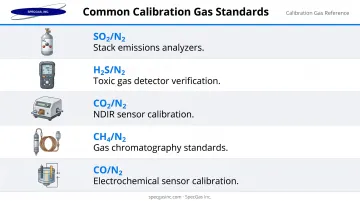
Common calibration gas applications include:
- SO₂ in nitrogen at low ppm for stack emissions analyzers (CEMS)
- O₂ in nitrogen for oxygen sensor calibration
- H₂S in nitrogen from 300 ppb to 10% for toxic gas detector verification
- NO/NOx at low ppm for air quality and combustion monitoring
- CO₂ in nitrogen for NDIR sensor calibration
EPA Protocol Gases must be vendor-certified within 2.0% of the cylinder label concentration. NIST has certified more than 19,000 gas-mixture NTRM standards since 1992, providing the traceability chain that connects field instruments to primary standards.
Specialty multi-component blends push the complexity further. Excimer laser gas mixtures (used in semiconductor photolithography and medical procedures) contain precise ratios of reactive and rare gases. A KrF (248 nm) laser blend, for example, contains approximately 1% krypton, 0.1% fluorine, and a neon balance. ArF (193 nm) and XeCl (308 nm) systems each require their own specific ratios, where even minor deviations directly affect laser output wavelength and energy stability.
SpecGas Inc. produces NIST-traceable calibration gas blends and specialty multi-component mixtures across all of these categories, including stable reactive gas standards. A proprietary internal cylinder treatment process maintains homogeneity and compositional accuracy throughout the cylinder's service life.
Medical and Scientific Gas Mixtures
Entonox is the 50% nitrous oxide / 50% oxygen blend used in pain management and procedural anesthesia. It is a verified homogeneous gas mixture where consistent ratios are non-negotiable: concentration errors translate directly to patient risk.
Research and laboratory gas mixtures place equally strict demands on homogeneity:
- CO₂/N₂ blends for cell culture incubators — typically 5% CO₂ — must be uniform to maintain stable pH in bicarbonate-buffered media; any concentration drift shifts cell growth conditions
- GC carrier gas blends (helium, argon, argon/methane 5% for ECD applications) require high purity and consistent composition to deliver reproducible chromatographic results
- Certified air quality reference standards used in ambient monitoring programs must trace to NIST primary standards to support regulatory data quality objectives
Why Homogeneous Gas Mixtures Matter in Science and Industry
The connection between homogeneity and measurement reliability is direct. As OSHA states in its guidance on portable gas monitor calibration: "the instrument can only be as accurate as the test gas used for calibration."
If the calibration gas is not compositionally uniform — whether due to stratification, adsorption, or improper preparation — every reading that instrument produces is suspect. In CEMS applications governed by 40 CFR Part 75, that means inaccurate emissions data submitted to regulators. In confined space monitoring, it means a gas detector that may fail to alarm.
Homogeneity also makes results repeatable. When a semiconductor fab runs a thin-film deposition process or a research lab measures trace atmospheric pollutants, consistent gas composition is what allows results to be compared across runs, across instruments, and across facilities. Without it, there is no reliable baseline to measure deviation against.
When homogeneity fails, the consequences compound quickly:
- Reactive components adsorb onto cylinder walls, reducing effective concentration
- Heavier components can stratify under certain conditions, creating concentration gradients
- Moisture ingress or reactive contaminants alter the mixture composition over time
- Result: instrument drift, failed quality audits, wasted product, and potentially unsafe readings
What Determines Whether a Gas Mixture Stays Homogeneous?
Gases mix homogeneously in theory. Maintaining that homogeneity inside a pressurized cylinder over months or years is a separate engineering challenge.
Thermal Energy vs. Gravity
An LLNL analysis of compressed gas cylinders found that molecular thermal energy exceeds gravitational potential energy by more than 3 orders of magnitude in a standard cylinder — meaning gravity alone won't cause stratification under normal conditions. However, without mechanical mixing, diffusion can take over 300 days for a 3,000 psia cylinder containing 60% helium / 40% nitrogen to reach complete homogeneity. Proper blending procedures matter from the start.
Reactive Gas Stability
Diffusion timelines are manageable. The harder long-term challenge is reactivity. A 2023 paper in Measurement Science and Technology documented adsorption losses for compounds including H₂S, HCl, ammonia, water, and methanol — with methanol showing losses around -9% at 5 µmol/mol in some reference gas standards. The same research confirmed that proprietary cylinder surface treatments, including amorphous silicon coatings, measurably reduced adsorption losses.
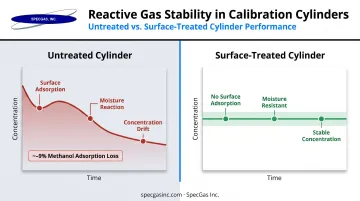
Common threats to long-term mixture stability:
- Surface adsorption of reactive components (H₂S, NO, SO₂, HCl, NH₃) onto cylinder walls
- Moisture contamination reacting with reactive gas species
- Pressure-related changes affecting solubility and diffusion dynamics
- Temperature cycling during transport and storage
Cylinder Treatment and Verification
SpecGas addresses these challenges with a proprietary internal cylinder treatment process developed through decades of reactive gas R&D, tracing back to founder Alfred Boehm's work at Messer Griesheims Industries beginning in 1976. SpecGas uses specially-treated aluminum cylinders for reactive mixtures including H₂S, NO, SO₂, NH₃, HCl, and formaldehyde, with the SpecGas Stability Guarantee backing the long-term accuracy of those blends.
Verification through NIST-traceable analytical methods is the final confirmation step. ISO 6142-1 requires gravimetric preparation, uncertainty calculation, and stability estimation for calibration gas mixtures.
A blend can be prepared correctly and still require analytical certification before it's fit for regulated use. That's why properly certified, expiration-dated gas standards are required under EPA Protocol and OSHA calibration guidelines.
Conclusion
Homogeneous gas mixtures — from dry atmospheric air to precision-blended calibration standards — share one defining property: uniform composition throughout. That uniformity makes them predictable, reproducible, and scientifically useful. That uniformity isn't accidental in naturally occurring gases; it's a direct consequence of how gas molecules behave. In engineered applications, it's the product of careful blending, appropriate cylinder selection, and rigorous analytical verification.
The distinction between naturally occurring and manufactured homogeneous gas mixtures matters in practice. Industrial, research, and environmental monitoring applications don't just need gases that are homogeneous when blended: they need mixtures that remain stable and accurately composed through months of storage, draw-down, and field use.
That's where cylinder preparation, material compatibility, and certified traceability become as important as the chemistry itself. For calibration gas standards in particular — where a 5 ppm shift in H2S or NO concentration directly affects instrument readings — verified stability from fill date to last draw is what separates a reliable standard from a liability. Companies like SpecGas Inc. address this through proprietary internal cylinder treatment and NIST-traceable gravimetric blending, ensuring that the homogeneity achieved at the time of production holds through the life of the cylinder.
Frequently Asked Questions
What is a homogeneous mixture of gases?
A homogeneous gas mixture is a single-phase combination of two or more gases where composition is uniform throughout — any sample drawn from any point contains the same ratio of components. Dry atmospheric air is the most common example, with nitrogen, oxygen, and argon distributed evenly throughout.
What are 5 examples of a homogeneous mixture?
Five examples across phases: atmospheric air (gas), pipeline natural gas (gas), a certified calibration gas blend (gas), saline solution (liquid), and steel (solid). Each has uniform, single-phase composition — no visible boundaries separate one component from another.
Is air a homogeneous mixture?
Dry atmospheric air is a homogeneous gas mixture of nitrogen (~78%), oxygen (~21%), argon (~0.93%), and trace gases including CO₂. However, air carrying suspended water droplets (fog) or particulates (smoke, dust) becomes heterogeneous because those particles form a separate dispersed phase.
What is the difference between a homogeneous and heterogeneous gas mixture?
A homogeneous gas mixture has uniform composition with no visible phase boundaries — every sample is identical. A heterogeneous gas mixture contains non-uniformly distributed components or suspended particles. Clean air vs. smoke-filled air is a clear contrast: the smoke particles create a separate solid phase dispersed through the gas.
How are homogeneous gas mixtures used in calibration?
Precisely blended, NIST-traceable calibration gas mixtures serve as reference standards to set and verify analytical instruments. Their homogeneity ensures every draw from the cylinder delivers the same certified concentration — critical for emissions monitors, gas detectors, and chromatography systems where measurement accuracy depends on the reference gas.
Can a gas mixture become heterogeneous over time?
Yes. Reactive components can adsorb onto cylinder walls or undergo moisture-related reactions, shifting composition over time. Proper cylinder treatment, correct storage conditions, and respecting shelf-life limits are essential for maintaining homogeneity in reactive gas standards.