Introduction
When a CO2 laser starts losing cut depth or pulling more power than usual, the gas mixture is often the first place to look. Carbon dioxide, nitrogen, helium, and trace additives don't just fuel the system — they're the active medium through which the beam is generated. Get the ratio wrong, let contamination creep in, or skip routine monitoring, and the consequences follow: reduced cutting power, unstable beam quality, damaged optics, and unplanned downtime.
What makes this tricky is that degradation is gradual. It rarely announces itself with a sudden failure. Cut depths get shallower, power draw climbs, mirrors need cleaning more often — the decline is incremental until it's impossible to ignore.
This guide covers why mixture composition matters, what each component gas actually does, how to spot mixture-related problems, and a practical framework for monitoring and replacement.
Key Takeaways
- CO2 lasers require a precise blend of CO2, N2, He, and trace additives; ratio accuracy and gas purity determine beam quality and equipment longevity
- Each component has a defined role: N2 transfers excitation energy, CO2 emits the laser beam, He cools the system and sustains population inversion
- Warning signs include gradual power loss, inconsistent cut quality, rising power draw, and discharge instability
- Sealed-tube systems need active CO2 regeneration management; flow-through systems require regular replenishment and purging discipline
- Sourcing NIST-traceable, precision-blended resonator gas eliminates batch variability and protects sensitive optics
Why CO2 Laser Gas Mixture Optimization Matters
The gas mixture isn't a background consumable you swap on a fixed schedule — it's the medium through which lasing occurs. Any deviation from the correct composition has a direct effect on beam intensity, wavelength stability, and how efficiently the laser converts electrical input into usable output.
Efficiency Is More Fragile Than It Looks
According to RP Photonics, CO2 lasers achieve wall-plug efficiencies of 10–20% under well-optimized conditions. Industrial systems typically land in the 10–15% range. That's already a narrow window, and it depends on the resonant energy transfer between N2 and CO2 molecules operating at the right partial pressures. Even modest ratio imbalances disrupt the population inversion needed for lasing and push efficiency toward the lower end of that range — or below it.
Contamination Attacks Your Optics
Impurities in the resonator gas don't just reduce efficiency — they damage optics. Under laser irradiation, contaminants in the beam path burn into reflective surfaces. According to EOC, contamination that increases absorption by just one part per thousand can be enough to trigger laser damage on copper and gold-coated mirrors.
Optic replacement costs vary by laser class and mirror type, but the combination of component cost and labor makes contamination-related optic damage one of the more avoidable expensive failures in laser maintenance. Damage caused by gas contamination is typically excluded from manufacturer warranties.
Sealed-Tube Systems Have a Built-In Chemistry Problem
In sealed-tube CO2 lasers, electrical discharge continuously dissociates CO2 into CO and oxygen. Without proper regeneration management — typically via small amounts of H2 or water vapor that catalytically re-oxidize CO back to CO2 — output power declines steadily regardless of how many hours the laser has run.
Trotec confirms that sealed-off lasers add oxygen, water vapor, and hydrogen specifically to drive this reformation reaction over a platinum catalyst. Managing this chemistry is what keeps sealed-tube systems productive over time. Skip it, and output loss is inevitable.
Precision Applications Require Consistent Output
In regulated industries, beam consistency is a hard requirement, not a preference. A degraded gas mixture can push output below what applicable standards allow — without any other hardware fault.
Industries where this matters most:
- Semiconductor manufacturing — process uniformity depends on repeatable beam parameters
- Medical laser systems — IEC 60601-2-22 imposes output and stability requirements
- Emissions monitoring — NDIR and similar analyzer lasers require stable wavelength for accurate readings
- Beam quality testing — ISO 11146 parameters are directly affected by output degradation
These standards don't specify gas composition, but they define the performance thresholds a poorly maintained mixture will cause a system to miss.
The Role of Each Component Gas in the CO2 Laser Mixture
The CO2 laser gas mixture isn't arbitrary. Each component was selected for a specific function in the excitation-emission cycle. Changing ratios without understanding these roles can silently degrade performance in ways that are easy to misattribute.
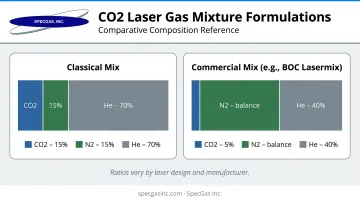
A classical mixture runs approximately 15% CO2, 15% N2, and 70% He, though exact ratios vary by laser design and manufacturer. Commercial premixed products like BOC's Lasermix use different proportions (5% CO2, 40% He, balance N2), illustrating that there's no single universal formulation.
Carbon Dioxide (CO2) — The Lasing Medium
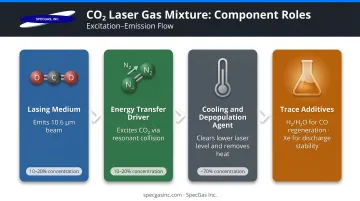
CO2 molecules emit the laser beam through vibrational-rotational transitions, producing the characteristic 10.6 µm wavelength (with other lines available between 9–11 µm). Typical concentrations in the discharge tube sit around 10–20%.
Too much CO2 isn't better. At elevated concentrations, self-absorption and quenching reduce output rather than increasing it. The gas is also reactive — partial dissociation to CO is continuous during discharge, and in sealed systems, this ratio drift directly suppresses output if left unmanaged.
Nitrogen (N2) — The Energy Transfer Driver
N2 is the primary pumping intermediary. Electrons in the discharge excite N2 into a long-lived metastable vibrational state, and because N2's v=1 level is nearly resonant with CO2's asymmetric stretch upper laser level (energy difference of just ~18 cm⁻¹), molecular collisions transfer energy with very high efficiency. Since N2 is a homonuclear molecule, it can't release energy through photon emission — everything it absorbs goes directly to CO2, making it an ideal intermediate carrier. Typical concentrations run 10–20%; both under- and over-concentration affect excitation efficiency and output power.
Helium (He) — The Cooling and Depopulation Agent
Helium makes up the majority of the mixture and handles two jobs that nothing else can substitute for:
- Collisionally empties the lower laser level after emission, sustaining population inversion
- Transfers waste heat from the gas to the resonator walls, enabling continuous-wave operation
According to ScienceDirect Topics, insufficient helium causes heat buildup, reduced discharge stability, and lower average electron energy — all of which degrade efficiency. Neon and argon cannot replace it; their thermal and collision properties are fundamentally different.
Minor Additives — Regeneration and Tuning
In sealed-tube systems, trace additives are what extend gas life:
- H2 and water vapor catalyze CO-to-CO2 re-oxidation, counteracting discharge-driven dissociation
- Xenon improves discharge stability, particularly at lower operating voltages
Concentration precision is critical here. A US patent on sealed RF CO2 lasers documents that excess H2 and H2O measurably slow the collision relaxation rate of the CO2 upper laser level — meaning too much of a corrective additive actively suppresses output.
This is where supplier quality matters most. Getting these trace ratios right requires gravimetric blending and tight analytical controls. SpecGas's NIST-traceable premixed blends — covering CO2, N2, He, H2, and Xe — are gravimetrically blended and come with a certificate of analysis confirming composition, verified batch to batch.
Signs Your CO2 Laser Gas Mixture Needs Attention
Gas mixture degradation is frequently misattributed to optics wear, alignment drift, or power supply aging. Recognizing the specific indicators of gas-related performance loss saves time and avoids replacing components that aren't actually failing.
Gradual Power Loss or Output Inconsistency
A steady decline in cutting depth, engraving contrast, or processing speed — particularly in sealed-tube systems — often signals CO2-to-CO dissociation reducing the active lasing medium. The key distinction from optic contamination: optics contamination tends to cause a more sudden drop; gas-related decline is progressive.
Omniseal Solutions notes that in sealed CO2 laser systems, power may decrease over time or reduce significantly during operation, making the beam unstable and affecting production quality.
Poor Cut Quality or Beam Profile Irregularities
Gas mixture imbalance pushes lasing onto unintended rotational-vibrational transitions or produces mode instability. This shows up as:
- Ragged or inconsistent cut edges
- Incomplete engraving at previously reliable power settings
- Asymmetric beam profiles that alignment checks don't resolve
Abnormally High Power Consumption
When gas mixture efficiency drops due to N2/CO2 ratio drift, helium depletion in slow-flow systems, or CO buildup, the laser controller compensates by pulling more discharge power to maintain output. A measurable increase in energy consumption for the same workload is a direct indicator of gas-related efficiency loss.
The Fabricator reports that failure to properly purge ambient air before connecting to a resonator can cause the laser to consume significantly more power and eventually require technical repair.
Discharge Instability or Unexpected Shutdowns
Contaminated or depleted gas changes the electrical properties of the discharge medium: breakdown voltage, discharge uniformity, and ignition behavior all depend on gas composition. Symptoms include arc instability, premature shutdowns, or repeated failure to ignite at normal operating settings.
Research published in Optics and Lasers in Engineering found that CO and O2 additives at elevated concentrations can cause discharge contraction, power overshoots, and suppressed efficiency. Fresh-gas power overshoot in these conditions can exceed three times the steady-state set power.
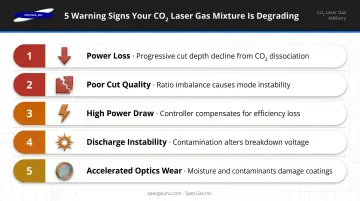
Accelerated Optics Degradation
If mirrors or lenses need cleaning or replacement more frequently than the manufacturer's expected interval, gas contamination is a likely contributor. Moisture is especially problematic. According to The Fabricator, moisture in resonator gas can be absorbed into optical coatings, decrease power output, and destabilize the beam — and this damage typically falls outside warranty coverage.
CO2 Laser Gas Mixture Monitoring and Replacement Schedule
There's no universal replacement interval. The right schedule depends on laser type, duty cycle, and whether you're running premixed cylinders or separate component gases. The table below provides a practical starting framework.
| Interval | Task |
|---|---|
| Per use | Verify inlet pressure on resonator gas supply; purge lines on any new cylinder hookup before connecting to resonator |
| Weekly | Review power draw vs. output trend; note any increase in discharge power needed to maintain set output |
| Monthly | Compare current output power against original baseline specs; inspect inline filters and replace if discolored or partially blocked |
| Quarterly | Full beam quality check; review cutting/engraving consistency across representative test materials |
| Annually / at power decline | Flow-through systems: evaluate reservoir gas, purge and replenish; sealed-tube systems: assess output vs. original spec and consult manufacturer or gas supplier on regeneration status |
Sealed-Tube vs. Flow-Through Considerations
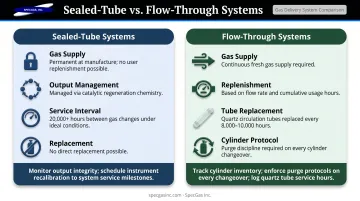
These two system types require different approaches:
- Sealed-tube lasers — gas is permanent at manufacture; output decline driven by CO2 dissociation is managed through catalytic regeneration chemistry in the initial fill. Photonics.com notes that no-flow slab lasers can run more than 20,000 hours between gas changes under ideal conditions, but dissociation rates vary by excitation method and duty cycle
- Flow-through systems — axial and cross-flow CO2 lasers require a continuous supply of fresh gas; replenishment intervals depend on flow rates and usage hours. Quartz circulation system tubes typically need replacement every 8,000–10,000 hours
Low-Usage vs. High-Duty-Cycle Scenarios
- Low-usage systems can go longer between formal checks, but purge discipline on cylinder changeovers remains non-negotiable
- High-duty-cycle systems should run the monthly checks on a more frequent cadence and track power consumption trends closely
Sourcing Matters as Much as Scheduling
Batch-to-batch variation from a gas supplier is a direct source of recurring performance problems. A slightly different N2/CO2 ratio on reorder introduces a variable that's easy to misread as equipment drift — triggering unnecessary maintenance or recalibration cycles.
The fix is a supplier who blends to a verified, repeatable spec. SpecGas produces precision-blended resonator gas mixtures using NIST-traceable gravimetric blending, with all components — CO2, N2, He, H2, Xe — blended in-house and verified before shipment. Rush service is available for urgent changeovers, so operators aren't forced to stockpile inventory as a buffer against delivery uncertainty.
Conclusion
The CO2 laser gas mixture is a performance-critical variable at every stage of a laser system's life — not a set-it-and-forget-it consumable. Ratio accuracy, gas purity, and active monitoring directly shape beam quality and optic longevity — and ultimately determine how efficiently the system converts power into useful output.
A structured approach delivers measurable results: knowing what each component does, recognizing early warning signs before they escalate, and sourcing from a supplier who can deliver consistent, verified blends on a reliable timeline. Together, those three practices do more to protect a CO2 laser investment than any single hardware upgrade or reactive repair schedule ever could.
Frequently Asked Questions
What is the ratio of gas mixture in a CO2 laser?
A typical CO2 laser mixture runs approximately 10–20% CO2, 10–20% N2, with helium making up the remainder, plus trace amounts of H2, Xe, or water vapor depending on system design. Exact ratios vary by manufacturer and application — commercial premixed products reflect this variability, so always verify the specification for your laser model.
What gas purity grade is required for CO2 laser resonator gas?
Resonator gases generally require Grade 5 (99.999%) purity or better. Even trace moisture, oxygen, or particulate contamination can damage gold-coated and metallic mirrors and destabilize beam quality. Lower-grade industrial gases are not suitable for resonator use.
What role does helium play in a CO2 laser gas mixture?
Helium depopulates the lower laser level after emission (a necessary step to sustain population inversion) and transfers waste heat from the gas to the resonator walls. Without adequate He concentration, the laser cannot sustain efficient continuous-wave operation, and heat buildup accelerates.
What happens if the gas mixture ratio is wrong in a CO2 laser?
Incorrect ratios reduce output power, cause discharge instability, accelerate CO2 dissociation in sealed systems, or push lasing onto unintended spectral lines. All of these degrade performance and can shorten both optic and tube service life.
How often should CO2 laser resonator gas be replaced?
Sealed-tube lasers don't allow direct gas replacement; output stability depends on the regeneration chemistry built into the original fill. Flow-through systems need replenishment based on usage rate and flow volume. A sustained output decline from baseline is the most reliable trigger for gas-related service.
Can I use a premixed resonator gas cylinder instead of separate gas components?
Yes. Premixed cylinders are widely used and offer consistency advantages over on-site component mixing. The critical factor is sourcing from a supplier who provides verified, NIST-traceable blends with documented ratio accuracy. Low-quality suppliers frequently introduce batch-to-batch inconsistency — a preventable problem that drives recurring performance issues.