Introduction
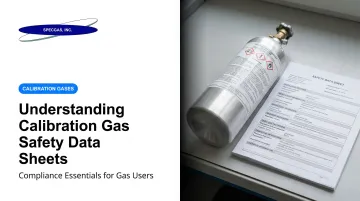
A new calibration gas cylinder arrives at your facility. Before connecting the regulator, opening the valve, or placing it in storage — the first document you should have in hand is the Safety Data Sheet.
This isn't a formality. Calibration gases present documentation challenges that generic chemical SDS guidance rarely covers. Many mixtures contain trace toxic constituents — CO, H2S, SO2, NO — at concentrations that look harmless on a label but trigger acute toxicity classifications under GHS. The balance gas might be nitrogen, which seems inert until it displaces oxygen in a confined space.
Understanding how to read a calibration gas SDS — and what to demand from your supplier's documentation — is the difference between managed risk and an incident waiting to happen.
Key Takeaways
- An SDS is legally required under OSHA HazCom 2012 for every hazardous chemical in the workplace — all calibration gases qualify
- The GHS 16-section format is standardized; once you know it, any SDS is readable
- Trace toxic components (CO, H2S, SO2) can trigger disclosure and classification at 0.1% concentration or lower
- Compressed gas physical hazards apply to every cylinder regardless of chemical content
- Keep both an SDS and a Certificate of Analysis (CoA) on file — each answers questions the other cannot
What Is a Calibration Gas Safety Data Sheet?
SDS vs. Certificate of Analysis
A Safety Data Sheet is a standardized hazard communication document required under OSHA's Hazard Communication Standard (29 CFR 1910.1200) and the Globally Harmonized System (GHS). It tells users, employers, and emergency responders about chemical hazards, safe handling procedures, exposure limits, and emergency response measures.
A Certificate of Analysis (CoA) serves a different purpose: it certifies the composition and concentration accuracy of the gas mixture, typically through NIST-traceable gravimetric verification. SpecGas Inc. documents that blending precision in the CoA, not the SDS.
The practical distinction matters:
- SDS: What hazards apply? How must this cylinder be handled, stored, and shipped?
- CoA: What exactly is in this cylinder, and at what certified concentration?
You need both on file. During an OSHA inspection, presenting a CoA in place of an SDS won't satisfy the Hazard Communication Standard — they document different things and neither substitutes for the other.
Why Calibration Gases Get Special Attention
Even when the balance gas is nitrogen or air, trace components in a calibration mixture can make the SDS far more complex than the cylinder label implies. OSHA's health hazard criteria require disclosure for ingredients above cut-off limits — 1% for most health hazards, but 0.1% for carcinogens, germ-cell mutagens, and Acute Toxicity Categories 1–3.
A 50 ppm H2S component in a nitrogen balance mixture is well under 0.1% by volume, yet it may still require SDS disclosure and classification depending on how the hazard assessment is applied to the mixture as a whole.
OSHA also requires employers to maintain SDSs in the workplace for every hazardous chemical in use, and to update them within 3 months of learning significant new hazard information.
Breaking Down the Key SDS Sections for Calibration Gases
All compliant SDS documents follow the GHS-mandated 16-section structure. OSHA enforces Sections 1–11 and 16; Sections 12–15 are included for GHS consistency but are not directly enforced by OSHA under HazCom.
Sections 1–3: Identification and Composition
Section 1 covers product identity, supplier contact details, and intended use. For calibration gas, verify that the product name on the SDS matches the cylinder label exactly, and confirm the supplier's emergency contact number is current and reachable around the clock.
Section 2 is your first-read checkpoint. It contains:
- GHS hazard classifications
- Signal words: Danger (more severe hazards) or Warning (less severe)
- Hazard statements describing the nature and degree of risk
- Precautionary statements outlining protective measures
For calibration gas mixtures, Section 2 will often list multiple classifications — compressed gas, simple asphyxiant, and acute toxicity — simultaneously.
Section 3 lists all hazardous components above threshold concentrations, including CAS numbers. This is where a multi-component calibration blend reveals its full hazard profile. A 25 ppm CO component in a four-gas mixture still belongs here.
Sections 4–8: Handling, Storage, and Exposure Controls
Sections 4–6 address first aid, fire-fighting, and accidental release. For calibration gas cylinders, these sections cover both chemical hazards and pressurization risks — a burst or leaking cylinder is a physical hazard even before the chemical hazard is considered.
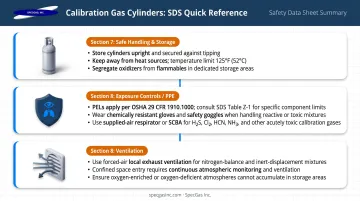
Sections 7 and 8 form the operational core of day-to-day safe use:
- Section 7 details safe handling and storage conditions — upright storage, secured cylinders, temperature limits
- Section 8 lists Permissible Exposure Limits (PELs) and required PPE
- Ventilation requirements in Section 8 apply even for nitrogen-balance mixtures commonly treated as inert in enclosed spaces
Sections 9–16: Physical Properties, Transport, and Regulatory Data
Sections 9–10 address physical/chemical properties and reactivity. For reactive calibration gases — mixtures containing H2S, ammonia, or chlorine — this section defines incompatibilities and stability conditions that directly affect where and how cylinders can be stored.
Section 14 is your DOT compliance reference. It should include the UN identification number, proper shipping name, DOT hazard class/division, and packing group. Under 49 CFR 172.202, this information must appear on shipping papers — review Section 14 before any cylinder leaves your dock.
Hazard Classifications Most Common in Calibration Gases
Compressed Gas and Simple Asphyxiant
Every calibration gas cylinder qualifies as a compressed gas under GHS — any gas in a receptacle at ≥200 kPa gauge pressure at 20°C. This physical hazard classification applies regardless of whether the chemical content poses any toxicological risk. Cylinder securing, upright storage, and transport requirements all flow from this classification.
Nitrogen, argon, and helium are commonly used as balance gases. OSHA has confirmed that nitrogen carries an inherent simple asphyxiant hazard. In confined or poorly ventilated spaces, these gases can displace oxygen below 19.5%, causing unconsciousness and death with no warning odor. Section 2 of the SDS will carry the asphyxiant warning even for mixtures that appear chemically benign — a detail easy to overlook on an otherwise "inert" cylinder.
Toxic Components at Trace Concentrations
Calibration gases for emissions monitoring, industrial hygiene instruments, and air quality analyzers routinely contain:
| Gas | OSHA PEL | GHS Acute Toxicity Category |
|---|---|---|
| Carbon monoxide (CO) | 50 ppm TWA | Category 3 |
| Hydrogen sulfide (H2S) | 20 ppm ceiling | Category 2–3 |
| Sulfur dioxide (SO2) | 5 ppm TWA | Category 3 |
| Nitric oxide (NO) | 25 ppm TWA | Category 3 |
| Nitrogen dioxide (NO2) | 5 ppm ceiling | Category 2–3 |
| Ammonia (NH3) | 50 ppm TWA | Category 3–4 |
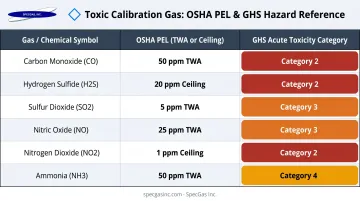
Source: OSHA Annotated PEL Tables Z-1 and Z-2
Even at calibration-level concentrations, these components trigger acute toxicity classifications on the SDS. The signal word "Danger" appears when Category 1–2 acute toxicity is assigned.
Flammable Gas Hazards
Calibration gases containing methane, propane, isobutane, or hydrogen are classified as Flammable Gas Category 1 under GHS, carrying hazard statement H220 (extremely flammable gas). GHS classifies the entire mixture, not only the individual flammable component.
SDS Sections 2 and 5 define the required storage and handling controls:
- No ignition sources near storage or use areas
- Segregated storage away from oxidizers
- Adequate ventilation at all times
How to Use an SDS in the Workplace
Practical Read Path
When a new calibration gas cylinder arrives, the priority sections are:
- Section 2 — Signal word and hazard classifications (30-second risk assessment)
- Section 3 — Confirm all components and concentrations are listed
- Section 8 — Verify PELs, ventilation requirements, and PPE
- Section 9 — Physical state and pressure properties
- Section 14 — Transport classification before any cylinder movement
SDS documents must be accessible to workers at all times during the shift — digitally or in print, at or near the point of use. An SDS locked in a filing cabinet during an incident is a compliance failure — one with real consequences for worker safety and regulatory standing.
SDS in Risk Assessments and Training
Knowing which sections to open first is only part of the picture. Safety officers and EHS coordinators can pull Sections 7, 8, and 11 directly into formal risk assessments to:
- Define ventilation requirements for cylinder storage rooms
- Select appropriate gas detectors for the specific hazards present
- Determine PPE requirements (respirator type, glove selection)
- Establish emergency procedures before exposure occurs
OSHA HazCom also mandates worker training covering how to locate an SDS, interpret hazard statements, and apply precautionary measures on the job. Document all training records and repeat the process whenever new gas mixtures enter the site.
Regulatory Compliance and SDS Requirements
OSHA HazCom 2012 Obligations
Under 29 CFR 1910.1200, employers must:
- Maintain an SDS for every hazardous chemical in the workplace
- Ensure worker access during every work shift
- Include SDS review in chemical safety training programs
- Update SDSs within 3 months of receiving significant new hazard information
DOT Transport Requirements
Calibration gas cylinders shipped as hazardous materials under 49 CFR 173.115 fall into three Class 2 divisions:
- 2.1 — Flammable gas (methane, hydrogen, propane blends)
- 2.2 — Non-flammable, nonpoisonous compressed gas (nitrogen, argon balance mixtures)
- 2.3 — Poisonous gas (H2S, HCN, Cl2 calibration standards)
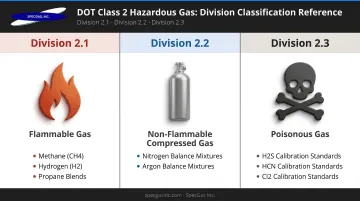
Section 14 of the SDS provides the UN number, proper shipping name, hazard class/division, and packing group needed for compliant shipping papers. Verify these against the actual DOT Hazardous Materials Table before shipping.
Record Retention
These transport classifications tie directly into your recordkeeping obligations. Under 29 CFR 1910.1020, SDS and chemical exposure records must be retained for at least 30 years. Key requirements include:
- Employee exposure records retained for a minimum of 30 years
- SDS records may be substituted with a log noting chemical identity, location of use, and dates of use — still held for 30 years
- Replacement records must remain retrievable and available to employees upon request
Organized SDS files hold up under OSHA compliance audits and give investigators a reliable paper trail when incidents occur.
What to Look for in a Calibration Gas Supplier's SDS
SDS quality reflects the manufacturer's documentation discipline. A well-prepared calibration gas SDS should include:
- All 16 sections present — no blank fields unless explicitly marked "not applicable"
- Mixture-level hazard classification — not just component-by-component listings
- Section 3 disclosures for trace toxic components — including sub-percent constituents that meet the 0.1% threshold for acute toxicity Categories 1–3
- Current OSHA PEL references in Section 8, not outdated limits
- Complete Section 14 with UN number, hazard class/division, and packing group
- Revision date in Section 1 or 16 — verify it's current
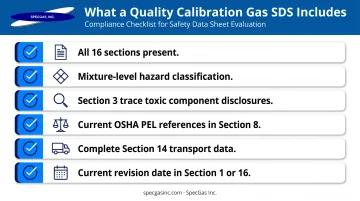
Red flags in a supplier's SDS: missing sections, vague concentration ranges in Section 3, outdated regulatory references, or a document that doesn't reflect the specific mixture formulation you ordered.
Documentation quality follows directly from blending discipline. When a supplier like SpecGas Inc. analytically verifies composition and defines concentration tolerances through gravimetric blending, the SDS can accurately reflect what's in the cylinder — including trace ppm and ppb components that generic documentation routinely omits.
Confirm the supplier can provide the SDS before shipment — and verify that the emergency contact number in Section 1 is reachable 24/7, not a general business line.
Frequently Asked Questions
Is calibration gas hazardous?
Yes, in most cases. All calibration gas cylinders carry compressed gas physical hazards regardless of their chemical content. Many blends also contain toxic components (CO, H2S, SO2) or use asphyxiant balance gases like nitrogen. The SDS is the primary document for understanding the specific risks of any mixture.
What are the 16 sections of an SDS?
GHS requires all compliant SDS documents to follow this standardized structure, as mandated under OSHA HazCom 2012:
- Identification
- Hazard Identification
- Composition/Ingredients
- First Aid
- Fire-Fighting
- Accidental Release
- Handling and Storage
- Exposure Controls/PPE
- Physical Properties
- Stability and Reactivity
- Toxicological Information
- Ecological Information
- Disposal
- Transport Information
- Regulatory Information
- Other Information
Where can I get the SDS for my calibration gas cylinder?
The manufacturer or supplier must provide the SDS at or before the time of delivery. Most suppliers can email it in advance or make it available via their website. Contact SpecGas directly at (215) 443-2600 or website-inquiries@specgasinc.com to request SDS documentation for a specific mixture.
Do I need an SDS for every calibration gas mixture I use?
Yes. OSHA HazCom requires an SDS for every hazardous chemical in the workplace. Virtually all calibration gases qualify — at minimum, the compressed gas physical hazard classification applies to every pressurized cylinder.
What is the difference between an SDS and a Certificate of Analysis for calibration gas?
A CoA certifies the gas concentration and blend accuracy, typically with NIST-traceable verification. An SDS documents safety, health, and environmental hazard information. Both are required, but for entirely different compliance purposes — the CoA answers "what's in it," the SDS answers "how do I handle it safely."
How long should I keep SDS documents for calibration gases?
OSHA requires chemical exposure records to be retained for at least 30 years. SDS records may be replaced by a log of chemical identity, use location, and dates — also kept for 30 years. OSHA accepts either format; a dedicated chemical inventory log with dates and locations is often easier to maintain across a large facility.