Introduction
Your gas detector is only as reliable as the reference it was calibrated against. If the calibration gas was off, the instrument reading is off, and in applications ranging from confined space entry to emissions compliance, an off reading carries real consequences.
OSHA has documented that improper or irregular calibration causes instrument drift, shifting an instrument's reference point over time and potentially masking hazardous exposures.
Calibration gas mixtures are the solution to that problem. They're precisely formulated reference gases that give instruments a verified known concentration to compare against. Industrial safety teams, environmental compliance officers, and analytical chemists across manufacturing, oil and gas, and laboratory settings rely on them as the foundation of every accurate measurement.
This guide covers what calibration gas mixtures are, the types available, the quality factors that matter, how they're produced, and what to look for when selecting a supplier — practical reference for anyone who needs measurements they can stand behind.
Key Takeaways
- Calibration gas mixtures are certified reference gases used to verify and adjust instrument accuracy
- Zero gas sets the baseline; span gas sets the upper measurement range — you need both for a complete calibration
- NIST traceability provides the documented link between your gas standard and national measurement benchmarks
- Reactive gases (H2S, NO, HCl, NH3) require specialized cylinder treatment to remain stable throughout their shelf life
- Always request and review the Certificate of Analysis before using any calibration gas
What Are Calibration Gas Mixtures?
A calibration gas mixture is a precisely composed reference gas used to verify and adjust the response of analytical instruments and gas detectors. Unlike bulk industrial gases purchased for process use, calibration gases have a certified known concentration — that's the entire point. The instrument gets exposed to a gas at a concentration you already know, and you confirm (or correct) its reading from there.
The terminology can be confusing because the same product gets called different things depending on context:
- Cal gas / calibration gas — general term for any reference gas used in instrument calibration
- Span gas — a gas at a specific concentration used to set the upper measurement range
- Zero gas — a pure or near-pure balance gas used to establish a baseline zero response
- Reference gas / standard gas — common in laboratory and analytical contexts
- Certified NIST calibration gas — signals that the mixture's concentration has been verified against NIST standards
- EPA Protocol gas — a calibration gas produced and certified under EPA's Traceability Protocol for regulatory emissions monitoring
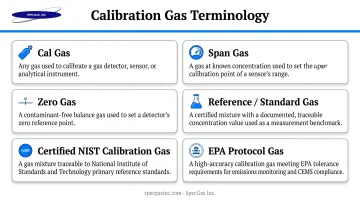
Each term signals something about how the gas is used or certified, but they all belong to the same product category.
Why Calibration Gases Matter in the Measurement Chain
Instruments drift. Sensors age, temperatures shift, and without periodic recalibration against a verified reference, readings slip away from reality without warning. A gas detector that once read 25 ppm CO accurately might be reading 18 ppm — or 34 ppm — months later without anyone knowing.
Blend complexity varies widely depending on what the instrument needs to verify:
- Binary blends — one component in a balance gas (for example, 500 ppm CO in nitrogen)
- Multicomponent mixtures — several analytes in a single cylinder for multi-gas detector calibration
- Low-concentration precision standards — sub-ppm and ppb-level mixtures for sensitive analytical instruments
The right blend depends entirely on the application, the detector technology, and any regulatory requirements that govern how the measurement is performed.
Types of Calibration Gas Mixtures
Zero Gas and Span Gas
Every complete calibration requires two gases working together.
Zero gas is a pure or near-pure balance gas — typically nitrogen or clean air — used to set an instrument's baseline response at zero. Per EPA Method 25A, zero gas must contain less than 0.1 ppmv of organic material, which illustrates just how clean it needs to be.
Span gas is a gas at a known concentration of the target analyte, used to calibrate the instrument's upper measurement range. Together, zero and span gases bracket the measurement scale: zero anchors the bottom, span confirms the top. Skip one, and your calibration is incomplete.
Binary vs. Multicomponent Mixtures
Binary mixtures contain one target component in a single balance gas. They're the most common type — straightforward to produce, well-suited for single-analyte applications like calibrating a CO detector with 50 ppm CO in nitrogen or checking an H2S sensor with 10 ppm H2S in air.
Multicomponent mixtures contain several analytes in one cylinder. They're used when an instrument or method monitors multiple gases simultaneously — CEMS systems, GC calibration standards, or process stream simulation where you need CO, CO2, SO2, and NOx all at certified concentrations in a single blend. SpecGas Inc. produces single and multi-component calibration mixtures, including complex reactive blends used by major gas distributors for their industrial clients.
Reactive Gas Mixtures
Some calibration gases contain components that don't sit quietly in a cylinder. Common reactive gases include:
- Hydrogen sulfide (H2S) — adsorbs to cylinder walls and degrades rapidly in untreated cylinders
- Nitric oxide (NO) — reacts with trace oxygen and moisture to form nitrogen dioxide
- Ammonia (NH3) — sticks to and releases from sampling surfaces, making concentration control difficult
- Hydrogen chloride (HCl) — loses concentration as cylinder pressure drops in untreated vessels
- Sulfur dioxide (SO2) — sensitive to moisture and reactive metal surfaces
Research on ammonia confirms it's a sticky molecule that adsorbs to and desorbs from sampling surfaces, making accurate gas-phase measurement difficult. HCl behaves similarly — a 2026 EPJ Web of Conferences paper on HCl primary reference gas standards documents significant concentration changes as cylinder pressure drops in untreated cylinders.
This is why reactive gas mixtures require specialized cylinder preparation before filling. Without proper passivation, a 10 ppm H2S mixture certified on day one may read 7 ppm by the time it reaches the instrument. The cylinder treatment process is what separates suppliers who can reliably produce reactive mixtures from those who can't.
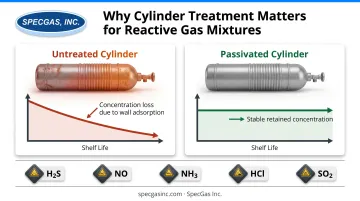
SpecGas employs a proprietary internal cylinder treatment process developed by founder Alfred Boehm, whose R&D work in reactive gas cylinder treatment dates back to his time at Messer Griesheims Industries in Germany beginning in 1976. That background shaped SpecGas's current production approach.
The result is backed by the SpecGas Stability Guarantee, which covers reactive mixture concentration integrity through the cylinder's certified shelf life.
EPA Protocol and Specialty Standards
EPA Protocol gases are required by regulation for emissions monitoring. Under 40 CFR Part 75, power plants and other affected sources must use EPA Protocol gases from suppliers participating in EPA's Protocol Gas Verification Program (PGVP) for CEMS calibration. Producers must meet strict EPA traceability requirements to label gases as Protocol grade.
Specialty standards for medical device testing, ISO 17025 laboratory calibration, and semiconductor process control follow similar traceability principles but may reference different certifying bodies or method-specific requirements.
Key Quality Factors: Tolerance, Accuracy, and Traceability
Preparation Tolerance vs. Analytical Tolerance
Two tolerance values should appear on every Certificate of Analysis:
- Preparation tolerance — the allowable concentration deviation resulting from the blending process itself
- Analytical (certification) tolerance — the uncertainty confirmed through independent laboratory measurement after blending
Analytical tolerance is the more meaningful number. It reflects actual verification, not just what the blending process was designed to achieve. A mixture might be blended to ±2% preparation tolerance, but the CoA should confirm — through independent analysis — the actual certified concentration and its associated uncertainty.
At SpecGas, blend tolerances and analytical accuracies are determined by component and concentration level and can be adapted to customer requirements where technically feasible.
Accuracy vs. Precision
These two terms are often used interchangeably, but they're not the same:
- Accuracy — how close the certified concentration is to the true value
- Precision — how consistently the same concentration is produced batch after batch
A concrete analogy: a supplier who consistently produces 95 ppm when you ordered 100 ppm is precise but inaccurate. Every batch will give you the same wrong answer. In calibration work, an inaccurate standard poisons every measurement it touches. Precision matters too — but only after accuracy is established.
NIST Traceability
NIST defines metrological traceability as a measurement result property that links the result to a reference through a documented, unbroken chain of calibrations, each contributing stated uncertainty. For calibration gases, this means the certified concentration can be traced back to NIST Primary Standard Gas Mixtures — typically through gravimetric blending validated against NIST Standard Reference Materials or NIST-calibrated weighing systems.
Why it matters practically:
- Required for ISO 17025 laboratory accreditation and ISO 9001 quality systems
- Mandatory for EPA Protocol gas certification under PGVP
- Necessary for regulatory defensibility in CEMS reporting and air quality monitoring
SpecGas produces NIST Traceable Gas Standards using gravimetric blending with proprietary techniques, with all analytical instruments calibrated and verified before each use.
Mixture Stability and Units
Shelf life varies widely by composition. Inert mixtures — nitrogen, argon, CO2 blends — can remain stable for several years under proper storage. NIST SP 260-126 notes that reactive gas mixtures such as NO, SO2, and H2S below 40 µmol/mol typically receive two-year certification periods, with NIST reserving the right to assign shorter windows depending on the specific mixture.
Units of measure deserve the same scrutiny as shelf life. Calibration gas concentrations are expressed in mole percent, volume percent, ppm (by mole), or ppb — and the unit on the specification must match the unit on the CoA and what your instrument expects. A mismatch doesn't just cause confusion; it introduces real calibration error.
How Calibration Gas Mixtures Are Produced
Gravimetric vs. Partial Pressure Blending
Two primary blending methods exist, and they're not equivalent in accuracy:
Partial pressure (manometric) blending uses pressure and temperature measurements to estimate component ratios. It's faster but less precise, making it unsuitable for low-concentration or high-accuracy standards.
Gravimetric blending mixes components by weight using calibrated scales. It's the method specified by ISO 6142-1:2015 for Class I traceable calibration gas mixtures and the approach used for NIST Primary Standard Gas Mixtures. For low-ppm and ppb-level blends, gravimetric production is the standard.
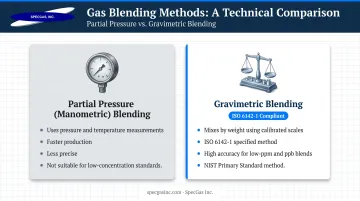
SpecGas uses gravimetric blending as its primary production method, including for reactive and toxic gas mixtures at concentrations as low as 300 ppb.
Cylinder Preparation and Passivation
For reactive gases, the cylinder itself is part of the product. An untreated cylinder wall can adsorb reactive components, effectively pulling them out of the gas phase and lowering the concentration below what's certified. For H2S at 5 ppm, even minor adsorption can shift the reading outside tolerance before the cylinder reaches the customer.
That's where passivation treatments come in — chemical or thermal surface treatments applied to the cylinder interior that minimize wall reactivity. The BIPM's CCQM working group on passivation chemistry is actively working to identify optimal techniques for low-level reactive gas standards, reflecting that this remains technically demanding even at the primary laboratory level.
SpecGas's proprietary cylinder treatment, developed from Alfred Boehm's decades of specialty gas R&D, is applied to reactive mixture cylinders before filling. It supports extended shelf life across a broad range of reactive gases — H2S, HCl, NH3, NO, SO2, HCN, PH3, Cl2, formaldehyde, and others.
The SpecGas Stability Guarantee covers reactive mixture concentration integrity throughout shelf life.
Certificate of Analysis
Every calibration gas shipment should include a CoA. Per ISO 6141:2015, a compliant certificate for a calibration gas mixture must include:
- Certified component concentrations
- Preparation and analytical tolerances
- Traceability statement (to NIST or equivalent national metrology institute)
- Expiration or shelf-life date
- Balance gas identification
- Cylinder identification number
If a supplier can't provide this documentation, that's the answer to whether you should use their gas for regulated or safety-critical applications.
Industries and Applications That Rely on Calibration Gas Mixtures
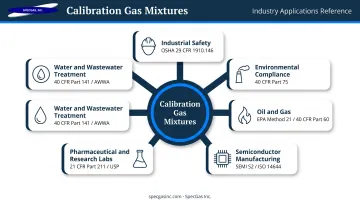
Calibration gas mixtures serve a wide range of industries — each with its own regulatory standards, instrument types, and accuracy requirements. Below are the sectors where proper calibration is not optional.
Industrial Safety and Confined Space Entry
OSHA 29 CFR 1910.146 requires pre-entry atmospheric testing with calibrated instruments covering oxygen content, flammable gases, and toxic air contaminants. Gas detectors deployed in refineries, utilities, and wastewater facilities need regular span and zero calibration to keep alarm thresholds accurate — a failure here can put workers at direct risk.
Emissions Monitoring and Regulatory Compliance
Power plants, chemical facilities, and industrial operations subject to 40 CFR Part 75 must use EPA Protocol gases for CEMS calibration and quality assurance testing. The EPA's Performance Gas Verification Program (PGVP) audits calibration gas quality at participating producers to confirm gases meet their certified concentrations.
Laboratory, Research, and Semiconductor Applications
Analytical laboratories and research facilities depend on batch-to-batch consistency across a range of applications:
- GC and GC-MS calibration standards for chromatographic analysis
- FTIR analyzer reference gases for spectroscopic measurement
- Air quality and environmental research monitoring
- Semiconductor process verification — ion implantation, plasma etching, and chamber cleaning gases are confirmed against certified standards, where concentration accuracy directly affects device yield
Other High-Demand Sectors
Several additional industries maintain strict calibration gas requirements:
- Pharmaceutical labs performing instrument qualification under cGMP requirements
- Water and wastewater treatment facilities monitoring chlorine, chlorine dioxide, and H2S
- Oil and gas operations conducting LDAR inspections per EPA Method 21
What to Look for in a Calibration Gas Supplier
Calibration gas quality is only as good as the supplier producing it. Choosing the wrong vendor can mean unstable reactive blends, documentation gaps that fail audits, or weeks-long delays when a detector is down. Here's what to evaluate before committing to a supplier:
NIST Traceability and Documentation
- Full CoA with stated uncertainties and a complete traceability chain
- Ability to produce custom blends when catalog products don't match your application
- Compliance with ISO 6141 certificate requirements
Reactive Gas Capability
- Ask specifically about cylinder treatment processes — not just whether they claim passivation
- Request documentation of stability testing or shelf-life studies
- Confirm blending is done in-house, not outsourced to a third party
Lead Times and Service Structure
- In-house blending enables faster turnaround than suppliers who outsource production
- Rush service availability matters when a detector is out of service and production is stalled
- Verify whether the supplier can commit to firm delivery timelines, not estimates
Cost Structure
- Cylinder rental fees accumulate when containers sit on-site between uses
- A deposit program is often more cost-effective than ongoing rental charges for long-term holders
- Compare total cost of ownership, not just per-cylinder price
Breadth of Capability
- Larger suppliers often decline small custom orders, unusual components, or very low-concentration reactive blends
- For labs and safety teams with non-standard requirements, verify the supplier has direct experience with your specific gas matrix
- SpecGas regularly fills orders that larger suppliers turn down, including low-ppm reactive blends and multi-component custom mixtures
Frequently Asked Questions
What is a calibration gas mixture?
A calibration gas mixture is a precisely formulated reference gas with a certified known concentration of one or more components. It's used to verify and adjust the accuracy of analytical instruments and gas detectors by giving them a known concentration to measure against.
What is the difference between span gas and zero gas?
Zero gas establishes the instrument's baseline by setting a zero response — it contains no detectable target analyte. Span gas contains a known concentration of the target and calibrates the upper measurement range. Together, they establish the instrument's floor and its working measurement range.
What does NIST-traceable mean for calibration gases?
NIST-traceable means the gas mixture's certified concentration has been verified through an unbroken chain of measurements back to NIST standards, with stated uncertainty at each step. This documentation supports regulatory compliance, ISO 17025 accreditation, and defensible quality records.
What is the difference between preparation tolerance and analytical tolerance?
Preparation tolerance is the acceptable concentration range resulting from the blending process. Analytical (certification) tolerance is the uncertainty confirmed through independent laboratory measurement after blending. Look for both on the CoA — analytical tolerance is the more meaningful number for calibration accuracy.
How long does calibration gas last?
Shelf life depends on composition — inert mixtures can remain stable for several years, while reactive components like H2S, NO, and SO2 at low concentrations may degrade within months. Cylinder treatment methods and storage conditions are the primary factors that determine whether a mixture stays within tolerance; suppliers with a proprietary treatment process (such as SpecGas's internal cylinder treatment, backed by the SpecGas Stability Guarantee) typically deliver longer-lasting reactive gas standards.
What industries use calibration gas mixtures?
Calibration gas mixtures are used across a wide range of industries:
- Industrial safety — gas detector calibration and confined space entry (OSHA 1910.146)
- Environmental compliance — stack emissions monitoring and CEMS
- Oil, gas, and petrochemical — H2S monitoring, sour gas, LDAR
- Semiconductor manufacturing — dopant and etchant gas standards
- Pharmaceutical and research laboratories — GC-MS, FTIR, and analytical instrument verification
- Water and wastewater treatment — chlorine, ClO2, and H2S monitoring