Introduction
Liquid-gas mixtures are everywhere — the fog that reduces morning visibility to a few feet, the bubbles rising through a glass of sparkling water, the spray from a can of hairspray. Most people encounter dozens of these systems every day without registering them as a distinct category of matter.
These mixtures appear across environmental science, food production, medicine, and industrial processes. Understanding what distinguishes an aerosol from a foam, or a foam from a dissolved gas solution, helps explain why each behaves so differently — and why the composition of a gas-liquid system directly affects performance in applications ranging from gas detector calibration to industrial emissions monitoring.
With that in mind, this article covers what liquid-gas mixtures are, the three main types, real-world examples for each, and why precise composition control becomes critical in technical and industrial settings.
Key Takeaways
- A liquid-gas mixture combines liquid and gas phases through suspension, dispersion, or molecular dissolution
- The three main types are aerosols (liquid in gas), foams (gas in liquid), and dissolved gas solutions (gas dissolved into liquid at the molecular level)
- Common examples: fog, carbonated drinks, whipped cream, fire-suppression foam, and oxygen dissolved in water
- Behavior varies significantly by type: aerosols disperse fine droplets, foams trap gas in liquid matrices, and dissolved gases behave as single-phase solutions
- In emissions monitoring and gas detector calibration, precise gas composition — not just mixture type — determines whether readings can be trusted
What Is a Liquid-Gas Mixture?
A liquid-gas mixture is any system where liquid and gas phases are combined — either by suspending one phase within the other or by dissolving a gas into a liquid at the molecular level. No chemical reaction occurs between the components; the substances retain their identities.
The key distinction is whether the mixture is homogeneous or heterogeneous:
- Homogeneous (true solution): Gas molecules disperse uniformly throughout the liquid at the molecular scale. Carbonated water is one example.
- Heterogeneous (colloidal): Gas bubbles or liquid droplets remain as distinct suspended phases. Fog and foam fall here.
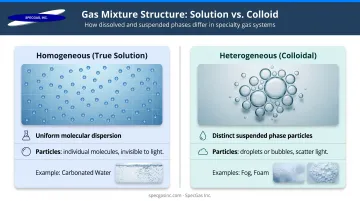
IUPAC's definition of colloidal dispersions classifies aerosols and foams as colloidal subtypes — heterogeneous systems where the dispersed and continuous phases remain physically distinct.
That physical distinction matters practically. Unlike pure gas mixtures, liquid-gas systems span two states of matter, and their behavior depends on pressure, temperature, surface tension, and solubility — factors that determine how much gas dissolves, how stable the mixture remains, and how it responds to changes in its environment.
Types of Liquid-Gas Mixtures
Liquid-gas mixtures occur in three fundamentally different forms. Each has its own structure, stability characteristics, and practical applications.
Aerosols: Liquid Droplets Dispersed in a Gas
An aerosol is a colloidal system where tiny liquid droplets are suspended within a continuous gas phase. The droplets are small enough to stay suspended rather than settling out immediately.
Aerosols form through:
- Condensation of water vapor (natural fog, clouds)
- Atomization or pressurized spraying (hairspray, inhalers, spray paint)
- Mechanical disruption (ocean spray, waterfalls)
Particle size is critical. According to the EPA's particulate matter guidance, particles below 10 micrometers can penetrate deep into the lungs, and those below 2.5 micrometers may enter the bloodstream. For medical aerosols specifically, a peer-reviewed deposition study found that particles between 2 and 6 micrometers are best suited for central and small airway delivery — which is why inhaler formulations are engineered to hit that window.
Common aerosol examples:
- Fog and mist (water droplets in air)
- Clouds
- Hairspray and spray paint
- Aerosol medication inhalers
- Pesticide application sprays
Aerosols deliver liquids efficiently over wide areas or into confined spaces. The trade-off: they're unstable over time and sensitive to temperature and humidity shifts.
Foams: Gas Bubbles Dispersed in a Liquid
Foam is the structural inverse of an aerosol: gas is the dispersed phase, trapped as bubbles within a continuous liquid. IUPAC defines foam as a dispersion with a large proportion of gas by volume, with bubble diameters typically larger than 1 micrometer.
Surfactants and stabilizing agents hold foam structures together by reducing surface tension at the gas-liquid interface. Without them, bubbles coalesce rapidly and the foam collapses.
Common foam examples:
- Whipped cream (air trapped in cream)
- Beer head and soda foam (CO₂ bubbles in liquid)
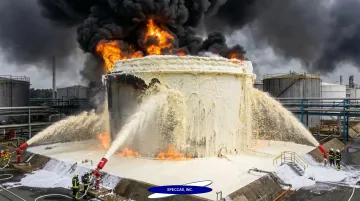
- Fire-suppression foam (air or CO₂ in water-based solution)
- Shaving foam
- Sea foam along coastlines
Foams offer high volume-to-mass ratios, making them useful for fire suppression, insulation, and food texture. Their weakness is inherent instability: bubbles coalesce, liquid drains, and the structure breaks down over time.
Dissolved Gas Solutions: True Homogeneous Mixtures
Dissolved gas solutions are different from aerosols and foams in one important way: the gas isn't suspended as bubbles or droplets — it's dispersed at the molecular level throughout the liquid, forming a true homogeneous solution.
Gas solubility follows Henry's Law: solubility increases with higher pressure and decreases with higher temperature. The IUPAC-NIST Solubilities Database documents CO₂ solubility in water from 273 K to 433 K, with a clear decrease as temperature rises. That's why a warm soda goes flat faster than a cold one.
Common examples:
- CO₂ dissolved in carbonated water and soft drinks
- Oxygen dissolved in water (critical for fish and aquatic organisms)
- Nitrogen and oxygen dissolved in blood (relevant to decompression sickness in divers)
- CO₂ absorbed into scrubbing liquids in emissions control systems
Common Examples Across Everyday Life and Industry
The same three liquid-gas principles appear across very different fields.
Everyday and Environmental
- Fog and mist: According to National Weather Service training material, fog forms when the temperature-dew point spread drops below 5°F, causing water vapor to condense into suspended droplets — a natural aerosol
- Humid air: Water vapor mixed with dry air forms a gas-phase solution; once droplet condensation begins, it crosses into true aerosol territory
- Clouds: Water droplets suspended in air at altitude — same aerosol mechanics as fog, just at altitude
Food and Beverage
- Carbonated beverages: CO₂ dissolved under pressure during packaging; releasing the cap reduces solubility and releases bubbles
- Whipped cream: Air mechanically incorporated into cream, stabilized by fat and protein
- Beer head and sparkling wine: CO₂ produced during fermentation dissolves into liquid, then releases on pouring or pressure change
- Food-grade CO₂ quality: The International Society of Beverage Technologists (ISBT) maintains quality guidelines for beverage-grade bulk CO₂, since purity affects both taste and safety
Medical and Biological
- Aerosol drug delivery: Inhaled medications atomize liquid into a carrier gas, with particle size tuned to reach specific areas of the lungs or airways
- Oxygen in blood plasma: Dissolved oxygen enables cellular respiration — the body's most critical dissolved gas solution
- Decompression sickness: During deep dives, elevated pressure forces inert gas into solution in blood and tissues; rapid ascent causes that gas to come out of solution as bubbles, with potentially serious consequences
Industrial and Environmental
- Fire-suppression foam: Gas dispersed in water-based concentrate, designed to smother flammable liquid fires
- Wet scrubbers: Gas absorbed into liquid to remove pollutants from exhaust streams. The EPA's Control Cost Manual reports SO₂ removal rates of 90–98% for wet scrubbing systems, with newer designs reaching 99%
- Dissolved oxygen monitoring: Water treatment facilities track dissolved O₂ levels in mg/L or percent saturation to manage biological treatment processes
- Aerosol coating systems: Industrial spray applications for surface treatments and coatings
Why Precision in Liquid-Gas Mixture Composition Matters
In daily life, approximate compositions are fine. A glass of soda doesn't need a certified CO₂ concentration. But in environmental monitoring, emissions compliance, and laboratory calibration, the exact composition of a gas or gas-liquid system has direct consequences.
The Calibration Gas Connection
Many instruments that measure gas concentrations in air quality monitoring, stack emissions, and industrial safety applications rely on calibration gases — certified gas blends with verified concentrations. If the calibration gas itself is off, every downstream measurement made with that instrument is off by an equivalent or greater margin.
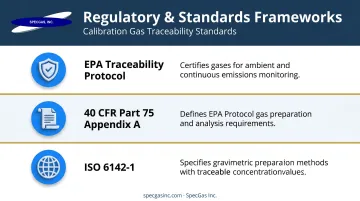
This is why regulatory frameworks take composition traceability seriously:
- The EPA Traceability Protocol certifies calibration gases for ambient and continuous emissions monitoring
- 40 CFR Part 75 Appendix A defines EPA Protocol gases as calibration mixtures prepared and analyzed according to that protocol
- ISO 6142-1 specifies gravimetric methods for preparing calibration mixtures with traceable concentration values
Concentration drift is a particular concern for reactive gases. Components like H₂S, SO₂, HCl, Cl₂, and formaldehyde can interact with cylinder walls and degrade over time, shifting concentrations away from certified values.
Where SpecGas Fits In
SpecGas Inc. produces NIST-traceable calibration gas standards and precision specialty gas blends used across emissions monitoring, air quality measurement, and industrial process calibration. Their proprietary internal cylinder treatment passivates cylinder walls before filling, reducing the wall interactions that cause reactive gases to lose concentration over time.
For applications like CEMS calibration, EPA stack emissions monitoring, or scrubber system performance verification, the precision of the calibration gas standard directly determines the accuracy of compliance data. This matters most with reactive components, where even small concentration shifts can push readings outside acceptable tolerance ranges — and every measurement taken against that standard is affected until the instrument is recalibrated against a verified blend.
Conclusion
Liquid-gas mixtures appear in three distinct forms: aerosols, foams, and dissolved gas solutions. Each has a different physical structure, different stability characteristics, and different practical applications — from the fog outside to the fizz in a drink to the foam suppressing an industrial fire.
In everyday contexts, these systems work without much precision. Move into research, calibration, or regulated emissions monitoring, and composition accuracy becomes non-negotiable. An unverified mixture can produce false readings, failed audits, or undetected hazards — which is why applications like EPA stack emissions testing and gas detector calibration depend on NIST-traceable standards with confirmed concentrations.
Frequently Asked Questions
What is a mixture of liquid and gas called?
Depending on its structure, a liquid-gas mixture may be called an aerosol (liquid droplets in gas), a foam (gas bubbles in liquid), or a dissolved gas solution. Aerosols and foams are colloidal systems; dissolved gases form true homogeneous solutions.
What is an example of a liquid and gas mixture?
Fog is a classic aerosol — water droplets suspended in air. Carbonated water is a dissolved gas solution (CO₂ under pressure), and whipped cream is a foam (air bubbles trapped in cream). Each is a distinct structural type.
Are liquid-gas mixtures homogeneous or heterogeneous?
Dissolved gas solutions are homogeneous — gas disperses at the molecular level throughout the liquid. Aerosols and foams are heterogeneous because the liquid and gas remain as distinct phases suspended within each other.
What is the difference between an aerosol and a foam?
In an aerosol, liquid is the dispersed phase (droplets in gas). In a foam, gas is the dispersed phase (bubbles in liquid). The continuous medium — gas or liquid — is what distinguishes one from the other.
How does gas dissolve in a liquid?
Gas dissolves in liquid when pressure forces gas molecules into solution, as described by Henry's Law. Higher pressure and lower temperature increase solubility — which is why releasing pressure from a carbonated drink causes CO₂ bubbles to form and escape.
What are some industrial uses of liquid-gas mixtures?
Key applications include fire-suppression foams, aerosol coating systems, and wet scrubbers for SO₂ and CO₂ emissions control. Wherever these systems are monitored — particularly in stack emissions and CEMS environments — instruments must be calibrated against NIST-traceable gas standards to meet EPA method requirements.