This article covers everything you need to know: what noble gases are, where they sit on the periodic table, why they resist chemical reaction, what physical properties they share, and which industries depend on them.
Key Takeaways
- Noble gases are the seven elements in Group 18 of the periodic table: helium, neon, argon, krypton, xenon, radon, and oganesson
- Completely filled outer electron shells make them almost entirely unreactive under normal conditions
- Each element has distinct physical properties and specific uses, ranging from MRI cooling to spacecraft propulsion
- Argon is the most abundant noble gas in Earth's atmosphere, while oganesson exists only as a lab-synthesized element
- Some heavier noble gases (xenon, krypton) do form compounds under the right conditions — "inert" is no longer accurate
What Are Noble Gases? Definition and Their Place on the Periodic Table
Noble gases occupy Group 18 — the rightmost column of the periodic table. IUPAC has used the 1–18 group numbering system since 1988, though you'll still see older references to Group 0 or Group VIII A in historical texts.
The name "noble" draws a direct analogy to noble metals like gold and platinum — elements that resist chemical reaction. Two earlier labels have fallen out of favor:
- "Inert gases" — inaccurate, because xenon and krypton do form real compounds
- "Rare gases" — misleading, because argon makes up 0.934% of dry air by volume, hardly qualifying as rare
Monatomic Structure and the Octet Rule
Unlike oxygen (O₂) or hydrogen (H₂), noble gases circulate as single atoms. This comes down to electron configuration: each noble gas has a completely filled outermost electron shell — helium with 2 electrons filling its only shell, and the rest with 8 electrons in their outermost shell (the octet).
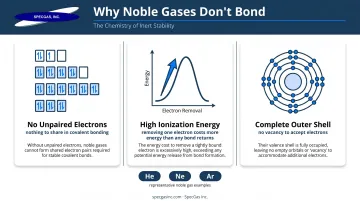
Because noble gases already satisfy the stability condition, they have no chemical incentive to bond. Three reasons explain this:
- No unpaired electrons — nothing to share in a covalent bond
- High ionization energies — removing an electron costs more energy than any bond could return
- Complete outer shell — no "vacancy" to accept electrons from another atom
Discovery Timeline
Noble gases were completely unknown until the late 19th century:
| Year | Event |
|---|---|
| 1785 | Henry Cavendish observes an unreactive fraction in air |
| 1894 | Lord Rayleigh and William Ramsay isolate argon |
| 1895–1898 | Ramsay identifies terrestrial helium, neon, krypton, and xenon |
| 1900 | Friedrich Ernst Dorn identifies radon from radium decay |
| 1904 | Rayleigh (Nobel Prize in Physics) and Ramsay (Nobel Prize in Chemistry) honored |
| 2002 | Oganesson first synthesized at JINR Dubna |
The group was originally labeled "0" because early chemists believed noble gases had zero valence and could form no compounds. The modern Group 18 designation reflects a more complete picture.
Meet the Noble Gases: A Profile of Each Element
Helium (He) and Neon (Ne)
Helium (atomic number 2) is the second most abundant element in the universe after hydrogen, produced during the Big Bang and in ongoing stellar fusion. On Earth, it doesn't accumulate in the atmosphere — the planet's gravity can't hold such a light atom.
Instead, terrestrial helium forms by the alpha decay of uranium and thorium in the crust, then collects in natural gas deposits where concentrations can reach up to approximately 7% of the gas stream.
Its boiling point of –268.93°C (4.22 K) makes liquid helium the coldest practical coolant available — the workhorse of superconducting MRI magnets.
Neon (atomic number 10) produces its characteristic red-orange glow in gas-discharge tubes. It's extracted from air by fractional distillation and also serves as a cryogenic refrigerant with over 40 times the refrigerating capacity per unit volume of liquid helium.
Argon (Ar), Krypton (Kr), and Xenon (Xe)
Argon (atomic number 18) is the most abundant noble gas in Earth's atmosphere at 0.934% by volume — much of it produced over geological time by the radioactive decay of potassium-40. It's the go-to inert shielding gas for MIG and TIG welding of aluminum and other metals.
Krypton (atomic number 36) and xenon (atomic number 54) are heavier, rarer, and far more valuable:
- Krypton (atmospheric concentration: 1.14 ppm) is used in energy-saving fluorescent lighting and laser gas mixtures
- Xenon (atmospheric concentration: 0.09 ppm) powers IMAX arc lamps, serves as an anesthetic due to its low blood-gas partition coefficient of 0.115 and rapid washout, and is the preferred propellant in ion thrusters for deep-space missions
Radon (Rn) and Oganesson (Og)
Radon (atomic number 86) is a naturally occurring radioactive gas produced by alpha decay of radium-226 in the Earth's crust. It has no stable isotopes. When it seeps into poorly ventilated buildings, it becomes a serious health hazard — the EPA attributes approximately 21,000 lung cancer deaths per year in the United States to radon exposure.
Oganesson (atomic number 118) is the only fully synthetic noble gas, created in 2002 by bombarding californium-249 with calcium-48 ions. So few atoms have ever been produced that its physical properties remain largely theoretical. Its confirmed isotope, Og-294, has a half-life of roughly 0.69 milliseconds. Due to relativistic effects on its electrons, theoretical models predict it may behave as a solid semiconductor at room temperature — not a gas at all.
Physical Properties of Noble Gases
All noble gases share a consistent set of physical characteristics under standard conditions:
- Colorless, odorless, and tasteless
- Nonflammable under all practical conditions
- Exist as monatomic gases — single unbound atoms
- Have the lowest boiling points of any elements in their periods
Those low boiling points follow directly from their electron structure. Without permanent dipoles, the only attractive forces between noble gas atoms are weak London dispersion (van der Waals) forces, generated by tiny, temporary electron imbalances — too weak to hold atoms together unless temperatures drop to near absolute zero.
Physical Property Trends Down the Group
Those London dispersion forces grow stronger as atomic number increases. Larger atoms carry more electrons, so their temporary imbalances are larger — and that directly raises boiling points, melting points, and density down the group.
| Element | Atomic No. | Boiling Point (K) | Boiling Point (°C) | Density at STP (g/L) |
|---|---|---|---|---|
| He | 2 | 4.22 | –268.93 | 0.178 |
| Ne | 10 | 27.07 | –246.08 | 0.899 |
| Ar | 18 | 87.50 | –185.65 | 1.784 |
| Kr | 36 | 119.78 | –153.37 | 3.750 |
| Xe | 54 | 165.02 | –108.13 | 5.881 |
| Rn | 86 | 211.45 | –61.70 | 9.730 |
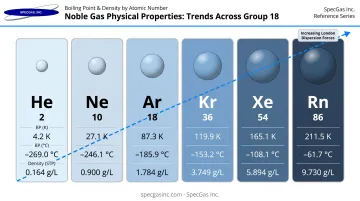
Source: NIST WebBook and Britannica
One notable exception: helium cannot be solidified at atmospheric pressure at any temperature. This is a quantum mechanical effect — helium's zero-point energy is high enough that the atoms remain mobile even at absolute zero unless placed under extremely high pressure. Every other noble gas solidifies at atmospheric pressure; argon, for instance, freezes at 83.8 K (–189°C).
Why Noble Gases Rarely React: Chemical Properties Explained
Electron Configuration as the Root Cause
A filled valence shell removes the thermodynamic driving force — the energetic incentive — for bond formation. Take argon (electron configuration: 2,8,8). It cannot easily accept an additional electron because there's no net nuclear pull available for it, donating one requires enormous ionization energy, and it has no unpaired electrons to offer for covalent bonding.
Noble gases also hold the highest first ionization energies of any elements in their respective periods — the energy required to remove even one electron is too high to make most reactions favorable. This ionization energy decreases down the group as outer electrons sit farther from the nucleus and are shielded by more inner electron layers. That trend is exactly why heavier noble gases are the ones that occasionally do react.
The 1962 Breakthrough
In 1962, Neil Bartlett at the University of British Columbia demonstrated that platinum hexafluoride could oxidize xenon — producing the first confirmed noble gas compound. Researchers have been expanding noble gas chemistry ever since, largely focused on xenon and krypton.
The reason heavier noble gases can react while lighter ones cannot: in xenon and krypton, the energy gap between electron shells is small enough that electrons can be promoted to slightly higher energy levels, creating the unpaired electrons needed for bonding. In helium, neon, and argon, that gap is too large.
Known Noble Gas Compounds
- Xenon fluorides: XeF₂, XeF₄, XeF₆ — the most thoroughly studied
- Xenon tetroxide (XeO₄): contains xenon in oxidation state +8; stable only below –36°C
- Krypton difluoride (KrF₂): the central krypton compound
- Argon fluorohydride (HArF): reported in 2000, stable only in a solid argon matrix at extremely low temperatures
- Helium and neon: no confirmed neutral compounds exist
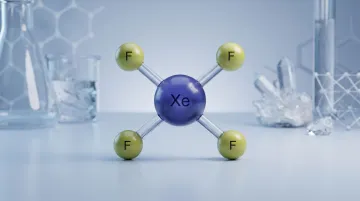
By 2006, over 100 noble gas compounds had been characterized, with xenon chemistry representing the largest body of work. Oganesson is a different case entirely — theoretical models suggest it may be reactive in oxidation states of +2 and +4, raising genuine questions about whether it belongs in Group 18 at all.
Noble Gas Applications Across Key Industries
The Three Workhorses: Argon, Helium, and Neon
Argon dominates by volume:
- Shields welding arcs and base metals from atmospheric oxygen and nitrogen during MIG/TIG welding
- Fills incandescent and some fluorescent bulbs as an inert atmosphere
- Provides inert blanket conditions for air-sensitive chemical synthesis
Helium covers the high-precision end:
- Cools superconducting MRI magnets to ~4 K using liquid helium
- Serves as a carrier gas in gas chromatography (GC and GC-MS) systems
- Replaced flammable hydrogen in airships and weather balloons after the Hindenburg disaster in 1937
Neon does double duty: produces its signature red-orange glow in gas-discharge lighting, and serves as a high-efficiency cryogenic refrigerant.
Specialized High-Value Applications
Krypton, xenon, and radon each fill niches where no cheaper substitute exists:
- Xenon arc lamps in IMAX projectors produce output closer to natural daylight than virtually any other artificial source
- Xenon as an anesthetic: its blood-gas partition coefficient of 0.115 enables rapid induction and fast washout, with minimal side effects
- Xenon ion thrusters: NASA's Dawn mission and Deep Space 1 both used xenon as propellant in ion propulsion systems — inert, dense, and storable
- Excimer lasers: ArF (193 nm) is the workhorse wavelength for semiconductor chip fabrication via DUV photolithography; the same ArF chemistry drives LASIK corneal reshaping. KrF operates at 248 nm for additional lithography applications
- Radon brachytherapy: Rn-222 has historically been encapsulated for permanent interstitial cancer treatment, though modern applications have largely moved to other isotopes

Precision Gas Mixtures for Calibration and Process Control
Many of these applications don't just need the gas — they need it at exact, verified concentrations. Excimer laser systems, semiconductor process chambers, emissions monitoring instruments, and gas chromatographs all require calibration standards where the noble gas component is precisely known and stable.
SpecGas Inc., based in Bridgeport, PA, produces NIST-traceable noble gas blends and rare gas mixtures, including pure helium, argon, neon, krypton, and xenon, plus multi-component rare gas blends such as 70% krypton/30% xenon and excimer laser gas mixtures for ArF and KrF systems. All mixtures are blended in-house using gravimetric methods and proprietary cylinder preparation techniques.
Alfred Boehm founded SpecGas in 2001 after beginning his specialty gas career in 1976 at Messer Griesheims Industries in Germany, rising to director-level roles, and transferring to the US in 1991 to continue R&D in reactive gas mixtures. For labs and manufacturers that need custom rare gas blends, fast turnaround, or difficult-to-source formulations, that in-house capability matters most when timing and precision are non-negotiable.
Frequently Asked Questions
What are the rare gases on the periodic table?
The six naturally occurring noble gases — helium, neon, argon, krypton, xenon, and radon — were historically called "rare gases." The term has largely been replaced by "noble gases" because argon, at 0.934% of dry air, is far too abundant to call rare.
What is the rarest noble gas on the periodic table?
Among naturally occurring noble gases, xenon is the rarest in Earth's atmosphere at just 0.09 ppm by volume. Overall, oganesson is rarest — a fully synthetic element with only a handful of atoms ever produced, each surviving less than one millisecond.
Why are noble gases called "noble"?
The analogy is to noble metals like gold and platinum, which resist chemical reaction. The term Edelgas (noble gas) was coined in 1898, reflecting these elements' reluctance to bond with other substances. It replaced the older "inert gas" label, which proved inaccurate once compounds like xenon tetrafluoride were synthesized.
Are noble gases completely inert?
For helium, neon, and argon — essentially yes under normal conditions. For xenon and krypton, no. Xenon forms dozens of well-characterized compounds with fluorine and oxygen, and over 100 noble gas compounds were documented by 2006. Oganesson shows predicted reactivity significant enough that its classification as a noble gas remains contested.
What is the most common noble gas in Earth's atmosphere?
Argon, at approximately 0.934% by volume — with neon at 18.18 ppm, helium at 5.24 ppm, krypton at 1.14 ppm, and xenon at 0.09 ppm trailing far behind. Most atmospheric argon accumulated over billions of years from the radioactive decay of potassium-40 in Earth's crust.
Can noble gases be dangerous?
Radon is the primary hazard — radioactive, colorless, and odorless, it can accumulate in poorly ventilated buildings and is responsible for approximately 21,000 lung cancer deaths annually in the US. The other noble gases are non-toxic but can act as asphyxiants in enclosed spaces if they displace enough oxygen.