The real-world consequences extend well beyond the injury numbers. When a chlorine release occurred at a Houston water treatment plant, two workers were hospitalized and OSHA proposed $63,000 in penalties for serious violations. Facilities also face production shutdowns, evacuations, and long-term liability exposure — outcomes that detection equipment and safety discipline are built to prevent.
This article covers what makes chlorine gas particularly dangerous, how to build a reliable detection program, and where facilities most often go wrong. The through-line: chlorine safety requires more than a detector on the wall.
Key Takeaways
- Chlorine gas is heavier than air (density ~2.5x air) and accumulates at floor level — detector placement must account for this
- OSHA's PEL is 1 ppm ceiling; NIOSH recommends no more than 0.5 ppm over 15 minutes; symptoms can appear below these limits
- Electrochemical sensors are the standard for chlorine detection — fixed units for continuous area monitoring, portables for personnel
- Detectors must be bump tested regularly and calibrated with NIST-traceable reference gas to stay reliable — skipping either step compromises your entire detection program
- Detection equipment alone isn't enough — maintenance schedules and trained response protocols determine whether it actually protects people
Understanding Chlorine Gas Hazards
Physical Properties That Drive Risk
Chlorine is a greenish-yellow gas with a sharp, bleach-like odor. Two physical properties make it especially dangerous in enclosed spaces:
- Density — At roughly 2.5 times heavier than air, chlorine accumulates in low-lying areas: floor level, pits, trenches, and below-grade plant rooms, rather than dispersing upward
- Odor — Most people can detect it at around 0.32 ppm, below OSHA's ceiling limit of 1 ppm. Your nose may give some warning, but smell is not a monitoring method
Beyond these physical properties, chlorine is a strong oxidizing agent. It reacts violently with combustibles, ammonia, hydrogen, turpentine, hydrazine, and organic materials — creating fire and explosion hazards that extend well beyond its direct toxicity.
Health Effects by Concentration
| Concentration | Effects |
|---|---|
| 0.08–0.32 ppm | Odor detectable by most people |
| 1–3 ppm | Mild mucous membrane irritation |
| 5–15 ppm | Moderate upper respiratory tract irritation |
| 10 ppm | IDLH (Immediately Dangerous to Life or Health) |
| 30 ppm | Chest pain, vomiting, dyspnea (difficulty breathing), coughing |
| 40–60 ppm | Toxic pneumonitis, pulmonary edema |
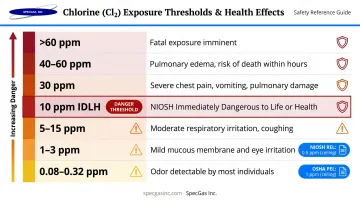
These thresholds come from NIOSH and ATSDR reference data. The gap between "detectable by smell" and "serious respiratory harm" is narrow — which is exactly why instrumented detection cannot be optional.
Why Human Senses Fail
Smell provides some warning, but three factors make it unreliable as a primary control:
- Chronic low-level leaks may not produce a noticeable odor
- Olfactory fatigue occurs during prolonged exposure — the brain adapts and stops registering the smell
- Chlorine only becomes visibly yellow-green at concentrations well above safe working levels
Any safety program that treats human senses as the first line of defense against chlorine exposure has a critical gap — one that continuous gas detection is specifically designed to close.
Safety Guidelines for Chlorine Gas Detection
Chlorine safety requires three elements working together: properly selected and installed detection equipment, consistent operational discipline, and trained personnel who know how to act when alarms trigger. No single element is sufficient.
General Safety Precautions
PPE requirements for chlorine-risk areas:
- Chemical splash goggles
- Nitrile or neoprene gloves
- Half-face respirator with chlorine-rated cartridges (minimum for routine entry)
- Supplied-air respirator or positive-pressure SCBA for high-concentration or confined space entry
PPE is the last line of defense. It does not substitute for detection. OSHA's respiratory protection standard (1910.134) requires employers to maintain a full respiratory protection program — not just provide equipment.
Emergency protocols must be established before an incident occurs. Every worker in chlorine-risk areas should know:
- What each alarm threshold means
- Their evacuation route
- When to attempt leak isolation versus when to evacuate immediately and call emergency response
Detector Placement and Installation
Because chlorine is heavier than air, fixed sensors must be installed low — approximately 30 cm (1 ft) from the floor, per Honeywell installation guidance. Installing sensors at head height in a chlorine-risk space means the instrument reads air that has not yet accumulated chlorine while floor-level concentrations build.
Before commissioning any detection system:
- Confirm the detector integrates with ventilation controls and alarm systems
- Verify the sensor is rated for the operating environment (temperature, humidity, chemical cross-sensitivity)
- Perform initial calibration with a verified reference gas
Operating Safely in Chlorine-Risk Areas
Before entry: Always check the detector reading or control panel display before entering any enclosed space where chlorine may be present. Absence of odor does not mean safe conditions.
If an alarm triggers:
- Evacuate the affected area immediately
- Activate ventilation systems if safe to do so
- Notify emergency response personnel
- Do not re-enter until trained personnel with appropriate equipment confirm the area is safe
Environmental Factors and Calibration
High humidity, temperature extremes, and interfering gases — sulfur dioxide and bromine are common examples — can affect electrochemical chlorine sensor performance. Bump testing in actual site conditions helps confirm the sensor is still responding correctly.
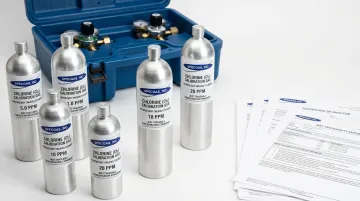
Electrochemical sensors degrade over time, and a sensor that drifts low will under-report actual chlorine concentrations. Calibrating with a NIST-traceable reference gas at a known, certified concentration is the only reliable way to verify the detector is reading accurately.
SpecGas Inc. produces chlorine calibration gas standards from 0.5 ppm to 10% concentration, covering the full range from OSHA PEL-level occupational monitoring to high-concentration leak detection. Each standard includes NIST traceability and uses a proprietary cylinder treatment process to prevent concentration drift in reactive gas mixtures.
Choosing and Placing Your Chlorine Gas Detector
Fixed vs. Portable Detectors
| Type | Best For |
|---|---|
| Fixed electrochemical | Continuous monitoring of enclosed high-risk areas (storage rooms, plant rooms, process areas); integrates with alarm and ventilation systems |
| Portable | Personnel working across varied locations, inspection rounds, confined space entry |
Most industrial facilities need both. Fixed units provide around-the-clock coverage; portables protect workers moving through areas with variable exposure risk.
How Electrochemical Sensors Work
When chlorine contacts the sensor's working electrode, it undergoes a redox reaction that generates an electrical current proportional to the chlorine concentration. This current converts to a ppm reading and triggers alarms when it crosses programmed thresholds.
Electrochemical sensors detect chlorine at very low ppm levels — minimum detection limits can reach 0.02 ppm depending on the sensor — well-suited for occupational monitoring where OSHA's ceiling is just 1 ppm.
Key Selection Factors
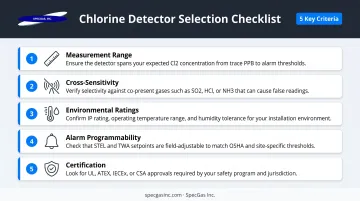
When specifying a chlorine detector, evaluate:
- Measurement range: Low-ppm sensitivity for occupational monitoring versus broader range for leak detection
- Cross-sensitivity: Electrochemical Cl2 sensors can respond to bromine, ClO2, NO2, and ozone — review the sensor's cross-sensitivity table
- Environmental ratings: Operating temperature and humidity limits for your specific installation
- Alarm programmability: Ability to set warning and alarm thresholds at OSHA PEL levels
- Certification: Compliance with ANSI/ISA-92.00.01 performance requirements for toxic gas detectors
The Calibration Gas Factor
A detector is only as accurate as the reference gas it calibrates against. Using imprecise or degraded calibration gas introduces measurement error that compounds with every subsequent calibration cycle. The result: a detector that appears functional but reads lower than actual chlorine concentrations.
Chlorine is also a reactive gas that interacts with cylinder walls and tubing. SpecGas's proprietary internal cylinder treatment process stabilizes reactive Cl2 mixtures and extends shelf life, with concentrations available in nitrogen or zero-air balance to match your detector's specified calibration gas.
For tubing and regulators, stainless steel or aluminum-based materials are required. Brass reacts with chlorine and compromises both the calibration gas integrity and detector response times.
Common Safety Mistakes to Avoid
Relying on Smell
Workers familiar with chlorine's bleach-like odor often assume they will notice a leak before it becomes dangerous. Three reasons this fails:
- Low-level chronic leaks may not reach the odor detection threshold
- Olfactory fatigue suppresses odor perception during prolonged exposure
- By the time the smell is strong enough to be obvious, exposure may already be at harmful levels
Smell is a warning indicator, not a monitoring program.
Neglecting Detector Maintenance
OSHA's direct-reading monitor guidance is direct: accuracy can be affected by sensor degradation, environmental conditions, and exposure to contaminants. An instrument that passes a visual inspection but has a degraded sensor may not alarm during an actual release.
The consequences of skipped maintenance:
- Missed bump tests: A sensor that no longer responds correctly to challenge gas will not alarm reliably in the field
- Delayed calibration: Sensor output drifts over time; uncalibrated detectors may under-read actual concentrations
- Expired sensors: Leaving electrochemical sensors in service past their rated lifespan creates false confidence in a non-functional detector
If a bump test fails, the instrument requires full calibration, repair, or removal from service — not a second bump test.
Improper Detector Placement
Mounting chlorine sensors at head height is one of the most common installation errors. Because chlorine is heavier than air, it settles toward the floor — a head-height sensor can show minimal concentration while floor-level accumulation builds to hazardous levels.
Sensor location matters beyond height. Common placement mistakes include:
- Mounting near HVAC intakes, which dilutes or redirects sampled air
- Installing in areas with poor circulation that don't reflect conditions at the leak point
- Positioning behind obstructions that interrupt airflow to the sensor face
Frequently Asked Questions
How do you detect chlorine gas?
Chlorine gas is detected using electrochemical gas detectors — either fixed units installed in high-risk areas or portable personal monitors carried by workers. These devices continuously sample the air and trigger audible and visual alarms when chlorine concentrations exceed pre-set thresholds.
What is the best chlorine gas detector?
The best detector depends on the application. Fixed electrochemical units are ideal for continuous area monitoring in enclosed spaces; portable monitors suit personnel working across varied locations or conducting confined space entry. Key selection factors: low-ppm sensitivity, cross-sensitivity performance, and alarm system integration.
Would I know if I inhaled chlorine gas?
Chlorine has a strong bleach-like odor and causes immediate irritation to the respiratory tract and mucous membranes. However, meaningful exposure can occur before symptoms become obvious, and olfactory fatigue during prolonged exposure reduces odor perception — making sensory warning alone an unreliable safety measure.
What are OSHA's permissible exposure limits for chlorine gas?
OSHA sets a ceiling PEL of 1 ppm for general industry; NIOSH recommends no more than 0.5 ppm over any 15-minute period. The IDLH is 10 ppm. Even short-term exposures above 1 ppm can cause noticeable respiratory effects, which is why detection at very low concentrations matters.
Where should chlorine gas detectors be placed?
Because chlorine is heavier than air, detectors should be mounted near floor level — approximately 1 ft (30 cm) from the floor — in enclosed or poorly ventilated spaces such as plant rooms, storage areas, and chemical handling zones. Control panels and displays should be positioned outside the hazard area for safe monitoring.
How often should chlorine gas detectors be calibrated?
Portable units should be bump tested before each use, with full calibration at manufacturer-recommended intervals — typically every three to six months. Full calibration must use a certified, NIST-traceable chlorine calibration gas standard at a known concentration. A failed bump test requires immediate full calibration or removal from service.