Introduction
Select the wrong oxygen cylinder mixture and the consequences are immediate: inaccurate instrument readings, failed compliance audits, or an unexpected combustion hazard. The category is far broader than it appears. Oxygen cylinders span an enormous range of formulations: from single-component pure O2 at 99.999% purity to multi-component certified reference standards where oxygen coexists with CO, NO, SO2, and H2S at precisely measured ppm-level concentrations.
That breadth creates real selection challenges. The wrong formulation — even one that seems close — can produce inaccurate instrument readings, trigger compliance failures, or create combustion hazards. Choosing correctly requires understanding what each mixture type is actually designed to do.
The four major categories — pure oxygen, oxygen-inert diluent blends, oxygen-reactive multi-component standards, and deficient atmosphere mixtures — each serve a distinct purpose, and each demands a different selection approach.
Key Takeaways
- Oxygen cylinder formulations range from single-component pure O2 to complex multi-gas calibration blends, always driven by application
- The four main types: high-purity oxygen by grade, binary O2/N2 mixtures, multi-component calibration gases containing oxygen, and specialty oxygen-based blends
- Using the wrong type causes measurement drift, failed audits, or safety hazards
- For calibration and compliance work, NIST-traceable certification and proper cylinder preparation are both required — neither is optional
- Never select based on availability alone — match the mixture to the application, concentration accuracy requirement, and regulatory obligation
What Are Oxygen Cylinder Mixtures?
Oxygen cylinder mixtures are compressed gas formulations where oxygen is either the sole component or one of several precisely specified components. They're filled into high-pressure cylinders at verified concentrations for use across industrial, laboratory, environmental, and specialty applications.
The range spans a wide spectrum:
- At one end: cylinders containing pure oxygen at 99.999% purity for research or laboratory use
- In the middle: two-component O2/N2 blends certified to replicate ambient air composition (~20.9% O2) for instrument calibration
- At the other end: oxygen present at trace concentrations alongside reactive gases like SO2 and NO in certified reference standards used to calibrate emissions analyzers
What unites them is precision. Each formulation is specified to achieve a defined outcome: calibrating an analyzer to within ±2%, supporting a combustion process, or delivering a reference standard that satisfies regulatory documentation requirements. Every mixture is purpose-built for a specific application, not a generic fill from a common source.
Why Oxygen Mixture Selection Matters
Selecting the wrong oxygen mixture type has direct consequences across three areas: measurement accuracy, operational safety, and regulatory compliance.
Measurement and Compliance Risks
EPA 40 CFR Part 75 Appendix A requires Protocol gases used for CEMS calibration to have analytical uncertainty not exceeding ±2.0% of certified concentration at a 95% confidence interval. Production sites must also participate in the EPA Protocol Gas Verification Program for Methods 3A, 6C, and 7E.
A calibration gas that doesn't meet this standard cannot support a valid regulatory submission, regardless of how close the labeled concentration appears.
For confined space safety monitors, OSHA 29 CFR 1910.146 defines two critical thresholds:
- Oxygen-deficient atmosphere: below 19.5% O2
- Oxygen-enriched atmosphere: above 23.5% O2
A portable monitor calibrated with an uncertified binary blend — one lacking documented traceability — may produce readings that fail to detect either condition reliably.
The Stability Problem
The EPA issued a February 2022 memo on calibration gas mixtures sold as Protocol gases not meeting long-term stability requirements. This is a documented, real-world problem — not a theoretical one. When reactive components in an oxygen-containing mixture degrade inside the cylinder before use, the certified concentration on the label no longer reflects what's inside, and any calibration performed with that gas is invalid.
Medical Applications
The consequences of a wrong selection reach beyond compliance into patient safety. FDA guidance under 21 CFR 213 and 21 CFR 201.161 governs medical gas labeling and prescription-use requirements. Medical oxygen requires USP-grade production with strict contamination controls and chain-of-custody documentation. Industrial or calibration-grade oxygen carries none of these controls and must never be substituted for medical-grade supply.
Types of Oxygen Cylinder Mixtures
High-Purity Oxygen by Grade
These cylinders contain oxygen as the sole component, differentiated by grade based on allowable contaminant levels and the regulatory or quality framework governing production.
| Grade | Minimum O2 Purity | Key Governing Standard |
|---|---|---|
| Industrial/High-Purity | ≥99.5% | Manufacturer specification (e.g., CGA G-4) |
| Medical/USP | ≥99.0% | FDA/USP; 21 CFR 201.161 |
| Aviator's Breathing (ABO) | ≥99.5% | MIL-PRF-27210J |
| Research/UHP | 99.999% | Manufacturer specification |
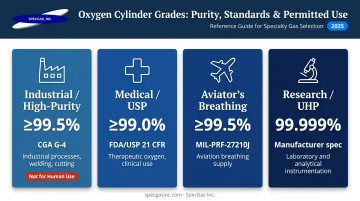
The distinguishing factor between grades is not the O2 percentage alone ; it's the standards governing production, cylinder cleanliness, and documentation. Medical oxygen requires a valid prescription and an FDA-registered supplier. Industrial oxygen carries no such controls and must not be used for human respiration.
Best suited for: Medical respiratory therapy, emergency oxygen delivery, oxy-fuel cutting and welding, combustion enhancement, and laboratory applications requiring a clean single-component oxidizer.
Key limitation: Pure oxygen is a powerful oxidizer. Per NFPA 53, cylinders, valves, regulators, and all contact surfaces must be scrupulously oxygen-cleaned and free of oil and combustibles. Research-grade UHP oxygen is significantly more expensive than industrial grade.
Binary Oxygen-Nitrogen Mixtures
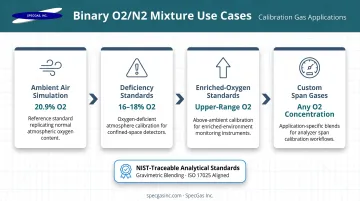
Binary O2/N2 mixtures are two-component blends at precisely certified concentrations, produced primarily as reference standards and calibration gases. Common formulations include:
- Ambient air simulations (~20.9% O2 balance N2) — CIPM-2007 places the dry air oxygen mole fraction at 0.20946
- Oxygen-deficiency standards (16–18% O2) for safety alarm calibration
- Enriched-oxygen standards for upper-range sensor verification
- Custom span gases matched to a specific instrument's measurement range
A concrete example of what certified traceability looks like: NIST SRM 2659a — Oxygen in Nitrogen at nominal 21% — is certified at 20.863% mol/mol O2 with an expanded uncertainty of ±0.021% mol/mol, valid through August 2033 if stored as specified.
Why not just use filtered atmospheric air? Every certified binary cylinder is gravimetrically blended to a documented uncertainty value with a lot-specific Certificate of Analysis. That precision and traceability cannot be achieved with filtered ambient air, which is why certified binary blends are the correct choice wherever calibration accuracy must be formally documented.
Best suited for: Calibrating fixed and portable oxygen analyzers, confined space safety monitors, O2-deficiency alarms, OEM instrument verification, air quality sensor testing, and process control calibration.
Limitation: Binary O2/N2 blends cannot replicate multi-component emission source compositions. Adding reactive gases to an O2/N2 matrix requires specialized cylinder treatment — something outside the scope of a simple two-component blend.
Multi-Component Calibration Gas Mixtures Containing Oxygen
These are complex certified reference standards containing oxygen alongside multiple precisely measured gases, including CO, CO2, NO, SO2, H2S, CH4, and non-methane hydrocarbons. They're used to calibrate CEMS, environmental analyzers, multi-gas safety detectors, and process control instrumentation.
EPA Method 3A, which governs continuous O2 and CO2 measurement at stationary emissions sources, lists example calibration mixtures including O2/SO2 in N2 and O2/CO2/SO2 in N2. For O2 monitors under Part 75, the span value must fall between 15.0% and 25.0% O2, and calibration error must not exceed 0.5% O2.
The Cylinder Stability Problem
Oxygen is a reactive oxidizer. Inside a high-pressure cylinder, it can react with reducing gases like CO, NO, and H2S over time, shifting their concentrations away from the certified values on the label. Once that happens, the Certificate of Analysis is no longer valid, and any calibration performed with the gas produces results that cannot be defended.
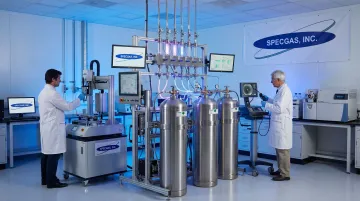
Cylinder preparation methodology is the primary quality differentiator between suppliers of these blends. SpecGas addresses this through a proprietary internal cylinder treatment process developed by founder Alfred Boehm, whose specialty gas R&D work dates to his director-level tenure at Messer Griesheims Industries in Germany. SpecGas performs compatibility and shelf life studies on gas-and-cylinder material combinations, and backs reactive multi-component mixtures with a Stability Guarantee: if a customer believes a mixture is out of specification, SpecGas will immediately remake and reship a replacement while investigating the original cylinder through re-analysis.
Best suited for: EPA-compliant CEMS calibration, stationary source emissions verification, multi-gas confined space detector calibration, stack emissions testing, and laboratory reference standards requiring NIST traceability.
What to ask any supplier before ordering:
- What cylinder passivation or internal treatment process do you use?
- Can you provide stability data for reactive components in an oxygen matrix?
- Is a lot-specific Certificate of Analysis included with every cylinder?
- What is your replacement policy if the mixture degrades before use?
Specialty Oxygen-Based Blends
Specialty blends are purpose-specific oxygen-containing formulations engineered for applications requiring a unique gas combination at tightly controlled ratios. This category includes:
- Heliox (helium-oxygen): Standard clinical heliox formulations run at 80:20, 70:30, and 60:40 helium:oxygen ratios for respiratory therapy applications
- Oxygen-CO2 blends: Used in cell culture incubator atmosphere control and CO2 sensor calibration, where tri-gas incubators generate controlled hypoxic conditions
- Ultra-trace oxygen in inert gases: Sub-ppm oxygen in nitrogen or argon for semiconductor process environment monitoring, available from specialty producers like SpecGas in disposable and high-pressure refillable cylinder formats
- Oxygen-containing excimer laser support gases: Linde confirms gas supply for ArF (193 nm) and KrF (248 nm) excimer laser systems used in electronics manufacturing and semiconductor photolithography
Each formulation is defined by the application: gas ratios, purity specifications, and cylinder requirements are set by the end use, not industry templates. Most of these blends are difficult or impossible to source from standard industrial gas distributors.
Best suited for: Excimer laser systems, clinical respiratory therapy, cell biology and incubator atmosphere control, confined space safety monitoring on cruise ships and similar commercial environments, and advanced semiconductor process monitoring.
Limitation: Specialty blends often have narrower stability windows. Formulations with highly reactive components require strict materials compatibility verification. Buyers must work directly with producers who have specific technical expertise for the blend type — off-the-shelf substitutions frequently result in incorrect performance.
How to Choose the Right Oxygen Cylinder Mixture
The correct type is determined entirely by the application. Choosing based on availability or cost without matching actual requirements is the most common source of instrument errors and compliance failures.
Match Grade to End Use and Regulatory Obligation
- Human respiration: FDA-regulated USP/medical-grade oxygen with prescription compliance infrastructure — no exceptions
- Regulatory calibration (CEMS, EPA Method 3A): EPA Protocol gas with NIST-traceable certification, documented uncertainty ≤±2.0%, and PGVP-participating production site
- Instrument calibration (non-regulatory): Certified binary or multi-component blend with lot-specific Certificate of Analysis and documented uncertainty value
- Industrial combustion/process use: defined O2 concentration appropriate for the equipment and process design
Evaluate Reactive Component Stability Before Ordering
When the required mixture combines oxygen with CO, NO, H2S, SO2, or other reducing gases, ask these questions before placing an order:
- What internal cylinder treatment process does the supplier use?
- How do they verify certified concentrations are maintained throughout the product's shelf life?
- Is stability data available for this specific reactive combination?
- What is the replacement or remake policy if concentrations shift before use?
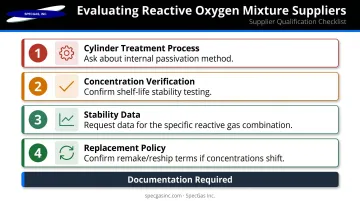
Avoid suppliers who cannot provide documented evidence that certified concentrations hold across the product's intended use window — that documentation is what determines whether calibration performed with the gas is defensible.
Factor in Total Cost of Ownership
Reactive mixture instability and long lead times both add hidden costs. Beyond the unit price per cylinder, factor in:
- Cylinder deposit programs vs. rental fees — deposit-based arrangements typically reduce long-term carrying costs compared to ongoing rental
- Lead times and whether rush service is available for time-sensitive calibration schedules
- Recalibration cost if a mixture degrades before use — this can exceed the original gas cost by a wide margin
SpecGas offers a cylinder deposit program as a cost-effective alternative to ongoing rental arrangements, along with rush service for urgent calibration schedules.
Frequently Asked Questions
Which gas is mixed with oxygen in an oxygen cylinder?
It depends on the application. Nitrogen is the most common diluent — used in binary calibration blends and air simulations. Helium, CO2, CO, NO, SO2, and H2S appear in specific multi-component formulations. Pure oxygen cylinders contain no other gases and must meet the purity criteria for their designated grade.
Will oxygen help my shortness of breath?
Supplemental oxygen therapy using medical-grade USP oxygen — prescribed by a physician — can help conditions involving low blood oxygen levels such as COPD or acute respiratory distress. Calibration-grade or industrial-grade oxygen carries no FDA oversight or contamination controls and is never appropriate for human respiration.
What is the difference between medical-grade oxygen and industrial oxygen?
Both are primarily oxygen, but they differ in purity standards, regulatory oversight, and permitted use. Medical oxygen is FDA-regulated, requires a prescription, and must meet strict USP contamination limits with a documented chain of custody. Industrial oxygen carries none of these controls and must never be administered to humans.
What are calibration gas mixtures containing oxygen used for?
These certified reference blends are used to calibrate and verify the accuracy of oxygen analyzers, multi-gas safety detectors, CEMS, and air quality instrumentation. Without periodic calibration using a certified gas of known concentration, sensors drift and produce readings that cannot be trusted for compliance or safety decisions.
What does NIST-traceable mean for an oxygen gas mixture?
NIST traceability means the mixture's concentration has been verified against certified reference standards maintained by the National Institute of Standards and Technology, creating an unbroken, documented audit trail. This validates the blend for use in regulatory-compliant calibration, environmental monitoring, and laboratory accreditation contexts.
Why do reactive gases degrade in oxygen-containing cylinder mixtures?
Oxygen is a strong oxidizer that can chemically react with reducing gases such as CO, NO, and H2S inside the cylinder over time, shifting their concentrations away from certified values. Proper cylinder passivation or internal treatment before filling prevents these reactions and ensures the mixture remains within specification throughout its shelf life.