Introduction
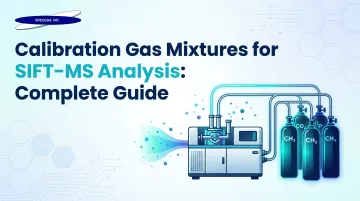
SIFT-MS (Selected Ion Flow Tube Mass Spectrometry) uses ion-molecule reaction kinetics to calculate VOC concentrations from first principles — in theory, without external calibration. In practice, instrument-dependent variables like mass discrimination and ion diffusion introduce systematic errors that only certified gas standards can correct.
For labs and industrial operations running trace-level gas analysis in the ppt to ppm range, that correction depends entirely on the quality of the calibration gas mixture used. A poorly certified or unstable gas standard introduces error at the source, making every downstream measurement unreliable.
This guide covers what SIFT-MS calibration gas mixtures are, the different types used, how the calibration process works, and what specifications matter when sourcing them.
Key Takeaways
- SIFT-MS performs absolute quantitation using reaction kinetics, but gas standard calibration is required for high-accuracy, repeatable real-world results
- Calibration gas mixtures include multicomponent performance check standards (for ICF determination), span calibration gases, zero/balance gases, and reactive VOC mixtures
- Gas standards must match the instrument's sample flow rate and be certified at known ppbv–ppmv concentrations
- NIST traceability, mixture stability, and certified analyte concentrations are the foundation of reliable SIFT-MS results
- Suppliers with reactive gas blending expertise are essential for labs handling unstable or trace-level VOC standards
What Are Calibration Gas Mixtures for SIFT-MS?
Calibration gas mixtures for SIFT-MS are certified gas blends containing known concentrations of analyte compounds in a balance gas — typically nitrogen or air — used to validate the instrument's response, determine key calculation parameters, and generate external calibration curves where high accuracy is required.
These mixtures serve two distinct functions in SIFT-MS workflows:
Performance Check Standard: The instrument analyzes this multicomponent mixture automatically to determine the reaction time (tr) and Instrument Calibration Function (ICF). These parameters feed directly into every subsequent concentration calculation, correcting for instrument-specific mass discrimination and ion diffusion effects across the full m/z range.
External Calibration Standard: Used to generate compound-specific calibration curves for high-accuracy quantitative methods when first-principles calculations alone don't meet precision requirements.
The "No Calibration Required" Misconception
SIFT-MS is often described as not needing calibration because it can calculate absolute concentrations from ion-molecule reaction kinetics. This "first principles" approach is powerful — but it doesn't eliminate the need for a gas standard entirely.
Instrument-dependent variables, specifically mass discrimination and ion diffusion, must still be corrected empirically. Research published in the Journal of the American Society for Mass Spectrometry confirms that ICF and reaction time values derived from a multicomponent gas standard are essential for these corrections, making calibration mixtures non-optional for accurate work.
Balance Gas Requirements
The balance gas must not interfere with the three reagent ions used in SIFT-MS: H₃O⁺, NO⁺, and O₂⁺•. Nitrogen is the preferred balance gas in modern SIFT-MS instruments, offering better high m/z transmission than helium, which was the historical standard. When ordering calibration blends, confirm your supplier is familiar with the balance gas requirements for your specific instrument configuration.
Concentration Range Challenges
Calibration mixtures for SIFT-MS span an unusually wide concentration range — from low ppbv for trace-level VOC standards to low ppmv for performance check gases. Maintaining certified accuracy at these extreme dilutions requires tight blending tolerances and specialized cylinder treatment to prevent analyte degradation.
Why Calibration Gas Quality Matters in SIFT-MS Analysis
In SIFT-MS analysis, the Instrument Calibration Function (ICF) is built entirely from the calibration gas standard. The ICF corrects for mass discrimination and ion diffusion across the instrument's full m/z range — so if certified concentration values in the standard are inaccurate, every analyte concentration the instrument calculates inherits that error.
According to metrological guidelines in JCGM 100:2008 (the GUM) and ISO/IEC 17025, reference gas uncertainty propagates through the ICF and reaction time calculations into the final measurement result. An unbroken chain of calibrations traceable to SI units is required for defensible analytical results.
Mixture Stability: The Critical Quality Factor
Unlike many GC-MS calibration standards prepared in solvent, SIFT-MS gas-phase standards must maintain analyte concentrations over the cylinder's usable life. Reactive VOCs are known to degrade or adsorb onto cylinder walls — particularly in untreated steel or aluminum — leading to concentration drift that invalidates calibration.
Research findings on reactive VOC stability:
- Formaldehyde: In CCQM-K90 international comparisons, formaldehyde at ~2 μmol/mol in treated Al-Acu-VIII cylinders showed an average loss rate of −1.9% over 600 days
- Acetonitrile: Untreated and Performax-treated aluminum cylinders showed significant adsorption losses ranging from 6% to 49% for acetonitrile at concentrations below 10 nmol/mol
- Sulfur Compounds: Untreated stainless steel rapidly adsorbs sulfur compounds like methylmercaptan and H₂S — passivation treatments like SilcoNert 2000 are required to prevent adsorption and ensure stability
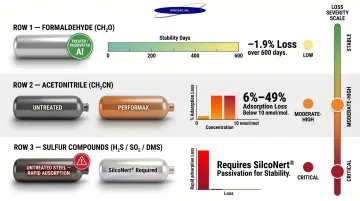
Cylinder passivation and internal treatment are essential for reactive SIFT-MS calibration mixtures. Untreated cylinders produce systematic concentration drift that corrupts calibration curves and introduces measurement bias.
What "Bad Calibration Gas" Looks Like in Practice
Experienced SIFT-MS users watch for these indicators of calibration standard problems:
- Abnormal ICF curve shape — excessively high or low ICF values, abnormal curvature at higher m/z, or lack of smoothness across the mass range
- Inconsistent reagent ion signal levels — fluctuations that suggest contamination or balance gas interference
- Systematic bias — over- or under-reporting of analyte concentrations across product ions that traces back to inaccurate certified values
According to published SIFT-MS calibration methodology research, an abnormal ICF plot serves as a diagnostic tool, typically indicating user error (such as an additional valve left open to the flow tube) or gas standard issues.
Types of Calibration Gas Mixtures Used in SIFT-MS
Multicomponent Performance Check (ICF) Standard
This is the most critical mixture type: a certified blend of typically 6–8 stable, nonpolar gases at known concentrations (nominally ~2 ppmv) covering the instrument's full m/z range. These compounds are chosen because they don't fragment, don't form secondary product ions, and produce clean, predictable ion signals across all reagent ions.
Standard ICF mixture composition:
| Compound | Role in Calibration | Anchor m/z | Nominal Concentration |
|---|---|---|---|
| Ethene (C₂H₄) | Determines reaction time (tr) via reaction with O₂⁺• | 28 | ~2 ppmv |
| Isobutene | Mid-mass transmission coverage | - | ~2 ppmv |
| Benzene | Cross-ion pair interpolation (H₃O⁺/O₂⁺•) | 78/79 | ~2 ppmv |
| Toluene | Cross-ion pair interpolation (H₃O⁺/O₂⁺•) | 92/93 | ~2 ppmv |
| Tetrafluorobenzene | High-mass transmission anchor | 150 | ~2 ppmv |
| Hexafluorobenzene | High-mass transmission anchor | 186 | ~2 ppmv |
| Octafluorotoluene | High-mass transmission anchor | 236 | ~2 ppmv |
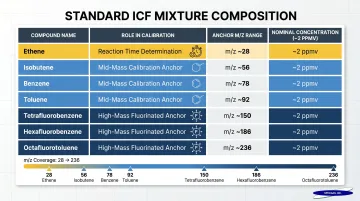
The instrument uses this mixture automatically during its performance check sequence to generate the ICF curve that governs all subsequent analyses. These gases must be genuinely stable nonpolar compounds — any reactive component or incorrect concentration will produce an abnormal ICF curve and corrupt every downstream measurement.
Span Calibration Standards (External Calibration Gases)
When high-accuracy quantitation is required beyond the first-principles approach, SIFT-MS users generate compound-specific calibration curves using certified span gases — single-component or multicomponent mixtures containing the target analyte(s) at known concentrations in a nitrogen or air balance. These are similar to GC-MS calibration standards but delivered as compressed gas.
Key requirements:
- Concentration range and number of calibration points should bracket expected sample concentrations
- The calibration gas flow rate must be matched to the instrument's sample inlet capillary flow (typically ~22 sccm)
- Failure to match flow rates introduces systematic error into the concentration calculation
Zero Gas / Balance Gas Standards
Zero gas is a high-purity, analyte-free gas — typically ultra-high-purity nitrogen or certified "zero air" — used to establish the instrument's baseline before sample introduction. Per standard analytical method requirements, zero gas must contain less than 0.1 ppmv of organic material or less than 0.1 percent of the span value, whichever is greater.
Zero gas plays a critical role in:
- Blank measurements during method development
- Reagent ion signal level verification
- Day-to-day quality control checks
- Establishing baseline ion counts before sample introduction
Reactive VOC and Low-Concentration Calibration Mixtures
Reactive trace VOC mixtures at low ppbv concentrations represent the most demanding calibration category. They support SIFT-MS applications across breath analysis, environmental monitoring, industrial hygiene, and pharmaceutical purity testing. Target analytes include:
- Formaldehyde and acetaldehyde
- Sulfur compounds (H₂S, methylmercaptan)
- Nitrosamines
- Other chemically active species
Reactive analytes degrade on untreated cylinder surfaces, so achieving certified accuracy at sub-ppm concentrations requires both advanced blending techniques and specialized cylinder passivation — capabilities that commodity gas suppliers typically cannot provide.
How SIFT-MS Calibration with Gas Mixtures Works – Step by Step
This section provides a practical walkthrough of how calibration gas mixtures are integrated into a SIFT-MS workflow — from receiving a new cylinder to generating validated quantitative data.
Step 1 – Verify the Calibration Gas Certificate
Check the Certificate of Analysis (CoA) for:
- NIST traceability statement: Confirms the standard's metrological link to SI units
- Certified concentration(s) with stated uncertainty: Typically ±2–5%, required for uncertainty budget calculations
- Balance gas identity: Must be nitrogen or another reagent-ion-compatible gas
- Preparation date and shelf life/expiry: Critical for reactive VOC standards
- Component-specific certification: For multicomponent standards, each component concentration must be independently certified — not just the blend ratio
Step 2 – Match Flow Rate and Configure the Inlet
The calibration gas must be delivered to the SIFT-MS instrument at the same flow rate as the sample inlet capillary. Modern SIFT-MS instruments use a passivated capillary with a typical fixed flow rate of 22 sccm (0.3 Torr L s⁻¹), though some configurations use 20 or 25 sccm depending on the specific inlet design.
Flow rate mismatch is a common source of systematic calibration error. Verify the flow rate with a calibrated flow meter before beginning any calibration sequence. Dilution or pressure transients caused by flow mismatch will invalidate your calibration data.
Step 3 – Run the Instrument Performance Check
The automated sequence proceeds as follows:
- Gas delivery: The certified multicomponent ICF standard is introduced at the matched flow rate
- Reaction time (tr) determination: Because static voltage accelerates reagent ions, tr cannot be calculated solely from carrier gas flow. Instead, the reaction of O₂⁺• with ethene (C₂H₄), which yields a single product ion at m/z 28, is used to empirically calculate tr
- ICF generation: ICF values are calculated using the reactions of NO⁺ or O₂⁺• with the standard's components. The ICF is anchored at 1 for m/z 28-32, with values for higher masses determined up to m/z 236, and extrapolated linearly up to m/z 400
- Storage and application: The tr and ICF values are stored in the instrument's configuration files and applied to all subsequent raw data files until the next check
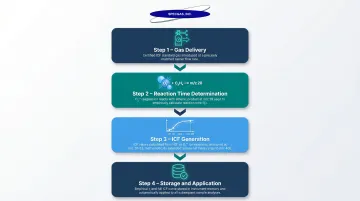
Visually inspect the ICF curve after each performance check. An abnormal shape — excessively high/low values, a non-smooth curve, or unexpected discontinuities — indicates gas standard problems or instrument issues. Halt analysis until the cause is resolved.
Step 4 – Generate External Calibration Curves (When Required)
External calibration makes sense when:
- High-accuracy requirements exceed first-principles uncertainty
- Regulated methods specify calibration curve validation
- Compounds have known ICF uncertainties or complex fragmentation patterns
- Method validation requires documented linearity and precision
To build external calibration curves:
- Run span gases at multiple concentration levels (minimum 3–5 points)
- Extract averaged SIFT-MS responses per injection
- Plot calibration curves in data processing software
- Verify linearity (r² > 0.995 typically required)
Calibration longevity advantage: SIFT-MS calibrations remain valid for longer durations than GC-MS because there is no chromatographic column (eliminating retention time drift), and the ratio of product to reagent ions self-corrects for reagent ion intensity fluctuations.
Step 5 – Validate and Establish Quality Control Checks
Ongoing quality control check (QCC) standards confirm that calibration has not drifted during batch runs. Periodic re-analysis of a known concentration standard should be interleaved within sample sequences.
Typical action limits:
- If reported concentration deviates from certified value by more than ±10% (or your defined tolerance), investigate before proceeding
- Research on validated SIFT-MS methods shows QCC results within 1.2% of original calibration mean, with %RSDs between 1.6% and 2.3%, easily meeting typical acceptance criteria
Performance check frequency: Instrument manufacturers recommend conducting the automated performance check daily. Run QCC standards at the beginning of each analytical batch and after every 10–20 samples, depending on how critical the application is.
How SpecGas Supports Your SIFT-MS Calibration Gas Needs
SpecGas Inc. has spent more than two decades producing NIST-traceable calibration gas standards, including the reactive and low-concentration mixtures that SIFT-MS workflows demand. All blends are produced in-house under the direction of founder Alfred Boehm, a research chemist whose specialty gas R&D background dates to 1976 — a depth of expertise that commodity gas distributors rarely offer.
Specific Capabilities Relevant to SIFT-MS Users
- Trace-level precision mixtures: Stable, NIST-traceable blends at ppb to ppm concentrations, covering formaldehyde (1–100 ppm), acetaldehyde, ethylene oxide, and other reactive VOCs that are notoriously difficult to stabilize
- Proprietary cylinder treatment: SpecGas's in-house cylinder treatment process addresses the most common cause of calibration standard degradation in SIFT-MS workflows, enabling longer shelf life and verified concentration accuracy. Reactive gas mixtures are backed by the SpecGas Stability Guarantee, supported by documented shelf life studies.
- Fast turnaround with rush service: Idle instruments cost labs time and money. SpecGas maintains lead times well ahead of industry norms, with rush service available for urgent calibration needs
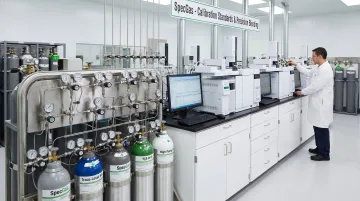
Custom Calibration Blend Consultation
SIFT-MS users working in research, environmental monitoring, pharmaceutical testing, or industrial hygiene can contact SpecGas to discuss custom calibration blend requirements — whether that means a multicomponent performance check standard, reactive VOC span gas, or a specialized trace-level mixture not available from standard distributors.
Contact SpecGas:
Phone: (215) 443-2600
Email: website-inquiries@specgasinc.com
Address: 86 Vincent Circle, Bridgeport, PA
When you reach out, the technical team can advise on cylinder material selection, balance gas compatibility, and concentration ranges — details that directly affect stability and measurement accuracy in SIFT-MS applications.
Frequently Asked Questions
What is SIFT-MS (Selected Ion Flow Tube Mass Spectrometry)?
SIFT-MS is a real-time trace gas analysis technique that uses chemical ionization via three reagent ions (H₃O⁺, NO⁺, O₂⁺•) to detect and quantify volatile compounds in air at concentrations down to parts-per-trillion. No sample preparation or chromatographic separation is required.
What is the standard for calibration of a gas detector?
Gas detectors and analytical instruments like SIFT-MS are calibrated using NIST-traceable certified reference gas mixtures with documented analyte concentrations and uncertainties. ISO/IEC 17025 and related quality standards require this traceability.
What are the different types of calibration gases?
The four main categories used in SIFT-MS work are:
- Zero gas — analyte-free reference for baseline correction
- Span gas — known concentration for sensitivity calibration
- Multicomponent performance check standards — cover a range of m/z values for ICF determination
- Specialty reactive gas mixtures — used for trace VOC calibration in advanced applications
How often should SIFT-MS calibration gas mixtures be replaced?
Check the expiry date on your Certificate of Analysis and replace accordingly. Most performance check standards last 12–24 months; reactive VOC mixtures typically have shorter shelf lives because unstable compounds degrade faster.
What concentration range is typically used for SIFT-MS calibration standards?
ICF/performance check standards typically contain analytes at approximately 2 ppmv. External calibration span gases for specific VOC quantitation are prepared to bracket expected sample levels, generally in the low ppbv to low ppmv range to align with SIFT-MS's sub-ppbv detection capability.