Introduction
When you specify a two-component gas mixture, the mole ratio is the number that defines everything else. It determines how the mixture behaves analytically, what partial pressure each component exerts, and whether your calibration results are trustworthy.
Many users treat composition as an afterthought — ordering a gas blend by volume percent or nominal concentration without verifying whether the certified value carries an uncertainty band, how it was confirmed, or whether it will remain stable in the cylinder over time. Each of those gaps introduces measurement risk.
According to IUPAC, the formal definition of mole fraction (amount fraction) is the amount of a constituent divided by the total amount of all constituents. For gaseous mixtures, it is expressed using the symbol y. That ratio feeds directly into partial pressure calculations, average molecular weight, analyzer calibration response, and regulatory reporting — so errors at this step propagate forward.
This article covers:
- What mole ratio represents in a binary gas system and how it's calculated
- What can shift a mixture away from its certified value over time
- What rigorous specification looks like for calibration-grade applications
Key Takeaways
- Mole fraction = moles of component A ÷ total moles, which equals the partial pressure fraction and volume fraction for ideal gases
- Average molecular weight of a mixture = (X_A × M_A) + (X_B × M_B), weighted by mole fraction
- Any error in certified mole fraction produces a proportional bias in every instrument reading that gas calibrates
- Reactive gases (H₂S, HCl, NH₃, NO) can drift from their certified mole ratio during storage, making proper cylinder treatment essential
- Mole fraction is the most pressure-independent way to express gas composition — volume percent is only equivalent under ideal conditions
What Mole Ratio Represents in a Two-Component Gas Mixture
The Formal Definition
For a binary mixture of Gas X and Gas Y, the mole fraction of Gas X is:
y_X = n_X / (n_X + n_Y)
where n represents moles. The result is dimensionless, ranging from 0 to 1. In practice, it's expressed as:
- Mole percent (multiply by 100) for percent-level components
- ppm by mole (μmol/mol) for trace-level analytes
- ppb by mole for sub-ppm concentrations in specialty calibration standards
Which notation you use depends on the concentration range — and which representation you specify on a certificate of analysis affects how the mixture is interpreted across pressure and temperature conditions.
Mole Fraction vs. Volume Percent vs. Mass Percent
These three representations are not always interchangeable. Here's when they agree and when they don't:
| Representation | Equivalent to Mole Fraction? | Conditions |
|---|---|---|
| Volume percent | ✅ Yes | Ideal gases, constant T and P |
| Volume percent | ❌ No | High-pressure cylinders, heavy gases, near-condensation |
| Mass percent | ❌ Never directly | Always requires conversion via molar mass |
ISO 14912 explicitly treats mole fraction, mass fraction, and volume fraction as distinct composition quantities and restricts conversion guidance to homogeneous, stable mixtures well outside the condensation region. This matters when you're drawing from a high-pressure cylinder containing a heavy molecular weight component.
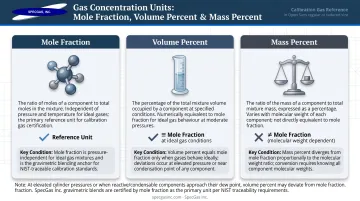
Mole fraction is the preferred basis for specialty gas specifications because it's pressure-independent and mathematically unambiguous — no conversion factors shift when cylinder pressure drops. SpecGas Inc. produces certified calibration gas mixtures from 300 ppb up to percent-level concentrations, blended gravimetrically with NIST-traceable documentation, so the certified mole fraction holds throughout the cylinder's usable life.
Factors That Affect the Actual Mole Ratio in a Blended Gas Mixture
Getting the mole ratio right requires controlling every stage of production. Four factors determine whether the delivered blend matches the certificate.
Blending Method
Gravimetric blending — filling by precisely measured mass — is the primary reference route for calibration gas preparation. ISO 6142-1:2015 specifies gravimetric methods for preparing Class I calibration gas mixtures with traceable amount-fraction values. NIST primary standard gas mixtures are also prepared gravimetrically.
SpecGas produces all calibration mixtures gravimetrically, which is how low-ppb blends remain accurate — there's no alternative at those concentration levels.
Pressure-based or volumetric blending introduces larger uncertainties, especially for trace components where small mass measurement errors translate to large relative errors in mole fraction.
Reactive Gas Stability
Reactive components — H₂S, HCl, NH₃, NO, Cl₂, ClO₂, PH₃, HCN — can shift away from their certified mole fraction during storage through two mechanisms:
- Bind to bare cylinder walls through surface adsorption, removing analyte from the gas phase
- React with moisture, metal oxides, or each other through chemical interaction
EPA data shows that SO₂-in-air mixtures were prohibited from EPA Protocol certification because studies found median concentration decay of 2.2% over six months. That decay isn't a labeling problem. It's a systematic measurement error built into every reading taken from an unstable cylinder.
SpecGas addresses this through a proprietary internal cylinder treatment process that passivates surfaces before filling. The SpecGas Stability Guarantee applies specifically to reactive gas mixtures, backed by compatibility and shelf life studies conducted on gases and cylinder materials.
Analytical Verification Limits
A stable cylinder still depends on an accurate certified value — and that accuracy is only as good as the analytical method used to verify it.
The certified mole fraction is only as accurate as the method used to verify it. Per NIST SP 260-222, certification methods vary by analyte:
- GC-FID for hydrocarbon components
- CRDS for methane and H₂S
- Chemiluminescence for NO
- NDUV for SO₂
Method selection depends on the analyte and concentration level. There is no single universal approach.
How Mole Ratio Relates to Partial Pressure, Molecular Weight, and Mixture Behavior
Dalton's Law and the Ideal Gas Equivalence
For ideal gas mixtures, three quantities are numerically equal:
y_A = n_A/n_total = P_A/P_total = V_A/V_total (at constant T, P)
This is Dalton's Law. It means composition can be expressed in mole fraction, partial pressure fraction, or volume fraction interchangeably — under ideal conditions.
That equivalence has direct consequences for sensor calibration. Gas sensors and electrochemical detectors respond to the partial pressure of the target component, not total pressure — so calibrating at one pressure and deploying at another introduces real error unless mole fraction is the controlled parameter.
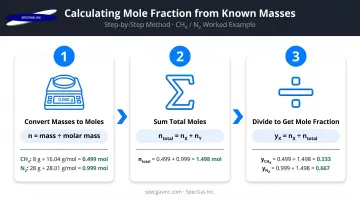
Calculating Mole Fraction from Known Masses
For a binary mixture prepared by mass:
- Convert masses to moles: n = mass / molar mass
- Sum total moles: n_total = n_X + n_Y
- Divide: y_X = n_X / n_total
Worked example — 2.00 g CH₄ (M = 16.04 g/mol) in 78.00 g N₂ (M = 28.01 g/mol):
- n_CH₄ = 2.00 / 16.04 = 0.1247 mol
- n_N₂ = 78.00 / 28.01 = 2.7847 mol
- y_CH₄ = 0.1247 / (0.1247 + 2.7847) = 0.0429, or 4.29 mol%
Average Molecular Weight of the Mixture
Once mole fractions are known, the mixture's average molecular weight follows directly — a value that matters for flow calculations and mixture identification.
M_avg = (y_X × M_X) + (y_Y × M_Y)
Using the example above:
M_avg = (0.0429 × 16.04) + (0.9571 × 28.01) = 0.688 + 26.81 = 27.50 g/mol
This matters when diagnosing unknown mixtures or calculating critical-orifice flow rates in dilution-based calibration systems. A wrong assumed molecular weight propagates into flow calculations and produces systematic error.
When Ideal Gas Assumptions Break Down
Mole fraction and volume fraction diverge under:
- High-pressure cylinders (real gas behavior, compressibility factors deviate from 1)
- Gases with significant intermolecular forces
- Mixtures near their dew point (condensation conditions)
In these conditions, mole fraction is the only composition unit that stays consistent regardless of pressure — which is why gravimetrically blended, NIST-traceable standards specify composition in mole fraction rather than volume percent.
How Mole Ratio Is Specified, Measured, and Certified in Specialty Gas Blends
Documentation Formats
Certificates of analysis for calibration gas blends report composition in one or more of these units:
- Mole percent — for percent-level components
- ppm by mole (μmol/mol) — for trace analytes, the unit used in EPA and NIST documentation
- ppb by mole — for sub-ppm specialty standards
For example, NIST SRM 2731 certifies hydrogen sulfide at 20.43 μmol/mol ± 0.27 μmol/mol — cylinder-specific, not batch-average. That specificity matters when uncertainty propagation affects compliance.
NIST Traceability: What It Actually Means
"NIST traceable" describes a specific chain of calibration, not just a label. NIST defines three tiers:
- SRMs (Standard Reference Materials) — prepared gravimetrically by NIST, highest tier
- NTRMs (NIST Traceable Reference Materials) — produced by specialty gas companies under NIST specifications; NIST audits 10% of each batch of minimum 10 cylinders
- EPA Protocol Gases — certified under the EPA Traceability Protocol for CEMS applications; requires individual cylinder assay, no batch certification
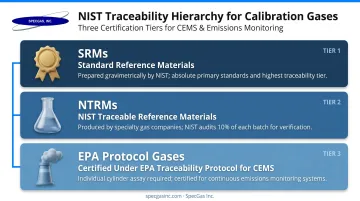
Understanding which tier applies to your application determines what documentation to request. SpecGas operates as an NTRM producer, using gravimetric blending and cylinder-level CoAs to meet NIST traceability requirements. For CEMS applications, EPA Protocol Gas status and PGVP participation are the applicable requirements under 40 CFR Part 75 — a separate certification path from the NTRM tier.
Tolerance and Uncertainty
Every certified mole fraction carries a stated expanded uncertainty — typically ±1–2% relative for gravimetrically prepared standards. On a CoA, this appears as a range around the nominal value.
Key points for end users:
- The nominal label value is not an exact number; it is the center of a tolerance band
- ISO/IEC 17025:2017 requires accredited laboratories to identify and report measurement uncertainty
- Using the label value as absolute without accounting for stated uncertainty leads to underreported calibration error
Implications of an Incorrect Mole Ratio
Direct Measurement Bias
An error in mole fraction is not contained within the gas cylinder — it transfers directly to every instrument calibrated against it. A 5% error in the analyte mole fraction produces a 5% proportional offset in span calibration, and every subsequent reading carries that offset forward.
EPA guidance on CEMS systems documents that multicomponent SO₂/NO/CO₂ blends used instead of single-component standards can introduce biases of up to 7% through molecular weight effects in critical-orifice dilution systems. Under 40 CFR Part 75, a biased monitoring system requires a calculated bias adjustment factor applied retroactively to reported data.
Application-Specific Failure Modes
The consequences vary by application — but in high-stakes environments, the failure mode is rarely just a number being off:
- Emissions monitoring: low analyte concentration in the standard underestimates actual emissions — a regulatory liability
- Excimer laser gas mixtures: even minor discrepancies in halogen-to-rare-gas ratio alter laser wavelength and output; SpecGas's documentation notes that "even a minor discrepancy in the required gas blends can negatively impact the laser's process"
- Medical calibration gases: FDA cGMP guidance requires calibration gases traceable to nationally recognized standards, making an incorrect mole fraction a quality system failure, not just a measurement error
Reactive Mixture Degradation During Storage
A correctly certified blend can become non-conforming before use. The mechanism:
- Reactive analyte adsorbs onto untreated cylinder walls
- Gas-phase concentration drops below the certified value
- The label no longer reflects what's in the cylinder
- Every instrument calibrated from that cylinder reads low
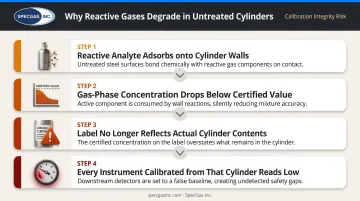
Cylinder treatment before filling is the only reliable way to prevent this. SpecGas's proprietary treatment process addresses wall reactivity for gases including H₂S, HCl, NH₃, NO, and Cl₂ — and the Stability Guarantee backs that performance.
Frequently Asked Questions
How do you calculate the molecular weight of a gas mixture?
The average molecular weight equals the mole-fraction-weighted sum of individual component molar masses: M_avg = (y_A × M_A) + (y_B × M_B). For a 5% CH₄ / 95% N₂ mixture, that's (0.05 × 16.04) + (0.95 × 28.01) = 27.41 g/mol.
What gas has a molar mass of 16 g/mol?
Methane (CH₄) has a molar mass of approximately 16.04 g/mol (12 for carbon + 4 × 1.01 for hydrogen). It appears as both analyte and balance gas in natural gas calibration standards, BTU standards, and LEL detector calibration.
What is 16 grams of CH₄ equal to?
Since the molar mass of methane is approximately 16 g/mol, 16 grams of CH₄ equals 1 mole — containing approximately 6.022 × 10²³ molecules.
What is the difference between mole fraction and volume percent?
At standard temperature and pressure with ideal gas behavior, mole fraction and volume percent are numerically equal. They diverge under high-pressure conditions, with significant molecular weight differences between components, or near condensation — which is why mole fraction is the standard basis for specialty gas certification.
Why does mole ratio matter for calibration gas accuracy?
Calibration instruments span against the actual concentration of the analyte, which is defined by its mole fraction. Any error in that mole fraction transfers directly and proportionally to every measurement the instrument produces after calibration.
How is the mole ratio of a two-component gas certified?
Certification starts with gravimetric blending — each component weighed to a known mass — followed by analytical verification using methods such as GC or cavity ring-down spectroscopy (CRDS), depending on gas type. The resulting NIST-traceable certificate documents the nominal mole fraction, expanded uncertainty, and reference standard.