Argon is chemically inert and colorless. Oxygen is highly reactive and supports combustion. Together, they form a blend whose behavior you can tune — but only if you understand what you're working with. OSHA data shows that oxygen-enriched environments can cause violent flash fires, while argon-related asphyxiation incidents have proven fatal in confined spaces.
This article covers the chemistry of Ar/O2 mixtures, their major industrial and scientific applications, and the safety practices that anyone handling these blends must understand.
Key Takeaways
- Argon does not react with oxygen — it's a noble gas, so the two coexist in stable blends
- Common Ar/O2 ratios range from 98/2 (stainless steel MIG welding) to 75/25 (industrial oxidizing applications)
- Key uses: MIG welding, steel refining (AOD), plasma surface treatment, and calibration gas standards
- Two hazards apply: oxygen enrichment raises fire risk, and argon displaces air without odor or warning
- Ar/O2 blends above 23.5% oxidizing power require oxygen-rated equipment and oxidizer-class labeling
What Is an Argon/Oxygen Mixture and Why Is It Used?
The Chemistry Behind the Blend
The Royal Society of Chemistry describes argon as "totally inert to other substances." It's a Group 18 noble gas with a complete electron shell — no chemical bonding, no reactivity under normal conditions. NASA data places argon at roughly 0.93% of dry air by volume, making it Earth's third most abundant atmospheric gas.
Oxygen is the opposite: reactive, combustion-supporting, and eager to form compounds.
Does argon react with oxygen? No. Because argon has a full valence shell, it cannot form chemical bonds with oxygen or any other element under standard conditions. When the two gases are blended, they coexist as a physical mixture — no new compounds form, and no chemical reaction occurs. That stability is exactly why the blend is useful.
Why Blend Them at All?
Oxygen adds reactivity, heat, and combustion support; argon moderates the process. By adjusting the ratio, operators can control how aggressively a system behaves.
Common verified commercial ratios include:
- 98% Ar / 2% O2 — stainless steel MIG welding; minimal oxidation, stable arc
- 95% Ar / 5% O2 — general steel GMAW, per AWS A5.32 classification SG-A-O-5
- 75% Ar / 25% O2 — industrial oxidizing applications; significantly higher reactivity
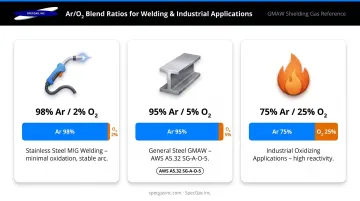
Higher oxygen content increases chemical reactivity and heat, while higher argon content favors arc stability and inert shielding. The Airgas SDS for 75% Ar / 25% O2 confirms this blend is stable in cylinders under normal storage conditions, with no hazardous decomposition products expected.
That ratio control becomes even more critical in precision calibration gas applications, where blend accuracy must hold to parts per million. At that level, cylinder preparation matters as much as the blending itself — even a stable gas can drift in concentration if the cylinder hasn't been properly conditioned.
Industrial Uses of Argon/Oxygen Mixtures
Welding and Metal Fabrication
Ar/O2 mixtures are among the most common shielding gases in MIG (GMAW) welding of stainless steel. Lincoln Electric recommends 1–2% oxygen in argon for most stainless steel spray-arc welding. ESAB lists 98/2 and 95/5 Ar/O2 as standard welding gas mixtures, noting that the oxygen addition improves arc stability, wetting action, bead shape, and spatter performance.
Pure argon shielding alone produces a less stable arc on steel. The small oxygen addition — even just 1–2% — creates a more consistent arc cone and improves how the weld metal flows into the joint. The tradeoff is minor surface oxidation, which is manageable at low oxygen percentages.
AWS A5.32 formally classifies these mixtures as SG-A-O-2 and SG-A-O-5, covering 2% and 5% oxygen blends respectively.
Argon Oxygen Decarburization (AOD) in Steel Production
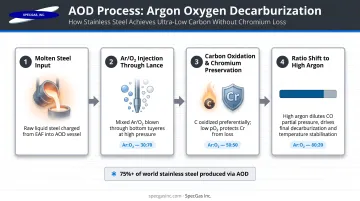
AOD is one of the largest-scale industrial applications of Ar/O2 mixtures. The process, developed in 1954, involves injecting an argon/oxygen gas mixture through molten steel to reduce carbon content while preserving chromium. According to Linde, more than 75% of the world's stainless steel is produced using AOD.
The mechanism works because argon dilutes oxygen in the injection stream. Lower oxygen partial pressure drives preferential carbon oxidation. Carbon burns off while chromium, which is expensive and behaves similarly to carbon under oxidation, is largely preserved. As carbon drops, the injection ratio shifts toward higher argon to manage temperature and prevent further oxidation.
Plasma Surface Treatment
Beyond bulk metallurgy, Ar/O2 mixtures also enable precision work at the surface level. In plasma systems, these blends are used to clean, etch, and activate material surfaces. The two gases serve distinct roles:
- Argon plasma — drives physical bombardment and sputtering via charged species
- Oxygen plasma : introduces reactive oxygen species that chemically modify surfaces
Peer-reviewed research has documented Ar/O2 plasma use in surface modification of polymer films, gelatin nanofibers for tissue engineering, and PLA packaging materials. The blend allows operators to tune the balance between physical etching and chemical reactivity based on the material being treated.
Emissions Monitoring and Calibration Gas Applications
In analytical chemistry and environmental monitoring, the balance gas matrix in a calibration standard matters. Instruments calibrated against a nitrogen-balance standard may read differently when exposed to an argon-balance matrix. For monitoring applications where the background gas contains argon, Ar/O2 calibration blends ensure the instrument is verified under the correct matrix conditions.
Common applications where Ar/O2 calibration blends are used include:
- ICP-OES configurations where argon serves as the plasma carrier gas
- Specialty emissions source testing requiring matrix-matched standards
- CEMS verification under EPA Traceability Protocol requirements
- Instrument cross-calibration checks across mixed-matrix environments
The EPA Traceability Protocol establishes certification requirements for calibration gases used in ambient and continuous emissions monitoring, with traceability to NIST reference standards.
Scientific and Calibration Applications
ICP-OES (Inductively Coupled Plasma – Optical Emission Spectrometry) instruments use argon as the plasma-forming gas. When organic solvents are analyzed, controlled oxygen addition to the argon plasma helps prevent carbon deposition on the torch and addresses plasma stability issues common with high-carbon-load samples.
In calibration gas production, the argon/oxygen matrix itself can be the critical specification. If an emissions monitor or analyzer operates in an environment where the background contains argon, calibrating with a nitrogen-balance standard introduces a matrix mismatch that can skew results. Precision Ar/O2 certified reference standards eliminate that mismatch and protect measurement accuracy.
Key requirements for calibration-grade Ar/O2 blends:
- NIST traceability with documented analytical uncertainty
- Gravimetric blending to verified concentration tolerances
- Proprietary cylinder treatment to prevent concentration drift over shelf life
- Certified analysis accompanying each cylinder
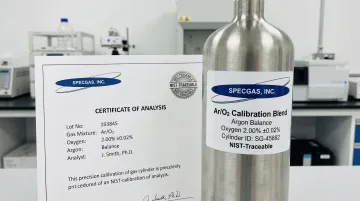
SpecGas Inc. produces custom Ar/O2 precision blends — including calibration-grade mixtures — using proprietary blending techniques and cylinder treatment processes rooted in Alfred Boehm's specialty gas R&D work dating to 1976. All mixtures are NIST-traceable, and SpecGas's in-house production supports faster turnaround than most larger suppliers, with rush service available for time-sensitive calibration needs.
Safety Considerations for Argon/Oxygen Mixtures
Dual Hazard: One Cylinder, Two Risk Categories
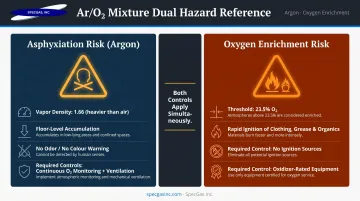
Ar/O2 mixtures present a unique challenge because the two components carry opposite hazards that must be managed simultaneously.
Oxygen enrichment risk: Argon is an asphyxiant. It displaces oxygen in the breathing air with no warning — no odor, no color, no detectable signal before oxygen levels drop. With a vapor density of 1.66 (air = 1), argon accumulates at floor level and in low-lying spaces.
In 2001, an employee TIG welding in a confined space at a refinery died from argon asphyxiation. The CSB has documented 80 nitrogen asphyxiation fatalities over a prior decade — a figure that directly informs the ventilation and monitoring requirements OSHA applies to inert gas work environments.
Why the combination is harder to manage: Each hazard requires different controls. Oxygen enrichment demands no-ignition-source policies and flammability awareness. Asphyxiation risk demands ventilation and oxygen monitoring. With Ar/O2 in the same cylinder, both sets of controls apply simultaneously — there's no way to address one without the other.
Oxygen enrichment — OSHA defines an oxygen-enriched atmosphere as greater than 23.5% O2 by volume. Above that threshold, materials that burn slowly under normal conditions — clothing, grease, organic materials — can ignite rapidly. In 2008, an uncontrolled cylinder discharge in an oxygen-enriched atmosphere caused a flash fire that hospitalized three workers with second- and third-degree burns.
Pressure and Equipment Hazards
All compressed gas cylinders carry pressure hazards. For Ar/O2 mixtures:
- Use only oxygen-rated regulators and fittings — standard inert gas equipment is not appropriate for oxidizing mixtures
- Keep oils and greases away from all oxygen-containing equipment — these can ignite violently on contact with high-pressure oxygen
- Never use damaged valves or non-compatible regulators
Regulatory Classification
Under 49 CFR 171.8 and OSHA HazCom, Ar/O2 mixtures with oxidizing power greater than 23.5% are classified as oxidizing compressed gases. The 75% Ar / 25% O2 blend, for example, carries UN3156 as "Compressed gas, oxidizing, n.o.s." under DOT Class 2.2/5.1. This classification affects labeling, storage requirements, and transport documentation.
Handling and Storage Best Practices
Ventilation and Confined Spaces
- Always work with Ar/O2 in well-ventilated areas
- In enclosed or low-lying spaces, use continuous oxygen monitoring — argon settles at floor level and depletes oxygen without warning
- Never enter a potentially argon-affected confined space without breathing apparatus and a direct-reading gas monitor
- OSHA 1910.146 requires atmospheric testing before and during confined space entry: oxygen content first, then flammable gases, then toxic contaminants
Cylinder Storage and Segregation
- Store cylinders upright and secured against falling
- Keep away from heat sources and flammable materials
- Segregate from fuel gases — OSHA 1910.253 requires at least 20 ft (6.1 m) separation from fuel gas cylinders, or a noncombustible barrier at least 5 ft high with 0.5-hour fire resistance
Equipment Compatibility
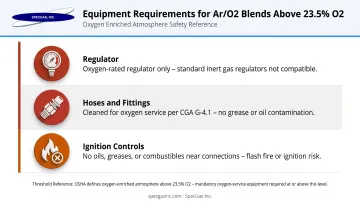
Storage requirements address the cylinder itself — but the equipment connected to it matters just as much. CGA guidance establishes that any system handling gas above 23.5% oxygen must be designed and cleaned for oxygen service. For any Ar/O2 blend that crosses this threshold:
- Use only oxygen-compatible regulators, hoses, and fittings
- Ensure all equipment has been cleaned for oxygen service per CGA G-4.1
- Never substitute standard argon or inert gas equipment — using incompatible hardware risks regulator failure, flash fire, or ignition at the connection point
Sourcing Precision Argon/Oxygen Mixtures
For industrial welding applications, sourcing a 98/2 or 95/5 Ar/O2 blend is straightforward. For calibration and analytical applications, the requirements are considerably more demanding.
What to verify before sourcing a precision Ar/O2 blend:
- NIST traceability — is the blend ratio certified against national standards, with documented uncertainty?
- Gravimetric or verified volumetric blending — how was the concentration confirmed?
- Cylinder treatment — has the cylinder been properly prepared to prevent concentration drift over the blend's shelf life?
- Analytical verification — what testing confirmed the final blend ratio after production?
- Stability documentation — is there a guarantee that the blend remains within specification throughout its usable life?
Low ppm and ppb Ar/O2 precision blends are genuinely difficult to produce consistently. Concentration drift in improperly treated cylinders can push a calibration standard out of specification before it's even used, invalidating calibration records and potentially skewing monitoring data.
That cylinder treatment problem is precisely where sourcing decisions matter. SpecGas Inc. has produced precision specialty gas blends since 2001, with a technical foundation built on founder Alfred Boehm's decades of specialty gas R&D experience — including internal cylinder treatment for reactive and precision gas mixtures. Custom Ar/O2 blends are available with NIST-traceable certification and in-house blending, with lead times that consistently run faster than the industry norm. Rush service is available for urgent analytical or compliance needs.
Frequently Asked Questions
Does argon react with oxygen?
No. Argon is a noble gas with a complete electron shell and cannot form chemical bonds under normal conditions. The two gases blend as a stable physical mixture without forming new compounds.
What is argon and oxygen used for?
The main applications include MIG welding shielding gas (particularly for stainless steel), Argon Oxygen Decarburization in stainless steel production, plasma surface treatment, and calibration gas matrix standards for emissions monitoring and analytical instruments.
What ratio of argon to oxygen is used in welding?
Common welding blends run from 98% Ar / 2% O2 for stainless steel spray-arc MIG welding up to 95% Ar / 5% O2 for general steel GMAW, per AWS A5.32 classifications. The right ratio depends on base metal, transfer mode, and weld quality requirements.
Is an argon/oxygen mixture dangerous to inhale?
Argon is an asphyxiant that displaces oxygen with no warning signal; oxygen-enriched mixtures add fire and combustion risk on top of that. Don't intentionally inhale either gas in any occupational setting — adequate ventilation is required whenever working with these gases.
Can you use an argon regulator with an argon/oxygen mixture?
It depends on the oxygen content. Blends that exceed the 23.5% oxidizing power threshold are classified as oxidizing gases and require oxygen-rated regulators and fittings — using standard inert gas equipment on these mixtures is a serious safety hazard. Always check the SDS and confirm equipment compatibility before connecting any regulator.
How do I ensure my Ar/O2 calibration gas blend stays accurate over time?
Mixture stability depends on proper cylinder treatment before filling, accurate gravimetric blending, and certified post-production analysis. Look for a supplier that documents both their cylinder treatment process and their stability guarantee — SpecGas's proprietary treatment and Stability Guarantee are specifically designed to keep reactive and precision blends within spec for the full shelf life of the cylinder.