Introduction
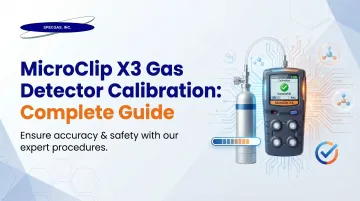
The GasAlertMicroClip X3, manufactured by BW Technologies (a Honeywell company), is a widely deployed 4-gas personal safety detector that continuously monitors hydrogen sulfide (H2S), carbon monoxide (CO), oxygen (O2), and combustible gases (LEL).
Calibration verifies and adjusts the instrument's sensors against a known gas concentration so readings stay accurate. Without it, the detector cannot be trusted to alarm at the correct thresholds — creating life-safety risks for workers in confined spaces, utility infrastructure, oil refineries, or industrial facilities.
Those risks are preventable. OSHA mandates calibrated direct-reading instruments for confined space entry, yet uncalibrated detectors remain a leading cause of workplace gas-related injuries.
This guide is written for safety managers, industrial workers, and lab technicians responsible for maintaining a MicroClip X3. You'll learn why calibration is required, exactly how to perform it, and the most common mistakes that compromise results.
Key Takeaways
- Calibration adjusts the MicroClip X3's sensors against a known reference gas concentration
- BW Technologies recommends calibrating before first use and at least every 180 days
- Required equipment: a 4-gas NIST-traceable cylinder (H2S, CO, LEL, O2), a fixed-flow regulator, and the BW calibration cap and hose
- The process runs auto-zero, then spans each sensor against calibration gas for ~30 seconds
- Bump testing confirms sensor response; calibration establishes the accuracy baseline
- Avoid contaminated environments, expired gas, or calibrating immediately after charging
What Is MicroClip X3 Calibration and Why It Matters
Calibration is the process of exposing the detector's sensors to a precisely known concentration of reference gas and adjusting the instrument's output to match, ensuring the device accurately reports actual gas levels in the field.
Accurate sensor readings ensure that low and high alarms trigger at the correct thresholds, protecting workers from H2S, CO, combustibles, and oxygen-deficient or enriched atmospheres. This precision matters because electrochemical and catalytic bead sensors naturally drift over time.
Research confirms that electrochemical sensors exhibit long-term drift and baseline shifts, caused by age, contaminant exposure, temperature variation, and humidity. An uncalibrated detector may fail to alarm or produce false readings entirely.
BW Technologies recommends calibration at least every 180 days, and most industries require documented records. Key compliance requirements include:
- Calibration interval: Every 180 days at minimum, or per site-specific safety programs
- Confined space mandate: OSHA 29 CFR 1910.146 requires calibrated direct-reading instruments for confined space entry
- Record retention: OSHA guidance directs employers to keep calibration records for the life of each instrument as proof of fitness
Note that calibration and bump testing serve different purposes. Calibration adjusts sensor output to a known standard; a bump test only confirms the sensor responds to gas and triggers an alarm.
What You Need Before You Start
Required equipment includes:
- 4-component calibration gas cylinder containing H2S (25 ppm), CO (100 ppm), LEL/methane (50% LEL), and O2 (18% vol)
- Fixed-flow regulator set to 250–500 ml/min
- BW MicroClip calibration cap and hose
Calibration gas must be NIST-traceable and within its expiration date. OSHA requires that test gas be certified using a standard traceable to the National Institute of Standards and Technology (NIST). SpecGas blends NIST-traceable 4-gas mixtures formulated for detectors like the MicroClip X3, with verified concentrations and cylinder treatment that preserves reactive gas accuracy through the shelf life of the cylinder.
Environmental conditions are critical:
- Perform calibration in a safe area free of hazardous gas
- Atmosphere must contain 20.9% oxygen
- Never calibrate during or immediately after charging, as charging affects sensor baseline readings
Standard alarm setpoints for the X3:
| Gas | Low Alarm | High Alarm |
|---|---|---|
| H2S | 10 ppm | 15 ppm |
| CO | 35 ppm | 200 ppm |
| LEL | 10% LEL | 20% LEL |
| O2 | 19.5% vol | 23% vol |
These are standard operational alarm thresholds — not calibration environment targets. Confirm they match your site's configured values before proceeding.
How to Calibrate the MicroClip X3: Step by Step
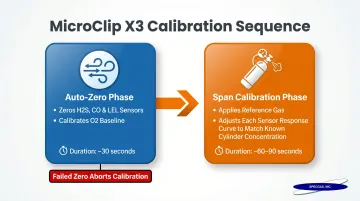
The MicroClip X3 uses a one-button design with automatic zero and automatic span functions, with no multi-menu navigation required. The entire sequence is initiated and completed through a single button hold. Before starting, understand what each phase does:
- Auto-zero phase: The detector zeros H2S, CO, and LEL sensors against clean air while simultaneously calibrating the O2 sensor. Any failed zero aborts calibration. Takes approximately 30 seconds.
- Span calibration phase: After zeroing, the detector prompts you to apply gas and adjusts each sensor's response curve so the known cylinder concentration matches the on-screen reading.
Step 1: Initiate Calibration Mode
Press and hold the single pushbutton (C) through the full OFF countdown. Continue holding while the LCD briefly deactivates and then begins the CAL countdown. Release only when the CAL countdown completes to enter calibration mode. Releasing too early will abort the sequence.
Step 2: Auto-Zero and O2 Calibration
The detector automatically zeros all sensors. The LCD displays the zeroing icon during this phase. Do not expose the detector to any gas during this phase — ensure you are in fresh air at 20.9% O2. If a sensor fails to zero, the unit cannot be calibrated and the sensor may need replacement.
Step 3: Connect the Calibration Gas Assembly
When the LCD displays "APPLY GAS," complete the following in order:
- Attach the calibration hose to the calibration cap
- Clip the calibration cap onto the detector
- Open the regulator on your gas cylinder
- Begin flowing gas at 250–500 ml/min
Confirm gas is flowing before fully seating the cap to avoid delays.
Step 4: Span Calibration
After approximately 30 seconds of gas exposure, the detector beeps and displays the span icon while it completes calibration for each sensor. Verify that the concentrations shown on screen match the values printed on the calibration cylinder label. If values do not match, the wrong cylinder or incorrect programmed span values may be the cause.
Step 5: Complete and Record
Once calibration is complete, the LCD displays "CAL DUE" followed by the number of days remaining before each sensor's next calibration is due. Turn off gas flow, remove the calibration cap, allow sensors to clear, and log the calibration date, gas lot number, and results in a calibration maintenance record.
Bump Testing vs. Full Calibration: What's the Difference?
A bump test is a functional check in which the detector is briefly exposed to a gas concentration above its alarm setpoints to confirm that each sensor responds and that audible, visual, and vibration alarms activate. It does not adjust sensor readings or correct for drift.
BW recommends a bump test before each day of use to confirm sensor responsiveness. Calibration goes deeper — perform it at least every 180 days, or in any of these situations:
- After sensor replacement
- After exposure to known sensor poisons
- After any alarm event triggered by high gas concentration
The risk of relying on bump tests alone is accuracy. A bump test confirms a sensor responds to gas, but it won't catch whether the sensor is reading accurately at specific concentrations. A detector that bumps successfully but is not calibrated may alarm at the wrong threshold, creating either a false sense of safety or missed alarms. The International Safety Equipment Association (ISEA) states that if a detector fails a bump test, a full calibration must be performed before further use.
Common Calibration Mistakes to Avoid
Mistake 1: Calibrating in a Contaminated Environment
Calibration performed in an area with background gas will corrupt the auto-zero phase, causing the detector to set a skewed zero baseline. Always move to a confirmed fresh-air location before starting calibration.
Mistake 2: Using the Wrong or Expired Calibration Gas
Using a cylinder past its expiration date, with incorrect concentrations, or without NIST traceability produces span values that don't reflect real sensor performance. Verify the cylinder label values match the X3's programmed span concentrations before applying gas — NIST-traceable blends like those from SpecGas provide the mixture stability needed for reliable results.
Mistake 3: Calibrating Immediately After Charging
BW Technologies explicitly warns against calibrating during or immediately after charging, as the process can affect sensor baseline readings. Allow the detector to rest and stabilize before initiating calibration.
Mistake 4: Ignoring Sensor Poison Exposure
Environmental exposure is just as disruptive as procedural errors. Common workplace substances can poison sensors and corrupt future calibration readings:
| Poison Category | Affected Sensor | Common Sources |
|---|---|---|
| Silicones/Siloxanes | Catalytic Bead (LEL) | Cleaners, adhesives, hand creams, polishes |
| Alcohols/Solvents | Electrochemical (H2S, CO) | Hand sanitizers, windshield washer fluid |
| Chlorinated Hydrocarbons | Catalytic Bead (LEL) | Brake cleaners, degreasers |
| Lead Compounds | Catalytic Bead (LEL) | Leaded gasoline, aviation fuel |
| Aerosols | Catalytic Bead (LEL) | Bug repellents, lubricants |
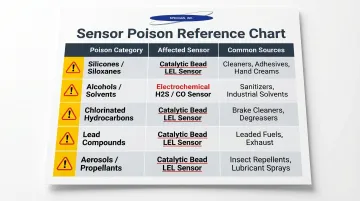
If the detector has been exposed to any of these, perform a bump test or full calibration immediately. BW Technologies recommends checking the combustible sensor with calibration gas after any known exposure to catalyst poisons. Shorten calibration intervals based on how frequently exposure occurs.
Frequently Asked Questions
Do gas detectors need to be calibrated?
Yes, gas detectors must be calibrated regularly because electrochemical and catalytic sensors drift over time due to age, temperature, humidity, and contaminant exposure. Without calibration, the detector may not alarm at the correct concentration, creating a life safety risk.
What does a bump test tell you?
A bump test confirms that each sensor physically responds to gas and that the audible, visual, and vibration alarms activate. It does not verify that the detector is reading gas concentrations accurately, which is why full calibration is required on a scheduled basis.
How often should I calibrate the MicroClip X3?
BW Technologies recommends calibration at least once every 180 days (6 months). Calibration is also required in these situations:
- Before first use
- After any sensor replacement
- After exposure to sensor poisons
- After an alarm event triggered by a high concentration of combustible gas
What calibration gas does the MicroClip X3 use?
The X3 requires a 4-component calibration gas cylinder with the following concentrations: H2S at 25 ppm, CO at 100 ppm, LEL/methane at 50% LEL, and O2 at 18% vol. Apply gas using a fixed-flow regulator at 250–500 ml/min. The cylinder must be NIST-traceable and within its expiration date.
What should I do if the MicroClip X3 fails calibration?
Start by verifying three things: the correct calibration gas is in use, the environment is free of background gas, and the sensor is not damaged or poisoned. If the sensor fails to zero or span after a second attempt, replace it before returning the detector to service.
Can I calibrate the MicroClip X3 without the MicroDock II docking station?
Yes, manual calibration using the pushbutton sequence, calibration cap, and gas cylinder is fully supported and does not require the MicroDock II. The docking station automates the process and is useful for managing fleets, but manual calibration works just as well for single-unit use in the field.