Introduction
A widely referenced industry audit revealed that 11% of calibration gas vendors failed accuracy requirements—meaning emissions data collected with those calibration gases was invalid. In semiconductor manufacturing, a single miscalibrated instrument can trigger batch rejections costing tens of thousands of dollars. For pharmaceutical manufacturers subject to FDA inspection, undocumented calibration gaps appear in warning letters, directly threatening product release and facility operations.
The phrase "NIST traceable" appears on calibration certificates across industries, yet it remains one of the most misunderstood terms in metrology. Few phrases carry more regulatory weight—or more frequent misuse.
This guide defines what NIST traceability actually means, breaks down the six required elements of a valid traceability chain, addresses common misconceptions including the widespread "NIST number" fallacy, and explains what to look for in calibration certificates to ensure compliance and measurement validity.
Key Takeaways:
- NIST traceability is a property of measurement results, not instruments or certificates
- Valid traceability requires six documented elements: unbroken chain, stated uncertainty, competence, SI linkage, and recalibration intervals
- A "NIST number" alone is not proof of traceability—certificates must include certified values, uncertainty, and reference standard identification
- Federal, FDA, and ISO 17025 regulations mandate traceable measurements for emissions monitoring, pharmaceutical manufacturing, and calibration laboratories
- Gravimetric blending and proprietary cylinder treatments are key to producing stable, traceable calibration gas standards
What Is NIST Traceability?
The International Vocabulary of Metrology (VIM) defines metrological traceability as the "property of a measurement result whereby the result can be related to a reference through a documented unbroken chain of calibrations, each contributing to the measurement uncertainty." The key phrase here is "documented unbroken chain": every step linking your measurement back to NIST standards must be recorded.
Traceability Applies to Results, Not Instruments
A fundamental principle often misunderstood: traceability is a property of a measurement result, not an instrument, laboratory, or certificate. NIST explicitly warns: "It is important to note that traceability is the property of the result of a measurement, not of an instrument or calibration report or laboratory." A thermometer, gas cylinder, or flow meter cannot itself be "NIST traceable"—only the measurement results derived from it can be.
NIST's Role as the U.S. National Metrology Institute
Established by Congress in 1901, NIST serves as the U.S. National Metrology Institute (NMI), responsible for maintaining national measurement standards and transferring those standards to industry, research, and regulatory bodies. NIST accomplishes this through calibrations, Standard Reference Materials (SRMs), and programs like the National Voluntary Laboratory Accreditation Program (NVLAP).
NIST traceability ultimately connects to the International System of Units (SI): the seven base units (second, meter, kilogram, ampere, kelvin, mole, candela). Following the 2019 SI redefinition, all base units are now defined by fixing the numerical values of seven fundamental physical constants, eliminating dependence on physical artifacts.
That shift matters practically: measurement results produced in a Pennsylvania calibration lab and a facility in Germany now reference the same underlying constants, making results mutually recognized across regulatory jurisdictions.
The Layered Traceability Chain
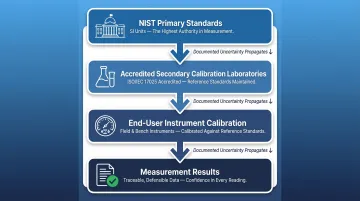
The traceability chain operates in tiers:
- NIST establishes primary standards that realize SI units
- Accredited secondary calibration laboratories calibrate reference standards against NIST
- End users calibrate instruments or obtain certified reference materials from those laboratories
- Each link carries documented uncertainty that propagates through the chain
The Six Elements of a Valid NIST Traceability Chain
ISO/IEC 17025:2017 and ILAC policy P10:07/2020 define specific requirements for establishing valid metrological traceability. Organizations must verify that calibration certificates satisfy all six elements.
Element 1: Unbroken Chain of Comparisons
Every step from your measurement back to NIST (or another recognized national standard) must be documented without gaps. If any link lacks documentation, the entire traceability claim fails. For calibration gases, this means the supplier must document how their blend verification standards trace back to NIST SRMs or NTRMs.
Element 2: Stated Measurement Uncertainty at Every Step
Uncertainty must be calculated at each calibration level using recognized methods such as the Guide to the Expression of Uncertainty in Measurement (GUM). The overall uncertainty for the full chain is determined by combining individual uncertainties. A certificate listing only nominal values, with no uncertainty statements, does not meet traceability requirements.
Element 3: Documented Procedures and Records
Each calibration must be performed according to documented, recognized procedures, with results recorded in a calibration report or certificate. Required documentation includes:
- Certified measured values
- Identification of reference standards used
- Environmental conditions during calibration
- Calibration date and validity period
Element 4: Demonstrated Laboratory Competence
Laboratories performing calibrations must demonstrate technical competence, typically through accreditation to ISO/IEC 17025 by bodies such as NVLAP or A2LA. Accreditation confirms general capability, but does not certify any individual measurement result. Each result must independently satisfy traceability criteria.
Element 5: Reference to SI Units
The traceability chain must terminate at primary standards realizing SI units. For gas standards, this means linking back to gravimetrically prepared NIST SRMs where concentrations are determined by mass measurements traceable to the kilogram.
Element 6: Calibration Intervals
Calibrations must be repeated at appropriate intervals determined by required uncertainty, frequency of use, and equipment stability. A calibration performed five years ago with no recalibration evidence does not support current traceability claims.
NIST Traceable Standards for Calibration Gases
The NTRM Program for Gas Standards
The NIST Traceable Reference Material (NTRM) program was established in 1992 in partnership with specialty gas producers to support the 1990 Clean Air Act Amendments and its emissions trading provisions. NTRMs differ from Standard Reference Materials: they are produced by secondary standards producers following NIST-defined protocols, with traceability documented in a Certificate of Traceability.
| Standard Type | Producer & Certifier | Traceability Path | Regulatory Use |
|---|---|---|---|
| SRM | Contractors produce; NIST certifies | Certified by NIST against primary gravimetric standards | Top-tier reference for emissions monitoring programs |
| NTRM | Specialty gas companies produce & certify jointly with NIST | Vendor analyzes 100%; NIST analyzes 10% subsample | Functional equivalent to SRMs for emissions monitoring programs |
| Certified Gas | Specialty gas vendors produce & certify | Assayed per traceability protocol against SRMs/NTRMs | Required for 40 CFR Part 75 CEMS |
What a Valid Certificate Must Contain
According to established traceability protocols for gaseous calibration standards, valid certificates must include:
- Certified concentration values for each component
- Stated measurement uncertainty (expanded uncertainty calculated per the GUM)
- Identification of reference standards used in blend verification (e.g., SRM 1689)
- Documentation of preparation method (gravimetric blending procedures)
- Expiration date and cylinder identification
- Supplier identification (for certified CEMS calibration gases)
A cylinder serial number or "NIST number" alone is not proof of traceability.
Blending and Verification Process
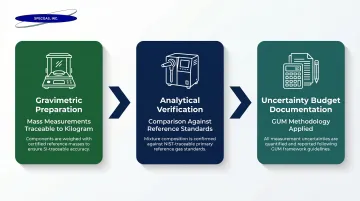
Producing NIST traceable specialty gas mixtures requires three core steps:
- Gravimetric preparation: Each component is weighed precisely, with mass measurements traceable to the kilogram — the highest-accuracy method for concentration determination.
- Analytical verification: Finished blends are analyzed against primary or certified reference standards to confirm concentrations fall within stated tolerances.
- Uncertainty budget documentation: All uncertainty contributors — balance calibration, gas purity, instrument repeatability, and cylinder stability — are quantified and combined per GUM methodology.
Reactive and trace-level components (low ppm/ppb concentrations) add difficulty at every step, since gas-cylinder interactions can shift concentrations before the mixture ever reaches a customer.
SpecGas NIST Traceable Gas Standards
SpecGas produces precision specialty gas blends from 300 PPB to 10% concentration using proprietary gravimetric blending techniques and an in-house cylinder treatment process developed specifically for reactive gas stability. Founder Alfred Boehm began this work at Messer Griesheims Industries in Germany in 1976, refining reactive-mixture techniques after transferring to the U.S. in 1991. That foundation now underpins SpecGas's ability to produce stable low ppm and ppb mixtures with documented NIST-traceable certified values.
The SpecGas Stability Guarantee covers reactive gas mixtures including formaldehyde, nitric oxide, ammonia, hydrogen chloride, and hydrogen sulfide — combinations that larger commodity suppliers often cannot match at comparable lead times. All mixtures arrive with complete NIST traceability documentation, supporting compliance with ISO 17025, FDA, and other regulatory requirements.

Common Misconceptions About NIST Traceability
The "NIST Number" Fallacy
The most widespread misconception: a NIST test report number on a certificate is proof of traceability. NIST policy explicitly rejects this: "Test report numbers issued by NIST are intended to be used solely for administrative purposes... and should neither be used nor required as the sole proof of traceability."
NIST report numbers are administrative identifiers only. Valid traceability requires:
- Assigned certified value with stated uncertainty
- Identification of reference standards used in the calibration chain
- Documentation of measurement procedures
- Environmental conditions recorded during calibration
Instrument Calibration Does Not Equal Automatic Traceability
A NIST-calibrated instrument is a strong starting point — but it doesn't automatically make your measurement results traceable. The distinction matters: traceability lives in your process, not just your equipment. To close the gap, you must:
- Maintain an internal measurement assurance program
- Document the full calibration chain, including your own measurement process
- Ensure calibrations remain valid through appropriate recalibration intervals
Organizations Cannot Be "Traceable"
Only specific measurement results can be traceable — not laboratories, not organizations. ISO/IEC 17025 accreditation certifies a lab as capable of producing traceable results, but each individual measurement must independently meet the full set of traceability criteria.
In practice, this means:
- Accreditation: Confirms the lab has the systems and procedures in place
- Traceability: Must be demonstrated for each measurement result, separately
An accreditation certificate is not proof that any particular measurement is traceable.
Why NIST Traceability Matters Across Industries
Regulatory and Compliance Requirements
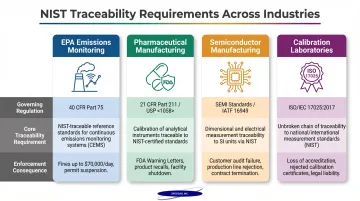
| Industry / Regulation | Traceability Requirement | Enforcement Impact |
|---|---|---|
| Emissions Monitoring (40 CFR Part 75) | Requires certified calibration gases traceable to NIST SRMs/NTRMs for CEMS calibration | An industry audit showed 11% of vendors failed accuracy requirements—invalidating emissions data |
| Pharmaceutical Manufacturing (21 CFR Part 211) | 21 CFR 211.160(b)(4) requires calibration at suitable intervals with accuracy limits; 211.194(d) requires complete calibration records | FDA warning letters routinely cite inadequate calibration; 2020 warning letter cited failure to evaluate impact when flow meters failed calibration |
| Semiconductor Manufacturing (SEMI Standards) | SEMI T23 and E142 require standardized traceability for single-device failure analysis and counterfeit prevention | Lack of traceability hinders end-to-end failure analysis critical for automotive and medical chip applications |
| Calibration Laboratories (ISO/IEC 17025:2017) | Clause 6.5.1 mandates documented unbroken chains for all measurement results | Loss of accreditation renders laboratory certificates invalid for regulated customers |
Equipment Accuracy and Quality Assurance
NIST traceable calibration gases ensure analytical instruments—gas detectors, process analyzers, emissions monitors, laser systems—are calibrated to known references with documented uncertainty. This reduces risks of:
- False readings triggering unnecessary facility evacuations or missed hazard detection
- Out-of-spec product release in pharmaceutical or semiconductor manufacturing
- Regulatory violations from inaccurate emissions reporting
- Safety incidents from uncalibrated confined space monitors
Industry Applications
Documented NIST traceability is the evidentiary standard auditors, regulators, and quality systems require — regardless of industry. Applications that depend on it include:
- University and independent research laboratories requiring traceable reference standards
- Semiconductor fabrication facilities managing process control and failure analysis
- Excimer and helium-neon laser systems requiring precisely characterized gas compositions
- Confined space and facility safety programs relying on calibrated gas detectors
SpecGas produces NIST-traceable calibration gas standards for all of these applications, blending each mixture in-house to documented concentration levels with full traceability records.
Frequently Asked Questions
What does NIST traceability mean?
NIST traceability is the property of a measurement result that can be related to NIST-maintained reference standards through a documented, unbroken chain of calibrations, each with stated uncertainties. It applies to measurement results, not instruments or certificates.
What makes something NIST traceable?
Six required elements make a measurement NIST traceable:
- Unbroken chain of comparisons back to NIST standards
- Stated measurement uncertainty at each step
- Proper documentation throughout
- Demonstrated lab competence (typically ISO/IEC 17025 accreditation)
- Reference to SI units
- Recalibration at appropriate intervals
What is NIST traceable calibration?
NIST traceable calibration is a calibration process where the instrument or standard is calibrated through an unbroken, documented chain of measurements linking back to NIST reference standards, with uncertainties reported at every step.
What is a NIST traceable calibration certificate?
A valid NIST traceable calibration certificate must include the certified measured value, stated measurement uncertainty, identification of the reference standards used, environmental conditions, and the calibration date—not merely a NIST report number.
What is the ISO standard for metrological traceability?
ISO/IEC 17025:2017 is the primary standard governing calibration laboratory competence and traceability requirements. The VIM (International Vocabulary of Metrology, JCGM 200:2012) provides the internationally accepted definition of metrological traceability used by ISO, NIST, and other bodies.
What is the 4:1 rule of calibration?
The 4:1 rule (Test Accuracy Ratio) means the calibration standard must have uncertainty at least four times smaller than the instrument's tolerance—ensuring its own uncertainty doesn't compromise the result. NIST guidance on measurement uncertainty now favors comprehensive uncertainty budgets per the GUM over blanket ratios.