
Introduction
Tetraselenium tetranitride — more commonly called nitrogen selenide — sits at an unusual intersection in inorganic chemistry: a structurally elegant cage compound with genuinely dangerous handling characteristics. For researchers working in selenium-nitrogen chemistry, advanced materials, or coordination chemistry, understanding this compound properly is not optional.
PubChem identifies nitrogen selenide as CAS 10102-12-2 (N₄Se₄, molecular weight 371.9 g/mol), and the DOT classifies it as a forbidden explosive for transport purposes. Both designations carry practical weight: quantities that appear small by laboratory standards can detonate under friction or heat, while the compound's unique electronic structure makes it genuinely useful in semiconductor and materials research.
This article covers the compound's chemical identity and structure, verified physical and chemical properties, known synthesis routes, research applications, and the safety protocols that working with it demands.
Key Takeaways
- Se₄N₄ (tetraselenium tetranitride, CAS 10102-12-2) is the primary compound referred to as nitrogen selenide, with a molecular weight of 371.9 g/mol
- Its cage structure is isostructural with tetrasulfur tetranitride (S₄N₄), both belonging to D₂d symmetry
- DOT and PHMSA classify selenium nitride as a forbidden explosive — no standard commercial transport
- Primary research value: Se₄N₄ generates reactive Se₂N₂ intermediates for coordination compounds and inorganic heterocycles
- Synthesis yields reach 66–71% using silylated nitrogen reagents with selenium chloride precursors
Chemical Identity, Structure, and Nomenclature
Registry Identity and Naming
PubChem (CID 134812014) is the authoritative registry source for this compound. Key identity data:
- Formula: N₄Se₄ (also written Se₄N₄)
- CAS: 10102-12-2
- Molecular weight: 371.9 g/mol
- IUPAC name: 2,4,6,8-tetraselena-1,3,5,7-tetrazatricyclo[3.3.0.0³,⁷]octane
The compound appears in the literature under several synonyms — nitrogen selenide, tetraselenium tetranitride, selenium nitride, and N₄Se₄ — which can cause confusion when searching databases. The IUPAC cage name is unambiguous but rarely used in practice; most synthetic papers simply write Se₄N₄.
That said, "nitrogen selenide" technically covers a broader family of binary Se-N species, including Se₂N₂ and the hypothetical SeN monomer. When researchers use the name without qualification, Se₄N₄ is what they mean.
Cage Structure and Symmetry
X-ray crystallography has established that two crystalline polymorphs of Se₄N₄ are known, one of which is isostructural with S₄N₄. Both Se₄N₄ and S₄N₄ are D₂d species with twelve Raman-active vibrations — a structural relationship that defines much of how Se₄N₄ chemistry is interpreted.
The compound adopts an eight-membered Se-N ring folded into a cage geometry. This architecture arises from the interplay of ring strain, delocalized π-bonding across the Se-N framework, and transannular Se···Se interactions that pull the cage into its characteristic shape.
The bonding is genuinely delocalized — neither purely covalent nor ionic. That character is what produces the compound's unusual combination of kinetic stability and explosive sensitivity to mechanical shock.
Comparison to S₄N₄
The structural analogy to tetrasulfur tetranitride is useful context, but the practical differences define how Se₄N₄ is actually handled:
| Property | S₄N₄ | Se₄N₄ |
|---|---|---|
| Symmetry | D₂d | D₂d |
| Raman-active modes | 12 | 12 |
| Solubility in organic solvents | Moderate | Notably lower |
| Shock sensitivity | High (Eᵢ ≈ 4 J, comparable to PETN) | Higher than S₄N₄ |
| Transport status | Hazardous | DOT Forbidden |
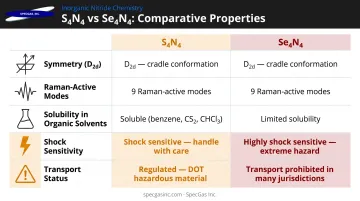
Lower solubility complicates solution-phase synthesis, while the heightened shock sensitivity and DOT Forbidden status narrow the viable handling and transport options significantly compared to the sulfur analog.
Physical and Chemical Properties of Nitrogen Selenide
Physical Properties
Several commonly cited physical values for Se₄N₄ (including a density of 4.223 g/cm³ and specific decomposition temperatures) remain unverified in primary registry or peer-reviewed crystallographic sources. The following reflects what is currently confirmed:
- Molecular weight: 371.9 g/mol (PubChem)
- Solubility in liquid NH₃: Dissolves at approximately 50 atm pressure
- Reaction media: CH₂Cl₂ and CH₂Br₂ are documented as reaction solvents in synthesis papers, though no quantitative solubility data have been established in the primary literature
- Thermal behavior: Review literature references pyrolysis under vacuum up to 220°C, but this should not be treated as a clean decomposition point
Researchers should treat unverified physical constants (density, decomposition onset temperature, impact/friction thresholds) with caution and consult primary crystallographic papers before citing specific values.
Chemical Reactivity
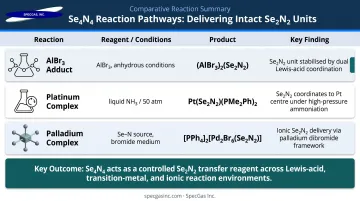
Se₄N₄'s most significant chemical role is as a selenium-nitrogen transfer reagent, acting as a source of reactive Se₂N₂ fragments. Three well-characterized pathways illustrate how Se₄N₄ transfers Se₂N₂ fragments:
1. Reaction with AlBr₃ (Lewis acid adduct formation)
Kelly and Slawin (1996, J. Chem. Soc., Dalton Trans., DOI: 10.1039/DT9960004029) reported that Se₄N₄ reacts with AlBr₃ in CH₂Br₂ at room temperature to give air-sensitive yellow [(AlBr₃)₂(Se₂N₂)], the first main-group element adduct of diselenium dinitride. X-ray crystallography confirmed that the neutral Se₂N₂ bridges the two aluminum centers via Al-N bonds, showing the Se₄N₄ cage releases Se₂N₂ fragments under mild Lewis acid conditions.
2. Reactivity in liquid ammonia
Kelly and Woollins (Polyhedron, 1993, 12(10), 1129–1133) showed that Se₄N₄ dissolves in liquid NH₃ at approximately 50 atm and reacts with PtCl₂(PMe₂Ph)₂ to give Pt(Se₂N₂)(PMe₂Ph)₂ in quantitative yield. Isotopic labeling experiments (¹⁵N) confirmed that less than 20% of the nitrogen in the product came from the ammonia solvent, establishing that the Se-N framework is largely preserved during the reaction.
3. Palladium adducts
Kelly, Slawin, and Soriano-Rama (1997, J. Chem. Soc., Dalton Trans., DOI: 10.1039/A606311J) documented the preparation of [PPh₄]₂[Pd₂Br₆(Se₂N₂)] using Se₄N₄ as the Se-N source. Together with the platinum chemistry, this establishes Se₄N₄ as a versatile reagent for installing Se₂N₂ ligands onto transition metals.
The three pathways share a common outcome: Se₄N₄ delivers intact Se₂N₂ units to the product structure. The table below summarizes the key conditions across each reaction:
| Reaction | Reagent/Conditions | Product | Key Finding |
|---|---|---|---|
| AlBr₃ adduct | CH₂Br₂, room temperature | [(AlBr₃)₂(Se₂N₂)] | First main-group Se₂N₂ adduct; Se₂N₂ bridges via Al-N bonds |
| Pt complex | Liquid NH₃, ~50 atm, PtCl₂(PMe₂Ph)₂ | Pt(Se₂N₂)(PMe₂Ph)₂ | Quantitative yield; <20% N from solvent (¹⁵N labeling) |
| Pd complex | Se₄N₄ as Se-N source | [PPh₄]₂[Pd₂Br₆(Se₂N₂)] | Extends Se₂N₂ ligand chemistry to palladium |
Synthesis Routes and Characterization
Synthesis
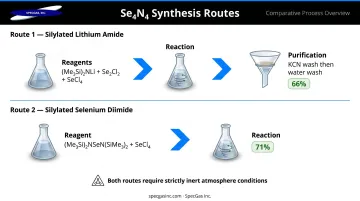
The 1993 ACS paper (Inorg. Chem., 32(8), 1519–1520, DOI: 10.1021/ic00060a031) established the benchmark for efficient Se₄N₄ synthesis. Review literature documents two high-yielding modern routes:
Route 1 — Silylated lithium amide: 12 (Me₃Si)₂NLi + 2 Se₂Cl₂ + 8 SeCl₄ → 2 Se₄N₄ + 24 Me₃SiCl + 12 LiCl
Pure Se₄N₄ is isolated in 66% yield after washing with 10% aqueous KCN (to remove red selenium, selenium halides, and selenium oxides), then water to remove LiCl.
Route 2 — Silylated selenium diimide: (Me₃Si)₂NSeN(SiMe₃)₂ + SeCl₄ → Se₄N₄ in 71% yield
Older routes using selenium tetrahalides with gaseous ammonia at elevated temperature, or diethyl selenite with ammonia in benzene, have also been documented but are less efficient.
All synthesis work requires inert atmosphere techniques (Schlenk line or glovebox), small-scale batches, and careful handling to avoid mechanical shock.
Characterization
Confirming Se₄N₄ identity and purity requires multiple complementary methods:
- X-ray crystallography — the definitive structural tool; confirms cage geometry and polymorph identity
- Raman spectroscopy — the Raman spectrum of solid Se₄N₄ has been recorded over 30–1000 cm⁻¹ and assigned using D₂d symmetry; serves as a primary fingerprint for identity confirmation
- Mass spectrometry — supports molecular weight confirmation and fragmentation pattern analysis
Purity assessment is critical given the explosive hazard — any sensitizing impurities must be identified and removed before storage or further use. The KCN wash in Route 1 directly addresses selenium-containing byproducts that would otherwise compromise both analytical results and safe handling.
Instrument calibration is a parallel requirement in this work. Research labs characterizing selenium compounds typically rely on NIST-traceable gas standards to verify detector and analyzer performance. SpecGas Inc., based in Bridgeport, PA, supplies NIST-traceable calibration gas mixtures for reactive chalcogen applications, supporting the analytical instrument verification that inorganic synthesis programs require.
Applications in Research and Materials Science
Se₄N₄'s research value is concentrated in one area: it is the most practical laboratory source of Se₂N₂, a reactive species that cannot easily be handled or stored independently.
Coordination Chemistry
The Se₂N₂ fragments generated from Se₄N₄ act as ligands for transition metals. Verified examples include:
- Palladium: [PPh₄]₂[Pd₂Br₆(Se₂N₂)] — anionic palladium bromide complex with bridging Se₂N₂
- Platinum: Pt(Se₂N₂)(PMe₂Ph)₂ and Pt(Se₂N₂)(PPh₃)₂ — neutral platinum phosphine complexes
- Aluminum: [(AlBr₃)₂(Se₂N₂)] — the first main-group element adduct of Se₂N₂
These compounds represent new classes of selenium-nitrogen coordination chemistry. Installing a Se₂N₂ unit onto different metal centers enables access to inorganic ring systems and heterocyclic species that are hard to synthesize by other routes.
Broader Research Context
Laitinen's 1998 review (Chalcogen Nitrides, DOI: 10.1080/10426509808545966) places Se₄N₄ within the broader landscape of chalcogen nitride chemistry, treating it as a primary reagent for selenium-nitrogen framework construction.
Research into Se-N frameworks as potential low-dimensional inorganic materials continues, though no peer-reviewed Se₄N₄-specific thin-film, CVD, or ALD application has been verified to date. The compound's explosive nature makes it unlikely to become a scalable deposition precursor without significant chemical modification.
Research labs handling selenium compounds often require calibration standards for the analytical instruments used to characterize reaction products. SpecGas Inc. supplies NIST-traceable H₂Se and NH₃ calibration gas standards — reactive gases relevant to selenium and nitrogen chemistry workflows — in low ppm and ppb concentrations for GC-MS and FTIR analyzer use.
Safety, Hazards, and Handling
Explosive Classification and Transport
PHMSA lists selenium nitride among forbidden materials, and 49 CFR 173.21 prohibits offering for transportation or transporting any material designated Forbidden in 49 CFR 172.101. This is not a restricted or regulated category — it is outright forbidden.
Se₄N₄ is more shock-sensitive than S₄N₄, which itself has an impact sensitivity comparable to PETN (Eᵢ ≈ 4 J). Shock sensitivity means the compound can detonate from mechanical impact, friction, or sudden heating: exactly the kind of events that occur during routine laboratory operations without proper precautions.
Required Handling Practices
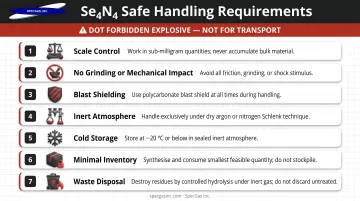
Working with Se₄N₄ safely requires:
- Scale control — synthesis and reactions conducted at the smallest feasible scale
- No grinding or mechanical impact — never grind, scrape, or apply friction to solid Se₄N₄
- Blast shielding — use appropriate blast shields and work behind protective barriers
- Inert atmosphere — Schlenk line or glovebox techniques to exclude moisture and air
- Cold storage — low temperatures minimize thermal decomposition risk
- Minimal inventory — do not accumulate quantities beyond immediate need
- Waste disposal — explosive classification affects disposal protocols; consult institutional safety officers
Decomposition and Toxicity
Physical handling hazards are only part of the risk profile. Se₄N₄ also decomposes to selenium-containing products that carry serious toxicological consequences. Selenium compounds carry significant toxicity risk — hydrogen selenide (H₂Se), for example, has a NIOSH REL TWA of 0.05 ppm and IDLH of 1 ppm, making it one of the more acutely toxic inorganic gases. Adequate ventilation, appropriate PPE, and a defined emergency response plan are required when working with Se₄N₄ or its decomposition products.
No Se₄N₄-specific GHS classification has been confirmed through ECHA or major supplier SDS sources; researchers should consult institutional safety programs and the primary literature for the most current hazard assessment.
Frequently Asked Questions
What is the chemical name for H₂Se?
H₂Se is hydrogen selenide, a toxic, colorless gas with a NIOSH REL TWA of 0.05 ppm and the selenium analog of hydrogen sulfide. It is a structurally and chemically distinct compound from nitrogen selenide (Se₄N₄), sharing only the presence of selenium.
How do you name N₄Se₄?
N₄Se₄ is named tetraselenium tetranitride under IUPAC multiplicative nomenclature, and is also commonly called nitrogen selenide. The formal IUPAC cage name (2,4,6,8-tetraselena-1,3,5,7-tetrazatricyclo[3.3.0.0³,⁷]octane) is rarely used outside specialized literature.
What is a selenide?
A selenide is a compound where selenium carries a formal −2 oxidation state, similar to a sulfide. The IUPAC Gold Book defines them as metal salts of selane (H₂Se) or compounds of the form RSeR, with hydrogen selenide (H₂Se) and zinc selenide (ZnSe) being common examples.
Is Se₄N₄ dangerous to work with?
Yes — Se₄N₄ is classified as a forbidden explosive by DOT and PHMSA, and is more shock-sensitive than S₄N₄. It requires small-scale handling, blast protection, and inert-atmosphere techniques. Decomposition also releases toxic selenium-containing species, compounding the explosive hazard.
What is Se₄N₄ used for?
Se₄N₄ is used primarily as a synthetic precursor to generate reactive Se₂N₂ intermediates in inorganic and coordination chemistry. These intermediates are used to prepare transition-metal coordination compounds (palladium, platinum, aluminum adducts), selenium-nitrogen heterocycles, and novel inorganic cage systems.
How does Se₄N₄ differ from S₄N₄?
Both share D₂d cage geometry and orange appearance. Se₄N₄ is less soluble in organic solvents, considerably more shock-sensitive, and carries a DOT forbidden-explosive classification rather than regulated-hazardous status. Longer, weaker Se−N bonds lower the stability threshold and account for the increased handling risk.