Introduction
Continuous Emissions Monitoring Systems (CEMS) are legally mandated at thousands of industrial facilities across the United States—power plants, refineries, municipal waste combustors, and other major stationary sources. These systems track pollutant emissions continuously, generating the compliance data that underpins Clean Air Act reporting. The accuracy of every emissions report hinges on one element: the quality and regulatory compliance of the calibration gases used to verify those analyzers.
The regulatory landscape is specific and unforgiving. Rules governing CEMS calibration gases span two primary programs: 40 CFR Part 60 (New Source Performance Standards) and 40 CFR Part 75 (Acid Rain Program and CSAPR), each with distinct requirements for gas concentrations, certifications, and testing schedules.
A single misstep—wrong cylinder concentration, lapsed calibration gas certification, or a degraded reactive gas mixture—can invalidate months of emissions data and trigger enforcement action. Facilities have faced penalties exceeding $280,000 for calibration gas compliance failures.
This article covers the essentials of CEMS calibration gas management: types of calibration gases and their regulatory concentration ranges, certified calibration gas requirements under Part 60 and Part 75, daily and quarterly calibration schedules, and practical cylinder management best practices that prevent costly downtime and data invalidation.
Key Takeaways
- Regulations mandate daily zero and span calibration checks plus quarterly audits using NIST-traceable certified gases
- Part 75 systems require stricter error tolerances (5%) than Part 60 systems (varies by Performance Spec)
- SO₂ and HCl degrade rapidly in untreated cylinders — passivated aluminum construction is required
- Replace cylinders at 200 psi; dropping below 150 psi risks contamination and data loss
- Failed calibrations trigger "out-of-control" status, invalidating all data until corrective action is complete
What Are CEMS Calibration Gases and Why They Matter
Calibration gases are certified gas mixtures of known, precise concentration used to verify that CEMS analyzers are measuring accurately. Federal regulations explicitly require that calibration gases be introduced "as close to the sampling probe outlet as practical." Unlike lab calibration, the gas must pass through all filters, scrubbers, conditioners, and other components used during normal sampling — validating the entire measurement pathway, not the analyzer alone.
Understanding Calibration Error
Calibration error is the difference between the concentration a CEMS reads and the known concentration of the calibration gas, expressed as a percentage of the instrument span. The formula under 40 CFR Part 75 is:
CE = (|R - A| / S) × 100
Where:
- R = Reference value of the calibration gas
- A = Actual monitoring system response
- S = Span of the instrument
Keeping calibration error within regulatory limits is essential for data validity. When a CEMS exceeds its allowable calibration error threshold, it enters "out-of-control" status, and all emission data becomes invalid until corrective action is completed and a successful calibration is performed.
Understanding which regulatory framework governs your facility directly determines the calibration gas specifications, error tolerances, and audit requirements you must meet.
Two Regulatory Frameworks: Part 60 and Part 75
Most U.S. CEMS operate under one of two primary federal regulations:
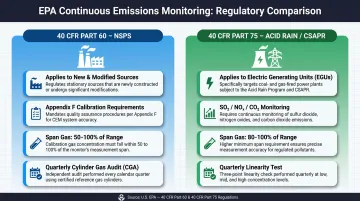
- 40 CFR Part 60 (New Source Performance Standards): Applies to new or modified stationary sources, with calibration requirements detailed in Appendix F and Performance Specifications in Appendix B
- 40 CFR Part 75 (Continuous Emission Monitoring): Governs SO₂, NOₓ, and CO₂ monitoring for affected electric generating units under the Acid Rain Program and Cross-State Air Pollution Rule
Part 60 and Part 75 differ most significantly in their gas concentration requirements and audit frequency — the sections below break down each framework in detail.
Types of CEMS Calibration Gases: Zero Gas, Span Gas, and Blends
CEMS calibration requires multiple gas types at different concentration levels to verify analyzer performance across the measurement range.
Zero Gas
Zero gas establishes the baseline (zero) reading of an analyzer. Regulations specify that zero-level concentration must represent 0-20% of the analyzer's measurement range.
Common zero gases include:
- High-purity nitrogen (for most pollutant analyzers)
- Purified air (for O₂ analyzers)
- Ambient air containing approximately 20.9% O₂ (acceptable reference for oxygen monitors)
Key regulatory exception: Unlike all other calibration gases, zero gas does not require NIST traceability. However, it must be vendor-certified to contain less than 0.1 ppm of target pollutants (SO₂, NOₓ, total hydrocarbons) and less than 1 ppm CO.
Span Gas
Span gas provides the upscale calibration point, verifying analyzer response at a known elevated concentration.
Regulatory concentration requirements:
- Part 60 systems: 50-100% of analyzer measurement range
- Part 75 systems: 80-100% of analyzer range
The common industry target is approximately 80% of range, which satisfies both regulatory frameworks and provides optimal linearity verification.
Quarterly Audit Gases: Low, Mid, and High Levels
Beyond daily calibration, quarterly audits require gas concentrations at additional levels.
| Level | Part 60 CGA | Part 75 Linearity Test |
|---|---|---|
| Low | 20-30% of span | 20-30% of span |
| Mid | 50-60% of span | 50-60% of span |
| High | Not required | 80-100% of span |
| Pass limit | ±15% of average audit value | ≤5.0% error at each level |
Blended Multi-Component Cylinders
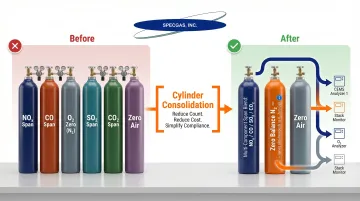
Multiple compatible gases can be combined in a single cylinder to reduce cylinder count, cost, and logistical complexity.
Practical example: For a NOₓ/CO/O₂ CEMS, a single cylinder containing NOₓ+CO in nitrogen can simultaneously serve as:
- Span gas for the NOₓ analyzer
- Span gas for the CO analyzer
- Zero gas for the O₂ analyzer (since nitrogen contains no oxygen)
In practice, a three-analyzer CEMS that might otherwise require five or six cylinders can often operate with two or three blended cylinders instead. Not every gas combination is this straightforward, however — reactive gases introduce a separate set of challenges.
The Reactive Gas Challenge: SO₂ and HCl Stability
Reactive gases like SO₂ and HCl present unique challenges because they interact with cylinder walls, causing concentration drift over time. Studies show that 100 μmol/mol HCl mixtures in aluminum cylinders decreased by 0.8 μmol/mol over two years, while nickel-coated manganese steel cylinders showed even greater degradation (6 μmol/mol decrease).
To address this, SpecGas Inc. uses a proprietary internal cylinder treatment process that chemically neutralizes cylinder surfaces before filling, minimizing gas-wall interactions. The result is reactive gas mixtures — including SO₂ and HCl blends — that hold certified concentration throughout their shelf life rather than drifting toward a failed audit.
Certified Calibration Gas Requirements: Understanding Part 60 and Part 75
What is a Certified Calibration Gas?
A certified calibration gas is a specific grade of calibration gas that meets strict certification and traceability requirements for emissions monitoring programs. Certified calibration gases must be:
- Produced by a qualified supplier with documented quality processes
- Certified according to established traceability protocols for gaseous calibration standards
- Certified with an analytical uncertainty (95% confidence interval) of ±2.0% or less of the certified tag value
Critical distinction: While NIST-traceable certified gas is acceptable for many daily calibration checks under Part 60, quarterly cylinder gas audits (CGA) and linearity tests under both Part 60 and Part 75 require calibration gas meeting the ±2.0% uncertainty requirement from a qualified supplier. Using substandard gas for these audits automatically invalidates the test.
Navigating Gas Grade Terminology
Gas manufacturers use various trade names for certified calibration grades:
- "CEMS Compliance Gas"
- "RATA Class Calibration Gas"
- "Compliance Grade Calibration Gas"
- "Certified Reference Standard"
Regardless of the marketing label, the gas must meet the ±2% uncertainty requirement and come from a qualified, documented production facility.
NIST Traceability Requirements
The traceability requirement connects directly to how gas grade terminology is assigned: all calibration gases except zero gas must have NIST traceability, meaning the certification chain links back to National Institute of Standards and Technology primary standards. Without this chain, your results can't withstand regulatory scrutiny in enforcement proceedings.
Under 40 CFR 75.21, cylinders analyzed directly by NIST must have an expanded uncertainty (k=2) of ±1.0% or better. However, the production site certification requirement remains at ±2.0% for PGVP Protocol gas.
Part 60 vs. Part 75: Key Differences at a Glance
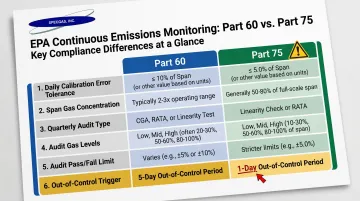
| Requirement | 40 CFR Part 60 | 40 CFR Part 75 |
|---|---|---|
| Daily Calibration Error Tolerance | 2× applicable Performance Spec limit | 5.0% of span value |
| Span Gas Concentration | 50-100% of range | 80-100% of range |
| Quarterly Audit Type | Cylinder Gas Audit (CGA) | Linearity Test |
| Audit Gas Levels | Low (20-30%), Mid (50-60%) | Low (20-30%), Mid (50-60%), High (80-100%) |
| Audit Pass/Fail Limit | ±15% of average audit value | 5.0% of reference value |
| Out-of-Control Trigger | 5 consecutive days >2× PS limit, or 1 day >4× PS limit | 1 failed daily calibration error test |
The table makes the compliance burden clear: Part 75 facilities operating under the Acid Rain Program have almost no margin for error. A single failed daily calibration triggers out-of-control status, compared to the five-day window under Part 60. If your facility operates under Part 75, your gas procurement and QA protocols need to reflect that tighter standard.
CEMS Calibration Schedules: Daily, Quarterly, and Beyond
Daily Calibration Checks
Federal regulations require automated daily zero and span checks for all CEMS, performed approximately every 24 hours.
How daily calibrations work:
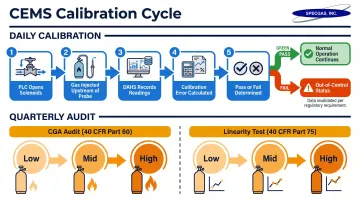
- A programmable logic controller (PLC) or data acquisition system (DAHS) opens solenoids to introduce calibration gases
- Gases are injected upstream of the sample probe, passing through the entire sampling system
- The DAHS records analyzer readings and compares them to known gas values
- Calibration error is calculated and logged
- The system determines pass or fail status
Critical requirement: Calibrations are conducted "hands-off"—no adjustments to the analyzer are permitted during the calibration period. This ensures an independent verification of system performance.
When daily calibration fails:
- The CEMS enters "out-of-control" status
- All emission data becomes invalid immediately
- Data remains invalid until corrective action is completed and a successful hands-off calibration is performed
For Part 60 systems, even calibrations within tolerance can trigger recalibration requirements: four consecutive "bad" calibrations (calibration drift between 5-10% of span) require corrective action even if no single calibration exceeds the 10% failure threshold.
Quarterly Calibration Audits
Part 60 Cylinder Gas Audit (CGA):
- Performed once every calendar quarter
- CEMS challenged three times each with low gas (20-30% range) and mid gas (50-60% range)
- Passing error limit: ±15% of average audit value
Part 75 Linearity Test:
- Performed once every calendar quarter
- CEMS challenged at low, mid, and high gas concentrations
- Passing error limit: 5.0% at each level
These quarterly tests use fresh certified calibration gas cylinders — separate from daily calibration cylinders — to independently verify system accuracy. That independence matters: quarterly audits are designed to catch drift that daily checks might miss over time, which is why the annual requirements go further still.
Annual and Post-Event Requirements
Annual RATA (Relative Accuracy Test Audit): Required at least once every four quarters, a RATA involves an independent testing firm operating a parallel CEMS to compare against the plant's system. The facility's CEMS must demonstrate relative accuracy within regulatory limits compared to the reference method.
Event-driven recalibration triggers: Recalibration is required after:
- Major repairs or component replacements
- Lamp replacements in optical analyzers
- Significant changes in fuel quality or combustion conditions
- Any modification that may affect system accuracy
Best Practices for Calibration Gas Cylinder Management
Cylinder Placement and Safety
Indoor storage:
- Requires ambient gas monitoring in case of leaks
- Provides temperature stability and protection from weather
- Simplifies cylinder exchange logistics
Outdoor storage:
- Requires regulator protection from freezing (insulated enclosures or heat trace)
- Must secure cylinders to prevent tipping
- Should provide weather shielding to extend equipment life
Plumbing and materials:
- Use Teflon or stainless steel tubing throughout
- Select regulators based on gas corrosivity:
- Stainless steel regulators for corrosive gases (SO₂, HCl, Cl₂)
- Brass regulators acceptable for non-corrosive gases (CO, CO₂, hydrocarbons)
- Position cylinders as close to CEMS cabinet as practical
- Keep cylinders on ground floor for ease of replacement
Cylinder Pressure Monitoring and Replacement
Regulatory minimum: Cylinders should not be used when pressure drops below 100 psig. Part 75 specifies a 150 psig minimum for expired cylinders being used pending recertification.
Industry best practice: Exchange cylinders at 200 psi to prevent air back-diffusion and ensure adequate gas supply during quarterly audits or troubleshooting events.
Spare cylinder inventory: Maintain at least one spare cylinder for each calibration gas on-site to cover:
- Unexpected leaks or regulator failures
- Increased consumption during troubleshooting
- Quarterly audit requirements (which may use separate audit cylinders)
Certification Lifespans and Recertification
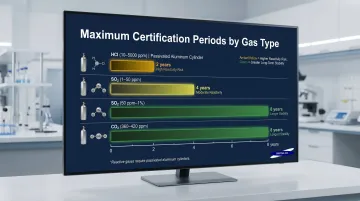
Cylinder pressure management is only half the equation — certification expiry determines whether your gas is legally usable regardless of pressure. Certification periods vary by gas type and reactivity:
| Gas Type | Cylinder Material | Maximum Certification Period |
|---|---|---|
| Hydrogen Chloride (10-5000 ppm) | Passivated Aluminum | 2 years |
| Sulfur Dioxide (1-50 ppm) | Passivated Aluminum | 4 years |
| Sulfur Dioxide (50 ppm - 1%) | Passivated Aluminum | 8 years |
| Carbon Dioxide (360-420 ppm) | Passivated Aluminum | 8 years |
Recertification option: Recertification is now widely accepted—sending a cylinder back to the manufacturer for reanalysis—typically cheaper than buying a new cylinder. An expired cylinder may be recertified if it has at least 100 psig remaining pressure and is successfully reanalyzed by the original production site.
For reactive gases like SO₂ and HCl, concentration stability throughout the stated shelf life is the deciding factor in whether a cylinder reaches recertification eligibility at all. SpecGas Inc. uses a proprietary internal cylinder treatment process specifically designed to keep reactive gas concentrations stable — backed by a Stability Guarantee — so cylinders are more likely to arrive at expiry still within specification and eligible for reanalysis rather than disposal.
Common Calibration Gas Issues and How to Prevent Them
Concentration-Related Issues
Problem: Incorrect cylinder concentration outside required regulatory range.
Examples:
- Zero gas at 25% of span (must be 0-20%)
- Span gas at 75% of range for Part 75 system (must be 80-100%)
- Mid-level audit gas at 65% of range (must be 50-60%)
Prevention checklist:
- Verify gas concentration is within required percentage of analyzer range
- Confirm gas grade meets Protocol requirements for intended use (daily cal vs. quarterly audit)
- Check certification is current and not expired
- Cross-reference cylinder tag values against current analyzer span settings quarterly
Even when concentration specs are correct at the time of purchase, the gas itself can change — and that's a problem regulators don't always warn operators about clearly.
Reactive Gas Degradation
SO₂, HCl, and similar corrosive gases react with cylinder walls, causing actual concentration to drift from the certified tag value before the expiration date.
Established calibration gas stability research confirms that SO₂-in-air and NO₂-in-N₂ standards may have been certified by specialty gas producers but are not stable long-term and should not be relied upon for compliance calibration without verified stability documentation.
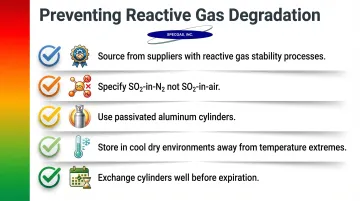
Prevention measures:
- Source reactive gases only from suppliers with demonstrated reactive gas stability processes
- Specify SO₂-in-N₂ mixtures (not SO₂-in-air) for improved stability
- Use passivated aluminum cylinders (not standard steel or nickel-coated cylinders)
- Store cylinders in cool, dry environments away from temperature extremes
- Exchange cylinders well before expiration dates, particularly for low-concentration reactive gases
At SpecGas, our proprietary internal cylinder treatment passivates cylinder surfaces to minimize gas-wall interactions — which is why we back reactive gas mixtures with a Stability Guarantee that standard suppliers don't offer.
Cylinder quality is only part of the equation. The hardware delivering the gas to your analyzer is just as likely to introduce error.
Regulator and Tubing Contamination
Aged tubing, corroded regulator wetted surfaces, and leaking compression fittings can all bias calibration results — especially for reactive gases like SO₂ that interact aggressively with metal surfaces.
Prevention measures:
- Inspect and replace calibration tubing annually
- Clean regulator diaphragms and inspect for corrosion quarterly
- Leak-check all compression fittings after cylinder changes
- Use dedicated regulators for reactive gases (don't switch between gas types)
- Purge new tubing thoroughly before first use
Frequently Asked Questions
What is a continuous emissions monitoring system?
A CEMS is an integrated system of analyzers, sampling equipment, and data acquisition hardware used to continuously measure and record pollutant emissions from industrial sources. These systems are legally required at power plants, refineries, and other major stationary sources to demonstrate compliance with air quality regulations under the Clean Air Act.
What is a calibration gas used for?
Calibration gases are certified gas mixtures of known concentration introduced into a CEMS to verify analyzers are reading accurately. The system's response is compared to the known concentration to calculate calibration error and confirm the CEMS meets regulatory performance specifications for data validity.
Which gas is used for calibration in CEMS?
CEMS use three main types: zero gas (high-purity nitrogen or purified air), span gas (target pollutant at 50–100% of analyzer range), and quarterly audit gases at low, mid, and high concentrations. All gases except zero gas must be NIST-traceable and meet certified calibration gas requirements for the applicable regulatory program.
How often are CEMS continuous emission monitors calibrated?
CEMS require automated daily zero and span checks, quarterly cylinder gas audits (Part 60) or linearity tests (Part 75), and annual relative accuracy test audits (RATAs). Additional recalibration is required after major repairs, component replacements, or system modifications.
What is 20.9 O2 calibration gas?
20.9% O₂ refers to the approximate oxygen concentration in ambient air. This natural atmospheric oxygen level can be used as a reference or span gas when calibrating oxygen analyzers, providing a convenient upper-range verification point without requiring specialty gas cylinders.
What is the difference between CEMS and PEMS?
CEMS directly measure actual pollutant concentrations in flue gas using analyzers and sampling systems. PEMS use process parameters like fuel flow, temperature, and combustion air to mathematically estimate emissions — no direct gas measurement required.
Ensuring CEMS Calibration Compliance
Calibration gas management is the foundation of CEMS data validity and regulatory compliance. Understanding the distinctions between Part 60 and Part 75 requirements, sourcing certified calibration gases from qualified suppliers, and implementing robust cylinder management practices are essential for avoiding data invalidation and enforcement actions.
For facilities using reactive gases like SO₂ and HCl, partnering with suppliers who employ proprietary cylinder passivation processes — like SpecGas Inc.'s internal treatment procedure and Stability Guarantee — ensures gas concentrations remain within certification throughout the cylinder lifespan, reducing failed audits and costly recertification cycles.
Whether you're managing a coal-fired power plant under Part 75 or a refinery incinerator under Part 60, the core requirements hold: verify gas concentrations match regulatory requirements, maintain strict pressure thresholds, track certification expiration dates, and source gases from suppliers with documented quality processes. These practices satisfy regulators and protect your facility's operational integrity and emissions reporting credibility.
For assistance sourcing NIST-traceable CEMS calibration gases with proprietary reactive gas stability processes, contact SpecGas Inc. at (215) 443-2600 or visit their website at specgasinc.com.