Introduction
Semiconductor photolithography nodes now measure just a few nanometers. LASIK surgery reshapes corneal tissue within microns. Dermatological UV treatments target only diseased skin. Each application depends on the same tool: the excimer laser, which generates intense ultraviolet pulses that break molecular bonds directly—without the thermal damage conventional lasers cause.
These specialized gas lasers produce UV light between 157–351 nm by energizing noble gas-halide mixtures to create short-lived excited molecules called excimers. The wavelength is entirely determined by the gas mixture used, making gas type selection the single most important decision when specifying an excimer laser system.
This article explains what excimer lasers are, how they're classified by gas mixture (ArF, KrF, XeCl, XeF, and F2), which wavelengths each produces, and how to select the right type for your application—plus why gas purity and mixture stability matter as much as the laser hardware itself.
Key Takeaways
- Excimer lasers emit UV light (157–351 nm) from short-lived excited noble gas-halide molecules
- Gas mixture directly determines wavelength: ArF (193 nm), KrF (248 nm), XeCl (308 nm), XeF (351 nm), and F2 (157 nm)
- Short UV wavelengths enable "cold" ablation—severing molecular bonds without thermal damage to surrounding material
- Applications span semiconductor photolithography, LASIK eye surgery, dermatological treatments, and industrial material processing
- Contaminated or unstable gas mixtures degrade output power and shorten laser service life
What Are Excimer Lasers?
Excimer lasers are pulsed gas lasers that produce intense ultraviolet light by forming short-lived excited molecular complexes between noble gases (like argon, krypton, or xenon) and halogens (fluorine or chlorine). These molecules—called excimers or exciplexes—exist only in an energized state. The moment they emit a photon, they dissociate immediately, preventing reabsorption of laser light and enabling high optical gain even at low concentrations.
The term "excimer" is shorthand for "excited dimer," though most commercial systems technically use exciplex molecules formed from two unlike atoms (for example, argon and fluorine to create ArF). This instant dissociation after emission is what makes excimer lasers some of the most efficient UV sources available — the gas medium essentially resets itself after every pulse.
That molecular reset shapes every operational characteristic of these lasers:
- Continuous-wave operation is impossible — stable electric discharge cannot be sustained, so excimer lasers are always pulsed
- Pulse durations typically run 5–50 nanoseconds, delivering energy in sharp, controlled bursts
- Output sits below 300 nm, making excimers the dominant UV source in that deep-UV range
- A high-voltage pulsed discharge initiates each cycle, energizing the gas mixture to reform excimers
These characteristics — short pulses, deep UV wavelengths, and high photon energy — explain why excimer lasers appear across such different fields. Semiconductor photolithography, LASIK surgery, and dermatological treatments all depend on the same underlying physics working in their favor.
Why Gas Type Is Central to Excimer Laser Performance
The gas mixture used in an excimer laser directly determines its emission wavelength—and wavelength drives both precision and material compatibility. Shorter wavelengths carry higher photon energy, enabling "cold" ablation where chemical bonds break directly rather than generating heat. This is why ArF lasers at 193 nm can reshape corneal tissue with sub-micron precision while leaving adjacent cells intact.
When the wrong gas type is used:
- Fails to break target material bonds when the wavelength is too long
- Causes heat buildup instead of clean ablation when photon energy falls short
- Limits minimum feature size, reducing cut and etch resolution
When gas purity is compromised:
- Output instability: Trace impurities like O₂, H₂O, and hydrocarbons form contaminants (CF₄, HF) that absorb UV light and scatter the beam
- Shortened laser life: Contaminants degrade discharge kinetics and cloud internal optics
- Reduced output: Contamination at just 0.1% (1,000 ppm) can cut laser output by 50%
- Corroded components: Halogens are inherently corrosive; impure gas accelerates equipment degradation
These contamination risks compound each other. Excimer laser gas mixtures are reactive by nature—fluorine and chlorine are both corrosive and toxic. The same laser platform can support different gas fills, but each combination requires a clean, well-mixed, and stable supply. A laser running degraded gas doesn't just underperform; it accumulates damage that shortens its usable life.
Types of Excimer Lasers by Gas Mixture
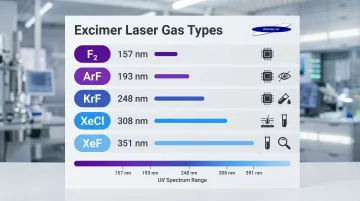
Excimer lasers are classified by their gas fill—the specific noble gas and halogen combination—which fixes the emission wavelength and dictates application suitability. Here's a quick reference before diving into each type:
| Gas Type | Wavelength | Primary Applications |
|---|---|---|
| F₂ (Fluorine) | 157 nm | VUV micromachining, specialized research |
| ArF (Argon Fluoride) | 193 nm | Semiconductor lithography, LASIK/PRK |
| KrF (Krypton Fluoride) | 248 nm | Industrial lithography, PLD, fusion research |
| XeCl (Xenon Chloride) | 308 nm | Dermatology (psoriasis, vitiligo), dye laser pumping |
| XeF (Xenon Fluoride) | 351 nm | Dye laser pumping, laser lift-off |
ArF (Argon Fluoride) — 193 nm
ArF lasers mix argon gas, fluorine (supplied as diluted F₂ or NF₃), and a buffer gas (typically neon). Under high-voltage electrical discharge, argon and fluorine form short-lived ArF* excimer complexes that emit at 193 nm, the shortest wavelength among the most commercially used excimer types. At this wavelength, photons carry enough energy (6.4 eV) to break molecular bonds in organic tissue and polymers with extreme precision.
Key strengths:
- Semiconductor photolithography: ArF immersion lithography has been extended to manufacture 7 nm and 5 nm technology nodes using multiple patterning and negative tone development. Despite the emergence of EUV lithography for cutting-edge nodes, ASML reported sales of 279 DUV systems (ArF/KrF) compared to just 48 EUV systems in 2025—demonstrating that ArF remains dominant for mature-node production
- Corneal refractive surgery: FDA-approved ArF lasers like the VISX STAR S4 IR are the clinical standard for LASIK and PRK. The 193 nm wavelength enables ablative photodecomposition, breaking organic bonds without thermal damage to surrounding corneal tissue
- Finest resolution: Achieves the best resolution of any commercially available excimer type
Trade-offs to consider:
- Atmospheric absorption: 193 nm output is strongly absorbed by air, requiring specialized UV-grade optics and purged optical systems
- Complex gas handling: Fluorine is highly corrosive (OSHA PEL: 0.1 ppm) and demands rigorous safety protocols
- Optics degradation: UV radiation rapidly degrades standard optical coatings; modern multilayer dielectric coatings offer up to 4× longer lifetimes
KrF (Krypton Fluoride) — 248 nm
KrF lasers mix krypton, fluorine (as diluted F₂ or KrF₂), and a buffer gas (helium or neon). The KrF* complex emits at 248 nm, still deep UV but with slightly longer wavelength and lower photon energy than ArF. KrF lasers historically have been the most powerful and widely used excimer type, capable of achieving the highest average output powers.
Key strengths:
- Semiconductor lithography: KrF systems pattern features from approximately 250 nm down to 90 nm for mid-critical layers. ASML shipped its 1,000th KrF lithography system in 2008
- Pulsed laser deposition (PLD): KrF (248 nm) lasers are heavily used for fabricating superconducting thin films like YBa₂Cu₃O₇₋ₓ (YBCO), typically at 1–3 J/cm² fluences
- Fusion energy research: The Naval Research Laboratory's Electra KrF laser demonstrated 90,000 shots over 10 hours of operation for inertial confinement fusion research
- High-power industrial environments: Excels in high-repetition-rate applications and widely used to pump dye lasers for scientific research
Trade-offs to consider:
- Lower resolution: At 248 nm, KrF cannot achieve the resolution of ArF for cutting-edge semiconductor nodes
- Corrosive gas handling: Like ArF, requires corrosion-resistant hardware due to fluorine reactivity
- Gas replacement intervals: Typically after a set number of million pulses (advanced systems with gas purification have extended this to 1 billion pulses)
XeCl (Xenon Chloride) — 308 nm
XeCl lasers use xenon, a chlorine donor (typically HCl or Cl₂), and a buffer gas (neon or helium). The XeCl* complex emits at 308 nm, which falls in the UVB range. This longer wavelength and lower photon energy make XeCl safer from an optics and material degradation standpoint while remaining highly effective for UV biological interaction.
Trade-offs to consider:
- Lower resolution: Longer wavelength limits resolution compared to ArF and KrF, ruling XeCl out of photolithography
- Toxic gas handling: HCl and Cl₂-based mixtures are toxic (OSHA PEL for HCl: 5 ppm ceiling) and require specialized handling protocols
- Material limitations: Less effective for the hardest materials that benefit from shorter-wavelength cold ablation
XeF (Xenon Fluoride) — 351 nm and Other Gas Types
XeF (351 nm): XeF lasers combine xenon and fluorine to emit at 351 nm in the near-UV/UVA range, the least energetic of common commercial excimer types. They're used for near-UV applications: pumping certain dye lasers (matching absorption bands of many laser dyes), photochemical processes, and specific scientific research tasks. XeF can be made slightly tunable using intracavity optics.
Output efficiency is typically only 50% of KrF systems. XeF is also used for Laser Lift-Off (LLO) processes where polymer films must remain transparent to prevent substrate damage.
F₂ (157 nm): F₂ lasers represent the shortest-wavelength excimer type, emitting in the vacuum UV spectrum. This extreme wavelength enables direct, high-precision micromachining of wide-bandgap materials like PTFE (Teflon) and PDMS without requiring dopants.
However, 157 nm radiation is strongly absorbed by atmospheric air and most optical materials, requiring fully purged or vacuum optical paths and specialized high-purity MgF₂ or CaF₂ optics. Standard UV fused silica degrades rapidly at this wavelength. Despite power output typically under 10% of KrF systems, F₂ lasers remain essential for specialized deep-UV optics research and next-generation lithography R&D.
Key UV Applications of Excimer Lasers
Semiconductor Photolithography
ArF (193 nm) and KrF (248 nm) excimer lasers are the backbone of deep-UV photolithography, the process of etching circuit patterns onto semiconductor wafers. Resolution follows the Rayleigh criterion: smaller wavelengths enable finer feature sizes.
ArF immersion lithography places purified water between the lens and wafer to increase numerical aperture. Combined with multiple patterning and negative tone development, ArF immersion has been extended to manufacture 7 nm and 5 nm technology nodes.
EUV lithography (13.5 nm) handles the most advanced nodes below 7 nm, but DUV systems still dominate equipment volume. ASML shipped 279 DUV systems versus 48 EUV systems in 2025.
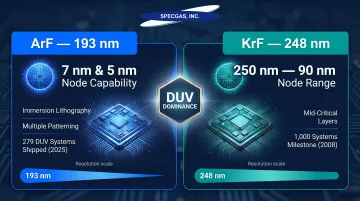
KrF lasers serve mid-critical layers with features from approximately 250 nm down to 90 nm. The short UV wavelength directly supports the miniaturization trend behind smaller, faster, and more energy-efficient chips.
Ophthalmology and Vision Correction
ArF (193 nm) lasers are the clinical standard for LASIK and photorefractive keratectomy (PRK), reshaping the cornea by ablating precise, micron-level layers of tissue. The ablation mechanism (direct molecular bond breaking rather than thermal cutting) is why excimer lasers are trusted for such delicate surgery. Surrounding cells remain undamaged because the process generates no heat.
Key clinical indicators for ArF-based vision correction:
- FDA-approved 193 nm ArF systems carry decades of established clinical safety data
- Market Scope reported a 2.2% increase in US ophthalmic procedures in Q2-2025 versus Q2-2024
Dermatological Treatments
XeCl (308 nm) excimer lasers are used to treat autoimmune and inflammatory skin conditions including psoriasis, vitiligo, atopic dermatitis, and alopecia areata. The targeted UV delivery allows higher doses to affected areas while minimizing exposure to healthy skin, a meaningful advantage over broadband phototherapy.
Clinical outcomes:
- Psoriasis: 84% achieved PASI 75 improvement after 10 or fewer treatments
- Vitiligo: 70% of UV-resistant lesions achieved ≥75% repigmentation when combined with topical tacrolimus
- Alopecia areata: 72.2% of scalp lesions showed complete regrowth after 12 weeks
- Atopic dermatitis: Excimer laser showed more long-term improvement than clobetasol propionate ointment
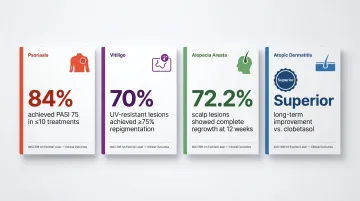
These outcomes depend on precise XeCl gas mixtures — the purity and stability of the laser gas directly affects delivered dose consistency across treatment sessions.
Industrial Material Processing and Scientific Research
Excimer lasers excel in applications requiring precise material removal without thermal damage:
- Polymer and ceramic ablation: Cold cutting for microelectronics and medical devices
- Laser marking and microstructuring: Glass and plastics patterning
- Pulsed laser deposition (PLD): Thin-film coatings for superconductors and advanced materials
- Fiber Bragg gratings fabrication: Telecommunications and sensing
- Dye laser pumping: Spectroscopy and tunable laser research
- Fusion energy research: KrF lasers for inertial confinement fusion experiments
Their high fluence, short wavelength, and pulsed delivery make excimer lasers a practical tool across both production environments and research facilities.
How to Choose the Right Excimer Laser Gas Type
Selection should be driven by required wavelength (fixed by the application), precision and resolution needs, and operating environment. Use this decision framework:
Decision framework:
- Maximum resolution required (semiconductor lithography, LASIK): ArF at 193 nm
- High-power deep UV for lithography or PLD: KrF at 248 nm
- Dermatological treatment or dye laser pumping: XeCl at 308 nm
- Near-UV applications (LLO, dye pumping): XeF at 351 nm
- Specialized VUV micromachining (PTFE, PDMS): F₂ at 157 nm
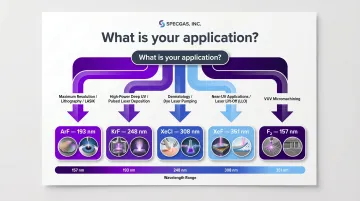
Once the wavelength is set, operational and supply factors determine whether your laser performs reliably in practice.
Practical factors often underweighted:
- Fluorine and chlorine are highly reactive — impure or unstabilized mixtures degrade optics, shorten tube life, and produce inconsistent output
- Modern systems with gas purification can extend replacement intervals to 1 billion pulses, but only with high-quality input gas
- NIST-traceable specialty gas mixtures directly affect laser reliability and total operating cost
- Proprietary internal cylinder treatment significantly extends reactive mixture shelf life and prevents in-cylinder degradation
Three selection mistakes consistently increase both cost and downtime:
Common selection mistakes to avoid:
- Choosing a shorter wavelength than needed adds unnecessary system complexity and gas handling burden
- Ignoring supply lead times — reactive halogen blends typically have a 1-year shelf life, though specialized cylinder treatments can extend this to 3 years
- Selecting a gas based on familiarity rather than application demands; wavelength must match the material's absorption characteristics and required resolution
Gas quality carries the same weight as laser hardware selection. Even 0.1% trace contamination can cut output by 50%. NIST-traceable mixtures with verified purity — such as excimer laser blends from SpecGas Inc. — give labs and production facilities the consistency needed for stable wavelength output and longer optics lifetime.
Frequently Asked Questions
How does the excimer laser work?
A high-voltage electrical discharge energizes a noble gas-halide mixture (e.g., argon + fluorine) to form short-lived excimer molecules. These molecules emit UV photons upon spontaneous or stimulated emission and immediately dissociate, preventing reabsorption and enabling high optical gain in nanosecond pulses.
What type of laser is an excimer laser?
Excimer lasers are a subtype of gas laser operating in the ultraviolet spectrum, always in pulsed mode (never continuous-wave). They're classified as both molecular lasers and UV lasers, distinct from solid-state, diode, or continuous-wave gas lasers.
What is the excimer laser used for?
Excimer lasers serve four primary application areas:
- Semiconductor photolithography — ArF and KrF for chip patterning
- LASIK and PRK eye surgery — ArF for corneal reshaping
- Dermatological treatment — XeCl for psoriasis and vitiligo
- Industrial material processing — ablation, marking, and pulsed laser deposition
Which excimer laser is best?
The right choice depends on the application. Each wavelength targets a different use case:
- ArF at 193 nm — maximum resolution for lithography and eye surgery
- KrF at 248 nm — high-power industrial and research applications
- XeCl at 308 nm — dermatology and dye laser pumping
What is the best laser for vitiligo?
The XeCl excimer laser at 308 nm is the established clinical standard for vitiligo treatment. Its targeted UVB output stimulates repigmentation in affected areas while limiting exposure to surrounding healthy skin. Clinical studies show 70% of UV-resistant lesions achieved ≥75% repigmentation when combined with topical tacrolimus.
Which laser is best for eczema?
The XeCl excimer laser (308 nm) is used for atopic dermatitis (eczema), where targeted UVB delivery reduces inflammation in affected patches. Clinical trials show better long-term outcomes than topical clobetasol propionate, though a dermatologist should guide treatment based on severity and skin type.