Introduction
PPM is the unit that ties together nearly every layer of gas measurement — from the regulatory limits posted on a confined space entry permit to the certified value printed on a calibration gas cylinder. Every gas detector, sensor, and monitoring system ultimately traces back to it.
PPM looks deceptively simple. One part per million. Easy enough. But in practice, a sensor reading 25 PPM of H₂S and a calibration gas certified at 25 PPM are two different representations of the same number — and the gap between them determines whether your measurement is trustworthy or not.
The most consequential errors in gas measurement trace back to PPM misuse: misreading concentration ranges, applying incorrect unit conversions, or calibrating against a reactive mixture that has drifted from its labeled value. Any of these can produce false alarms, missed toxic exposures, or regulatory non-compliance.
This article explains what PPM means, how it behaves across concentration ranges, what causes it to drift, and how it gets verified.
Key Takeaways
- PPM (parts per million) expresses the ratio of target gas molecules to the total air mixture — 1 PPM = 1 molecule per million
- Relevant ranges span from sub-1 PPM for ambient trace gases up to 50,000 PPM for flammable gas LEL thresholds
- Conversion is simple: PPM ÷ 10,000 = %VOL — so 5% VOL methane = 50,000 PPM
- Reactive gases (H₂S, NO, Cl₂, SO₂) drift from certified PPM values without proper cylinder treatment
- Reliable PPM measurement requires NIST-traceable calibration gas with documented uncertainty, not simply a labeled concentration
What PPM Means in Gas Concentration Measurement
PPM stands for parts per million. In gas detection, it's a dimensionless ratio — specifically, the number of molecules (or moles) of a target gas per one million molecules of the total gas mixture. NOAA's Global Monitoring Laboratory defines this as μmol/mol (micromoles per mole), which is the formal expression of the same concept.
The standard in gas detection and calibration is volume/mole fraction PPM — not mass fraction. This distinction matters when comparing values across different standards or regulatory documents, since mass-fraction PPM (PPM-w) produces different numbers for the same mixture.
PPM Relative to Adjacent Units
Understanding where PPM sits in the broader unit hierarchy helps prevent conversion errors:
| Unit | Equivalent | Common Use |
|---|---|---|
| 1 PPM | 0.0001% VOL | Trace toxic gas detection |
| 1,000 PPM | 0.1% VOL | Mid-range toxic/combustible threshold |
| 10,000 PPM | 1% VOL | Approaching flammable range |
| 1,000,000 PPM | 100% VOL | Pure gas |
| 1 PPB | 0.001 PPM | Ultra-trace ambient monitoring |
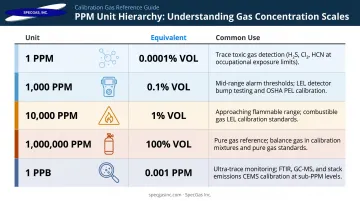
For concentrations below roughly 0.1%, percentage values become unwieldy — the differences between 0.0001% and 0.0003% are easy to misread or round incorrectly. PPM provides the resolution needed to work cleanly at the trace levels relevant to toxicity limits, environmental monitoring, and calibration accuracy.
PPM as Both Specification and Live Reading
PPM functions in two distinct roles simultaneously. On a certificate of analysis (CoA), it's a specification — the certified concentration of a gas blend against a traceable standard. On a field instrument display, it's a live measurement output. The gap between these two values, and understanding why that gap exists, is the core diagnostic problem in gas measurement practice.
A calibration gas supplier certifies a mixture at a specific PPM, and the instrument uses that gas to set its response before reporting PPM in the field. If any link in that chain introduces error, the reported value deviates from the true concentration. Common sources of that error include:
- Reactive gas instability in the cylinder between fill and use
- Sensor drift between calibration intervals
- Improper regulator use that causes concentration loss at the delivery point
PPM Ranges in Gas Measurement: Trace Levels to Dangerous Thresholds
PPM doesn't have a single standard range. What counts as trace-level in one application is an alarm threshold in another — the number only means something when you know the gas and the context.
Typical Concentration Ranges by Application
Ambient air monitoring operates in the low single-digit to low hundreds PPM range. NOAA's current measurements put atmospheric CO₂ at approximately 431 PPM at Mauna Loa (April 2026). Atmospheric methane sits around 1.94 PPM globally averaged. These are the background concentrations that ambient air quality instruments must detect and distinguish from elevated readings.
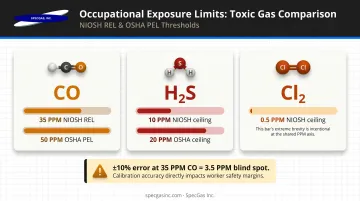
Occupational exposure limits (OELs) define the toxic thresholds that gas detectors must alarm before. Most OSHA and NIOSH limits fall between 0.1 and 1,000 PPM. Three illustrative examples:
- Carbon monoxide (CO): NIOSH REL of 35 PPM TWA; OSHA PEL of 50 PPM TWA
- Hydrogen sulfide (H₂S): NIOSH REL ceiling of 10 PPM; OSHA PEL ceiling of 20 PPM
- Chlorine (Cl₂): NIOSH REL ceiling of 0.5 PPM — toxic at concentrations most instruments struggle to resolve without high-quality calibration gas
These numbers illustrate why calibration accuracy at low PPM levels is not optional. A ±10% error on a CO detector calibrated at 35 PPM means a 3.5 PPM blind spot at the alarm threshold.
Flammable gas thresholds operate in a different magnitude entirely. Methane's Lower Explosive Limit (LEL) is 5% VOL, equal to 50,000 PPM. Hydrogen's LEL is 4% VOL, or 40,000 PPM.
At these concentrations, displaying values in PPM becomes impractical. A gas detector alarming at 10% LEL for confined space entry (per OSHA 29 CFR 1910.146) is responding to 5,000 PPM of methane — a figure that reads far more clearly as a percentage of LEL for the worker in the field.
Converting Between PPM and Other Units
The conversion between PPM and %VOL is straightforward:
- PPM × 0.0001 = %VOL
- %VOL × 10,000 = PPM
A commonly asked question: what is 5% gas in PPM? The answer: 5% VOL × 10,000 = 50,000 PPM. For methane, this equals exactly 100% LEL — the threshold at which the gas mixture becomes explosive.
One important caution: mass-fraction PPM differs from volume/mole-fraction PPM. In gas detection and calibration, volume/mole fraction is the standard unless explicitly stated otherwise. Applying mass-fraction values where volume-fraction is expected produces errors that compound at low concentrations.
Factors That Affect PPM Accuracy in Real-World Conditions
A certified PPM value on a cylinder is only the starting point. Several factors can cause the actual delivered concentration to diverge from that value before the reading ever reaches a sensor.
Reactive Gas Instability
Gases like H₂S, NO, Cl₂, SO₂, and HCl interact chemically with cylinder walls, moisture, and other mixture components. Without proper cylinder treatment, these interactions cause concentration drift — the actual PPM delivered can be measurably lower than the certified value.
The EPA's own Q&A documentation on protocol gases notes that H₂S-in-air standards are generally not recommended as analytical reference standards due to potential concentration instability, and that SO₂-in-air standards showed a median decay of 2.2% over six months in international comparisons. For a mixture certified at 10 PPM, that decay translates to a real-world delivered concentration below the instrument's alarm threshold.
SpecGas handles this through a proprietary internal cylinder treatment process — developed from Alfred Boehm's decades of reactive gas R&D work — that stabilizes reactive calibration gases including H₂S, NO, HCl, NH₃, SO₂, and formaldehyde at PPM and PPB levels. The SpecGas Stability Guarantee backs these mixtures, with specially treated aluminum cylinders used for the most reactive species.
Sensor Cross-Sensitivity and Environmental Variables
Field sensors are not perfectly selective. Published interference data shows H₂S sensor cross-responses ranging from -40% (NO₂) to over 300% (HCl), and an electrochemical CO sensor can show up to 20% response to hydrogen. A sensor reading 15 PPM in a mixed-gas environment may not be seeing 15 PPM of the target gas.
Environmental conditions compound this further:
- Temperature extremes — operating above 50°C or below -20°C can reduce instrument accuracy and affect alarm performance
- Humidity — moisture introduced through improper regulator use can degrade reactive gases in the delivery line before they reach the sensor
Sensor Calibration State
Even with a perfect calibration gas, a sensor that has drifted between calibration cycles will report incorrect PPM. Electrochemical cells age and deplete. PID lamp windows foul. The MSA ALTAIR 4XR, for example, specifies a CO accuracy of ±5 PPM or ±10% of reading — which means at 35 PPM (the NIOSH REL), the instrument could legitimately read anywhere from 30 to 40 PPM in normal operation.
Regular calibration with NIST-traceable gas is the only way to confirm what a sensor is actually detecting — not just what it was set to detect months ago.
How PPM Is Specified, Measured, and Validated
Specification and Documentation
In calibration gas applications, a certified PPM value is only as meaningful as the standard used to establish it. NIST-traceable calibration gases — including Standard Reference Materials (SRMs), NIST Traceable Reference Materials (NTRMs), and EPA Protocol gases — provide the reference chain that links a cylinder's certified value to a primary standard.
NIST traceability in practice means the certified PPM has been validated against a NIST primary standard through an unbroken measurement chain, with a defined uncertainty range. For instance, NIST SRM 1665b (Propane in Air) is certified at 3.0482 μmol/mol ± 0.0084 μmol/mol at 95% confidence. That level of documented precision is what distinguishes a reference standard from a nominal blend.
A complete Certificate of Analysis for a calibration gas should include:
- Certified PPM (or PPB) concentration
- Balance gas identity
- Uncertainty expressed as ±% relative
- Shelf life / expiration date
- Cylinder pressure at fill
- NIST traceability statement
For EPA continuous emissions monitoring under 40 CFR Part 75, Protocol gas concentrations must be certified with analytical uncertainty of no more than ±2.0% of the certified concentration — a hard regulatory requirement, not a best practice.
SpecGas produces NIST-traceable precision gas mixtures — including stable low-PPM and PPB blends of reactive species — with CoA documentation covering all parameters above. Concentration range runs from 300 PPB (H₂S, PH₃) up to 10% by volume, covering the full span from ultra-trace toxic gas work to LEL detector calibration.
Measurement and Verification Methods
Lab-grade preparation begins with gravimetric blending — transferring precise gas aliquots into evacuated cylinders by mass — then analytical verification via GC or FTIR to confirm the certified concentration. NIST uses GC-FID for hydrocarbons and GC-TCD for CO₂ in its primary standard work.
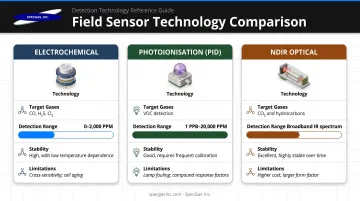
Field instruments use different detection principles, each suited to specific PPM ranges:
- Electrochemical sensors — best suited for toxic gas detection (CO, H₂S, Cl₂); typical range 0–2,000 PPM; limited by cross-sensitivity and cell aging
- PID (photoionization) sensors — VOC detection across a wide range, from 1 PPB to 20,000 PPM on some instruments; highly sensitive but affected by lamp fouling and compound response factors
- NDIR (non-dispersive infrared) — well-suited for CO₂, hydrocarbons; more stable over time but higher cost and larger form factor
A reading gap between lab-certified and field-measured PPM is normal — understanding why it happens is what matters. Regulator delivery pressure, ambient temperature, sensor response variability, and background gas interference all contribute. Tracking the uncertainty budget across all three stages — certified value, delivery variance, and sensor accuracy — gives you the confidence to act on a PPM reading.
Risks of Operating with Incorrect PPM Values
Safety and Compliance Failures
A gas detector calibrated with a mixture whose actual PPM has drifted from its labeled value will misread live gas concentrations proportionally. If a 25 PPM H₂S calibration gas has decayed to 22 PPM due to reactive instability, the instrument calibrated against it will under-report field readings by roughly 12%. At a NIOSH ceiling of 10 PPM, that error means the alarm triggers later than it should.
EPA 40 CFR Part 75 requires that Protocol gases be prepared and certified by a recognized production site with ±2.0% maximum analytical uncertainty. Using gases outside this specification — including expired cylinders — puts CEMS compliance at risk. Non-aluminum cylinder standards under the EPA Traceability Protocol generally carry only a 6-month certification period, after which the certified value is no longer valid.
Treating Nominal Values as Exact
Certified PPM is always a value with uncertainty attached to it. A gas certified at 50 PPM ± 2% represents a true concentration somewhere between 49 and 51 PPM. Operating as if the labeled value is exact — without accounting for that tolerance — introduces a hidden error that compounds through the calibration chain.
Shelf life follows the same logic. Assuming a reactive gas mixture certified today will deliver the same PPM after 12 months — without verified stability data — is an assumption the EPA's own documentation advises against for species like H₂S and SO₂.
Unit Confusion and Misapplication
A persistent error in industrial hygiene and emissions work is treating %LEL and PPM as interchangeable across gas species. They are not. The %LEL scale is gas-specific:
- 10% LEL for methane equals 5,000 PPM
- 10% LEL for hydrogen equals 4,000 PPM
Applying a methane-based conversion to a hydrogen reading produces a 20% error in the final reading.
Volume-fraction PPM and mass-fraction PPM produce different numbers for the same physical mixture. In emissions certification contexts, mixing these bases when comparing values across standards can misrepresent compliance status.
These unit errors don't just cause confusion — they produce incorrect compliance decisions. Accurate PPM measurement starts with accurate calibration gas: verified, NIST-traceable mixtures with documented stability and clearly stated uncertainty. Without that foundation, every downstream reading is built on an assumption.
Frequently Asked Questions
What PPM is a toxic gas?
Toxicity thresholds are gas-specific, defined by OSHA and NIOSH as Permissible Exposure Limits (PELs) and Recommended Exposure Limits (RELs). CO has a NIOSH REL of 35 PPM TWA; chlorine has a NIOSH REL ceiling of just 0.5 PPM — far below any flammable threshold.
What is 5% gas in PPM?
Using the standard conversion: 5% VOL × 10,000 = 50,000 PPM. For methane, this equals 100% LEL — the concentration at which the gas-air mixture becomes explosive.
What is PPM for gas?
PPM (parts per million) is the number of molecules of a target gas present per one million molecules of the total gas mixture. It is the standard unit for trace gas concentrations in detection, environmental monitoring, and calibration — preferred over percentage for concentrations below 0.1% VOL.
What is the difference between PPM and PPB in gas measurement?
PPB (parts per billion) = PPM ÷ 1,000. PPB is used when concentrations are too low to express meaningfully in PPM: common in ambient air quality monitoring, ultra-trace toxic gas detection (sub-1 PPM thresholds), and precision calibration of low-level sensors. For reference, SpecGas produces certified calibration blends down to 300 PPB for gases like H₂S and PH₃.
How do you convert PPM to percent volume (%VOL)?
Divide PPM by 10,000. Example: 1,000 PPM = 0.1% VOL. This conversion is useful when comparing PPM sensor readings to LEL thresholds, which are published as %VOL.
How accurate does a calibration gas mixture need to be in PPM?
Regulatory-grade monitoring (EPA CEMS under 40 CFR Part 75) requires ±2.0% relative uncertainty or better, traceable to NIST. Research and emissions certification applications may require ±1% or PPB-level precision. NIST-traceable certified reference gases provide the documented uncertainty needed to meet these requirements.