The supplier landscape splits cleanly into two categories: large multinational providers like Matheson (now operating as Nippon Sanso Matheson Inc.) and independent specialty gas suppliers focused exclusively on precision blending and custom calibration work. Each has a legitimate place in the market. Neither is universally the right answer.
This article breaks down what each supplier type actually offers, where each excels, and how to determine which fits your lab's specific requirements.
Key Takeaways
- Matheson is a large multinational best suited for high-volume, standard industrial and bulk gas needs
- Specialty gas suppliers offer custom blends, NIST traceability on every batch, and faster lead times — better suited for calibration gases, reactive mixtures, and low ppm/ppb precision work
- Reactive gas stability depends on cylinder treatment expertise that most large-catalog providers don't offer
- For low ppm/ppb work, reactive mixtures, or NIST-traceable standards, in-house production control is what separates reliable results from guesswork
Matheson Gas vs. Specialty Gas Suppliers: Quick Comparison
Here's how the two supplier types compare at a glance:
| Factor | Matheson (Nippon Sanso Matheson) | Specialty Gas Supplier |
|---|---|---|
| Scale | 300+ US facilities, 4,500+ employees | Smaller, focused operations |
| Product range | Broad catalog: industrial, semiconductor, EPA, rare gases | Custom blends, calibration standards, reactive mixtures |
| NIST traceability | Available on select lines (EPA Protocol, Cal-MAT grades) | Often certified on every batch |
| Custom formulations | Limited flexibility for non-catalog work | Core business model |
| Reactive gas handling | Standard cylinder inventory | Proprietary cylinder treatment, stability guarantees |
| Lead times | Longer for non-standard blends | Often days, including rush service |
| Service model | Corporate account management | Dedicated contacts, direct technical access |
| Organizational status | Rebranding under Nippon Sanso Holdings (2026) | Stable, independent |
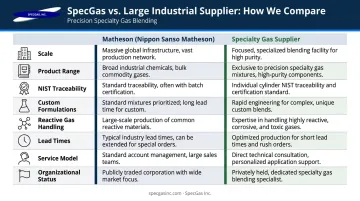
One practical note on the rebrand: Matheson officially changed its name to Nippon Sanso Matheson Inc. in 2026, part of a global rebrand across Nippon Sanso Holdings' regional brands. If you're weighing a long-term supplier relationship, it's worth considering how this transition may affect account management, pricing structures, and product line continuity.
What Is Matheson Gas?
Matheson was founded in 1927 and operates as a U.S. subsidiary of Nippon Sanso Holdings Corporation, which ranks it as the fourth largest supplier of industrial, electronic, and medical gases globally. The U.S. operation runs more than 300 facilities and employs over 4,500 people.
Their product portfolio is broad:
- Industrial and atmospheric gases (nitrogen, oxygen, argon)
- Semiconductor process gases (silane, arsine, boron trifluoride)
- Rare gases (krypton, neon, xenon)
- EPA Protocol Mixtures (CO, CO₂, H₂S, NO, SO₂, and others)
- Cal-MAT Daily Calibration Standards
Where Matheson Performs Well
Matheson's infrastructure supports high-volume, standardized gas needs reliably. For labs or industrial facilities running bulk gas programs, established semiconductor supply chains, or standard atmospheric gas requirements, their distribution network is a genuine advantage.
Their Cal-MAT grades carry NIST traceability — Cal-MAT 1 is certified to 1% accuracy traceable to NIST SRM or NTRM, and Cal-MAT 2 to 2% accuracy. For compliant continuous emissions monitoring under 40 CFR Part 75, their EPA Protocol Gases meet the program's ±2.0% analytical uncertainty requirement.
Where Matheson Has Limitations
That same scale drives standardization. For labs that need unusual mixtures, very low concentration blends, or custom reactive formulations, Matheson's catalog-driven model often doesn't accommodate those requirements without significant lead time or custom surcharges.
Rush orders and one-off R&D gas needs typically mean weeks of delay or minimum-order requirements that don't fit smaller lab workflows.
What Is a Specialty Gas Supplier?
Specialty gas suppliers are companies built exclusively around precision gas blending, custom calibration standards, and technically demanding mixtures. They blend everything in-house, maintain hands-on production control, and carry chemistry expertise that doesn't exist inside a general industrial gas distributor.
The operational difference is structural: specialty suppliers don't pull gases from a catalog. They produce each blend to your specification, verify concentration analytically, and issue documentation that traces the mixture back to NIST primary standards.
Reactive Gas Handling: The Real Differentiator
Reactive calibration gases — hydrogen sulfide, ammonia, hydrogen chloride, nitric oxide, chlorine, formaldehyde — degrade without proper cylinder preparation. The mechanism isn't mysterious: reactive components interact with cylinder walls, adsorb onto internal surfaces, and lose concentration over time without appropriate passivation treatment.
EPA's 2023 Protocol Gas overview requires 100% stability testing for reactive gas mixtures, often involving multiple assays over a six-month period, with shelf lives estimated through linear regression to a concentration decay limit. That level of quality control demands specialized expertise and infrastructure that large-scale providers rarely maintain across their full reactive gas line.
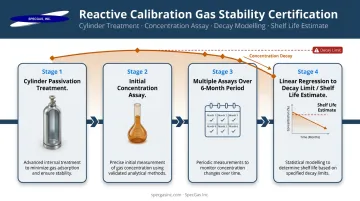
Leading specialty suppliers use proprietary internal cylinder treatment processes to extend shelf life and maintain concentration stability. That R&D background became SpecGas's foundation. The company produces NIST Traceable Gas Standards using proprietary blending procedures and backs reactive gas mixtures with a Stability Guarantee, including an immediate remake-and-reship policy if a customer disputes results. Cylinder types are matched to gas reactivity: aluminum for reactive gases, nickel-plated for highly corrosive compounds.
Their reactive gas portfolio includes H₂S, HCN, Cl₂, ClO₂, NH₃, PH₃, HCl, NO/NOx, SO₂, formaldehyde, and others. SpecGas also produces excimer laser gas mixtures (ArF, KrF, KrCl, XeCl) for photolithography and medical applications, a niche very few suppliers can serve at this precision level.
Where Specialty Suppliers Clearly Fit
- Air quality and emissions monitoring requiring EPA Protocol-grade gases
- Environmental testing labs needing CEMS calibration standards
- University and independent research labs with non-standard mixture requirements
- Semiconductor production requiring exotic formulations
- Any workflow where concentration accuracy and mixture stability are non-negotiable
- Labs that need gases larger companies list as unavailable or require prohibitive minimums
Head-to-Head: What Matters Most for Lab Gas Sourcing
Customization and Lead Times
Matheson's catalog covers a wide range of standard gases. Custom formulations at low ppm/ppb concentrations or with reactive components typically fall outside their standard service model, which can stretch lead times.
Regional EPA gas suppliers provide a useful market reference: WestAir, for example, lists EPA gases at 2–4 weeks for most products, 2–6 weeks depending on components. Specialty suppliers often fulfill custom orders in days, with rush service available for time-sensitive calibration or research needs.
NIST Traceability
"Certified" doesn't automatically mean NIST traceable. The NIST Traceable Reference Material (NTRM) program requires that specialty gas vendors produce mixtures to NIST specifications, analyze 100% of cylinders in a lot, and submit 10% for NIST audit before a Certificate of Traceability is issued.
Matheson offers NIST-traceable products on specific lines (EPA Protocol and Cal-MAT grades are documented examples). But not every Matheson calibration gas carries NIST traceability. Specialty suppliers focused exclusively on calibration work often certify every batch, with full analytical documentation as a standard deliverable.
For compliance use cases, ask your supplier specifically:
- Is this gas EPA Protocol-grade?
- Is it NTRM or SRM traceable?
- What is the stated uncertainty, and which traceability route does the certificate name?
Cost Structure
Matheson's scale delivers competitive pricing on bulk and standard gases. Custom or reactive work changes that equation.
Two cost models dominate this comparison:
- Cylinder rental (large suppliers): Demurrage fees accumulate after the initial free period. Arizona State University's gas services policy notes that specialty gases carry higher monthly rental rates.
- Cylinder deposit (specialty suppliers): Customers pay a one-time deposit rather than ongoing rental fees. A product specialist at MNR Lab in California called SpecGas's deposit program "so much more cost-effective than renting cylinders from other gas companies."
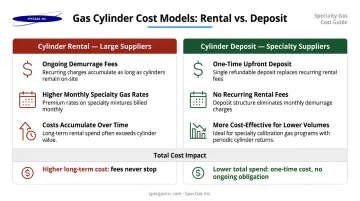
For labs buying outright at lower volumes or ordering non-catalog blends, the specialty supplier typically wins on total cost.
Which Supplier Type Is Right for Your Lab?
The decision comes down to what your lab needs:
Choose a large multinational like Matheson if:
- You need high-volume standard gases (atmospheric, industrial, common calibration standards)
- Your operation runs bulk deliveries or established semiconductor process gases
- Broad geographic distribution and infrastructure are priorities
Choose a specialty gas supplier if:
- Your work requires custom calibration gases, reactive mixtures, or low ppm/ppb precision blends
- NIST traceability on every batch is a compliance or quality requirement
- You need fast turnaround — days, not weeks
- You're sourcing gases that large providers can't produce reliably or list with prohibitive minimums
- Reactive gas stability and shelf life documentation are non-negotiable
Volume and standard composition favor large suppliers. Once your application requires a reactive blend at 500 ppb with NIST documentation and a two-day lead time, that calculus shifts — and specialty suppliers are often the only ones who can deliver.
If your application fits the specialty side of that line, SpecGas Inc. blends custom calibration gases — including reactive and low-concentration mixtures — with NIST traceability and some of the fastest lead times in the industry. Reach out to discuss your specific requirements: (215) 443-2600 or website-inquiries@specgasinc.com.
Conclusion
Neither supplier type is universally superior. Matheson provides scale and distribution breadth suited to high-volume, standardized gas programs. Specialty gas suppliers provide precision, customization, and technical depth for applications where those qualities directly affect results.
Choosing the wrong supplier creates real downstream problems: calibration drift from unstable reactive mixtures, compliance gaps from non-traceable standards, and project delays from extended lead times.
Match your supplier to what your application actually demands. If reactive gas stability, NIST-traceable documentation, and fast turnaround on custom blends are non-negotiable for your lab, a specialty gas manufacturer like SpecGas Inc. — which blends all mixtures in-house and backs reactive gas standards with a stability guarantee — is the more reliable fit than a broad-distribution generalist.
Frequently Asked Questions
What are the alternatives to Matheson gas?
Alternatives include other large industrial gas companies — Air Products, Air Liquide, and Airgas (an Air Liquide company) and Linde — as well as independent specialty gas suppliers. For custom calibration gases, reactive mixtures, or NIST-traceable blends, specialty suppliers typically offer more precision, flexibility, and faster service than any large multinational.
What is a specialty gas supplier?
Specialty gas suppliers are companies focused specifically on precision gas blending, calibration gas standards, and custom mixtures. Unlike general industrial gas distributors, they operate with in-house blending expertise and quality controls built specifically for technically demanding lab and industrial applications.
How do I know if my lab needs NIST traceable calibration gas?
NIST traceability is required when your instruments must meet regulatory, environmental, or quality compliance standards. Labs involved in emissions monitoring, environmental testing, or certified analytical work should insist on NIST Traceable Gas Standards with a documented traceability chain and stated uncertainty.
Can specialty gas suppliers handle reactive gas mixtures?
Leading specialty suppliers use proprietary internal cylinder treatment processes designed specifically for reactive gases. This passivation prevents concentration drift and extends shelf life — a clear advantage over standard large-supplier cylinders, especially for gases like H₂S, HCl, NH₃, formaldehyde, and NO.
How long does it take to get custom gas blends delivered?
Lead times vary significantly. Large suppliers may require several weeks for non-standard blends. Specialty gas suppliers often fulfill custom orders in days, with some offering rush service for time-sensitive calibration or research needs.
Is it more cost-effective to use a small specialty gas supplier vs. a large company?
For labs buying cylinders outright rather than renting, specialty suppliers with lower minimums and cylinder deposit programs can reduce costs noticeably — particularly for custom mixtures, where large suppliers typically charge premium pricing for non-catalog work.