Introduction
Hydrogen sulfide is a colorless, toxic gas with a distinctive rotten egg odor. At 10 ppm, it sounds like a small number. Workers in oil and gas, wastewater treatment, and agriculture encounter it routinely. Some walk into spaces where it lingers unaware that concentrations have already built up.
Ten ppm is not harmless. NIOSH set it as its regulatory ceiling for exactly this reason: animal studies place it at the boundary between no-effect and early biological damage. Sensitive individuals — particularly those with asthma — may already be experiencing airway changes at this level.
What follows is a breakdown of what the research shows: immediate physiological effects, long-term concerns, who's most at risk, and why gas detection calibrated to verified standards matters at this concentration.
Key Takeaways
- 10 ppm is NIOSH's 10-minute ceiling limit, not a safe working level — it's a hard maximum, not a target
- Olfactory fatigue is real: smell cannot reliably warn you at sustained concentrations
- Healthy adults show subtle metabolic changes at 10 ppm during exercise; asthmatics may react at 2–5 ppm
- Animal studies place the NOAEL at 10 ppm; respiratory lesions appear at 30 ppm and above
- Calibrated, NIST-traceable gas detectors are the only reliable protection
What 10 ppm H2S Actually Means
The Concentration Defined
According to NIOSH, ppm for airborne gases means "parts of vapor or gas per million parts of contaminated air by volume." At 10 ppm H2S, there are 10 molecules of hydrogen sulfide for every million molecules of air — a small fraction, but enough to trigger biological effects in certain individuals.
For context across the concentration spectrum:
| Concentration | Significance |
|---|---|
| 0.01–1.5 ppm | Odor detectable by most people |
| 10 ppm | NIOSH REL ceiling (10 minutes) |
| 100 ppm | NIOSH IDLH — immediately dangerous to life or health |
| 500–700 ppm | Collapse within 5 minutes; death after 30–60 minutes |
| 700–1,000 ppm | Rapid unconsciousness and death |
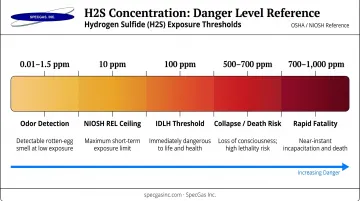
That table makes 10 ppm look modest. The danger is that workers often rely on their nose to gauge where they sit on that scale — and that instinct fails them.
Why Smell Isn't a Reliable Warning
Most people can detect H2S at 10 ppm by odor. The problem: NIOSH explicitly warns that the sense of smell becomes rapidly fatigued and cannot be relied on for exposure assessment. Olfactory paralysis (where smell disappears entirely) occurs at 100–150 ppm according to OSHA.
Fatigue sets in well before that threshold, leaving workers believing the hazard has cleared when H2S levels remain unchanged. This makes odor-based awareness actively dangerous.
A worker who stops smelling rotten eggs isn't necessarily in a safer environment.
Why Regulatory Agencies Focus on 10 ppm
The Three-Agency Landscape
Three major agencies set H2S exposure limits, and they land in very different places:
- NIOSH REL: 10 ppm as a 10-minute ceiling — no exceedances, even briefly
- OSHA PEL (general industry): 20 ppm ceiling, with a 50 ppm acceptable peak for up to 10 minutes per shift if no other measurable exposure occurs during the shift
- ACGIH TLV: 1 ppm TWA / 5 ppm STEL — the most protective of the three
Many occupational health programs follow NIOSH's 10 ppm ceiling rather than OSHA's more permissive 20 ppm standard, primarily because both human and animal data consistently identify 10 ppm as the threshold where measurable physiological effects begin.
The Human Evidence: Bhambhani Studies
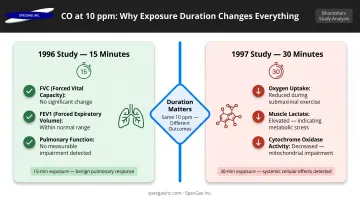
Two controlled studies by Bhambhani and colleagues exposed healthy, exercising volunteers to exactly 10 ppm H2S and produced findings that informed the regulatory threshold:
- 1996 study (15-minute exposure during exercise): No significant changes in pulmonary function — FVC, FEV1, and respiratory measurements remained within normal range
- 1997 study (30-minute exposure during exercise): Reduced oxygen uptake, increased muscle lactate in both men and women, and decreased cytochrome oxidase activity in men — consistent with inhibited aerobic metabolism
The 1996 study is occasionally cited as evidence that 10 ppm is benign. The 1997 data complicate that conclusion. Biochemical effects appeared at the same concentration with longer exposure. That duration-dependence is precisely why 10 ppm functions as a ceiling, not a comfortable working level.
Animal Subchronic Data
The Bhambhani studies were limited to 15–30 minutes. Animal subchronic data extend the picture to longer exposures and tissue-level effects. Dorman et al. (2004) and Brenneman et al. (2000) both exposed rodents to H2S across multiple concentration levels in subchronic inhalation protocols:
- At 10 ppm: No nasal mucosal lesions, no bronchiolar changes — established as the NOAEL
- At 30 ppm and above: Olfactory neuronal loss in rats and mice
This dose-response relationship is why 10 ppm appears repeatedly in regulatory guidance — at 30 ppm, one concentration tier above the NOAEL, measurable tissue damage emerges.
Immediate Health Effects at 10 ppm H2S
What the Research Actually Shows
OSHA's hazard documentation places tearing of the eyes at 2–5 ppm with prolonged exposure. At 10 ppm, controlled human studies in healthy adults generally show limited measurable effects — but that finding comes with important qualifications.
Effects that may occur at or near 10 ppm:
- Mild eye irritation (particularly in previously sensitized individuals or those exposed to co-contaminants)
- Headache and nausea with prolonged exposure
- Nose and throat irritation
Effects established at higher concentrations (not at 10 ppm):
- Olfactory paralysis — occurs at 100–150 ppm
- Pulmonary edema — associated with prolonged 200–300 ppm exposure
- Significant cardiovascular dysfunction in healthy adults
The Cellular Mechanism
H2S inhibits cytochrome c oxidase (Complex IV of the mitochondrial electron transport chain). This disrupts oxidative phosphorylation in a manner similar to cyanide, impairing cells' ability to use oxygen. At high concentrations, this mechanism is rapidly incapacitating.
At 10 ppm, the Bhambhani 1997 study found marginal but measurable effects on this pathway, particularly in exercising subjects under higher metabolic load.
That metabolic connection extends directly to the workplace. Workers performing heavy labor breathe more deeply and rapidly, increasing H2S uptake — the same concentration hits harder during activity than at rest.
Asthmatic Workers: A Lower Threshold
For individuals with asthma, 10 ppm is not a safe ceiling. Research cited by both ATSDR and OSHA shows this population responds at far lower concentrations:
- Clinically measurable increased airway resistance at 2 ppm for 30 minutes
- Headache onset at the same 2 ppm threshold
- OSHA specifically documents airway problems in asthmatic patients at 2–5 ppm
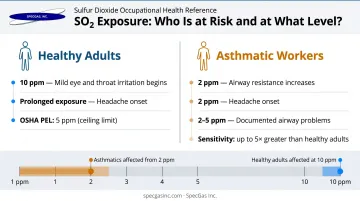
For this group, the ACGIH's 1 ppm TWA / 5 ppm STEL limits are the more appropriate clinical benchmark.
Long-Term Health Effects and Data Gaps
Chronic Exposure Evidence
Studies of pulp mill workers — exposed primarily in the 2–11 ppm range — provide the most relevant human occupational data. Jappinen et al. (1990) examined respiratory function including FVC and FEV1 in exposed workers.
ATSDR cites this occupational evidence as supporting the view that lung function changes are limited at low-level chronic exposure.
Subchronic animal data (Dorman 2004; Brenneman 2000) establish 10 ppm as the NOAEL for respiratory tract effects after 6 hours/day exposure over 10–13 weeks. At 30 ppm and above, olfactory neuronal loss was documented.
Neurological Concerns
ATSDR cites reports linking chronic low-level H2S exposure to:
- Fatigue and headaches
- Memory problems and difficulty concentrating
- Irritability and mood changes
- Dizziness
Much of this evidence comes from community-level environmental exposures rather than controlled occupational cohorts, and the data do not cleanly isolate 10 ppm as a specific threshold for neurological effects. That uncertainty is precisely why current exposure limits lean conservative rather than permissive.
What the Data Can't Yet Answer
ATSDR identifies significant gaps: no chronic lifetime animal inhalation studies for H2S exist, and epidemiological data on neurological outcomes specifically from 10 ppm occupational exposures are limited. For safety managers and industrial hygienists, these gaps reinforce the case for reliable continuous monitoring rather than relying on spot checks or averaged exposure estimates.
Who Encounters 10 ppm H2S at Work
High-Risk Industries
OSHA identifies these sectors as primary H2S exposure environments:
- Oil and gas extraction and refining — wellheads, processing facilities, sour gas operations
- Wastewater treatment — sewers, treatment plants, sludge processing
- Agriculture — manure pits, swine confinement operations, biodigesters
- Pulp and paper mills — kraft pulping processes generate H2S as a byproduct
- Mining — underground operations with sulfur-containing geology
Vulnerable Workers
Some workers face greater risk at the same nominal concentration:
- Asthmatics and those with pre-existing respiratory conditions — may react below 10 ppm
- Workers performing heavy physical labor — higher respiratory rate increases gas uptake
- Confined space workers — H2S accumulates rapidly in poorly ventilated areas
- Olfactory fatigue risk — in enclosed spaces, the nose adjusts to the odor, masking dangerous concentration spikes
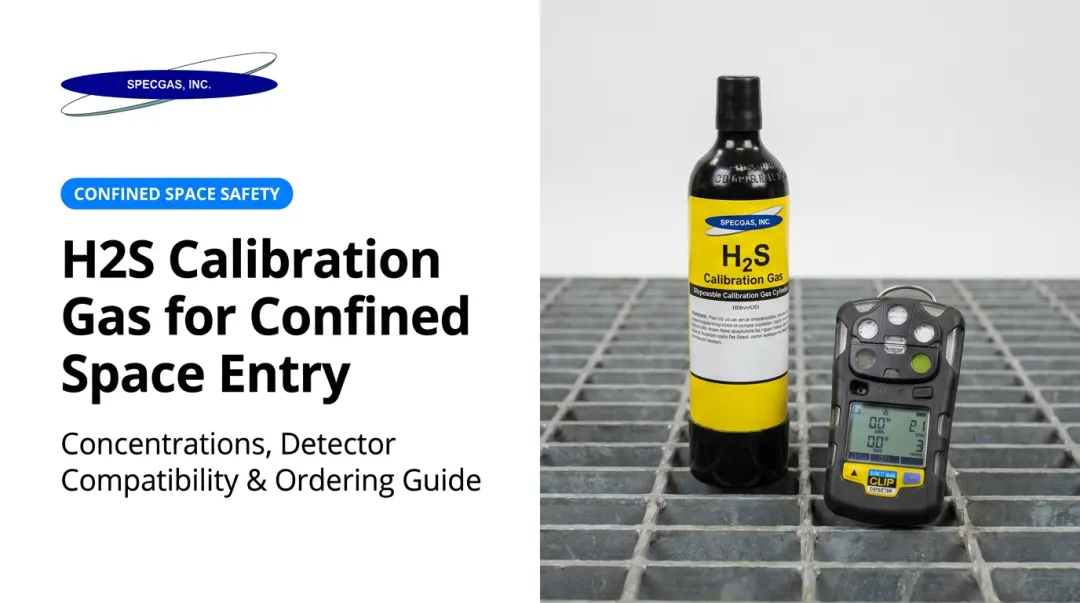
For all these groups, reliable gas detection depends on detectors that are properly bump-tested and calibrated — making accurate H2S calibration gas a critical line of defense.
Detecting 10 ppm H2S and Keeping Workers Safe
Why Continuous Gas Monitoring Is Required
Because smell cannot be relied on — particularly at sustained concentrations — continuous personal gas monitoring is the foundation of any H2S safety program. Personal H2S detectors are typically configured with a low alarm around 5–10 ppm and a high alarm at 15 ppm, according to device-specific settings documented by manufacturers such as MSA. Any alarm, though, is only as trustworthy as the calibration behind it.
Calibration Gas and NIST Traceability
OSHA's Safety and Health Information Bulletin on direct-reading monitors states that calibration test gas must always be certified using a standard traceable to NIST. This requirement exists because a gas detector calibrated against an inaccurate reference gas will read inaccurately — and at low-ppm concentrations where regulatory limits apply, small errors have direct safety consequences.
One technical complication specific to H2S is adsorption onto cylinder walls, which can cause concentration drift in standard cylinders — particularly at the low-ppb and low-ppm ranges where occupational limits sit. SpecGas Inc. addresses this through a proprietary internal cylinder treatment process designed to maintain concentration accuracy across the shelf life of reactive gas mixtures.
Additional Protective Measures
Accurate calibration gas is one piece of a broader protection framework. A complete H2S safety program also requires:
- Engineering controls — forced ventilation in confined spaces, continuous area monitoring
- Administrative controls — exposure time limits, pre-entry atmospheric testing, buddy systems for confined space entry
- PPE — supplied-air respirators or SCBAs where H2S may exceed safe levels
- Training — workers must understand that absence of odor does not mean absence of hazard
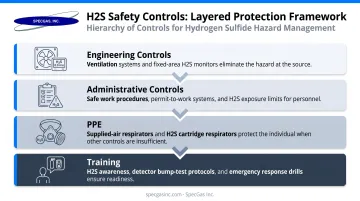
None of these controls function reliably without accurate baseline monitoring — which comes back to properly calibrated, regularly bump-tested detectors.
Frequently Asked Questions
What does 10 ppm H2S mean?
10 ppm means 10 molecules of hydrogen sulfide per million molecules of air by volume. Most people can detect it by its rotten egg odor. It is the NIOSH recommended ceiling exposure limit — meaning workers should not be exposed above this concentration even for brief periods.
How long can you work in 10 ppm H2S?
Not long — NIOSH sets 10 ppm as a 10-minute ceiling that should not be exceeded at any point. OSHA's PEL is more permissive: 20 ppm as a ceiling, with a 50 ppm acceptable peak for no more than 10 minutes per shift, provided no other measurable exposure occurs during that shift.
How many ppm is 10% H2S?
10% H2S equals 100,000 ppm: roughly 10,000 times higher than the NIOSH 10 ppm ceiling and 1,000 times above the IDLH of 100 ppm. At that concentration, exposure is immediately fatal within seconds to minutes.
Is 10 ppm H2S dangerous to breathe?
Controlled studies in healthy adults show limited measurable effects at exactly 10 ppm, but NIOSH set it as a ceiling precisely because it marks the threshold where harm becomes plausible — particularly for asthmatics and workers under physical exertion. Any H2S detector used in these environments needs to be calibrated against a verified 10 ppm standard to catch exposures at that limit reliably.
What are the first symptoms of H2S exposure at 10 ppm?
Potential early symptoms include mild eye irritation, headache, and nausea — especially with prolonged exposure or in sensitive individuals. Olfactory fatigue is the more dangerous factor: the rotten egg odor can vanish even as concentrations hold steady or climb. That's why symptoms alone are not a reliable warning system.