These aren't minor adjustments. Refiners alter the chemical composition of every gallon they produce to meet seasonal performance and regulatory requirements. The difference between a winter and summer blend affects how readily the fuel evaporates — a property that governs cold-weather ignition, summertime smog formation, and retail price at the pump.
One measurable parameter controls all of it: Reid Vapor Pressure, or RVP. Understanding what RVP is and why the EPA regulates it seasonally explains nearly every question about why gas costs more in spring, why prices vary by region, and what actually changes when a refinery switches blends.
Key Takeaways
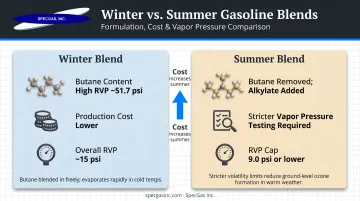
- Gasoline is an engineered hydrocarbon mixture whose formulation changes seasonally to meet temperature and regulatory requirements
- Reid Vapor Pressure (RVP) is the key parameter: winter blends reach ~15 psi; summer blends are federally capped at 9.0 psi
- Replacing cheap butane with costlier components for summer is the primary driver behind seasonal price increases at the pump
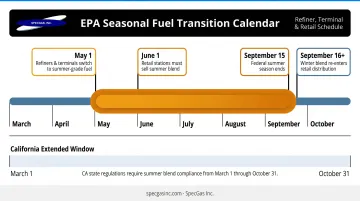
- The EPA's summer-blend mandate runs June 1 to September 15 at retail; refiners must comply by May 1
What Is a Gas Blend and Why Do Formulations Change Seasonally?
Motor gasoline is not a single chemical. The EIA defines finished motor gasoline as a complex mixture of relatively volatile hydrocarbons — alkanes, aromatics, and olefins — combined with chemical additives and blended to meet specific performance, emissions, and regulatory targets. The exact composition shifts by grade, region, and season.
That last variable — season — is where the engineering gets interesting.
Why Temperature Forces the Reformulation
Ambient temperature directly controls how fast fuel evaporates. A gasoline blend calibrated for reliable cold-weather ignition has enough volatility to vaporize quickly in a cold engine. In summer heat, that same formulation evaporates far too aggressively.
The result: excess vapor accumulates in fuel tanks, fuel lines, and injector systems — increasing evaporative emissions and contributing to ground-level ozone formation.
The reverse is also a real engineering constraint. A low-volatility summer blend won't vaporize readily enough in winter air, producing hard starts, rough idling, and extended cranking time before combustion stabilizes.
Seasonal reformulation addresses both failure modes. It's also not optional. Under Clean Air Act section 211(h), the EPA legally mandates summer-grade gasoline specifications. Refiners don't choose to change formulations as a quality initiative; they're required to.
Two Gasoline Types, Same Seasonal Rules
The U.S. market has two primary gasoline categories:
- Conventional gasoline — used in most areas that meet federal air quality standards
- Reformulated gasoline (RFG) — required in high-smog metropolitan areas, used in 17 states and DC, accounting for roughly 25% of U.S. gasoline supply
Both types follow seasonal RVP (Reid Vapor Pressure) switching requirements, though RFG carries stricter summer limits. RVP is the key parameter that defines both seasonal and regional differences in gasoline composition.
That same principle — controlling volatility at the component level to hit a precise measurable target — is central to how calibration gas standards are formulated. Whether the end product is pump fuel or a hydrocarbon reference standard for emissions analyzer calibration, the underlying chemistry demands the same kind of exacting blend control.
Reid Vapor Pressure: The Parameter Behind Seasonal Blending
Reid Vapor Pressure (RVP) measures a fuel's tendency to evaporate at a standard reference temperature of 37.8°C (100°F), expressed in pounds per square inch (psi). The higher the RVP, the more readily the fuel vaporizes. RVP is measured under ASTM D323-26, the active standard test method for petroleum vapor pressure.
The Regulatory Limits by Season and Region
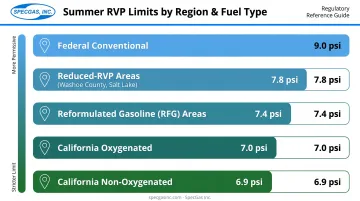
The EPA uses RVP as its primary regulatory lever for seasonal emissions control. The limits vary by geography and fuel type:
| Gasoline Type / Region | Summer RVP Cap |
|---|---|
| Federal conventional gasoline (most areas) | 9.0 psi |
| Designated reduced-RVP areas (e.g., Washoe County NV, Salt Lake/Davis counties UT) | 7.8 psi |
| Reformulated gasoline (RFG) areas | 7.4 psi |
| California (oxygenated fuels) | 7.0 psi |
| California (non-oxygenated fuels) | 6.9 psi |
Winter blends face no federal RVP ceiling, and historical EIA benchmarks put winter-grade values as high as ~15 psi depending on state and month.
Cold-Start Performance and Winter Volatility
Low temperatures suppress the vaporization of fuel molecules. Without sufficient volatility, the air-fuel mixture in a cold engine won't combust cleanly — resulting in hard starts, rough idling, and prolonged cranking. High-RVP winter formulations address this by including components that vaporize readily even at sub-freezing ambient temperatures.
Why Summer Needs Low RVP
In summer heat, a high-RVP fuel is already close to its evaporation threshold before it reaches the combustion chamber. This drives up evaporative emissions — volatile organic compounds that react with sunlight to form ground-level ozone. In severe cases, vapor forms inside fuel delivery lines before combustion can occur, a condition called vapor lock, which causes power loss, stalling, and difficult restarts.
California's stricter limits — enforced from as early as March 1 in Southern California through October 31 in most air basins — mean California effectively operates on summer-grade fuel for most of the year. That extended compliance window drives higher blending costs, which is one reason California retail prices consistently run above national averages — and a clear illustration of how RVP regulations ripple through to pump prices.
How Summer and Winter Blends Differ in Composition and Cost
The price difference between summer and winter gasoline isn't a refinery markup — it's a chemistry cost driven by which components are permitted in each formulation.
Butane: The Economics of Winter Blending
Butane (C₄H₁₀) has an RVP of approximately 51.7 psi at 100°F, making it one of the most volatile common blending components available. It's also inexpensive — ideal for winter formulations where refiners need to hit higher RVP targets without significantly raising production costs. That aggressive vaporization at ambient temperatures is precisely what cold-start combustion requires.
The EPA specifically evaluated butane blending into reformulated gasoline outside the high ozone season, confirming that butane tolerance is explicitly seasonal.
Why Summer Blends Cost More
To hit summer RVP limits, refiners must reduce or eliminate butane. The replacement components include alkylate, a high-octane, low-RVP refinery product that requires more intensive processing and costs more to produce. Beyond component substitution, summer blending adds:
- Stricter RVP compliance testing at each production stage
- Additional supply chain segregation to prevent winter/summer blend mixing during the transition
- More restricted blendstock options
No definitive dollar-per-gallon figure applies universally, but the mechanism is consistent: fewer low-cost blending options means higher production cost, and that difference flows to retail price.
The Ethanol Complication
Most U.S. gasoline contains up to 10% ethanol (E10), and ethanol creates a blending wrinkle. Adding ethanol at low blend concentrations actually raises RVP by approximately 1.0 psi, an effect the EPA explicitly accounts for by providing a 1.0 psi RVP allowance for E10 gasoline under the Clean Air Act.
In practice, the base hydrocarbon blendstock in summer E10 must be formulated to a lower RVP target, so the final mixture — after the ethanol bump — still meets the federal limit. That extra variable means refiners are solving a moving target with every summer batch.
EPA Regulations and the Seasonal Transition Calendar
The summer blend mandate doesn't flip on a single date. It's a staggered regulatory calendar:
- May 1 — Refiners and terminals must be producing and distributing summer-grade gasoline
- June 1 — Retail stations must sell compliant summer blend
- September 15 — Federal summer gasoline season ends; winter blend can re-enter retail markets
The May-to-June gap is intentional. It gives the supply chain time to clear summer-grade product through pipelines and terminals before the retail deadline. A refinery selling winter blend on June 1 isn't compliant just because it switched production on May 31.
Geographic Rollout
The transition isn't uniform across the country. Warmer southern markets typically switch to summer blend earlier in spring, while northern states, where ozone season arrives later, follow. The reverse applies in fall: the return to winter blend after September 15 starts in northern states and moves south as temperatures drop.
Emergency circumstances can alter this calendar. The EPA maintains fuel waiver authority for supply disruptions. Recent examples include:
- A 2024 Arizona waiver (May 31–June 14) following a pipeline disruption affecting cleaner burning gasoline supply
- 2023 Florida waivers tied to Hurricane Idalia and fuel terminal disruptions
State-Level Complexity
Those waivers represent temporary federal flexibility. Some states have built permanent, stricter requirements into their own programs — two in particular show how far state rules can diverge from federal minimums:
Arizona's Cleaner Burning Gasoline (CBG) program applies a 7.0 psi RVP requirement in the Phoenix/Maricopa nonattainment area — equivalent to California's limit, but applied to a smaller geographic market under a separate state program.
California's CARB requirements function as a year-round fuel market with the strictest RVP limits in the country and seasonal enforcement windows that extend well beyond the federal September 15 end date.
Both programs fragment the national fuel market. A tanker of gasoline spec'd for one region can't simply be redirected to another region during a supply emergency. That incompatibility tightens regional supply and sharpens local price swings when disruptions hit.
Consequences of Using the Wrong Seasonal Blend — and Common Misconceptions
The wrong blend doesn't destroy engines. What it does create is real, though different in each direction.
High-RVP Winter Blend in Summer
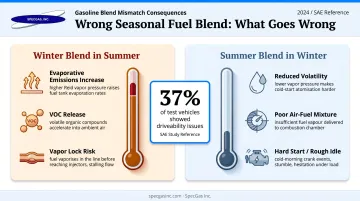
Excess evaporation from winter-formula fuel in summer heat increases volatile organic compound emissions (the precursors to ground-level ozone and smog). In severe cases with older fuel systems, vapor lock becomes a risk: fuel vaporizes inside delivery lines before reaching the combustion chamber, causing stalling, power loss, and restart difficulty.
For modern vehicles, the primary concern here is environmental — not mechanical.
Low-RVP Summer Blend in Winter
Reduced volatility in cold conditions means the air-fuel mixture may not form readily enough for reliable ignition. An SAE study (paper 892088) found that 37% of test vehicles showed significant driveability deterioration with low-RVP fuel. For most consumers, this scenario is unlikely — gas stations transition blends on a regional schedule timed to temperature patterns.
Debunking Three Common Misconceptions
"Summer blend damages your engine." It doesn't. Summer blend has lower cold-start compatibility, not a damaging chemical composition. The issue is ignition quality, not engine harm.
"Consumers need to check which blend they're buying." There's no way to check, and no reason to. Retail stations sell compliant seasonal blend by regulatory requirement — switching happens at the refinery and terminal level, long before fuel reaches a pump.
"The spring price increase is refinery price-gouging." The cost increase is real and structural. Removing butane and replacing it with more expensive low-RVP components genuinely costs more to produce. The pump price reflects formulation cost, not margin expansion.
Frequently Asked Questions
What is a gas blend?
A gas blend is an engineered mixture of hydrocarbons and additives formulated to meet specific performance, regulatory, and seasonal requirements. Properties like RVP, octane rating, and ethanol content are each calibrated to function reliably under defined conditions — not arbitrarily selected.
Are there different blends of gas?
Yes. Gasoline varies by season (summer vs. winter blend), by region (conventional vs. reformulated gasoline), by ethanol content (E10, E15, E85), and by octane grade. Each variation reflects performance needs, regulatory requirements, or vehicle compatibility.
Why is E85 so cheap today?
E85 looks cheaper per gallon because ethanol has lower per-gallon production costs. The catch: E85 contains about 27% less energy per gallon than gasoline, and the DOE's Alternative Fuels Data Center reports E85 runs $0.28 per gasoline-gallon-equivalent more than gasoline once adjusted for energy content — so the apparent savings typically disappear on a per-mile basis.
What is Reid Vapor Pressure, and why does it determine seasonal gasoline requirements?
RVP measures how readily a fuel evaporates at 100°F. The EPA uses it as the regulatory lever for seasonal gasoline formulation because controlling evaporation rate controls smog-forming emissions in summer while ensuring sufficient cold-start volatility in winter. One number — RVP — effectively encodes both environmental protection and engine reliability requirements into a single enforceable specification.
When do gas stations switch from summer to winter blend?
The federal summer mandate ends September 15, allowing winter blend retail sales from September 16. The full transition at the pump takes additional weeks as summer inventory clears through the supply chain, with northern states switching first and southern markets following as temperatures decline.