Introduction
Two terms appear on nearly every calibration gas certificate: "NIST traceable" and "ISO/IEC 17025 accredited." They sound similar — but choosing the wrong one can mean a failed audit, a rejected compliance report, or measurement data your clients won't accept.
For laboratories conducting emissions reporting, pharmaceutical batch releases, or international compliance testing, the certification on your calibration gas cylinder directly determines whether your measurement data holds up to scrutiny.
For most industrial applications — continuous emissions monitoring, process control, and research — NIST traceable gas standards meet accuracy and documentation requirements. When regulatory frameworks or international acceptance demand proof of laboratory competence, ISO/IEC 17025 accreditation adds an independent layer of assurance that satisfies even the most rigorous audits.
Key Takeaways
- NIST traceable confirms the reference standards used to produce your calibration gas are linked to NIST through an unbroken measurement chain—it validates the standard, not the laboratory
- ISO/IEC 17025 accredits the entire laboratory system, covering staff qualifications, validated methods, environmental controls, and documented measurement uncertainty
- Every ISO/IEC 17025 accredited lab is NIST traceable — but NIST traceability alone doesn't mean a lab holds accreditation
- For most industrial, environmental monitoring, and process control applications, NIST traceable standards are sufficient
- ISO/IEC 17025 becomes necessary when regulations, legal liability, or cross-border acceptance require documented proof of laboratory competence
NIST Traceable vs ISO/IEC 17025: Quick Comparison
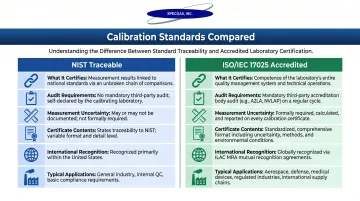
Both designations confirm measurement quality — but they operate at very different levels of rigor. The table below breaks down the key differences at a glance.
| Attribute | NIST Traceable | ISO/IEC 17025 Accredited |
|---|---|---|
| What It Certifies | Confirms measurement standard chain back to SI/NIST | Certifies entire laboratory system including methods, personnel, and equipment |
| Lab Audits Required | No mandatory third-party lab audit | Periodic independent audits by ILAC-MRA signatory bodies (A2LA, NVLAP) |
| Measurement Uncertainty | Documentation not always required | Must be calculated and reported on every certificate |
| Certificate Contents | Gas identities, certified values, reference standards, cylinder ID, expiration date | All NIST traceable elements plus formal uncertainty budgets and quality documentation |
| International Recognition | Primarily recognized in the US | Recognized in 122 economies through ILAC mutual recognition |
| Typical Applications | Routine industrial and environmental calibration gas applications | Regulated industries, international compliance, high-liability contexts |
What is NIST Traceable Calibration?
NIST traceable calibration means the reference standards used to produce or verify a measurement result connect to the International System of Units (SI) through an unbroken, documented chain of comparisons back to the National Institute of Standards and Technology. NIST serves as the U.S. national metrology institute responsible for maintaining primary measurement standards.
For calibration gas standards specifically, the traceability chain flows from NIST primary gas standards (or recognized equivalents) to manufacturer reference standards to working gas standards. Each step introduces measurement uncertainty that must be documented and carried forward in the traceability chain.
What NIST Traceability Does NOT Assess
NIST explicitly states it does not define, specify, assure, or certify metrological traceability of measurement results other than those it provides directly. Traceability confirms the pedigree of the measurement standard used, but does not evaluate:
- Laboratory personnel competence or training
- Calibration methods and procedures
- Environmental conditions during production
- Equipment maintenance practices
- Analytical procedures used to verify gas blends
These remain the responsibility of the gas supplier.
NIST Traceable Certificate Contents
A NIST traceable gas certificate typically contains:
- Gas component identities and certified concentration values
- Stated uncertainty of those values (though not always formally calculated)
- Reference standards cited for traceability
- Cylinder identification and expiration date
- Traceability statement linking to NIST
The absence of a formal uncertainty value on a NIST traceable certificate represents a meaningful gap compared to ISO/IEC 17025 accredited certificates, particularly when validating measurement systems against specific regulatory tolerances.
Use Cases of NIST Traceable Calibration Gas Standards
NIST traceable gas standards are the standard of choice for:
- Continuous emissions monitoring systems (CEMS), where documented concentration values tied to national standards meet regulatory requirements
- Ambient air quality monitoring requiring reliable reference gases for instrument calibration
- Process gas analyzers in industrial manufacturing and utilities
- OEM instrument calibration for equipment manufacturers
- R&D laboratory reference gas needs where the primary requirement is defensible concentration values
SpecGas Inc. supplies NIST traceable gas standards across all of these applications — including stable low-ppm and ppb reactive gas mixtures for emissions monitors, process analyzers, and research instruments — using blending procedures and cylinder treatment techniques refined since the company's founding in 2001.
What is ISO/IEC 17025 Accredited Calibration?
ISO/IEC 17025 is an international standard establishing requirements for the technical competence and quality management of testing and calibration laboratories. Accreditation means an independent, recognized accreditation body—such as A2LA, NVLAP, or any ILAC-MRA signatory organization—has audited the laboratory against these requirements and confirmed it meets them.
Full Scope of ISO/IEC 17025 Evaluation
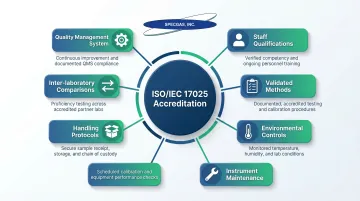
Unlike a simple traceability claim, ISO/IEC 17025 evaluates the entire laboratory system:
- Staff qualifications and ongoing training to ensure demonstrated competence
- Validated, documented calibration methods with formal written procedures
- Environmental controls covering temperature, humidity, and vibration monitoring
- Calibration and maintenance records for all analytical instruments
- Handling and storage protocols for test items
- Inter-laboratory comparisons to verify measurement accuracy
- A functioning quality management system with corrective action processes
Measurement Uncertainty as a Defining Requirement
ISO/IEC 17025:2017 Clause 7.6.2 mandates that laboratories evaluate measurement uncertainty for all calibrations. Clause 7.8.4.1 further requires every calibration certificate to report that uncertainty in the same unit as the measurand (the quantity being measured), or in relative terms.
In practice, this distinction is significant. A calibration gas certified at 50 ppm CO with ±2% uncertainty tells a very different story than one with ±0.5% uncertainty. ISO/IEC 17025 ensures that difference is always disclosed and defensible, so users can judge whether the certified value fits their specific application.
Ongoing Audit and Public Scope
Laboratories are audited periodically—typically every two years—and their accreditation scope (the specific tests and calibrations they are approved to perform) is published and publicly verifiable. This gives end users an independent means to confirm the lab's current accreditation status.
ISO/IEC 17025 in Gas Calibration Laboratory Context
For gas standard production, accreditation requires:
- Validated gravimetric blending procedures with documented methods
- Verified analytical instrumentation with calibration records
- Documented traceability for every reference cylinder
- Formal uncertainty budgets for certified concentration values
- Demonstrated competence through proficiency testing
Each requirement is audited on-site, not self-declared—which is what separates a verified accreditation from an unverified traceability claim.
Use Cases of ISO/IEC 17025 Accredited Calibration
ISO/IEC 17025 accreditation is explicitly required or strongly expected in:
- Pharmaceutical and biotech GMP validation, where supplier qualification audits demand documented evidence
- Regulated source testing using standard methods such as Methods 6C, 7E, and 10
- International trade documentation requiring mutually recognized calibration certificates
- Accredited laboratories that require their gas suppliers to meet the same standard
- Medical device and clinical diagnostic applications with strict quality system requirements
Key Differences That Matter for Precision Gas Applications
Traceability vs. Competence—The Core Distinction
NIST traceability answers one question: where does this measurement ultimately come from? ISO/IEC 17025 accreditation answers a different one: is this laboratory independently verified as competent to produce reliable results consistently?
These address different layers of confidence and one does not substitute for the other. Traceability establishes the measurement chain; accreditation verifies that the laboratory executing that chain is qualified to do so properly.
Measurement Uncertainty—The Practical Difference
ISO/IEC 17025 requires formal uncertainty budgets, so certificates from accredited labs allow users to calculate whether the certified gas value is fit for their specific measurement purpose. For example, confirming a calibration gas is within required tolerance for CEMS calibration (which requires ±2.0% analytical uncertainty) or a specific instrument specification becomes straightforward.
NIST traceable certificates without formal uncertainty values leave that question open, requiring users to independently assess measurement suitability.
That gap matters most when you're working against a specific regulatory threshold or instrument spec — which is exactly the scenario the next section covers.
Regulatory and Contractual Acceptance
Most US regulations accept NIST traceable calibration gas without requiring ISO/IEC 17025 accreditation. Here's how the major frameworks break down:
| Regulation | Key Requirement | ISO/IEC 17025 Mandated? |
|---|---|---|
| 40 CFR Part 75 (CEMS) | ±2.0% certified analytical uncertainty at 95% confidence | No |
| ISO 9001:2015 Clause 7.1.5.2 | Traceable measurement standards | Preferred, not required |
| 21 CFR Part 211 (FDA GMP) | Documented calibration schedules and limits | No |
Accreditation becomes a harder requirement in international trade contexts or contracts that explicitly specify it — situations where NIST traceability alone may not satisfy a customer's quality management system.
Cost, Speed, and Access Tradeoffs
ISO/IEC 17025 accredited gas calibrations typically cost more and carry longer lead times than NIST traceable standards from specialty gas suppliers. The practical question is whether your application actually requires the extra documentation layer.
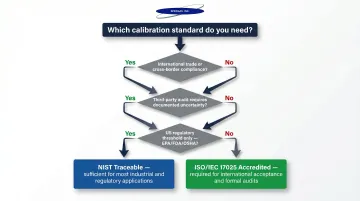
A useful decision point: if your process requires you to demonstrate uncertainty fitness-for-purpose to a third-party auditor or international customer, accreditation is worth the premium. If your obligation is meeting a specific US regulatory threshold — federal, FDA, or OSHA — NIST traceable certification with documented uncertainty values is generally sufficient.
Which Standard Does Your Lab Need?
Choose NIST Traceable If:
- Your application falls in a non-regulated or low-liability category
- Your internal quality manual accepts NIST traceable gas standards without specifying accreditation
- You are working in R&D, general process monitoring, or industrial calibration where the primary need is a reliable concentration value
- Cost-efficiency and fast turnaround are key priorities
Choose ISO/IEC 17025 If:
- Your laboratory is itself ISO/IEC 17025 accredited and requires gas suppliers to match that level
- You are subject to regulatory audits that specifically require accredited calibration certificates
- You need documented measurement uncertainty to validate your measurement system or support a quality audit
- Your calibration results will be used in international trade or cross-border compliance contexts (leveraging the ILAC MRA covering 122 economies)
Need NIST traceable calibration gas standards for your lab or monitoring operation? SpecGas Inc. produces precision low-ppm and ppb mixtures, reactive gas blends, and difficult-to-source specialty formulations using proprietary blending and cylinder treatment techniques developed over more than 20 years in the specialty gas industry. Call (215) 443-2600 or visit specgasinc.com to discuss your requirements.
Conclusion
Both NIST traceability and ISO/IEC 17025 accreditation serve legitimate roles in calibration. Choosing between them comes down to your regulatory environment, quality system requirements, and the risk profile of your application.
Here's a practical way to think about it:
- NIST traceable standards are the right fit for most calibration gas users — emissions monitoring, process control, semiconductor manufacturing, and research applications where accuracy and documentation are the primary requirements.
- ISO/IEC 17025 accreditation is the right fit when regulatory mandates, international acceptance, or full measurement uncertainty disclosure are required, providing independent third-party assurance that satisfies formal audit requirements.
Neither is universally superior. The standard that matches your compliance obligations and quality system is the one that matters.
Frequently Asked Questions
What is the difference between NIST traceable and ISO 17025?
NIST traceability confirms the reference standard used in calibration is linked to NIST through an unbroken measurement chain. ISO/IEC 17025 is a full accreditation of the laboratory's competence, methods, personnel, and quality system. An ISO/IEC 17025 certificate always includes traceability, but traceability alone does not imply accreditation.
What is the difference between NIST traceable and accredited?
"NIST traceable" refers to the documented chain connecting measurement standards back to NIST. "Accredited" means an independent body has formally verified the laboratory's entire operational competence—traceability is just one component of that broader verification.
What is a NIST traceable calibration?
A NIST traceable calibration is one in which the standards used to calibrate a device or verify a measurement—such as a calibration gas standard—are documented to connect to NIST through an unbroken chain of comparisons, confirming alignment with U.S. national measurement standards.
What is the difference between calibration and traceability?
Calibration is the process of comparing a measurement device against a reference to determine its accuracy. Traceability is the documented chain linking that reference back to a national standard like NIST — a property of the calibration process, not the same thing as calibration itself.
What does 17025 require for consideration of metrological traceability to the SI?
ISO/IEC 17025 requires an unbroken chain of calibrations performed by competent laboratories — typically through national metrology institutes like NIST — linking results to the SI. Documented traceability and accounted measurement uncertainty at each step are both mandatory.
What is the NIST policy on traceability?
NIST's policy states that metrological traceability does not require calibration directly at NIST. Rather, traceability is established through an unbroken chain of calibrations to recognized national or international measurement standards. NIST does not "certify" or endorse private laboratories as NIST traceable; instead, traceability is demonstrated through proper documentation of the measurement chain.