Introduction
Industrial gas manufacturing touches nearly every sector of modern commerce: from the steel mill and semiconductor fab to the environmental monitoring lab and hospital. Yet many buyers interact with these gases as if they're interchangeable commodities, selected by availability or price rather than fit for purpose.
They aren't interchangeable. Industrial gases differ fundamentally in how they're produced, what purity they achieve, and what they're designed to do.
Using a standard-grade bulk gas where a precision calibration standard is required doesn't just create inconvenience. It produces inaccurate measurements, regulatory exposure, and direct safety risk.
This article covers the three main categories of industrial gases — bulk commodity gases, specialty gases, and calibration standards — including how they're produced, where they're used, and what to evaluate when sourcing for a specific application.
Key Takeaways
- Industrial gases span three categories: atmospheric/bulk gases, specialty and calibration gases, and fuel/reactive gases — each produced and used differently.
- Atmospheric gases (nitrogen, oxygen, argon) are produced at massive scale via cryogenic air separation for high-volume industrial processes.
- Specialty and calibration gases are precision blends verified to exact concentrations — NIST-traceable, and essential where measurement accuracy and regulatory compliance are non-negotiable.
- Fuel and reactive gases (hydrogen, acetylene, CO₂) serve manufacturing, welding, and chemical synthesis — with significant safety considerations.
- Choosing the right gas means matching purity grade, volume, stability, and compliance requirements to the application.
What Is Industrial Gas Manufacturing?
Industrial gas manufacturing is the production of gaseous materials — pure elemental gases or precisely formulated mixtures — for commercial and industrial use. This is distinct from natural gas extraction or petrochemical refining, which deal with fossil fuel processing rather than manufactured gas products.
Three Primary Production Methods
| Method | Output | Typical End Use |
|---|---|---|
| Cryogenic air separation | Nitrogen, oxygen, argon | Bulk industrial processes |
| Steam methane reforming | Hydrogen | Energy, chemical synthesis |
| Precision gas blending | Specialty mixtures, calibration standards | Monitoring, research, calibration |
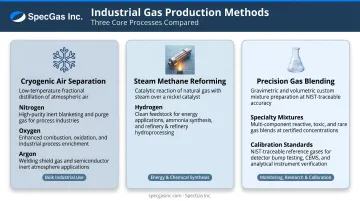
Each method suits different purity requirements and end-use demands — which is why production method and application must align from the start.
Production is only part of the picture. The industry also encompasses storage, transport, and delivery — whether in cylinders, bulk tankers, or via pipeline. A perfectly blended calibration gas stored in an untreated cylinder can degrade before it reaches the end user, which is why cylinder treatment and mixture stability are as critical as the blend itself.
Why Industrial Gases Matter in Modern Industry
Industrial gases are embedded in the core processes of modern manufacturing — not as inputs, but as conditions. They govern combustion efficiency, establish inert or reactive atmospheres, enable precise chemical reactions, and provide the reference standards that keep instruments and monitoring equipment accurate.
According to IMARC Group, the global industrial gas market was valued at $113.9 billion in 2025 and is projected to reach $163.4 billion by 2034, growing at a 3.97% CAGR. Manufacturing accounts for roughly 27% of end-use demand, with chemical processing and refining representing another 19.74%.
Where Gas Selection Errors Create Real Problems
The failure mode most buyers don't anticipate is treating gas selection as a commodity decision when it's actually a precision one:
- Calibration applications: An impure or unstable reference gas produces inaccurate readings and potential regulatory non-compliance. Under 40 CFR Part 58, gaseous pollutant concentration standards for ambient monitoring must meet ±2.0% analytical uncertainty at 95% confidence — a standard that requires verified, traceable calibration gases.
- Trace contamination from the wrong shielding gas or insufficient purity in semiconductor manufacturing can destroy an entire wafer batch.
- In medical and safety applications, incorrect gas composition carries direct human risk — there's no margin for error.
In each of these cases, gas selection determines whether the process works. The type, purity, and stability of the gas aren't supporting considerations — they're the foundation.
The Three Main Types of Industrial Gases
Industrial gases differ significantly in how they're made, what purity they achieve, how they're stored, and what they're designed to accomplish.
Atmospheric (Bulk) Gases
Atmospheric gases — primarily nitrogen (N₂), oxygen (O₂), and argon (Ar) — are extracted from air using cryogenic distillation in air separation units (ASUs). The process compresses and cools air to extremely low temperatures, then separates components based on differing boiling points: oxygen at -183°C, argon at -186°C, nitrogen at -196°C.
Air Products' cryogenic ASU facilities can supply anywhere from 50 to 7,000 tons per day, with some complexes exceeding 75,000 tons per day of combined oxygen and nitrogen output. These gases are also produced as liquids for bulk transport.
Common applications:
- Steel and metal production
- Glass manufacturing
- Water treatment
- Food packaging (nitrogen blanketing)
- Welding and cutting (oxygen, argon shielding)
Cost-effective at volume and available via bulk tanker or on-site generation, atmospheric gases are the workhorses of heavy industry. Standard-grade atmospheric gases typically don't meet the purity or compositional precision required for calibration, semiconductor, or research applications — that's where specialty gases come in.
Specialty and Calibration Gases
Specialty gases are high-purity gases or precisely formulated mixtures manufactured to exact compositional specifications — often at parts-per-million (ppm) or parts-per-billion (ppb) concentrations. Calibration gases are a subset used to set, verify, and certify the performance of analytical instruments and monitoring equipment.
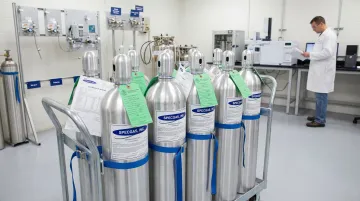
The defining characteristic is precision, not volume. Production uses gravimetric blending in specially treated cylinders, with verification through calibrated analytical instruments before release. Every batch must meet tight compositional tolerances, and certified mixtures must be NIST-traceable — meaning the concentration is verifiable against an unbroken chain of national measurement standards maintained by the National Institute of Standards and Technology.
Reactive mixtures add another layer of complexity. Gases like hydrogen sulfide, ammonia, chlorine, and nitric oxide can interact with cylinder walls, shifting concentration and invalidating the calibration standard before its expiration date. Preventing that requires internal cylinder treatment — a step that separates specialty blenders from bulk gas producers.
Best suited for:
- Environmental and stack emissions monitoring (EPA CEMS, ambient air quality)
- Occupational safety and gas detector calibration
- Laboratory research and analytical instrument verification
- Semiconductor and electronics manufacturing
- Medical and dermatological laser applications
- Any application where instrument accuracy or regulatory compliance depends on a verified reference gas
Mordor Intelligence values the specialty gas market at $15.65 billion in 2026, projected to reach $19.91 billion by 2031 at a 4.92% CAGR. Stricter emissions regulations, expanding air quality monitoring networks, and semiconductor fabrication requirements are all driving demand upward.
SpecGas Inc., a Pennsylvania-based specialty gas manufacturer, operates squarely in this category. Founded in 2001 by research chemist Alfred Boehm — whose specialty gas career began at Messer Griesheims Industries in Germany in 1976 — the company produces NIST-traceable calibration gas blends using gravimetric blending and a proprietary cylinder treatment process developed through decades of R&D. That treatment extends shelf life and maintains compositional accuracy for reactive mixtures including H₂S, HCl, NH₃, Cl₂, SO₂, NO, and formaldehyde.
The practical result: SpecGas produces stable mixtures down to 100 ppb for hydrogen cyanide and 300 ppb for phosphine. Many larger manufacturers won't touch those concentrations — achieving stability at ppb levels demands specialist blending expertise and cylinder preparation that most facilities haven't developed.
Fuel and Reactive Gases
Fuel and reactive gases — hydrogen (H₂), acetylene (C₂H₂), carbon dioxide (CO₂), propane — serve as energy sources, chemical feedstocks, or reactive agents. Production methods vary by gas:
- Hydrogen: Produced via steam methane reforming (SMR) at 700°C–1,000°C with a catalyst. According to the U.S. Department of Energy, natural gas reforming accounts for 95% of U.S. hydrogen produced in large central plants. Global demand reached nearly 100 Mt in 2024, per the IEA.
- Acetylene: Generated through the reaction of calcium carbide and water (wet hydrolysis).
- CO₂: Captured as a byproduct from fermentation, combustion, or chemical processes, then purified.
Common applications:
- Welding and metal cutting (acetylene and oxygen)
- Glass manufacturing and chemical synthesis
- Food and beverage (CO₂ for carbonation and preservation)
- Emerging clean energy applications (hydrogen as a low-carbon fuel)
- Power generation and industrial heating
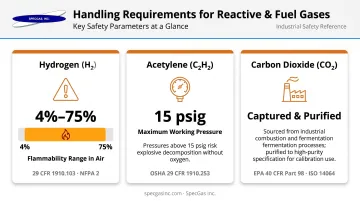
These gases carry significant handling requirements. Hydrogen has a flammability range of 4% to 75% in air — one of the widest of any common gas. Acetylene cannot be generated, piped, or used at pressures exceeding 15 psig under OSHA 29 CFR 1910.253 without specific approvals. Pressure vessel and transport compliance aren't optional; they're regulatory baselines.
Some reactive gases cross into specialty gas territory when formulated into precision mixtures. Hydrogen sulfide and carbon monoxide blends used in CEMS calibration are a clear example — at that point, production requirements shift from volume-based fuel gas handling to the precision blending protocols of specialty gas manufacturing.
How to Choose the Right Industrial Gas for Your Application
Start With What the Gas Must Do
Start with the function, not the gas name. Shielding a weld, calibrating a sensor, creating an inert atmosphere, and serving as a chemical feedstock each point to a different gas type with different production and purity requirements.
Match Purity Grade to the Application
- General manufacturing processes where moderate purity is acceptable → bulk atmospheric gases
- Measurement, regulatory compliance, or ultra-clean environments → certified specialty or calibration gases
- Regulatory traceability required → confirm NIST certification and ask for documentation before ordering
Ask Hard Questions About Reactive Gas Stability
Certain gas mixtures — particularly those containing reactive components at low concentrations — can shift in composition inside a cylinder over time. A peer-reviewed study found that VOC calibration gas standards below 1 nmol/mol showed instability in less than 10 months in untreated cylinders, while properly treated aluminum cylinders kept VOCs stable for 10–15 years.
Before sourcing reactive specialty gas mixtures, ask any supplier:
- What cylinder treatment process do you use for reactive components?
- What is the guaranteed stability period for this specific mixture?
- Do you perform shelf-life studies on reactive gas-cylinder combinations?
Match Delivery Model to Volume Needs
- High-volume operations → bulk delivery via tanker or on-site generation
- Research labs, calibration facilities, specialty applications → cylinder-based supply from a specialty manufacturer
- Tight timelines or non-standard blends → confirm whether the supplier accommodates rush or custom orders
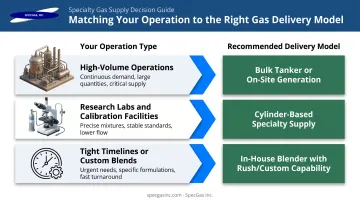
For labs and OEM manufacturers working against regulatory or project deadlines, SpecGas blends all mixtures in-house and offers rush service on custom orders — avoiding the lead time delays that occur when orders route through distribution intermediaries.
Sourcing from an in-house blender also simplifies the chain of custody, which becomes relevant when regulatory documentation is required.
Confirm Regulatory Alignment
Gases used for emissions monitoring, occupational safety equipment testing, or instrument certification may fall under:
- EPA 40 CFR Part 75 (CEMS, requiring EPA Protocol Gases)
- EPA 40 CFR Part 58 Appendix A (ambient monitoring, requiring ±2.0% analytical uncertainty)
- OSHA guidance on NIST-traceable test gases for direct-reading monitor calibration
Confirm that the supplier's production and certification processes align with the compliance framework governing your end use before placing an order.
Conclusion
Industrial gas manufacturing spans three distinct categories — atmospheric bulk gases, specialty and calibration gases, and fuel/reactive gases — each with different production methods, purity requirements, and application fits. Treating them as interchangeable leads to process errors, compliance failures, and unnecessary cost.
Understanding these distinctions is the foundation of smarter gas procurement. The right gas, produced to the right specification by a supplier with genuine technical depth, determines whether your instruments calibrate accurately, your data holds up to regulatory scrutiny, and your operations stay compliant. For calibration gas specifically — where concentration accuracy at the ppm or ppb level is non-negotiable — that means working with a blender who can certify traceability, guarantee reactive gas stability, and match the exact mixture to your analyzer's requirements. That's what SpecGas Inc. has built its reputation on since 2001.
Frequently Asked Questions
What is industrial gas manufacturing?
Industrial gas manufacturing is the production of gaseous materials — including nitrogen, oxygen, argon, hydrogen, and specialty blends — for commercial and industrial use. It encompasses the production process (air separation, reforming, precision blending) and the supply infrastructure (cylinders, bulk tanks, pipelines) needed to deliver gases safely to end users.
What are the three types of industrial gases?
The three main categories are atmospheric/bulk gases (nitrogen, oxygen, argon — produced from air via cryogenic distillation), specialty and calibration gases (precision blends used in monitoring, research, and instrument certification), and fuel/reactive gases (hydrogen, acetylene, CO₂ — used in manufacturing, welding, and chemical synthesis).
What is the difference between industrial gases and specialty gases?
Industrial gas is the broader category covering all manufactured gases for industrial use. Specialty gases are a subset defined by high purity and compositional precision — formulated to exact specifications, often NIST-traceable, and used where measurement accuracy or process cleanliness is critical rather than for general manufacturing volume.
What does NIST-traceable mean for a calibration gas?
NIST-traceable means the gas mixture's concentration has been verified against National Institute of Standards and Technology reference standards through a documented, unbroken calibration chain. This is required in regulated applications — including emissions monitoring and workplace safety testing — to confirm the reference gas is accurate and results are defensible.
Which industrial gases are used in semiconductor manufacturing?
Semiconductor manufacturing relies on nitrogen and argon (inert environments), helium (heat transfer), hydrogen (annealing and epitaxial deposition), and krypton/fluorine or argon/fluorine mixtures for excimer lasers used in photolithography. Purity requirements — often grade 6.0 (99.9999%) with sub-10 ppb impurity limits — are among the most stringent of any industrial sector.
How are reactive specialty gas mixtures kept stable in cylinders?
Reactive gases can degrade or shift in concentration if the cylinder interior is not properly treated before filling. Specialty gas manufacturers address this through internal cylinder passivation or proprietary coating processes that prevent reactive components from interacting with the cylinder wall, extending shelf life and maintaining compositional accuracy throughout the product's rated life.