Introduction
A single inert gas—neon—enables the production of virtually every modern semiconductor chip, yet most people outside the industry have never considered its industrial role. Without ultra-pure neon, argon-fluoride (ArF) excimer lasers cannot function, and without excimer lasers, the deep ultraviolet photolithography that patterns sub-10 nm transistors onto silicon wafers grinds to a halt.
When Russia invaded Ukraine in 2022, the semiconductor industry faced a stark reality: Ukraine supplied an estimated 50% of the world's neon and up to 90% of U.S. semiconductor-grade neon imports, and the sudden closure of key purifiers sent spot prices surging up to 10 times previous levels.
This guide covers everything procurement teams, engineers, and researchers need to know — from excimer laser science and purity standards to supply chain risks that can't be ignored.
Key Takeaways
- Neon comprises approximately 96% of the gas mixture in ArF excimer lasers that produce 193 nm deep ultraviolet light for semiconductor photolithography
- Without 99.999% (5N) purity neon, excimer laser efficiency drops — cutting chip yields at 7 nm nodes and below
- Neon is extracted as a by-product of cryogenic air separation, typically at oxygen plants co-located with steel mills
- Semiconductor lithography accounts for roughly 70% of global neon demand, making supply continuity mission-critical for chipmakers
- Neon also powers helium-neon lasers, LASIK surgery, flat-panel display manufacturing, and industrial marking
Why Neon Is Critical to Semiconductor Manufacturing
Neon's role in chip production isn't incidental — it's embedded in the physics of how modern circuits are printed. Here's why the industry cannot do without it.
DUV Photolithography Depends on 193 nm Light
Semiconductor photolithography—the process of "printing" nanoscale circuit patterns onto silicon wafers—relies on deep ultraviolet (DUV) light at 193 nm, a wavelength achievable only with ArF excimer lasers. This specific wavelength matters because shorter wavelengths enable finer resolution. 193 nm immersion lithography, combined with multiple patterning techniques (SADP and SAQP), is used to print critical features in sub-10 nm nodes — including 7 nm and 5 nm logic processes that power today's smartphones and data centers.
Neon Makes Up 96% of the ArF Gas Blend
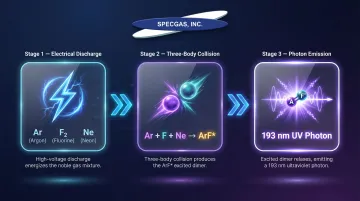
Neon's functional role is as the buffer gas in excimer lasers. Neon acts as the primary buffer gas, comprising approximately 96% of the gas content in ArF excimer light sources, with the remainder consisting of argon and fluorine. This isn't simply filler—neon facilitates the three-body collisions (Ar + F + Ne) that produce the excited (ArF)* dimer, which emits the crucial 193 nm photons when it dissociates back into ground-state argon and fluorine.
No other noble gas can substitute effectively. Helium reduces light source efficiency measurably when used as a buffer gas, and the energy transfer in a neon-based system is markedly more efficient than alternatives. Neon's atomic mass, ionization energy, and collision cross-section are optimally suited to the pressures and temperatures inside a semiconductor-grade laser cavity — properties no other noble gas replicates at these operating conditions.
Purity Standards Are Non-Negotiable
Semiconductor-grade neon must reach 99.999% (5N) purity or better. Even trace contaminants introduce impurities into the laser cavity, reduce photon output consistency, shorten gas blend lifespan, and ultimately lower chip yield. Excimer laser OEMs specify 5N purity minimums because any degradation in gas quality translates directly to manufacturing defects at the nanometer scale.
Continuous Consumption Drives Steady Demand
Neon is chemically inert under normal conditions, but the extreme electrical discharge inside laser cavities gradually introduces contaminants from cavity materials, degrading the gas blend over time. Modern high-volume manufacturing ArF lasers fire at repetition rates of 4,000 Hz to 6,000 Hz, accumulating billions of pulses. The gas mixture requires periodic "refreshes" or complete replacement roughly every two weeks per machine, consuming approximately 60,000 liters per year per system in HVM environments. This makes neon demand continuous, not one-time.
How Neon Functions Inside Excimer Lasers: The Science Explained
What Is an Excimer Laser?
An excimer laser is a pulsed, high-intensity ultraviolet gas laser where the lasing medium is a transient excited-state molecule (excimer) that exists only when energized and immediately dissociates upon emitting a photon. This natural dissociation into a lower-energy ground state inherently achieves population inversion without an external pumping scheme—a fundamental requirement for laser operation.
The ArF Excimer Reaction
The process begins when a high-voltage electrical discharge ionizes the Ar/F₂/Ne gas mixture inside the laser cavity. Neon facilitates three-body collisions that produce excited (ArF)* dimers. These dimers emit a 193 nm photon and dissociate back into ground-state argon and fluorine. Population inversion in excimer lasers is easily obtained because the ground state of the molecule is not stable—the ArF molecule exists only in its excited state, eliminating competition from ground-state atoms.
Why Neon Is the Optimal Collision Partner
Neon's physical properties make it the right collision partner for ArF* formation:
- Atomic mass sits in the range that maximizes energy transfer efficiency during three-body collisions
- Ionization energy is high enough that neon stays electrically stable under discharge conditions
- Collision cross-section aligns with the cavity pressures and temperatures where ArF* formation peaks
Substituting helium or argon in the buffer role reduces excimer formation rate and lowers overall laser efficiency. The three-body collision mechanism (Ar + F + Ne → ArF*) depends critically on neon's presence to achieve the photon output intensity and consistency required for sub-10 nm lithography.
From Laser Cavity to Silicon Wafer
The 193 nm UV photons bounce between laser cavity mirrors, building stimulated emission intensity, then direct through complex lens systems to expose photoresist on a silicon wafer. Diffraction-limited spot sizes enable sub-10 nm feature resolution.
Two techniques push resolution even further in production environments:
- Immersion lithography — water fills the gap between lens and wafer, shortening the effective wavelength
- Multiple patterning — repeated exposures define features smaller than a single pass allows
EUV (extreme ultraviolet) lithography at 13.5 nm is gaining ground at leading-edge nodes, but DUV ArF lasers continue to handle the majority of high-volume wafer production.
How Neon Gas Is Manufactured and Purified
Extraction from Atmospheric Air
Neon is not mined or synthesized—it is recovered exclusively as a trace by-product of cryogenic air separation (fractional distillation of liquefied air). Neon constitutes approximately 18.18 parts per million by volume in dry air, meaning enormous volumes of air must be processed to yield commercial quantities. During cryogenic distillation, neon concentrates in the nitrogen-rich fraction due to its low boiling point (-246°C).
Only the very largest Air Separation Units (ASUs)—those with oxygen output above roughly 1,000 tonnes per day—can economically extract rare gases like neon. Smaller ASUs lack the throughput to justify the capital investment in rare gas recovery equipment.
Multi-Stage Purification Process
| Purification Stage | Function | Outcome |
|---|---|---|
| Cryogenic Fractionation | Separates crude neon-helium mixture from nitrogen based on boiling points | Crude neon (~50% purity in helium-neon mixture) |
| Adsorption Columns | Remove oxygen, nitrogen, and other contaminants | Enriched neon (~90-95% purity) |
| Cryogenic Separation | Isolate neon from helium | High-purity neon (>99.9%) |
| Catalytic Oxidation | Convert hydrogen impurities to water | Ultra-high purity neon |
| Molecular Sieve Drying | Remove moisture, CO₂, and trace gases | Semiconductor-grade neon (99.999% or 5N) |
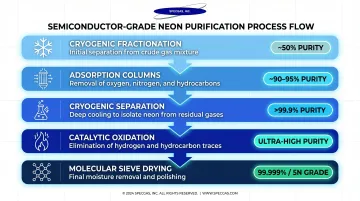
This multi-step process is energy-intensive and requires specialized infrastructure. The cost, technical complexity, and long lead times to add neon extraction to existing ASUs create structural supply rigidity.
Geographic Concentration and Structural Vulnerability
Large-scale ASUs are historically co-located with steel mills, which consume massive oxygen volumes. That co-location concentrated neon production in regions with major steel capacity—primarily Russia and Ukraine.
The former Soviet Union equipped steel mill ASUs with krypton, neon, and xenon purification capabilities, building a legacy infrastructure that dominated global rare gas extraction. When Russia invaded Ukraine in 2022, that concentration became a critical vulnerability—disrupting an estimated 50% of the world's neon supply overnight.
Several structural factors explain why this risk was so difficult to hedge:
- Neon extraction requires very large ASUs that take years and significant capital to build or retrofit
- Steel-producing regions naturally accumulate this infrastructure, limiting geographic diversification
- Long purification lead times mean supply cannot quickly shift to alternative sources
- Semiconductor fabs typically hold only weeks of neon inventory, leaving little buffer
Neon's Applications Beyond Chip Lithography
Helium-Neon (HeNe) Lasers
Helium-neon lasers use neon as the active lasing medium, producing visible red light at 632.8 nm. HeNe lasers are widely used in:
- Barcode scanners and point-of-sale systems
- Interferometry and metrology for precision measurement
- Alignment systems in manufacturing and construction
- Laboratory instrumentation
Excimer Laser Eye Surgery
ArF excimer lasers at 193 nm are used for LASIK and PRK refractive eye surgery to reshape the cornea without thermal damage. These medical excimer lasers use the same neon-based gas blends as semiconductor lithography systems, creating shared demand between healthcare and chip manufacturing.
Flat-Panel Display Manufacturing
Neon is used in excimer laser annealing processes that convert amorphous silicon into low-temperature polysilicon (LTPS) for OLED and LCD backplanes. As OLED panel production scales up globally, this demand is growing alongside semiconductor fab consumption.
Industrial Marking and Calibration
Neon is also used in:
- Industrial marking, cutting, and engraving systems
- Calibration gas blends for semiconductor process monitoring
- Emissions monitoring within fab environments
SpecGas produces NIST-traceable calibration gas mixtures containing neon for verifying analytical instruments used in process control, precision blends that help semiconductor fabs and research facilities maintain consistent quality standards.
Neon Supply Chain Challenges and What Procurement Teams Should Know
The 2022 Ukraine Supply Shock
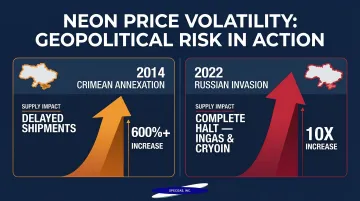
Prior to 2022, Ukraine supplied an estimated 50% of the world's neon gas and up to 90% of U.S. semiconductor-grade neon imports. The Russian invasion forced the closure of Ukraine's two leading suppliers, Ingas (Mariupol) and Cryoin (Odesa), triggering immediate supply disruption.
Price Volatility Comparison:
| Event | Supply Impact | Price Impact |
|---|---|---|
| 2014 Crimean Annexation | Delayed shipments, border crossing issues | Prices spiked over 600% |
| 2022 Russian Invasion | Complete halt at Ingas and Cryoin | Prices surged up to 10 times previous rates |
Why Supply Cannot Respond Quickly
Adding new neon extraction capacity to an existing ASU typically takes 1 to 3 years. Furthermore, qualification of a new semiconductor-grade gas source by fabs can take 3 to 18 months. Neon substitution in excimer lasers is not feasible without performance loss, so conservation and recycling are the primary near-term mitigation tools.
Emerging Mitigation Strategies
1. Neon Gas Recycling Systems
OEM-certified recycling systems capture spent laser gas from exhaust, recondition it, and reintroduce it into the laser gas blend:
- Gigaphoton hTGM achieves up to 85-92% gas recycling ratio while maintaining stable laser performance
- Cymer XLGR 100 allows reusing >90% of effluent gas, processing it back to ultra-high purity specifications
These systems can reduce per-fab neon consumption from 60,000 liters per year to under 10,000 liters, lowering exposure to supply shocks.
2. Geographic Diversification
China increased neon production capacity by 20% between 2021 and 2023, while the U.S. increased capacity by 10%. Major global industrial gas companies—Air Liquide (France), Linde (UK/US), Air Products (US), and Messer (Germany)—have expanded purification infrastructure alongside Chinese producers.
3. Government-Backed Initiatives
The U.S. CHIPS and Science Act of 2022 supports domestic semiconductor production and resilient supply chains, encompassing critical materials like neon. This has spurred investment in domestic rare gas production and strategic stockpiling.
Practical Procurement Guidance
Semiconductor manufacturers and labs should prioritize suppliers who can guarantee:
- Purity certification: NIST-traceable standards with documented batch-to-batch consistency
- Fast lead times: Domestic production capabilities that minimize geopolitical exposure
- Reliable supply: Established relationships with ASU operators and major purification networks
- Technical support: Custom formulations for excimer laser, HeNe, and calibration applications
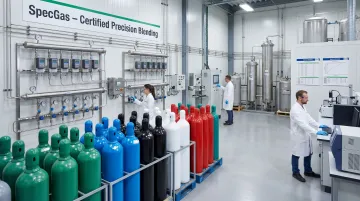
SpecGas produces high-purity, NIST-traceable specialty gas blends (including neon-containing mixtures) with in-house blending and proprietary cylinder treatment processes. For semiconductor manufacturers and research labs, this means domestic sourcing with faster turnaround than commodity distributors and the ability to fill difficult-to-source compositions that larger suppliers typically deprioritize.
Frequently Asked Questions
How is neon gas manufactured?
Neon is recovered as a trace by-product of cryogenic air separation at large industrial oxygen plants, where it concentrates in the nitrogen-rich fraction. It is then purified through adsorption, cryogenic separation, and catalytic steps to reach semiconductor-grade 99.999% purity.
Is neon gas used in semiconductors?
Yes. Neon serves as the primary buffer gas (roughly 96% of the mixture) in argon-fluoride excimer lasers used for deep ultraviolet photolithography — the process that prints nanoscale circuit patterns onto silicon wafers at 193 nm. Without high-purity neon, consistent laser output at that wavelength isn't achievable.
What chemicals are used in chip manufacturing?
Chip manufacturing relies on a range of specialty gases: neon (excimer laser buffer gas), argon, fluorine, krypton, xenon, hydrogen, nitrogen, silane, and various photoresist chemicals. Ultra-high-purity noble gases are especially critical for lithography and etch processes at sub-10 nm nodes.
Who is the largest producer of neon?
Before 2022, Ukraine — through companies Ingas and Cryoin — supplied roughly 50% of global purified semiconductor-grade neon. Since the 2022 conflict, production has redistributed toward China, the United States, South Korea, and European producers including Air Liquide and Linde.
Is neon gas used in lasers?
Neon appears in two major laser types. In ArF excimer lasers, it acts as the dominant buffer gas enabling 193 nm UV output for semiconductor lithography. In helium-neon lasers, neon is the active lasing medium — producing 632.8 nm red light used in alignment, interferometry, and scanning applications. Suppliers like SpecGas Inc. blend both excimer and helium-neon laser gas mixtures to the purity specifications each application requires.