Between 2011 and 2018, 1,030 workers died from occupational injuries involving confined spaces. Of these, 126 cases were caused by inhalation of harmful substances, including 38 involving hydrogen sulfide and 23 involving carbon monoxide. Many of these incidents involved detection failures or uncalibrated equipment that failed to alert personnel when hazardous conditions developed.
Gas calibration is often treated as routine maintenance or a compliance obligation. In practice, it is one of the most consequential safety controls an industrial operation can maintain. This article explains the specific, measurable ways consistent gas calibration improves process safety outcomes—not in theory, but in the day-to-day reliability of the systems industrial teams depend on.
Key Takeaways
- Gas calibration verifies and adjusts instrument accuracy against a known reference concentration—ensuring readings reflect real conditions
- Sensors drift 2-5% monthly due to environmental exposure, temperature changes, and contamination, producing false readings that mask serious hazards
- Proper calibration delivers three safety outcomes: accurate hazard detection, regulatory compliance with liability protection, and sustained process reliability
- Calibration is only as accurate as the reference gas used, which is why NIST-traceable, properly blended calibration gases are non-negotiable
- Skipping calibration allows sensor errors to accumulate undetected until equipment fails or an incident occurs
What Is Gas Calibration?
Gas calibration is the process of exposing a gas detector or analytical instrument to a known concentration of reference gas, then adjusting the instrument's output to match that value. OSHA defines a full calibration as one that confirms the device will respond accurately when exposed to real hazardous atmospheres — making the quality of the calibration gas itself a direct safety variable.
This process applies across industrial environments:
- Portable and fixed gas detectors in confined spaces and processing facilities
- Continuous emissions monitoring systems (CEMS) for regulatory compliance
- Process control analyzers measuring combustion efficiency, feedstock composition, or product quality
- Environmental monitoring instrumentation tracking air quality and leak detection
Across all these applications, accurate readings depend on one upstream requirement: calibration gases with verified, stable concentrations. An instrument is only as reliable as the reference gas used to set it.
Key Advantages of Gas Calibration for Industrial Process Safety
Gas calibration connects directly to outcomes safety managers can measure: alarm reliability, regulatory standing, and the cost gap between planned maintenance and unplanned failure.
Advantage 1: Accurate Hazard Detection When It Counts
The primary safety function of gas detectors in industrial settings is to alert personnel to dangerous concentrations of toxic, combustible, or oxygen-deficient atmospheres. Calibration ensures those alerts fire at the correct threshold—not too late, and not so frequently they cause alarm fatigue.
Industrial gas sensors degrade predictably over time. Electrochemical toxic gas sensors drift 2-5% per month under industrial conditions, while catalytic bead combustible gas sensors drift up to 10% LEL monthly. This degradation stems from:
- Humidity and temperature cycling
- Exposure to contaminant gases
- Electrochemical cell aging
- Catalyst poisoning in combustible sensors
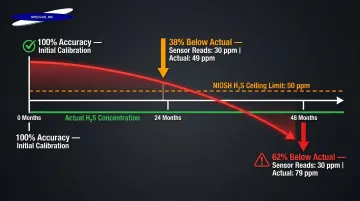
A detector calibrated once and ignored for 24 months can exhibit 38% lower readings than actual concentrations. After 48 months, readings may be 62% below reality—meaning an instrument shows 30 ppm when actual H₂S concentration is 79 ppm, well above the NIOSH 10-minute ceiling of 10 ppm.
Accurate calibration creates a decision chain that prevents incidents: alarm activation → personnel evacuation → process shutdown → incident prevention. The cost of a missed alarm in a confined space or combustible gas environment is measured in lives and facility damage, not just fines.
Calibration gas quality is foundational to that accuracy. Calibrating against a degraded or inaccurate reference gas produces an instrument that appears compliant but reads incorrectly in the field. NIST-traceable calibration gases with verified concentration at time of use — not just at manufacture — close this gap. SpecGas Inc.'s proprietary cylinder treatment process and Stability Guarantee address exactly this problem for reactive gas mixtures: H₂S, Cl₂, HCN, and similar compounds that degrade in standard cylinders before the gas is ever used.
KPIs impacted:
- Alarm response accuracy rate
- False negative rate
- Incident rate
- Near-miss frequency
When this matters most: Confined space entries, processing environments with toxic gas risk (H₂S, CO, NH₃, Cl₂), and facilities where personnel rely on fixed detection systems without continuous visual monitoring.
Advantage 2: Regulatory Compliance and Reduced Liability Exposure
Industrial operations face specific calibration requirements from OSHA, MSHA, NFPA, and other regulatory bodies. In most regulated environments, calibration is a documented legal obligation, not a discretionary best practice.
Regulatory requirements:
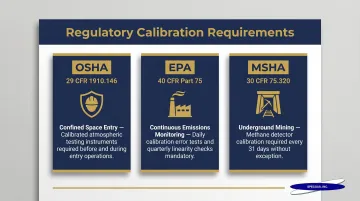
- OSHA 29 CFR 1910.146: Requires calibrated direct-reading instruments before confined space entry
- 40 CFR Part 75: Mandates daily calibration error tests and quarterly linearity checks for CEMS. Failure to perform required daily calibration invalidates CEMS data
- MSHA 30 CFR 75.320: Requires methane detector calibration with known methane-air mixture at least every 31 days
Regular, documented calibration creates an audit trail. Every calibration event, result, and gas certificate on file demonstrates instruments functioned within specification at the time of use. This is the difference between showing compliance and facing regulatory penalties, permit violations, or liability during incident investigations.
The financial stakes:
Under Part 75, CEMS calibration failures trigger mandatory missing data substitution procedures and potential excess emissions reporting obligations with associated fines. Regulatory agencies require certified reference gases—NIST-traceable standards with certified uncertainty not exceeding ±2.0% of tag value. Using substandard calibration gases can invalidate compliance data even when calibration was performed.
KPIs impacted:
- Regulatory audit pass rate
- Number of deviation reports filed
- CEMS data availability rate
- Number of reportable emission events
When this matters most: Facilities subject to Title V permits, continuous emissions reporting obligations, or operating in industries with heightened regulatory scrutiny (power generation, petrochemical refining, chemical manufacturing).
Advantage 3: Process Reliability and Reduced Cost of Failure
Regulatory compliance sets the floor — process reliability is where calibration pays dividends beyond avoiding fines. In process control applications, gas measurement accuracy drives decisions: combustion ratios, feedstock control, leak detection, and permit thresholds all depend on instruments reading correctly. Calibration keeps those instruments aligned with real-world conditions, catching measurement error before it causes process deviations.
A well-designed calibration program identifies sensor drift before it causes failure, allowing planned maintenance rather than emergency response. The cost difference is stark:
- Scheduled calibration: Planned downtime, gas cost, technician time
- Unplanned process shutdown: Emergency response, lost production, potential equipment damage
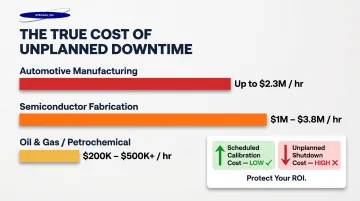
The average cost of unplanned industrial downtime varies by sector:
- Automotive manufacturing: Up to $2.3 million per hour
- Semiconductor fabrication: $1 million to $3.8 million per hour
- Oil & gas/petrochemical: $200,000 to $500,000+ per hour
Consistent calibration also extends sensor life by catching degradation early, reducing replacement frequency. Predictive maintenance and routine condition monitoring can reduce false-positive alerts by more than 90%, increasing operational efficiency.
KPIs impacted:
- Unplanned downtime frequency
- Mean time between equipment failures
- Sensor replacement intervals
- Cost per calibration event vs. cost per incident
When this matters most: High-throughput or continuous-process environments where single measurement failures cascade across connected systems.
What Happens When Gas Calibration Is Neglected
Skipping or inconsistently performing gas calibration creates specific operational consequences. Sensors operating outside their specified accuracy ranges produce readings that look valid but aren't — alarms miss correct trigger thresholds, emissions data becomes untrustworthy, and process control decisions get made on flawed inputs.
The Compounding Risk Over Time
These immediate accuracy failures compound the longer calibration is deferred. A detector calibrated once then ignored for 18 months may appear functional during a routine check but could be reading 20–30% below actual gas concentrations. The gap between instrument output and reality widens steadily — and so does the gap between perceived safety and actual risk.
Regulatory and Financial Consequences
The downstream consequences extend well beyond the instrument itself:
- Missed calibration windows trigger automatic data substitution requirements under CEMS regulations
- Compliance violations can lead to increased regulatory scrutiny or permit revocation
- Absent calibration records in post-incident investigations are treated as evidence of systemic negligence, increasing liability exposure
The paper trail matters as much as the readings themselves.
How to Get the Most Value from Gas Calibration
Calibration produces its full safety and operational benefit only when performed consistently, documented thoroughly, and acted upon when results fall outside acceptable ranges. Filed away without review, a calibration record is nearly useless — the value comes from integrating results into an active safety management cycle.
The Calibration Gas Supply Chain as a Limiting Factor
Calibration is only as reliable as the reference gas used. Three requirements are non-negotiable:
- NIST traceability: documented chain back to national standards, not just a certificate of analysis
- Blend stability: shelf-stable mixtures, especially for reactive gases that degrade over time
- Correct concentration range: matched specifically to the target instrument's detection range
Reactive gas mixture degradation is a common failure point that undermines otherwise sound calibration programs. SpecGas Inc.'s proprietary cylinder treatment process and Stability Guarantee address this directly — ensuring the gas in the cylinder reflects its certified concentration when you actually use it, not just at the point of manufacture. Formaldehyde, nitric oxide, hydrogen sulfide, and other reactive species are especially prone to concentration drift in untreated cylinders.
Practical Steps to Maximize Program Effectiveness
Consistent execution separates calibration programs that prevent incidents from those that only document them:
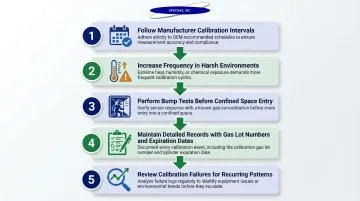
- Follow manufacturer-recommended calibration intervals as a baseline minimum
- Increase frequency in harsh or high-exposure environments where sensor drift accelerates
- Perform bump tests before each confined space entry or safety-critical job
- Maintain records that include gas lot numbers, expiration dates, and pass/fail outcomes
- Review calibration failures for patterns — recurring failures often signal sensor wear or environmental factors requiring correction
Conclusion
Gas calibration is an active, measurable safety control — not a paperwork exercise. Accurate detection, regulatory standing, and process reliability all depend on whether monitoring systems respond correctly when exposure occurs. These outcomes are interconnected, and they compound over time when calibration is performed on a consistent schedule.
The value of any calibration program ultimately comes down to two things: how consistently it is executed and how reliable the calibration gases are. Programs built around NIST-traceable, stable calibration gas mixtures — like those produced by SpecGas Inc. — consistently deliver:
- Fewer false readings and missed detections
- Uninterrupted operations with defensible audit trails
- Lower incident costs compared to reactive, post-failure responses
That combination is where the real return on calibration investment sits.
Frequently Asked Questions
How often should gas detectors be calibrated in industrial settings?
Manufacturer guidelines typically recommend full calibration every 6 months minimum, with bump tests before each use or confined space entry. Harsh environments or high-exposure conditions warrant more frequent intervals—monthly calibration is common in petrochemical and wastewater facilities.
What is the difference between a bump test and a full calibration?
A bump test is a quick functional check confirming the sensor responds to gas exposure and alarms activate. A full calibration adjusts the instrument's output to match a known reference concentration. Bump tests verify functionality but do not replace full calibration.
What makes a calibration gas "NIST traceable"?
NIST traceability means the gas mixture's certified concentration has been verified against national measurement standards maintained by NIST. This documented chain of accuracy is what regulators and auditors require for compliance.
What happens if I use expired or degraded calibration gas?
Expired or degraded calibration gas (particularly reactive mixtures that have lost concentration stability) calibrates instruments to an incorrect reference value. The result is readings that appear valid but are systematically wrong, creating false confidence in unsafe conditions.
Which types of gases are most commonly used for industrial calibration?
Common calibration gases by application include CO and H₂S for toxic gas detection in refineries and wastewater; methane/propane for combustible gas monitoring; O₂ for confined space and enriched-atmosphere environments; and NO₂, SO₂, and CO₂ for emissions monitoring systems.
Can a single calibration gas cylinder be used to calibrate multiple analyzers?
Yes, blended multi-component calibration gas cylinders are commonly used in CEMS and multi-gas monitoring applications to streamline calibration, provided each component concentration falls within the required range for each analyzer.