Introduction
Global demand for ultra high purity anhydrous hydrogen chloride (HCl) gas is accelerating in 2026, driven by semiconductor fab expansions, electronics manufacturing growth, and pharmaceutical production requirements. For procurement teams sourcing specialty gases, supply chain tightness, lead time volatility, and regulatory compliance requirements are forcing a fundamental rethink of how companies secure reliable HCl supply.
Ultra high purity anhydrous HCl carries specific requirements that set it apart from industrial-grade alternatives:
- Purity: 99.999% or higher (5N grade)
- Moisture content: ≤1 ppm H₂O (anhydrous, not aqueous)
- Metal contaminant tolerance: Near-zero — trace impurities cause surface oxidation, device defects, and process failures
Industrial-grade HCl cannot meet these thresholds. In semiconductor wafer cleaning and epitaxial deposition, even minor contamination translates directly to yield loss.
This analysis covers the market's growth trajectory, the industries driving demand, regional investment patterns, and the supply risks procurement teams need to track heading into 2026.
Key Takeaways: Ultra High Purity Anhydrous HCl Gas Market — 2026 Snapshot
- The global UHP anhydrous HCl gas market ranges from USD 3.6–6.3 billion depending on methodology, growing at 6.5–10% CAGR through the early 2030s.
- Semiconductor fabrication dominates demand, with fab construction in the U.S., India, and Europe creating sustained procurement pressure.
- Asia Pacific holds the largest regional share; North America is the fastest-growing zone due to the CHIPS and Science Act.
- Supply chain risks — including feedstock price volatility, energy-intensive production, and strict purity compliance — remain critical restraints for procurement planning.
Key Demand Drivers Fueling UHP HCl Market Growth
Semiconductor Boom: The #1 Catalyst
UHP anhydrous HCl is essential in silicon wafer etching, epitaxial deposition, and chip surface cleaning. Global semiconductor fab announcements are translating directly into escalating gas procurement volumes.
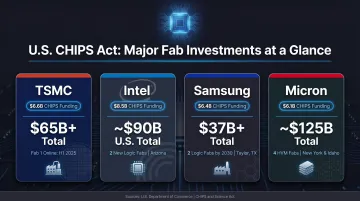
Verified U.S. CHIPS Act Investments:
- TSMC (Phoenix, AZ): $6.6 billion CHIPS funding; total investment exceeds $65 billion; Fab 1 operational by H1 2025, Fab 2 by 2028
- Intel (Chandler, AZ): $3.94 billion Arizona portion; ~$90 billion U.S. total for 2 new logic fabs and 1 modernization
- Samsung (Taylor, TX): $4.745 billion CHIPS funding; >$37 billion investment; 2 logic fabs operational by 2030
- Micron (Clay, NY & Boise, ID): $6.165 billion funding; ~$125 billion multi-decade investment for 4 HVM fabs
India's First Major Fab:
The Tata Electronics-Powerchip (PSMC) joint venture in Dholera, Gujarat, was officially notified as a Special Economic Zone in April 2026. The INR 910 billion (~USD 11 billion) facility targets 50,000 wafers per month, opening a new regional demand base for UHP process gases including HCl.
Integrated Circuit Demand Growth
Rising IC consumption across automotive electronics, AI hardware, 5G infrastructure, and consumer devices is pushing fabs to increase throughput. The World Semiconductor Trade Statistics projects the global semiconductor market to reach USD 975 billion in 2026. At that scale, even incremental per-wafer gas consumption translates into substantial UHP HCl volume requirements across every production stage.
Electronics & Display Manufacturing Expansion
Beyond semiconductors, UHP HCl is used in:
- Flat panel displays: Indium Gallium Zinc Oxide (IGZO) thin-film transistor dry etching using HCl/Ar mixtures
- LED fabrication: Hydride Vapor Phase Epitaxy (HVPE) uses anhydrous HCl reacting with liquid gallium to form GaCl for GaN deposition
- Solar panel production: Doping and surface treatment processes in photovoltaic manufacturing
Pharmaceutical & Laboratory Demand
Pharmaceutical and laboratory applications demand documented purity and traceability. Key uses include:
- API manufacturing: Forming hydrochloride salts of basic active pharmaceutical ingredients to improve drug solubility and bioavailability
- Chemical synthesis: pH-controlling reagent in specialty chemical production
- Analytical laboratories: NIST-traceable gas standards required for instrument calibration and regulatory compliance
Pharmaceutical operations require documented purity certificates and lot traceability under FDA and ICH Q7 Good Manufacturing Practice guidelines.
Chlor-Alkali Production Investments
Petrochemical companies in Asia are expanding chlor-alkali capacity, increasing anhydrous HCl supply-side availability:
- Thailand: AGC Vinythai commissioned a 220,000 tons/year caustic soda expansion in February 2026
- Indonesia: Chandra Asri's CA-EDC plant (400,000 tons/year caustic soda, 500,000 tons/year EDC) reached 50% completion in February 2026, targeting Q1 2027 startup
- China: Projected to add ~5.5 million dry metric tonnes of chlor-alkali capacity between 2025–2026
As chlorine supply grows across these regions, HCl feedstock costs face downward pressure. For UHP HCl buyers, that means more sourcing options — but also greater variability in purity specifications that suppliers must manage.
Primary Applications: Where Ultra High Purity HCl Is Used
Semiconductor Manufacturing (Core Application)
UHP anhydrous HCl is used in:
- Wafer cleaning: Removing contaminants and native oxides before epitaxial growth
- Silicon epitaxy: Trichlorosilane (SiHCl₃) process where HCl reacts with silicon to form volatile chlorides for purification
- Dry etching: Removing unmasked silicon and metal layers during device fabrication
- CVD reactor chamber cleaning: Preventing particle contamination between production runs
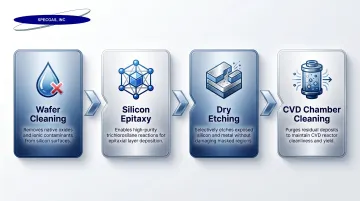
Even trace moisture (H₂O >1 ppm) causes oxide regrowth at the epitaxial/substrate interface, leading to hazing, structural defects, and device failures. Sub-ppb impurity levels for oxygen, metals, and organics are therefore required to avoid defect formation in advanced semiconductor nodes. There is no workable threshold — any contamination introduces yield risk.
Electronics & Display Manufacturing
UHP HCl serves two distinct roles across display and lighting applications:
- Flat panel displays: Used in thin-film deposition and etching for LCD, OLED, and advanced display panels — anhydrous specification is critical, as moisture causes surface oxidation and process failures at nanometer scale
- LED production: HVPE processes rely on anhydrous HCl reacting with liquid gallium to form GaCl vapor for GaN epitaxial layer deposition
Pharmaceutical & Chemical Synthesis
Pharmaceutical and chemical synthesis applications demand both purity and rigorous documentation:
- API salt formation: Anhydrous HCl converts basic APIs into hydrochloride salts, improving stability and bioavailability; pharmaceutical-grade supply requires Certificate of Analysis (CoA), lot traceability, and FDA 21 CFR Part 11 compliance
- Specialty chemical production: HCl serves as a reagent for chlorinated intermediates and pH control in synthesis reactions
Research & Analytical Laboratories
Universities, independent labs, and R&D facilities use certified UHP HCl gas mixtures as:
- Calibration standards for gas chromatography, FTIR analyzers, and moisture analyzers
- Process gases for experimental reactors and material synthesis
NIST-traceable gas standards are required for instrument calibration and regulatory compliance, especially for regulatory submissions and published research.
Regional Market Dynamics in 2026
Asia Pacific — Dominant Market Position
Asia Pacific holds the largest share of the global HCl market, accounting for over 52% of consumption. China, Japan, South Korea, and Taiwan represent the world's largest semiconductor and electronics manufacturing hubs.
India's accelerating role: Following government approvals of the Tata-PSMC fab and other semiconductor projects, India is emerging as a major demand corridor. The Dholera fab's 50,000 wafers-per-month capacity will create sustained UHP gas procurement requirements through the late 2020s.
North America — Fastest-Growing Investment Zone
The CHIPS and Science Act's funding for domestic semiconductor manufacturing is creating a surge in UHP gas procurement across the U.S.
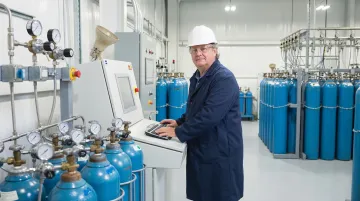
Domestic supply expansion: In May 2024, New York Governor Hochul announced a $50 million investment by Niacet Specialty Chemicals to expand its Niagara Falls facility. Niacet produces 5N (99.999%) ultra-high purity anhydrous HCl specifically for the semiconductor industry, providing a critical domestic supply node. For U.S. fabs sourcing UHP HCl, this translates to shorter lead times and reduced cross-border logistics risk.
Europe — Regulatory-Driven Growth
The European Chips Act entered force in September 2023, catalyzing €69 billion in public and private investments by October 2025. The European Semiconductor Manufacturing Company (ESMC)—a joint venture of TSMC, Bosch, Infineon, and NXP—broke ground in Dresden, Germany in August 2024. The €10+ billion project targets 40,000 300mm wafers per month by 2027.
Regulatory emphasis: Europe's specialty gas regulations are among the most demanding globally. Buyers sourcing UHP HCl for European fabs must verify:
- REACH registration status for anhydrous HCl
- Supplier-provided Safety Data Sheets meeting EU GHS standards
- Chain-of-custody documentation confirming purity certification
Gaps in any of these areas can delay facility commissioning or trigger regulatory penalties.
Middle East & Africa — Emerging Refinery-Driven Supply
Growth in petrochemical and refinery projects is increasing anhydrous HCl production capacity in the region — HCl is a by-product of chlorination and hydrocarbon cracking processes. The added output supports global supply chain diversification, though purity certification standards and regulatory frameworks lag behind established markets. Procurement teams relying on MEA sources should conduct independent purity verification before qualifying suppliers.
Market Challenges and Restraints
Raw Material Price Volatility
Anhydrous HCl production is energy-intensive and tied to chlorine feedstock pricing. Chlorine production via NaCl electrolysis consumes approximately 3.3 MWh of energy per ton, making HCl pricing highly sensitive to regional electricity costs and natural gas prices.
Price swings in chlorine, natural gas, and electricity affect production economics and can cause supply tightness or pricing instability. Procurement teams should monitor energy market trends and build supplier redundancy.
Regulatory Compliance Complexity
Handling, transporting, and storing UHP anhydrous HCl is subject to stringent safety regulations:
| Agency/Body | Regulation | Classification/Limit |
|---|---|---|
| U.S. DOT/PHMSA | 49 CFR 172.101 | UN1050; Class 2.3; Inhalation Hazard Zone C |
| OSHA/NIOSH | Exposure Limits | Ceiling: 5 ppm (7 mg/m³) |
| Federal CEMS Regulations | Performance Spec 18 (PS-18) | Mandates NIST-traceable calibration for HCl CEMS |
| EU ECHA | REACH/CLP | Registered substance; strict handling/classification |
Maintaining compliance documentation, gas certificates of analysis, and traceability records adds operational complexity and cost for both suppliers and end users.
Maintaining Purity Consistency at Scale
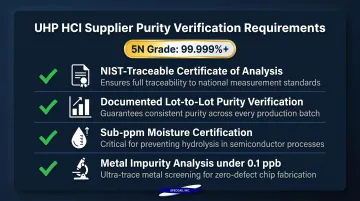
Achieving and verifying 99.999%+ purity across production batches is technically demanding. Even trace moisture, oxygen, or metal contaminants can render a batch unsuitable for semiconductor applications. That's why analytical infrastructure is as important as production capability. Leading suppliers use gas chromatography, mass spectrometry, and moisture analyzers to verify each batch. Buyers should confirm suppliers provide:
- NIST-traceable certificates of analysis
- Documented lot-to-lot purity verification
- Sub-ppm moisture certification
- Metal impurity analysis (typically <0.1 ppb for critical metals)
What This Means for UHP HCl Gas Buyers in 2026
Prioritize Supply Security & Lead Time Reliability
With semiconductor fab expansions creating sustained demand pressure, procurement teams should evaluate suppliers not just on price but on:
- Lead time consistency and available inventory
- Ability to fulfill rush orders during production ramp-ups
- Geographic proximity to reduce shipping delays
Smaller specialty gas suppliers with dedicated production capacity can outperform large distributors on responsiveness and order flexibility. Smaller specialty gas suppliers with dedicated in-house production—such as SpecGas Inc., which blends all mixtures on-site and uses proprietary cylinder treatment processes for reactive gas stability—can turn orders around faster than distributors relying on third-party blenders.
Demand Documented Purity & NIST Traceability
In semiconductor, pharmaceutical, and laboratory applications, gas certificates of analysis and NIST-traceable standards are required for:
- Process validation and equipment qualification
- Regulatory audits (FDA, REACH, and other applicable authorities)
- Instrument calibration with unbroken analytical chains
Buyers should confirm their supplier provides documented lot traceability and can deliver batch-specific CoAs showing impurity levels at the ppb level.
Plan for Price & Availability Fluctuations
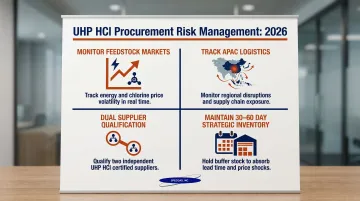
Qualifying a supplier on purity and traceability is only half the equation — procurement teams also need a strategy for cost and availability volatility. Specifically, teams should:
- Track chlorine market trends and regional energy costs to anticipate feedstock price shifts
- Monitor Asia-Pacific logistics developments, where geopolitical risks can disrupt supply chains quickly
- Maintain relationships with at least two qualified suppliers to avoid single-source exposure
- Hold 30-60 days of strategic inventory for critical production processes to absorb short-term disruptions
Domestic U.S. capacity expansions (such as Niacet's Niagara Falls facility) provide opportunities to reduce dependence on imported HCl and shorten supply chains.
Frequently Asked Questions
What is ultra high purity anhydrous hydrogen chloride gas?
Ultra high purity anhydrous hydrogen chloride is a moisture-free HCl gas refined to 99.999% or higher purity, with moisture ≤1 ppm and oxygen ≤0.5 ppm. Unlike industrial-grade HCl, it contains no trace contaminants that would cause defects in semiconductor wafer etching, epitaxial deposition, or precision manufacturing — where even ppb-level impurities are unacceptable.
What is ultra high purity anhydrous HCl gas used for?
Primary applications include semiconductor wafer etching and cleaning, silicon epitaxy (trichlorosilane process), electronics manufacturing (flat panel displays, LEDs), pharmaceutical API synthesis (forming hydrochloride salts), analytical laboratory calibration standards, and specialty chemical production. Each application requires documented purity and NIST traceability.
Why does the anhydrous (water-free) specification matter for semiconductor applications?
Even trace moisture (>1 ppm H₂O) causes surface oxidation and process contamination in semiconductor fabrication. Moisture leads to oxide regrowth at the epitaxial/substrate interface, resulting in hazing, structural defects, and defective chips. Anhydrous purity is therefore non-negotiable for wafer cleaning, epitaxy, and dry etching steps in advanced semiconductor nodes.
How is the CHIPS and Science Act affecting the UHP HCl gas market in the U.S.?
CHIPS Act subsidies are funding domestic semiconductor fab construction—including TSMC's Arizona fabs, Intel's Chandler facilities, and Samsung's Texas site—which is directly increasing U.S. demand for process gases including UHP HCl. Domestic specialty gas producers are expanding production capacity in response, improving supply availability and reducing lead times for U.S. buyers.
What purity grades are available for anhydrous HCl gas and how do I choose the right one?
Three grades cover most applications: electronic grade (5N/99.999%) for semiconductor processing, pharmaceutical grade with full CoA and lot traceability, and industrial grade for metal treatment and general synthesis. Match the grade to your contamination tolerance, process validation requirements, and regulatory obligations (FDA, REACH, or other applicable standards).
What should I look for when evaluating a UHP HCl gas supplier?
Prioritize NIST-traceable certificates of analysis, consistent lot-to-lot purity data (sub-ppm moisture, sub-ppb metals), reliable lead times with rush service options, and proprietary cylinder treatment standards for reactive gas stability. Confirm the supplier provides batch-specific CoAs and holds full compliance with DOT, OSHA, and applicable regulatory requirements for Class 2.3 gases.