Introduction
Airgas is one of the largest industrial and specialty gas distributors in the United States, and for high-volume, standardized gas supply, that scale has real advantages. Buyers with more demanding requirements, though, often run into friction that scale creates rather than solves.
Two problems come up repeatedly. Custom or low-volume specialty orders (uncommon component mixtures, reactive gas blends, low ppm/ppb precision standards) can face longer lead times and less flexibility than the application demands.
Separately, cylinder rental models and minimum order requirements at large distributors can drive up costs for labs and facilities that need smaller specialty runs.
For buyers in air quality monitoring, emissions compliance, semiconductor manufacturing, or research, a delayed calibration gas order isn't just inconvenient. It can trigger compliance failures, halt instrument calibration, or shut down a project timeline entirely.
This article covers what drives buyers to look beyond large distributors, the quality criteria that matter most in calibration gas, how to evaluate any supplier, and where specialty gas producers earn their place in the supply chain.
Key Takeaways
- NIST traceability is a compliance requirement under EPA 40 CFR Part 60 and Part 75, not a preference
- Every cylinder should arrive with a Certificate of Analysis covering concentration, traceability, balance gas, and expiration
- Reactive gases require specialized cylinder preparation; not all suppliers have this capability
- Specialty suppliers often outperform large distributors on custom blends, reactive mixtures, and lead times for non-standard orders
- A dual-supplier strategy (large distributor for standard gases, specialty supplier for complex needs) works well for many facilities
Why Specialty Gas Buyers Start Looking for Airgas Alternatives
Airgas competes in the custom and specialty calibration gas space — the company markets multi-component specialty gas mixes down to the ppb level and EPA protocol gases. The issue isn't capability at the catalog level; it's fit for buyers whose needs fall outside standardized production volumes.
The Custom and Low-Volume Problem
Large-scale distributors are built around throughput. Custom orders — unusual component combinations, reactive gas blends, or very low concentration standards — require different production infrastructure and more hands-on attention than commodity gases. For buyers whose requirements are genuinely uncommon, this can mean longer wait times and, in some cases, a "we don't produce that" response.
Labs and facilities that need smaller cylinder runs also face cost pressure from the cylinder rental model that large distributors typically use. A Clemson University procurement notice documented that Airgas moved from monthly cylinder rental fees to a per-cylinder service fee because low-dollar rental invoices were generating administrative friction.
That shift illustrates the overhead that rental-based models create for buyers who aren't running high-volume accounts.
When Delays Have Consequences
For buyers operating under EPA monitoring requirements, the stakes of a supply interruption are higher than a scheduling inconvenience:
- Continuous emissions monitoring (CEMS) facilities require calibration gas to maintain compliance under 40 CFR Part 75 — a gap in supply affects reporting
- Stack emissions testing under EPA reference methods requires traceable calibration gas present and verified before testing begins
- Research and semiconductor applications have project timelines that don't flex easily around extended lead times
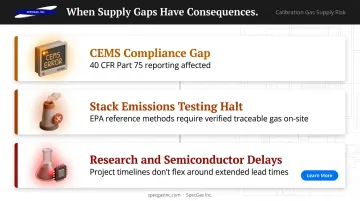
For these buyers, supplier responsiveness and rush order capability are operational risk factors, not preferences.
What Makes Calibration Gas Quality So Critical
Calibration gas quality determines the accuracy of every measurement instrument it's used with — from portable gas detectors in industrial settings to continuous emissions monitors in compliance environments.
An out-of-spec gas produces false readings that can trigger non-compliance citations, missed hazard detection, or equipment miscalibration that goes undetected until something goes wrong.
NIST Traceability and EPA Compliance
NIST-traceable calibration gas standards are certified by comparison to reference materials from the National Institute of Standards and Technology. For emissions monitoring applications, this isn't optional.
40 CFR Part 60 Appendix F, Procedure 1 requires that cylinder gas audit gases be Certified Reference Materials certified against NIST Standard Reference Materials or EPA Protocol Gases. Under 40 CFR Part 75, facilities with CEMS must procure EPA Protocol Gases, and the EPA's Protocol Gas Verification Program audits production-site gas accuracy to ensure those gases are reliable for compliance use.
Buyers should treat NIST traceability documentation as a compliance gate — confirming it before accepting any calibration gas cylinder, not after.
Blend Accuracy, COA Requirements, and Balance Gas Selection
Blend accuracy matters because even a small concentration deviation produces measurement error. Buyers should understand the difference between preparation tolerance (acceptable range during blending) and analytical/certification tolerance (the verified range on the certificate) — they are not the same number.
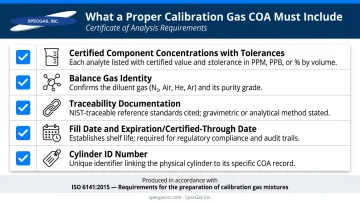
NIST traceability documents what was certified; the Certificate of Analysis (COA) documents what's actually in the cylinder. ISO 6141:2015 specifies minimum certificate requirements, and OSHA's guidance on portable gas monitor calibration confirms buyers should receive a COA for every cylinder. A proper COA includes:
- Certified component concentrations with tolerances
- Balance gas identity
- Traceability documentation
- Fill date and expiration/certified-through date
- Cylinder ID number
Balance gas selection is not interchangeable. NO mixtures require a nitrogen balance to maintain stability; NO₂ mixtures require an air balance. Errors in balance gas selection cause reactive degradation and concentration drift that renders the gas unusable — and this failure mode often isn't obvious until the cylinder is already in service.
Key Criteria for Evaluating Any Calibration Gas Supplier
When assessing a new supplier — whether you're moving away from a large distributor or vetting a specialty provider — these five criteria help identify suppliers worth trusting.
1. NIST Traceability and Certification Documentation
Any legitimate calibration gas supplier should provide NIST-traceable gas standards as standard practice. Confirm this upfront — it should not be an upsell or an option. For Part 75 CEMS applications, also verify the supplier participates in the EPA's Protocol Gas Verification Program (PGVP).
2. Blend Accuracy for Standard and Custom Mixtures
Request historical COA data or batch consistency records for the specific mixture type you're buying. For multi-component mixtures especially, consistency across repeat orders matters as much as accuracy on a single cylinder.
3. Reactive Gas Handling Capability
Reactive gases — NO, NO₂, SO₂, H₂S, HCl, NH₃, and others — require specialized cylinder preparation. Not all suppliers have the production infrastructure to handle these gases at low ppm and ppb concentrations with acceptable stability. Ask specifically:
- What internal cylinder treatment process do you use for reactive mixtures?
- What certified periods do you achieve for reactive gases like NO and SO₂?
- Do you conduct stability testing, and how is that documented on the COA?
4. Lead Times and Rush Order Availability
Lead time gaps between catalog items and custom blends can be significant — verify both. Confirm whether the supplier has a documented rush order process and what turnaround that realistically delivers. Supply interruptions halt operations. This is a practical question, not a secondary one.
5. Direct Access to Technical Expertise
Buyers benefit from reaching a knowledgeable person quickly when questions arise about gas compatibility, balance selection, regulator choice, or mixture stability. Large distributors often route technical questions through customer service tiers before reaching someone with relevant expertise.
Specialty suppliers tend to offer more direct access. At SpecGas Inc., customer service, laboratory, and production staff are veterans of the specialty gas industry — technical questions reach people with hands-on blending experience, not a general support queue.
Where Specialty Suppliers Outperform Large Gas Companies
Specialty gas suppliers are built around complexity. They handle low-volume custom orders, unusual component combinations, and reactive mixtures that large distributors may decline, deprioritize, or require extended lead times to fulfill.
Custom and Unusual Gas Mixtures
The clearest advantage is in non-standard applications. A product specialist at MNR Lab in Livermore, California, noted directly that SpecGas "always helps me out, when other (bigger) companies are not able to provide the chemicals that we need" — specifically for unusual gases required for respirator cartridge challenge testing.
SpecGas produces stable mixtures for some of the most technically demanding gases in the calibration market: Formaldehyde, Nitric Oxide, Phosgene, Hydrogen Chloride, Arsine, Phosphine, Hydrogen Cyanide, and Trichlorosilane. Excimer laser gas mixtures (ArF 193 nm, KrF 248 nm, KrCl 222 nm, XeCl 308 nm) serve semiconductor photolithography, display annealing, and medical laser applications that large commodity distributors rarely touch.
Major gas distributors themselves request SpecGas to blend multi-component specialty gases for their own clients, a dynamic that reflects the gap between large-distributor volume capability and specialty blending expertise.
Cylinder Deposit vs. Rental Models
Large industrial gas distributors typically use cylinder rental programs. Specialty suppliers like SpecGas offer a cylinder deposit program instead — customers pay a deposit rather than ongoing rental fees, which reduces long-term cost of ownership for labs and facilities that use calibration gas regularly. A customer testimonial from MNR Lab explicitly cited this as "so much more cost-effective than renting cylinders from other gas companies."
For facilities running multiple cylinders at high frequency, that difference compounds quickly.
A Practical Dual-Supplier Approach
Many facilities benefit from using both types of suppliers strategically. The split is straightforward once you map each application to the right supply model:
- Use a large distributor for high-volume, standardized gases where catalog availability and contract pricing dominate the decision
- Use a specialty supplier for custom blends, reactive gases, and low ppm/ppb precision standards
- Default to the specialty supplier when lead time, technical depth, or mixture stability is the primary concern
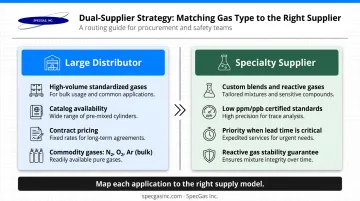
This approach avoids the all-or-nothing decision and gets the right supply model matched to each application type.
Reactive Gas Mixtures: The Hardest Test for Any Supplier
Reactive gas mixtures represent the most technically demanding segment of calibration gas production — and the segment where supplier capability gaps cause the most consequential failures.
What Makes Reactive Gases Unstable
Gases like NO, NO₂, SO₂, H₂S, HCl, and NH₃ are chemically active in ways that affect the cylinder itself. They can:
- Adsorb onto cylinder walls, reducing the actual concentration below the certified value
- React with each other in multi-component mixtures if balance gas selection is incorrect
- Convert between forms: EPA Method 7E notes that NO is highly reactive and converts to NO₂ on contact with air
- Degrade over time at rates that vary with concentration and cylinder preparation
The EPA's 2023 Protocol Gas Q&A requires reactive gases including NH₃, HCl, H₂S, NO, NOx, and SO₂ to be tested (assayed) on at least two dates separated by seven or more days, because stability must be demonstrated, not assumed.
Cylinder Treatment: The Critical Differentiator
Proper cylinder preparation — internal passivation or treatment that conditions the cylinder surface before filling — is what separates a reactive gas mixture with a reliable certified period from one that drifts within weeks.
Not all suppliers have this capability. It requires specialized equipment, deep formulation knowledge, and ongoing compatibility and stability testing.
Alfred Boehm, founder of SpecGas Inc., began developing internal cylinder treatment methodology during his work at Messer Griesheims Industries in Germany, continuing that R&D after his 1991 transfer to the United States. That work is the technical foundation of SpecGas's proprietary cylinder treatment process and the SpecGas Stability Guarantee for reactive gas mixtures. It's what allows the company to produce stable low ppm and ppb precision standards for gases that other suppliers cannot reliably fill at all.
When sourcing reactive gas mixtures from any supplier, ask specifically about their cylinder treatment process and request stability data before committing to a supply arrangement.
Handling Practices That Affect Performance
Even a well-produced reactive gas mixture can degrade through improper handling. Follow these practices:
- Use stainless steel regulators dedicated to a single mixture — don't share across gas types
- Use Teflon or Teflon-lined tubing, not standard Tygon; EPA Method 7E specifies non-absorptive materials for reactive gas calibration setups
- Keep tubing runs short to minimize surface contact area
- Confirm the certified period and expiration date on the COA before the cylinder goes into service — EPA Method 7E states calibration gases must not be used beyond their expiration date
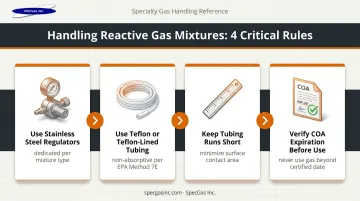
Handling factors compound with supplier quality. Even the best-prepared cylinder won't hold its certified concentration if connected through absorptive tubing or a contaminated regulator.
Frequently Asked Questions
What is in a 4-gas calibration gas mix?
A standard 4-gas calibration mix typically contains carbon monoxide (CO), hydrogen sulfide (H₂S), oxygen (O₂), and a combustible gas — commonly methane or pentane expressed as a percentage of LEL. Specific concentrations vary by manufacturer and instrument; this is a common configuration, not a fixed universal formula.
How do I know if my calibration gas is NIST traceable?
NIST-traceable calibration gas comes with a Certificate of Analysis documenting the traceability chain back to NIST reference standards. Confirm this documentation is provided before accepting any cylinder. Traceability must be stated explicitly on the COA, not assumed from the supplier's general marketing.
What makes calibration gas reactive, and why does stability matter?
Reactive gases such as NO, NO₂, SO₂, and H₂S interact with cylinder walls or other gas components, causing concentration to drift over time. A drifted gas produces false readings even if the original certification was accurate. Proper cylinder preparation and internal treatment are what maintain certified accuracy through the cylinder's full usable life.
Can I get custom calibration gas blends from a specialty supplier?
Yes. Specialty suppliers can produce custom multi-component blends, low ppm/ppb precision mixtures, and unusual combinations that large distributors may not offer. Before ordering, verify in-house blending capability, confirm COA documentation for custom orders, and check that NIST traceability is explicitly stated.
How do lead times for calibration gas affect my operations?
Delays in calibration gas supply can halt instrument calibration, trigger compliance failures for facilities under EPA monitoring requirements, and shut down research workflows. Ask any supplier specifically about lead times for custom blends versus catalog items, and confirm whether rush order service is available before you need it.
What should I look for in a Certificate of Analysis for calibration gas?
A proper COA should include certified component concentrations with tolerances, balance gas identity, traceability documentation, cylinder ID, fill date, and expiration or certified-through date. Any COA missing these elements should be questioned before placing an order.