This article covers how gas lasers work, the major types in commercial use, and the real-world applications where they remain indispensable — from cutting steel to reshaping corneas to patterning silicon wafers at the nanometer scale.
Key Takeaways
- Gas lasers excite a gas or gas mixture electrically to produce a coherent light beam — first demonstrated in 1961
- Key types: helium-neon (HeNe), CO₂, argon-ion, nitrogen, and excimer, each operating at distinct wavelengths
- Industrial uses include cutting, welding, engraving, and semiconductor photolithography
- Medical uses span LASIK/PRK vision correction, dermatology treatments, and retinal procedures
- Scientific uses cover interferometry, spectroscopy, holography, and precision calibration
- Gas purity and blend accuracy directly affect output power, beam stability, and tube lifespan
How Gas Lasers Work
All gas lasers share the same underlying physics: an electric discharge excites gas atoms or molecules to a higher energy state. When those excited particles return to their ground state, they release photons. If enough particles are in the excited state simultaneously — a condition called population inversion — stimulated emission takes over and produces coherent light. This is fundamentally different from solid-state lasers, where a crystal or glass rod serves as the gain medium.
The Optical Cavity
Two mirrors bracket the gas tube: one is fully reflective, the other partially transmissive. Photons bounce between them, stimulating additional emission with each pass. The partially transmissive mirror lets a fraction of that amplified light exit as the usable beam.
That low-density gain medium also explains why gas lasers produce exceptionally clean beams. HeNe lasers, for example, achieve near-perfect beam quality (Melles Griot specifications list TEM₀₀ mode and M² < 1.05) because the gaseous medium avoids the thermal distortions common in solid-state designs. Solid-state lasers suffer from thermal lensing; gas lasers sidestep it entirely.
Gas Choice Determines Everything
The gas selection sets:
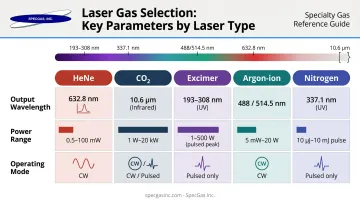
- Output wavelength — red visible for HeNe, deep infrared for CO₂, ultraviolet for excimers
- Power range — from a few milliwatts (HeNe) to multiple kilowatts (CO₂)
- Operating mode — continuous-wave (CW) or pulsed nanosecond pulses (excimer, nitrogen)
The Main Types of Gas Lasers
Gas lasers are categorized by the nature of their active medium — neutral atoms, ions, molecules, or excited dimers — and each produces distinct wavelengths and power outputs.
Helium-Neon (HeNe) Lasers
First demonstrated on February 1, 1961 — documented by the American Physical Society as the first gas laser and the first continuous laser — HeNe lasers emit a characteristic red beam at 632.8 nm. They can also be built for green (543.5 nm) or infrared (1,523 nm) output.
Power output is low, typically 0.2 mW to 17 mW depending on the line, but beam quality is exceptional.
The energy transfer mechanism relies on metastable helium atoms colliding with neon atoms, transferring energy to populate neon's laser levels. That precise collisional transfer requires a precisely controlled helium-to-neon ratio — any contamination or drift in the mixture degrades the process.
Primary uses:
- Laser alignment and interferometry
- Holography
- Frequency standards in metrology
Carbon Dioxide (CO₂) Lasers
CO₂ lasers are among the most powerful and efficient gas lasers available. They operate in the mid-infrared at 10.6 µm, with wall-plug efficiencies above 10% and CW outputs ranging from the 20 W class up to 8 kW systems in commercial product lines.
The active medium is a three-gas mixture: CO₂, nitrogen, and helium. Nitrogen absorbs discharge energy and transfers it vibrationally to CO₂ molecules, producing high gain. Helium depopulates the lower laser level and cools the gas; remove it, and the laser self-quenches.
Primary uses:
- Industrial cutting and welding
- Engraving and marking
- Surgical tissue ablation
Excimer Lasers
Excimer lasers generate pulsed ultraviolet radiation by forming unstable "excited dimer" molecules from noble gas and halogen combinations. Commercial wavelengths include 193 nm (ArF), 248 nm (KrF), 222 nm (KrCl), and 308 nm (XeCl). Each pulse lasts nanoseconds, delivering enough energy to break molecular bonds in the target material without transferring heat to surrounding tissue or substrate.
Primary uses:
- Semiconductor photolithography (DUV)
- LASIK and PRK vision correction surgery
- Precision surface processing and dermatological phototherapy
Argon-Ion and Krypton-Ion Lasers
Argon-ion lasers emit CW output in the blue-green visible range, with the two strongest lines at 488 nm and 514.5 nm. They require substantial electrical power and water cooling, but deliver stable, high-brightness beams that made them the workhorse of research labs for decades.
Krypton-ion lasers extend coverage into red (647.1 nm), yellow-green (568.2 nm), and blue-violet (413 nm to 476 nm) — useful when applications need multiple visible wavelengths.
Primary uses:
- Retinal photocoagulation
- Raman spectroscopy and flow cytometry
- Dye laser pumping
Nitrogen Lasers
Nitrogen lasers emit pulsed UV radiation at 337.1 nm, operate without the exotic gas mixtures that excimers require, and are relatively simple to build and run. Their nanosecond pulses make them efficient pump sources for tunable dye lasers.
Primary uses:
- Dye laser pumping
- Fluorescence spectroscopy
- Atmospheric remote sensing
Industrial Uses of Gas Lasers
CO₂ lasers dominate industrial settings because of their combination of high power, excellent beam quality, and broad material absorption at 10.6 µm. The global CO₂ laser market was reported at USD $3.2 billion in 2024, with industrial manufacturing accounting for a substantial share of that installed base.
Cutting and Welding
The 10.6 µm wavelength is strongly absorbed by non-metallic materials — plastics, wood, textiles, glass, and organic composites. High-power CO₂ systems are also used for metal cutting and welding, where continuous multi-kilowatt output produces clean, narrow kerf lines at production speeds.
Industries that rely on CO₂ laser cutting include:
- Automotive (airbag fabrication, body panels)
- Electronics (printed circuit board processing)
- General fabrication (sheet metal, acrylic, wood products)
Marking and Engraving
Both CO₂ and excimer lasers handle precision marking. CO₂ systems mark organic surfaces at high speed. Pulsed excimer lasers — particularly KrF and XeCl — mark at the micron scale without thermal damage to surrounding material, which matters in medical device manufacturing and electronics where heat-affected zones are unacceptable.
Semiconductor Photolithography
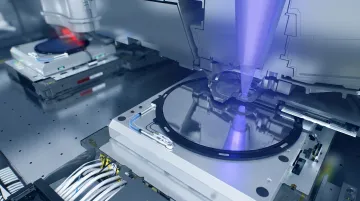
ArF excimer lasers at 193 nm are the backbone of deep ultraviolet (DUV) photolithography. Cymer, ASML's light source division, confirms that production DUV lithography tools use either KrF (248 nm) or ArF (193 nm) excimer sources. The short UV wavelength provides the resolution needed to pattern features at nanometer scales on silicon wafers — transistors, capacitors, and interconnects that define modern processor performance.
ASML's DUV product line spans three system types, each dependent on precisely blended excimer gas fills to maintain consistent pulse energy and beam homogeneity across billions of pulses:
- ArF immersion — highest resolution, used for leading-edge nodes
- ArF dry — mid-range node patterning
- KrF — mature node production and specialty layers
Air Quality and Emissions Monitoring
Nitrogen lasers serve as pump sources in tunable dye laser systems used for LIDAR-based atmospheric pollutant detection. These instruments can remotely detect greenhouse gases, NOₓ, SO₂, and particulate matter across kilometers of atmosphere.
Those instruments require reference gas standards of known concentration to verify accuracy — NIST-traceable mixtures blended to match the target analytes precisely. SpecGas produces calibration gas standards at low ppm and ppb concentrations for air quality monitoring equipment, covering the gases these systems measure most:
- NO and NO₂ (nitrogen oxides)
- SO₂ (sulfur dioxide)
- CO and CO₂ (carbon monoxide and carbon dioxide)
These mixtures support continuous emissions monitoring systems (CEMS) as well as ambient air quality instrumentation.
Medical and Scientific Uses of Gas Lasers
Gas lasers entered medicine in the 1960s and remain integral to several surgical, therapeutic, and diagnostic applications. Their precise wavelength control makes them particularly valuable where accuracy is life-critical.
Vision Correction Surgery (LASIK and PRK)
ArF excimer lasers at 193 nm are the standard tool for LASIK and PRK procedures. The American Academy of Ophthalmology confirms that the 193 nm excimer beam precisely etches corneal tissue with submicron adjacent damage, reshaping the eye's curvature to correct myopia, hyperopia, and astigmatism.
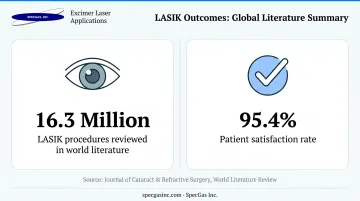
A 2009 world literature review published in Ophthalmology reported 16.3 million LASIK procedures with 95.4% patient satisfaction across the reviewed literature. The FDA's LASIK Quality of Life Collaboration Project similarly found that more than 95% of participants were satisfied with their vision following surgery.
The precision that makes this possible comes directly from the ArF gas mixture. Every procedure depends on consistent pulse energy and beam uniformity — which depend on a correctly blended, stable excimer gas fill.
Dermatological and Surgical Applications
CO₂ lasers at 10,600 nm are strongly absorbed by intracellular water, making them effective for skin resurfacing, scar revision, wart removal, and surgical incisions. The infrared absorption produces clean tissue ablation with simultaneous cauterization, reducing bleeding during procedures.
StatPearls and the American Society for Dermatologic Surgery both document CO₂ laser resurfacing for wrinkles, scars, and related conditions. Because the surrounding dry tissue absorbs far less energy, these treatments can be highly targeted — a property that extends to the retinal applications covered below.
Ophthalmology Beyond LASIK
Argon-ion lasers at 514 nm are used for retinal photocoagulation — the standard treatment for diabetic retinopathy and retinal tears. The American Academy of Ophthalmology identifies CW laser treatment at 514 nm and 532 nm as conventional therapy for proliferative and nonproliferative diabetic retinopathy. The blue-green wavelengths are selectively absorbed by the retinal pigment and hemoglobin in leaking vessels, sealing them without damaging surrounding retinal tissue.
Beam stability is critical here. Any fluctuation in output during a delicate retinal procedure carries direct clinical risk, which is why consistent gas mixture quality matters for these applications.
Scientific Research and Spectroscopy
Gas lasers serve as the backbone of several precision measurement disciplines. Key instruments and their applications include:
- HeNe at 633 nm — iodine-stabilized lasers used by NIST as interferometric references for length-scale measurement and SI length traceability
- Nitrogen lasers — pump tunable dye lasers across fluorescence spectroscopy and atmospheric research
- Argon-ion lasers — drive Raman spectroscopy instruments where stable CW output produces consistent excitation conditions
Each of these applications demands repeatable output. That consistency starts with an uncontaminated, precisely blended lasing gas fill.
Why Gas Purity and Mix Quality Matter for Laser Performance
The link between gas composition and laser output is direct and quantifiable. A 1996 Journal of Laser Applications study found that 1,000 ppm propane contamination in an industrial CO₂ laser caused a 17% output power decrease through carbon deposition on internal optics. That's a performance specification failure from a single contaminant at parts-per-million levels.
Other documented degradation mechanisms include:
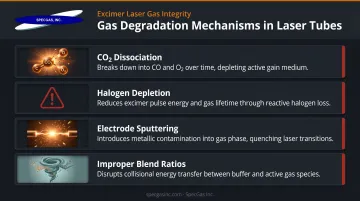
- CO₂ dissociation into CO and O₂ over time in sealed laser tubes
- Halogen depletion in excimer laser fills, reducing pulse energy and shortening gas lifetime
- Electrode sputtering introducing metallic contamination into the gas phase
- Improper blend ratios disrupting the collisional energy transfer mechanisms that gas lasers depend on
What This Means for Gas Sourcing
Laser operators and manufacturers need certified specialty gas, not commodity industrial gas. The requirements include:
- Concentration accuracy at low ppm and ppb levels — not the percent-level tolerances typical of welding gases
- Stable reactive gas mixtures — particularly for fluorine- and chlorine-containing excimer blends, where halogen reactivity degrades mixtures that aren't properly prepared
- NIST traceability — verifiable concentration references that support quality documentation
- Blend-to-blend reproducibility — consistent fills across cylinder batches so laser performance doesn't vary with each refill
SpecGas produces NIST-traceable specialty gas blends for laser applications, including helium-neon mixtures for HeNe lasers and excimer laser gas fills (ArF 193 nm, KrF 248 nm, KrCl 222 nm, and XeCl 308 nm) for photolithography, vision correction, and dermatology. The company's proprietary internal cylinder treatment process, developed through Alfred Boehm's decades of reactive gas R&D, extends shelf life and maintains stability for halogen-noble gas blends.
The SpecGas Stability Guarantee covers these reactive mixtures. If a delivered blend is disputed, SpecGas remakes and reships it at no charge.
For facilities running gas lasers continuously, supply reliability matters as much as blend quality. SpecGas blends all mixtures in-house and offers rush service, a practical option when laser downtime delays production schedules.
Frequently Asked Questions
What are the different types of gas lasers?
The main categories are neutral atom lasers (HeNe), ion lasers (argon-ion, krypton-ion), molecular lasers (CO₂, nitrogen), and excimer lasers. Each is defined by its active medium, which determines output wavelength, power level, and the applications it can serve.
What is the principle of a gas laser?
An electric discharge excites gas atoms or molecules to a higher energy state, creating population inversion. When they return to their ground state, they release coherent photons that are amplified between two mirrors to produce a laser beam.
What are excimer lasers used for?
The two dominant applications are semiconductor photolithography and refractive eye surgery (LASIK/PRK). ArF at 193 nm patterns circuit features on silicon wafers and ablates corneal tissue with submicron precision. XeCl (308 nm) is also used in dermatological phototherapy.
What is the difference between a CO₂ laser and a HeNe laser?
CO₂ lasers emit infrared radiation at 10.6 µm, can reach kilowatt power levels, and are used for cutting, welding, and surgical tissue ablation. HeNe lasers emit visible red light at 632.8 nm at milliwatt power levels and are used for alignment, interferometry, and frequency standards. The two types share no overlap in application or gas chemistry.
How does gas purity affect laser performance?
Impurities or incorrect concentrations reduce population inversion efficiency, destabilize the beam, and accelerate tube degradation. Even 1,000 ppm of a single contaminant can cause measurable output power loss. Laser-grade gas mixtures require ppm and ppb-level certification — precision that commodity industrial gases are not produced to meet.
Are gas lasers still widely used today?
CO₂ lasers remain dominant in industrial material processing, excimer lasers are standard in semiconductor manufacturing and refractive eye surgery, and HeNe lasers continue as interferometric references in scientific instrumentation. Solid-state and diode lasers have replaced them in some consumer applications, but for high-power industrial use and UV precision work, gas lasers have no practical substitute.