This article covers what happened to Scott Specialty Gases, why your choice of calibration gas supplier matters more than most buyers realize, and what to look for when qualifying an alternative.
Key Takeaways
- Scott Specialty Gases was acquired by Air Liquide in November 2007, absorbing its brand and operations into a large multinational structure
- Calibration gas must be NIST traceable to be valid for EPA, OSHA, and ISO-governed applications
- Prioritize suppliers who blend in-house, ship a certificate of analysis with every cylinder, and handle reactive formulations
- Independent specialty gas producers often offer faster lead times and more flexibility than large conglomerates
- Ask targeted qualification questions before switching suppliers; using the wrong gas invalidates your data
What Happened to Scott Specialty Gases?
Scott Specialty Gases was a privately held specialty gas producer headquartered in Plumsteadville, Pennsylvania. The company built a strong reputation producing EPA protocol gases, natural gas standards, and analytical, medical, and electronics-grade gas mixtures — particularly earning trust for difficult reactive blends and the kind of direct technical relationships larger suppliers rarely offer. The acquisition in 2007 changed all of that.
Air Liquide announced on September 27, 2007 that its US affiliate, American Air Liquide Holdings, Inc., had agreed to purchase Scott Specialty Gases' assets. The deal closed on November 5, 2007, with Air Liquide America Specialty Gases LLC finalizing the acquisition and absorbing Scott's 450 employees into its US specialty gas operations.
What the Acquisition Meant for Customers
The products technically continued. But the Scott brand identity — the independent service model, the specialized focus, the responsive direct relationships — got absorbed into a much larger corporate structure. For many longtime Scott customers, that difference mattered.
Customers who had relied on Scott for these specific needs found the transition difficult:
- Difficult-to-produce reactive gas mixtures
- EPA reference standards with fast turnaround
- Custom low-volume formulations
- Direct technical support from specialists
A major multinational's priorities, minimum order requirements, and lead times no longer matched their operational reality. That's why, nearly two decades after the acquisition, buyers are still searching for a true Scott equivalent.
Why Calibration Gas Sourcing Matters More Than You Think
Calibration gas isn't a commodity. These are precision gas mixtures used to verify, adjust, and validate the performance of gas analyzers, detectors, and monitoring equipment across emissions monitoring, air quality testing, semiconductor manufacturing, medical diagnostics, and industrial safety.
The Compliance Stakes
Using uncertified or out-of-spec calibration gas creates serious downstream problems:
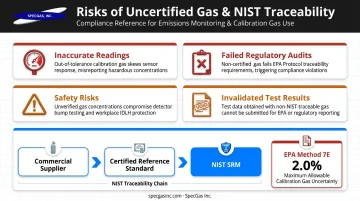
- Inaccurate readings that corrupt monitoring data
- Failed regulatory audits under EPA, OSHA, or ISO frameworks
- Safety risks in confined space entry, H₂S monitoring, or continuous emissions monitoring programs
- Invalidated test results — EPA Method 7E requires calibration gas certified within 2.0% uncertainty, and drift check failures can void affected results
OSHA's SHIB 09-30-2013 requires calibration gas for portable gas monitors to be certified using NIST-traceable standards, and specifically flags reactive gases like H₂S for limited stability — making cylinder expiration dates a real compliance concern, not just a formality.
NIST Traceability Explained
NIST traceability means the certified composition of a gas mixture has been verified through a documented, unbroken chain of calibrations back to reference standards maintained by the National Institute of Standards and Technology. That chain documents uncertainty at each step.
NIST publishes its own gas mixture Standard Reference Materials (SRMs) that commercial suppliers use as benchmarks for their traceability claims. Those SRMs cover common calibration gases including:
- Carbon dioxide in nitrogen
- Carbon monoxide
- Hydrogen sulfide
When evaluating a supplier's certificate of analysis, look for an explicit reference to the NIST SRM used and the stated uncertainty value — those two details confirm the traceability chain is intact.
Supply Chain Reliability
A verified traceability chain only helps if the gas arrives on time. Even a short supply disruption can halt instrument validation, delay product testing, or interrupt a continuous emissions monitoring program — which means supplier reliability matters as much as product quality.
Look for a supplier who can hit tight lead times, accommodate low minimums, and handle rush orders when your program demands it. Those operational factors have real compliance consequences when a cylinder runs out mid-audit cycle.
What to Look for in a Certified Calibration Gas Supplier
Not every supplier who sells calibration gas actually produces it. Knowing how to evaluate a supplier before you commit protects both your measurement accuracy and your compliance standing.
Certification and Traceability Documentation
Every cylinder should ship with a certificate of analysis (COA). A compliant COA for regulated applications should include:
- Certified component concentrations (at least three significant figures)
- Balance gas identity
- 95% uncertainty values
- Traceability references to NIST SRMs, NTRMs, or EPA Protocol standards
- Assay and certification dates, expiration date
- Cylinder ID and reference standard cylinder numbers
ISO 6141:2015 sets the minimum requirements for calibration gas certificates. If a supplier can't produce documentation meeting this standard, don't use their gas for regulated applications.
In-House Blending Capability
Suppliers fall into two categories: those who blend their own gas and those who resell from an upstream producer. In-house blending means:
- Direct control over accuracy and consistency
- Ability to handle custom and reactive formulations
- Faster turnaround without waiting on an upstream producer
- Accountability — the blender and the seller are the same entity
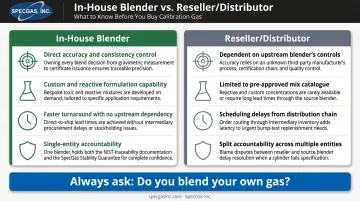
Ask directly: do you blend your own gas, or do you source from another producer?
Custom and Reactive Mixture Capability
Many labs and industrial operations need formulations that generic catalog suppliers simply won't attempt: low-ppm and ppb-level precision blends, uncommon multi-component combinations, and reactive gas mixtures such as H₂S, NO, SO₂, HCl, and HCN.
Reactive gases are particularly demanding. Without proper cylinder passivation, these compounds degrade, react with cylinder walls, and lose concentration accuracy before the shelf life expires. SpecGas Inc. (Bridgeport, PA) addresses this through proprietary internal cylinder treatment methods developed through decades of reactive gas R&D, backed by a Stability Guarantee for reactive mixtures. Formaldehyde calibration gas is one of the hardest mixtures to stabilize; SpecGas is among the few producers that can do it reliably.
Lead Times and Cylinder Program
- Lead times: Ask about standard production schedules and whether rush service is available. A SpecGas customer described their lead times as "far ahead of industry standards" — responsiveness that matters when instrument validation can't wait.
- Cylinder program: SpecGas offers a cylinder deposit program rather than a rental model. A customer from MNR Lab noted it's "so much more cost-effective than renting cylinders from other gas companies," worth factoring into total cost of ownership.
Where to Source Certified Calibration Gas Today
Independent Specialty Gas Producers
Independent producers — companies whose entire business is specialty and calibration gas blending rather than a sideline to bulk industrial gas — typically offer deeper technical expertise, more flexible custom blending, and faster response times.
SpecGas Inc. (86 Vincent Circle, Bridgeport, PA) was founded in 2001 by Alfred Boehm, a research chemist who advanced to director-level roles at Messer Griesheims Industries before coming to the US in 1991 to continue specialty gas R&D — including the proprietary cylinder treatment process that gives SpecGas its edge with reactive gas mixtures.
SpecGas produces NIST-traceable calibration gases across a broad range of applications:
- Toxic and reactive gas standards: Cl₂, ClO₂, H₂S, HCN, PH₃, HCl, NH₃, NO/NOx, SO₂, formaldehyde
- Hydrocarbon and combustible gas mixtures: CH₄, C₃H₈, LEL standards, BTU and RGA standards
- EPA compliance gases including formaldehyde per EPA Method 320 and NOx mixtures for CEMS
- Analytical standards for GC, GC-MS, FTIR, NDIR, PID, and electrochemical sensors
- Rare and pure gases: He, Ar, Kr, Xe, Ne
- Excimer laser gas mixtures for photolithography and medical applications
All blends are produced in-house with proprietary techniques, available in disposable cylinders (17–103 liters, suitable for field use and overseas shipping) and refillable high-pressure cylinders up to 2,000 liters for CEMS and laboratory applications.
Major Industrial Gas Distributors
Airgas (an Air Liquide company), Linde, and Matheson all carry standard EPA Protocol calibration gas lines with NIST traceability and COA documentation. For high-volume standard blends, they're a workable choice. The gaps appear with:
- Custom or multi-component formulations
- Low-volume specialty orders
- Reactive gas mixtures
- Time-sensitive needs requiring fast turnaround
Large-volume producers often impose minimum order requirements or longer lead times in these situations.
Regional Specialty Gas Distributors
Authorized regional distributors can be a convenient option for standard blends. Most lack in-house custom blending capability, so complex or reactive formulations aren't available through this channel.
Key Questions to Ask Before Switching Suppliers
Switching calibration gas suppliers mid-operation carries real risk. Before committing to a new source, get direct answers to these five questions — the responses will tell you quickly whether a supplier can meet regulated and operational requirements.
Does every cylinder ship with a COA? Confirm it includes certified concentrations, uncertainty ranges, balance gas, traceability references, and expiration date. Without all five elements, the gas can't be used for regulated applications.
Do you blend in-house? If the answer is no or unclear, ask who produces the gas and what traceability documentation they provide.
How do you treat cylinders for reactive gases? For H₂S, NO, SO₂, HCl, HCN, or similar compounds, ask specifically about cylinder passivation. Without a documented passivation process, reactive gas mixtures degrade faster and deliver inconsistent shelf life.
What are your standard lead times, and do you offer rush service? The answer tells you whether this supplier can realistically support your operation's pace.
What are your minimum order quantities? A supplier whose minimums exceed your needs will create waste or force you to stockpile gas that expires before use.
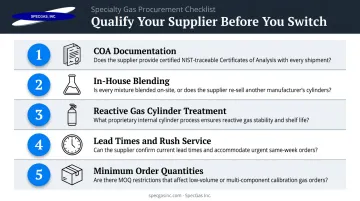
A supplier that answers these questions confidently — with documentation to back them up — is one worth considering. One that hedges or redirects is telling you something too.
Frequently Asked Questions
What is a good alternative to Scott Specialty Gas for calibration applications?
Independent specialty gas producers with NIST traceable certifications, in-house blending, and reactive gas capability are the closest functional equivalents. SpecGas Inc. serves US customers from Pennsylvania with custom blending, reactive and toxic gas formulations, and industry-leading lead times.
Is Scott Specialty Gas still available?
Scott Specialty Gases no longer exists as an independent brand. Air Liquide finalized the acquisition of Scott's assets on November 5, 2007, integrating its operations and product lines into Air Liquide's specialty gas division. Customers now interact with Airgas (an Air Liquide company) rather than Scott directly.
What does NIST traceable calibration gas mean?
NIST traceable calibration gas means the mixture's certified composition is verified through a documented chain of calibrations back to National Institute of Standards and Technology reference standards, with measurement uncertainty recorded at each step. This traceability chain is required for EPA, OSHA, and ISO regulatory applications.
How do I know if a calibration gas supplier is certified?
Request a certificate of analysis for each cylinder — it should reference NIST traceability, list certified concentrations with uncertainty values, and include expiration dating. Ask the supplier directly how they verify blend accuracy and document their quality system. A reputable supplier answers that without hesitation.
Can I get custom calibration gas blends from an alternative supplier?
Yes. Independent specialty producers are typically better equipped than large conglomerates for custom and uncommon blends, including low-ppm and ppb-level precision mixtures and reactive gas formulations. The key requirement is in-house blending with a documented cylinder treatment process for reactive gases — not every supplier can deliver that.