That standard is getting harder to meet with static pre-blended cylinders alone. Regulatory frameworks like EPA Part 75 demand documented traceability. Analytical instruments operating at ppm and ppb levels have no tolerance for reference gas drift. And reactive gas components — hydrogen sulfide, sulfur dioxide, ammonia — don't always survive the gap between cylinder fill date and point of use.
Dynamic gas blending addresses these pressures directly. It's a production and delivery approach that generates gas mixtures in real-time or on-demand, giving operators control over composition at the moment it matters most.
Key Takeaways
- Dynamic gas blending produces mixtures in real-time by controlling individual gas flows, bypassing the pressure pre-mixing that static cylinders require
- Concentration accuracy at ppm and ppb levels is where static cylinder concentrations drift most — dynamic blending holds those levels consistently
- Reactive gases like H₂S, SO₂, and NH₃ degrade in pre-mixed cylinders; dynamic blending delivers them fresh
- On-demand production eliminates expired cylinder waste and cuts inventory management overhead
- For regulated applications, NIST-traceable documentation is what separates a usable reference standard from a liability
What Is Dynamic Gas Blending?
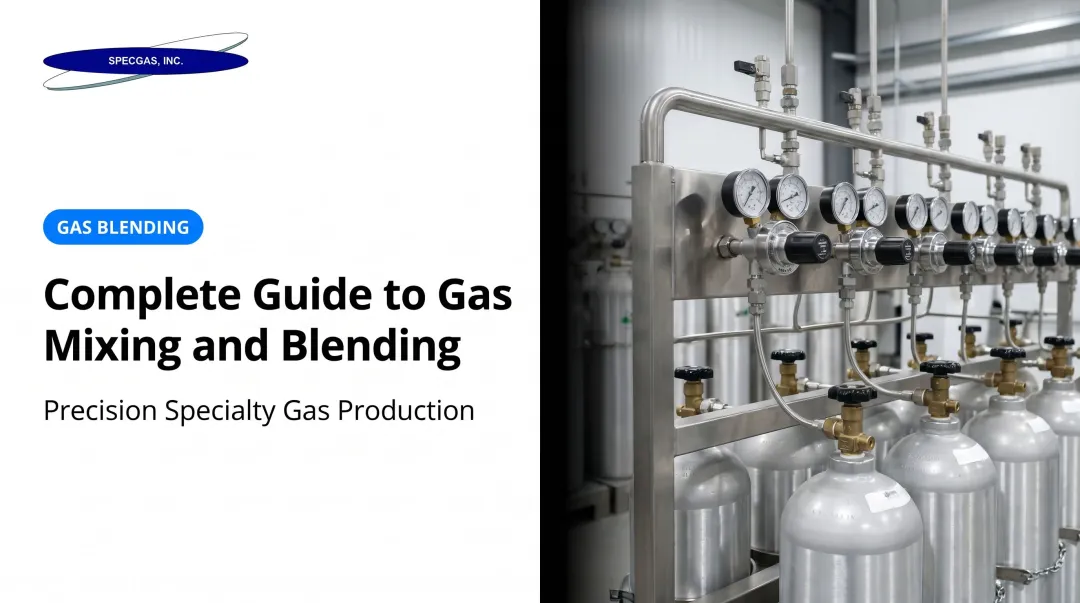
Dynamic gas blending is the process of combining two or more gases as they flow (using mass flow controllers or thermal mass flow meters) to produce a mixture at a defined concentration in real-time. The key distinction from static blending is timing: no pre-mixing under pressure in a cylinder before use.
What makes dynamic blending valuable in these contexts is traceability at the point of use: the mixture concentration is established continuously, not locked in weeks earlier, which matters when calibration validity or regulatory compliance depends on freshness.
Key Advantages of Dynamic Gas Blending
Advantage 1: Compositional Precision at Low Concentrations
Static cylinders fix a composition at fill time. Dynamic blending adjusts flow rates continuously to hit a target concentration — and that difference becomes consequential at ppm and ppb levels, where small deviations produce real analytical errors.
EPA's ambient air Protocol Gas Verification Program requires that protocol gases for ambient air monitoring be certified within ±2.0% of the certified concentration at a 95% confidence interval. EPA Method 205 applies the same ±2% threshold for dynamic dilution systems, requiring:
- Triplicate injections per dilution point
- No single injection deviating more than ±2% from the average
- Annual recalibration using NIST-traceable primary flow standards with uncertainty of 0.25% or less
Those requirements exist because calibration accuracy is entirely inherited from the reference gas. An instrument calibrated against an off-spec reference doesn't just produce one bad reading — it produces systematically biased data across every measurement taken until the error is caught.
In CEMS applications governed by 40 CFR 75.24, a failed calibration error test triggers an out-of-control period, rendering all data invalid until a successful recalibration is completed.
This advantage is most critical for:
- EPA stack emissions testing and CEMS calibration
- Semiconductor process gas verification
- Research applications requiring certified reference standards
- Any setting governed by NIST traceability requirements
Advantage 2: Reactive and Unstable Gas Mixtures
Reactive gases — H₂S, SO₂, NH₃, HCl, Cl₂, NO₂ — don't stay stable in pre-blended cylinders the way inert gases do. NIST SP 260-222 identifies reactive species as having elevated instability risk due to reactions with cylinder walls and other mixture components.
That instability has a measurable shelf-life impact. The same publication notes that typical SRM validity periods for inert gases like CO, CO₂, methane, and propane run to eight years, while low-level nitric oxide standards (0.5–20 µmol/mol) carry only a three-year validity period.
Dynamic blending sidesteps this entirely. Each component stays in its pure or inert-balanced form until the moment of blending, so the user receives the mixture at its certified concentration — not at whatever degraded value it reached after weeks or months in a pre-mixed cylinder.
EPA Method 205 acknowledges this challenge requiring a laboratory evaluation for reactive compounds once per calendar year to verify the dilution system does not cause significant loss of those components.
This advantage is most critical for:
- Air quality monitoring stations calibrating for SO₂, NO, H₂S
- Industrial hygiene and toxic gas detection calibration
- Facilities using reactive mixtures infrequently, where pre-blended cylinders often expire before full use
- Toxicology research requiring fresh reference concentrations
SpecGas addresses this problem on the static blending side through a proprietary internal cylinder treatment process, developed from founder Alfred Boehm's reactive gas R&D work at Messer Griesheims Industries. The SpecGas Stability Guarantee covers gases including H₂S, SO₂, NH₃, HCl, Cl₂, NO₂, and other corrosive or oxidizing components. For facilities where reactive mixtures sit on the shelf for months before use, that extended stability can make the difference between a valid calibration and an expired standard.
Advantage 3: Cost Efficiency Through On-Demand Production
Pre-blended cylinders require upfront purchase regardless of actual consumption before expiration. Dynamic blending changes that model: produce only what's needed, in the quantity required.
The EPA Protocol Gas Q&A confirms that a single high-concentration source gas can generate multiple calibration points through dynamic dilution — provided the dilution factor doesn't exceed 100:1. That means one source cylinder can replace multiple pre-blended cylinders covering different concentration ranges.
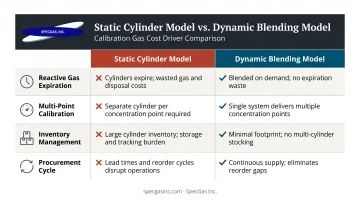
The cost impact compounds across several areas:
| Cost Driver | Static Cylinder Model | Dynamic Blending Model |
|---|---|---|
| Reactive gas expiration | Frequent losses | Eliminated — blended fresh |
| Multi-point calibration | Multiple cylinders required | Single source gas + dilution |
| Inventory management | Tracking, return logistics, mislabeling risk | Reduced overhead |
| Procurement cycle | Long lead times for custom blends | On-demand generation |
This advantage is most critical for:
- Labs running multiple concurrent calibration programs with different concentration targets
- Facilities where reactive or short shelf-life mixtures make up a significant share of gas usage
- Operations with diverse mixture requirements that don't map cleanly to standard pre-mixed offerings
What Happens Without Dynamic Blending Capability
Organizations that rely exclusively on static pre-blended cylinders face a predictable set of downstream problems:
- Calibration drift goes undetected when cylinder concentrations have shifted before the printed expiration date — the cylinder looks valid but the reference value has moved
- Reactive gases arrive within shelf life but outside certified tolerance, producing systematic error in emissions or safety monitoring data without triggering an obvious alert
- Procurement bottlenecks create calibration schedule gaps, especially with multi-component or uncommon mixtures with long supplier lead times
- Gas expenditure increases over time as partially used cylinders are returned, expired reactive blends are discarded, and re-calibration cycles add labor cost
- Scaling to new compliance requirements becomes constrained by whatever pre-mixed configurations a standard supplier offers off the shelf
Under 40 CFR Part 75, an out-of-control period begins the moment a calibration error test fails and doesn't end until a successful recalibration is completed. Every hour between a failed test and successful recalibration produces data the agency will not accept — a direct exposure to enforcement action and potential permit violations.
How to Get the Most Value from Dynamic Gas Blending
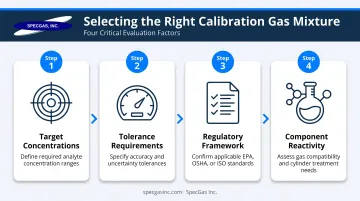
Dynamic blending delivers its full value when the inputs are well-defined. Imprecise concentration targets and loose tolerance specifications produce imprecise blends even with capable equipment. Before engaging a supplier or deploying a dynamic blending system, clarify:
- Target concentrations — exact ppm or ppb values, not approximate ranges
- Tolerance requirements — the acceptable deviation window for your application (EPA ambient air protocol requires ±2%)
- Regulatory framework — which EPA methods, NIST standards, or ISO protocols govern your application
- Component reactivity — which gases in the blend require special handling or fresh generation at point of use
The real payoff comes when dynamic blending is paired with NIST-traceable verification and certified documentation. NIST defines metrological traceability as a documented, unbroken chain of calibrations — each with assigned uncertainty — back to national reference standards. A blend is only as useful as the paperwork confirming it meets the required standard.
SpecGas produces NIST-traceable gas standards using proprietary blending procedures refined over more than four decades of specialty gas R&D. Every mixture ships with full traceability documentation and is backed by a quality guarantee: if the stated results are disputed, SpecGas will immediately remake and reship a replacement.
Treat dynamic blending as an ongoing practice tied to your instrument calibration schedule, not a one-time procurement event. That means:
- Refreshing reference standards on a defined cycle
- Reviewing results regularly against tolerance specs
- Maintaining documentation for regulatory audit readiness
These steps are what turn a blending capability into a compliance asset.
Frequently Asked Questions
What is gas blending?
Gas blending is the process of combining two or more pure gases in precise ratios to produce a mixture with a defined composition. It's used in calibration, emissions monitoring, research, and industrial process control where a gas of known concentration serves as a reference standard.
What is the difference between dynamic gas blending and static gas blending?
Static blending pre-mixes gases under pressure in a cylinder before use, fixing the composition at fill time. Dynamic blending mixes gases in real-time as they flow through controlled delivery systems, offering on-demand freshness and compositional control — especially for reactive components that degrade in pre-mixed cylinders.
Which industries use dynamic gas blending?
Key sectors include environmental and emissions monitoring, semiconductor manufacturing, research and university laboratories, industrial process controls, and air quality compliance applications governed by EPA reference methods and CEMS requirements.
How accurate are dynamically blended specialty gas mixtures?
Accuracy depends on equipment quality, component gas purity, and the blending process. EPA Method 205 sets a ±2% acceptance threshold for dynamic dilution systems calibrated against NIST-traceable primary flow standards.
What is NIST traceability in gas blending?
NIST traceability means the certified concentration of a gas mixture can be verified through a documented, unbroken chain of calibrations back to national measurement standards maintained by the National Institute of Standards and Technology.
Can reactive gases be used in dynamic blending?
Reactive gases are actually one of the primary reasons dynamic blending exists. Producing them fresh at the point of use avoids the degradation, wall reactivity, and concentration drift that affect pre-blended cylinders containing corrosive or oxidizing components like H₂S, SO₂, NH₃, or HCl.