Introduction
A compressed gas cylinder with a sheared valve doesn't leak — it rockets. A documented NIOSH case describes exactly that: a cylinder fell, the valve snapped off, and the cylinder tore through multiple brick walls. That's not a freak accident. It's what happens when a high-pressure vessel — carrying anywhere from 2,000 to 6,000 psi of internal pressure — is mishandled.
The consequences extend well beyond immediate physical danger. Regulatory fines, facility downtime, equipment damage, and liability exposure all follow incidents that were preventable.
Research labs, industrial facilities, and field operations teams share the same core risk: cylinders carrying flammable, toxic, asphyxiating, or reactive contents require consistent handling discipline at every stage — not just during emergencies.
This guide covers:
- Safe storage conditions and cylinder securing requirements
- Movement and handling procedures to prevent valve damage
- Vehicle transport rules under OSHA and DOT regulations — and the most common mistakes that lead to preventable incidents
Key Takeaways
- Store cylinders upright, secured with non-combustible restraints, in cool, dry, well-ventilated areas away from heat and combustibles
- Segregate incompatible gases — flammables and oxidizers must be at least 20 feet apart or separated by a rated barrier
- Cap valves, remove regulators, and use proper ratchet-style restraints before any move — never bungee cords
- Verify compliance with OSHA 29 CFR 1926.350 and DOT 49 CFR Part 173.301 — both set binding requirements for positioning, labeling, and transport
- "Empty" cylinders of Division 2.1 or 2.3 gases are still regulated hazmat; handle and label them as such
The Real Risks of Mishandling Compressed Gas Cylinders
Compressed gas cylinders present two distinct categories of hazard, and understanding both matters because they require different controls.
Physical Hazards
The mechanical risks stem from what these cylinders actually are: high-pressure vessels. According to the Compressed Gas Association, standard high-pressure cylinders operate at 2,000 to 2,640 psi at 70°F, with specialized cylinders reaching 6,000 psi.
That stored energy stays contained under normal conditions. Drop a cylinder on concrete, expose it to sustained heat, or shear the valve, and it converts almost instantly into a projectile event. In the valve-shear scenario, the cylinder itself becomes the projectile — not just the escaping gas.
Chemical Hazards
The chemical risk depends heavily on what's inside:
- Flammable gases (acetylene, hydrogen, methane) carry explosion and fire risk; ignition sources don't need to be close
- Oxidizing gases (oxygen) accelerate combustion — materials that barely burn in normal air ignite readily in oxygen-enriched environments
- Inert gases (nitrogen, helium, argon) displace breathable air silently — OSHA classifies oxygen-deficient atmospheres at below 19.5% O₂, with 6–10% O₂ causing rapid unconsciousness
- Toxic gases (chlorine, ammonia, hydrogen sulfide, phosphine) cause acute harm at very low concentrations
- Reactive specialty gas mixtures — including calibration gas blends used in emissions monitoring and detector calibration — can combine multiple risk profiles within a single cylinder
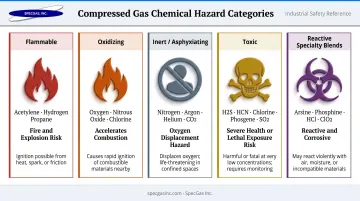
Reactive specialty blends are where risk profiles overlap. A low-ppm phosphine-in-nitrogen calibration mixture, for example, is simultaneously a toxic gas and an asphyxiation hazard — even at concentrations too small to ignite. Facilities receiving these gases need controls that address both hazards, not just one.
Safe Storage of Compressed Gas Cylinders
Site Selection and Temperature Control
Storage location is the foundation of cylinder safety. Cylinders must be kept in:
- Dry, cool, well-ventilated areas with adequate air circulation
- Locations away from direct sunlight, open flames, and heat sources
- Spaces free from combustible materials and ignition points
- Areas where temperature stays stable — heat increases internal pressure and accelerates the risk of pressure relief device activation or seal failure
Physical Restraint Requirements
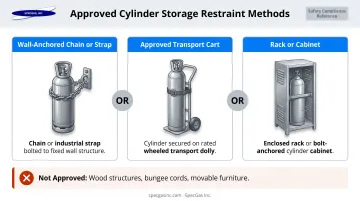
The 2024 International Fire Code (IFC Chapter 53) requires compressed gas cylinders to be secured against falling caused by contact, vibration, or seismic activity. Approved methods include:
- Attaching to a fixed object with one or more restraints (chains or straps anchored to wall-mounted or floor-bolted racks)
- Securing on a cart or mobile device designed for cylinder transport
- Using an approved rack, framework, or cabinet
Restraints must be non-combustible. Never chain or strap cylinders to wooden structures, movable furniture, or any fixture that could itself tip or burn.
Valve protection caps must be in place on all cylinders not actively in use or connected to equipment. A missing cap exposes the valve stem to impact, which is exactly how shear events happen.
Inventory and inspection practices:
- Use oldest stock first
- Remove any cylinder showing corrosion, dents, pitting, or unclear labeling from service immediately
- Cylinders due for hydrostatic requalification (DOT 3A and 3AA cylinders on a 5-year interval per 49 CFR 180.209) should not remain in active service past their retest date
Segregation and Special Categories
Oxygen and other oxidizing gases must be stored at least 20 feet from flammable gas cylinders or combustible materials. If 20 feet of separation isn't possible, a non-combustible barrier at least 5 feet high with a minimum ½-hour fire resistance rating is required — per both OSHA 1926.350(a)(10) and OSHA 1910.253.
Enhanced requirements apply to certain gas categories:
- Pyrophoric and highly toxic gases (phosphine, arsine, silane) must be stored and used in enclosed, exhausted cabinets with continuous alarms
- Cylinders at risk of polymerization or internal pressure buildup require special attention — if you encounter an aged or unknown-history cylinder of these types, do not attempt to move it; contact a hazmat team
- Reactive calibration gas mixtures need protection from heat, moisture, and incompatible co-storage; these conditions can degrade reactive components and shift concentrations at low-ppm levels, making storage a measurement accuracy issue as much as a safety one
For reactive calibration gas mixtures specifically, post-delivery storage conditions directly affect whether guaranteed concentration accuracy holds through the cylinder's shelf life. SpecGas's proprietary internal cylinder treatment process is designed to produce stable reactive gas mixtures with extended shelf life, but that stability requires customers to maintain the appropriate storage conditions outlined above.
Safe Transport and Handling of Compressed Gas Cylinders
Pre-Movement Inspection
Before any cylinder moves (by hand, cart, or vehicle), complete a visual inspection:
- Check for dents, rust, corrosion, and valve condition
- Verify the hydrostatic test date stamp is current
- Confirm the cylinder is properly labeled with the gas name (non-abbreviated) and relevant hazard markings
- Perform a soapy-water leak check on the valve area if there's any reason to suspect a leak
- Remove any attached regulator — regulators must never remain attached during transport
- Confirm the valve protection cap is secured
Manual and Short-Distance Movement
- Use a proper cylinder dolly or hand truck with a securing strap for any move beyond a few steps
- Cylinders 11 kg (25 lbs) or less may be hand-carried short distances
- Never drag, roll on the body, or attempt to lift a cylinder by its valve cap
- Only trained personnel may roll a cylinder on its base rim for brief in-room repositioning
For elevator transport: Use freight elevators whenever available. If transporting toxic gases or cryogenic liquids in a passenger elevator, no other occupants should be permitted. Cryogenic materials off-gas in enclosed spaces, and even a brief oxygen displacement event in an elevator can be severe. Post signage and have a second person ready to receive the cylinder at the destination floor.
Vehicle and On-Road Transport
OSHA 29 CFR 1926.350(a)(4) requires cylinders transported by powered vehicles to be secured in a vertical position. Key transport requirements:
- Use ratchet-style tie-down straps anchored to structural tie-down points (bungee cords, rope, and seat belts do not meet performance standards for cylinder restraint)
- A pickup truck bed is preferred over enclosed van cargo areas
- Never transport cylinders loose in a van or car trunk
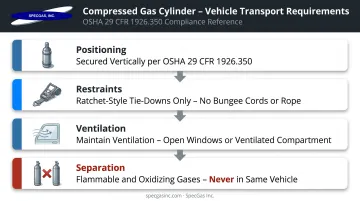
Ventilation must be maintained during transport:
- Keep windows open or use ventilated compartments
- Do not transport in closed, unventilated spaces
- Flammable and oxidizing gases must not travel in the same vehicle
- Remove cylinders from the vehicle promptly upon arrival — don't leave cylinders sitting in a parked vehicle in warm weather
Commercial and DOT Requirements
For larger loads, 49 CFR Part 173.301 governs cylinder shipment requirements:
- Cylinders must carry hazard class labels: Division 2.1 (flammable gas), 2.2 (non-flammable), or 2.3 (poison gas)
- Full non-abbreviated gas name and UN number are required markings
- Hydrostatic test certification must be current
- Vehicles transporting above the 454 kg (1,001 lb) aggregate gross weight threshold for Table 2 materials require placarding
- Drivers transporting placarded quantities need a hazmat endorsement, CDL, and current medical certificate
- Vehicles must carry emergency response information per 49 CFR 172.602
Regulatory Compliance: What OSHA and DOT Require
OSHA Standards
Two primary standards govern compressed gas cylinder handling:
| Standard | Scope | Key Requirements |
|---|---|---|
| 29 CFR 1910.101 | General industry | In-plant handling, storage, use; pressure relief devices per CGA S-1 standards |
| 29 CFR 1926.350 | Construction | Cylinders secured vertically during powered transport; valve caps during movement; regulators removed when not in use |
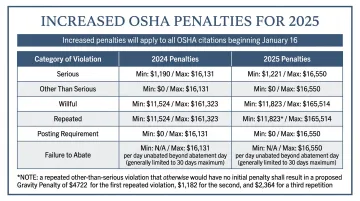
OSHA enforcement covers both on-site handling and transport at work sites. Current maximum penalties (as of January 15, 2025) reach $16,550 per serious violation and $165,514 per willful or repeated violation.
DOT Requirements
Under 49 CFR Part 173.301, cylinders must be properly marked, carry functioning pressure relief devices, and have current requalification certification. One compliance gap that catches facilities off guard: "empty" cylinders containing residue of Division 2.1 (flammable) or 2.3 (poison gas) materials remain classified as hazmat under 49 CFR 173.29. They require the same documentation, upright transport, and valve caps as full cylinders.
Local Fire Codes
Beyond transport rules, storage quantity is its own compliance layer. Facilities storing non-inert gases above certain thresholds may trigger Maximum Allowable Quantity (MAQ) limits under the International Fire Code. IFC 2024 examples per control area:
- Flammable gas (gaseous): 1,000 ft³ at NTP
- Oxidizing gas (gaseous): 1,500 ft³ at NTP
- Highly toxic gas (gaseous): 20 ft³ at NTP
Research labs, university facilities, and industrial sites should conduct a quantity assessment before expanding specialty gas inventories.
Common Safety Mistakes to Avoid
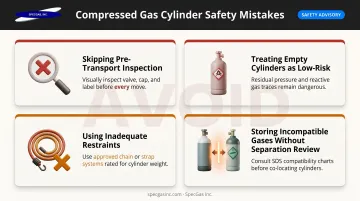
These four mistakes appear across facilities of all sizes — and each one is preventable:
- Skipping pre-transport inspection. Many incidents trace back to cylinders moved without checking valve caps, hydrostatic test dates, or visible damage. An undetected leak or a missing cap discovered mid-transit is exactly what a 5-minute walkthrough is designed to catch.
- Treating "empty" cylinders as low-risk. Residual pressure and residual gas make empty cylinders hazardous. A cylinder that previously held a Division 2.1 or 2.3 gas is still DOT-regulated hazmat — transport it upright, capped, and labeled.
- Using inadequate restraints. Bungee cords, rope, and seat belts fail under hard braking. A 150-pound steel cylinder rolling free in a truck bed can shear its valve on impact — an incident that draws both OSHA scrutiny and potential criminal liability.
- Storing incompatible gases without separation review. This mistake happens gradually: a facility adds new gas types without reassessing the layout. Flammables and oxidizers end up adjacent — a fire code violation and a direct ignition risk. Storage zones need re-evaluation every time a new gas category is introduced.
Conclusion
Cylinder safety comes down to three recurring behaviors: proper physical restraint and storage conditions, disciplined pre-movement inspection, and strict compliance with OSHA and DOT transport requirements. None of these are one-time actions. They're operational standards that apply every time a cylinder is received, stored, moved, or shipped.
That process starts before a cylinder ever reaches your facility. SpecGas supplies NIST-traceable calibration gas mixtures — including reactive and toxic gas blends — using a proprietary internal cylinder treatment developed to maintain mixture stability throughout shelf life. Cylinders arrive correctly labeled, properly certified, and blended to spec, so your team's focus stays on safe handling rather than verifying what's inside.
Frequently Asked Questions
What are the rules for transporting compressed gas cylinders?
OSHA 29 CFR 1926.350(a)(4) requires vertical positioning with valve caps on and regulators removed. DOT 49 CFR 173.301 adds hazard class labeling, current requalification markings, and functioning pressure relief devices. Vehicles must carry emergency response information; drivers moving placarded quantities need a hazmat endorsement.
What are five basic rules for using compressed gas cylinders?
Five core rules for safe cylinder use:
- Secure cylinders upright and restrain against tipping
- Keep valve protection caps on whenever a cylinder is not actively in use
- Never move a cylinder with a regulator attached
- Inspect for damage, leaks, and a current hydrostatic test date before use or transport
- Segregate incompatible gases by at least 20 feet or a rated non-combustible barrier
What is the gas cylinder amendment rules 2026?
A PHMSA rule published February 10, 2026 addresses broad hazmat harmonization with international standards, not cylinder-specific storage or transport handling. No OSHA or CGA rulemaking targeting cylinder storage was verified as finalized for 2026. Check the PHMSA Federal Register and OSHA Unified Agenda for current status.
How should compressed gas cylinders be stored safely?
Store cylinders in a cool, dry, well-ventilated area away from heat sources, with valve caps on and non-combustible restraints anchored to a fixed rack or approved cabinet. Segregate oxidizing and flammable gases by at least 20 feet or a 5-foot non-combustible barrier rated for a minimum ½-hour fire resistance.
Can compressed gas cylinders be transported horizontally?
OSHA 29 CFR 1926.350(a)(4) requires vertical positioning during powered vehicle transport. Horizontal transport is generally not permitted, with very limited exceptions for specific underground construction scenarios addressed in a 1992 OSHA interpretation. Acetylene cylinders must never be transported or stored horizontally — the dissolved acetone migrates toward the valve when the cylinder is on its side, creating serious handling and equipment hazards.
What PPE is required when handling compressed gas cylinders?
Standard requirements include:
- Safety glasses or goggles (OSHA 1910.133)
- Gas-appropriate work gloves, including chemical-resistant gloves for toxic or corrosive gases (OSHA 1910.138)
- Closed-toe protective footwear (OSHA 1910.136)
For toxic or oxygen-deficient atmospheres, OSHA 1910.134 requires respiratory protection; IDLH conditions call for a full-facepiece pressure-demand SCBA or equivalent.