Introduction
Most "neon" signs contain no neon at all. Pure neon produces only a red-orange glow — every other color in gas-discharge lighting comes from argon, krypton, phosphor coatings, or gas mixtures. For research labs, lighting manufacturers, and laser system integrators, that distinction matters.
Gas selection, purity, and fill pressure directly determine color output, luminous efficiency, and tube lifespan. Misspecification in any of these parameters leads to predictable failures: shifted color output, reduced efficiency, and shortened operational life.
This article covers how neon behaves as a lighting medium, its key physical and chemical properties, the full color spectrum it enables alone and in combination, and where specification errors cause real-world problems.
Key Takeaways
- Pure neon produces a red-orange glow (580–700 nm); other "neon" colors come from argon, krypton, xenon, or phosphor-coated tubes
- Operating performance depends on fill pressure (3–20 Torr), gas purity (99.995%–99.999%), and chemical inertness
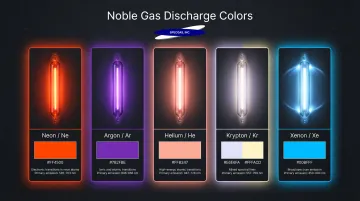
- Noble gas color outputs: argon (violet), helium (pink-orange), krypton (lavender), xenon (blue)
- Uses extend well past signage — He-Ne lasers, plasma displays, glow lamps, and neon indicator lamps all rely on these gases
- Even trace impurities shift emission color, cut efficiency, and accelerate electrode wear
How Neon Gas Functions as a Lighting Medium
Neon is a noble gas (atomic number 10, symbol Ne) that is colorless and chemically inert under standard conditions, present in Earth's atmosphere at just 18.18 parts per million by volume. Its lighting properties emerge from a straightforward physical process: when several thousand volts are applied across sealed electrodes in a low-pressure tube, the electric field strips electrons from neon atoms, creating ions.
As those ions recapture electrons and return to their ground energy state, they release photons — producing visible light at wavelengths determined by neon's electron configuration.
Neon operates as a cold-cathode gas-discharge lamp, not an incandescent source. Light comes from atomic emission — not a heated filament — which is why neon achieves 13–22 lumens per watt, comparable to standard incandescent lamps (17–20 lm/W) but without the associated heat loss.
The process depends on low fill pressure. Neon must be in a partial vacuum inside the sealed glass tube for ionization to occur at manageable voltages. At atmospheric pressure, the required voltage becomes impractically high and quenches the discharge entirely.
Once initiated, the discharge is self-sustaining: moving ions and electrons continuously collide with neutral atoms, maintaining the plasma as long as current flows. Cut the power, and the tube returns to an inert state immediately.
These fundamentals hold in controlled lab conditions — but real-world tubes introduce additional variables.
Factors That Affect Discharge Behavior in Real-World Tubes
Theoretical discharge properties assume pure gas at ideal fill pressure. In practice, tube length, electrode material, glass diameter (typically 8–25 mm outer diameter), and ambient temperature all modify how the discharge initiates and sustains.
Key variables in real-world tube performance include:
- Tube length and diameter — longer or narrower tubes alter voltage requirements and discharge uniformity
- Electrode material — affects ionization efficiency and long-term electrode wear
- Fill pressure precision — small deviations from optimal pressure shift brightness and color consistency
- Ambient temperature — influences gas density and discharge behavior at startup
Cold-weather performance: Neon gas does not rely on mercury vapor, so unlike argon-mercury tubes that suffer from mercury condensation, neon maintains consistent brightness at low temperatures — making it a reliable choice for outdoor signs in cold climates.
Neon Gas and the Color Spectrum
Each noble gas has a distinct electron configuration that produces a unique set of spectral emission lines when ionized. Gas selection is the primary lever for color in discharge lighting before any coatings or glass tinting are applied.
Neon: Red-Orange
Pure neon produces the characteristic red-orange glow with dominant emission in the 580–700 nm range, including strong lines at 585.2 nm and 743.7 nm. No coatings or additives are needed — this output is the direct result of neon's atomic emission spectrum.
Noble Gas Discharge Color Baselines
| Gas Fill | Discharge Color | Primary Emission Mechanism |
|---|---|---|
| Neon (Ne) | Red-Orange | Direct visible emission (585.2–743.7 nm) |
| Argon (Ar) | Violet / Near-IR | Direct visible/IR emission |
| Helium (He) | Pink-Orange | Direct visible emission |
| Krypton (Kr) | Lavender / Yellow | Direct visible emission from higher excited levels |
| Xenon (Xe) | Blue | Direct visible emission from higher excited levels |
Argon and Mercury: Blues, Greens, and Extended Spectrum
Argon alone produces a blue-violet discharge but is rarely used without mercury vapor. Combined, argon-mercury mixtures emit ultraviolet light at 253.7 nm that excites phosphor coatings inside the tube, enabling a broad palette including green, yellow, white, and warm white. Argon's primary role is its low striking voltage — it helps initiate the discharge.
Customization Techniques: Phosphors, Glass, and Gas Blending
Phosphor coatings convert UV emissions from argon-mercury discharges into a wide range of visible colors. Halophosphate phosphors were developed for lighting in the 1940s. Rare-earth phosphors — such as YVO₄:Eu³⁺ for red — emerged in the 1960s for color televisions and were later adapted for tri-phosphor fluorescent lighting in the 1970s. Tinted glass tubing provides an additional layer of color modification on top of the discharge color.
Companies like SpecGas Inc. supply high-purity rare gas blends customized to exact specifications, including neon-krypton-xenon combinations for specialty lighting applications that require precise emission profiles and repeatable performance across production runs.
Key Technical Properties of Neon Gas for Lighting Performance
Neon's suitability as a lighting medium is governed by physical properties that interact with tube design, electrical supply, and operating environment. Understanding these properties is essential for specifying the right gas for the right application.
Purity and Color Consistency
Even trace impurities in neon gas — contaminants such as oxygen, nitrogen, water vapor, or other noble gases — alter discharge color, reduce luminous efficiency, and accelerate electrode degradation. A tube filled with 99.9% neon will produce noticeably different and less consistent output than one filled with high-purity neon meeting lighting-grade specifications.
Non-inert gases (O₂, N₂, H₂O) increase breakdown voltages, alter afterglow chemistry, and cause electrode sputtering. Sputtering creates a spongy metal structure that occludes neon gas, dropping internal pressure and causing premature tube failure. Sourcing from a supplier with documented purity grades and NIST-traceable certification ensures tube-to-tube color consistency.
Chemical Inertness
Purity matters, but neon's long service life also depends on what the gas doesn't do. As a noble gas, neon does not react with electrode materials, glass walls, or other gases under normal operating conditions. This inertness allows sealed tubes to maintain stable discharge characteristics over years of operation, unlike reactive gas fills that degrade tube components over time.
Low Ionization Energy and Efficient Light Output
That chemical stability pairs with another practical advantage: neon ionizes easily. Neon has a first ionization energy of 21.56454 eV (173,929.75 cm⁻¹), which is relatively low among noble gases. It ionizes readily at achievable voltages for gas-discharge applications, enabling bright light output at milliwatt-level power consumption relative to visible light produced. This efficiency drove neon's commercial dominance in signage and display lighting — and still makes it the material of choice for applications where LED simply can't replicate the output.
Spectral Line Stability
Neon's emission spectrum is fixed by atomic physics. At consistent purity levels, the wavelengths of emitted photons are constant regardless of manufacturer, geography, or tube geometry. This makes neon emission lines useful as wavelength references in spectroscopy, typically covering the 540–754 nm range for optical calibration standards.
Operating Parameters and Specification Requirements
Neon lighting performance is governed by defined operating ranges. Deviations in fill pressure, applied voltage, or gas purity produce measurable changes in color, brightness, efficiency, and tube lifespan.
Fill Pressure Range
Gas inside a neon tube is held at low pressure — typically 3 to 20 Torr (0.4–3 kPa), representing a significant partial vacuum relative to atmospheric pressure (760 Torr). This range exists for specific reasons:
- Pressure too low: fewer ionizable atoms reduce discharge brightness
- Pressure too high: striking voltage climbs and the emission spectrum can shift
Tube diameter, length, and intended application influence where within this range the fill pressure is specified.
Voltage and Current Requirements
Neon signs require high voltage (typically 1,000 to 15,000 volts) to strike the initial discharge, then operate at lower sustaining voltage. Key operating parameters to specify correctly:
- Current draw is low — typically 20–60 mA during operation
- Transformers must match both gas type and tube length; a mismatched unit is a leading cause of premature failure or dim output
- Neon reaches full brightness instantly at any temperature — no warm-up period, unlike mercury-containing argon tubes
Gas Purity Specifications and Sourcing Considerations
For lighting applications, neon gas is specified at high purity grades:
| Application | Typical Grade | Minimum Purity | Impurity Limits (O₂ / H₂O) |
|---|---|---|---|
| Commercial Signage / Lighting | 4.5 to 5.0 | 99.995% to 99.999% | ≤ 2 ppm / ≤ 3 ppm |
| Scientific / Spectroscopy | Research / 5.0 | 99.999% | ≤ 0.5 ppm / ≤ 1 ppm |
| He-Ne Lasers | Semiconductor / UHP | 99.996% to 99.999% | ≤ 0.5 ppm / ≤ 1 ppm |
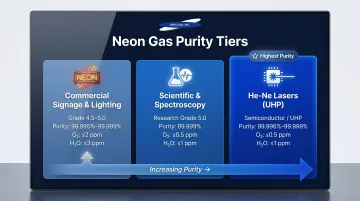
Even small purity deviations — particularly oxygen or moisture contamination — can alter discharge color and accelerate tube degradation. For reproducible results, tube manufacturers and researchers should specify the correct grade and require a certificate of analysis with every supply lot.
Applications of Neon Gas in Lighting Beyond Traditional Signs
While neon signage is the most recognized application, neon gas serves a broader set of lighting and photonic applications where its specific discharge properties — stable emission spectrum, inertness, and predictable ionization behavior — make it difficult to substitute with any other gas.
Neon Glow Lamps and Indicator Lights
Miniature neon glow lamps, first developed in 1910 by Georges Claude, operate on a "corona discharge" principle rather than the positive column discharge of tube lighting. These devices — less than one centimeter in length — were widely used as indicator lamps in appliances, instrument panels, and electronic circuits through the 1970s. Nixie tubes, invented in the 1950s and used for numerical display, are a historical example of neon discharge technology that informed the architecture of early plasma display panels.
Helium-Neon Lasers and Scientific/Industrial Uses
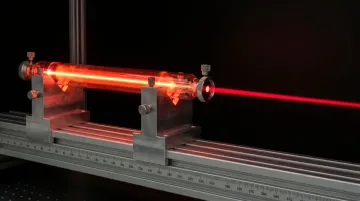
Helium-neon (He-Ne) lasers use a mixture of helium and neon gas (typically in a 5:1 to 10:1 ratio) to produce a coherent red laser beam at 632.8 nm through a different excitation mechanism than discharge lighting. Common He-Ne laser applications include:
- Optical alignment and interferometry
- Barcode scanning systems
- Holography
- Dermatological treatments
- Vision correction research
Each application requires highly pure neon at specific mixture ratios. Gas quality directly determines laser output consistency, making this one of the more precision-critical uses of neon in applied science.
Plasma Displays and Flat Panel Technology
Plasma display panels (PDPs) are a direct technological descendant of neon glow lamp technology. Each pixel in a PDP contains a neon-xenon gas mixture (typically 90% Ne, 10% Xe) that emits UV light upon discharge, which then excites color phosphors. Major manufacturers discontinued consumer PDP production between 2013 and 2014 due to the rise of LCD/LED technologies.
Conclusion
Neon gas is a precision material, not a commodity fill. Its performance in any lighting application is determined by physical properties, purity level, operating pressure, and interaction with tube geometry and electrical supply. Treating these variables as secondary concerns is what separates consistent, long-life lighting systems from underperforming ones — whether the application is commercial signage, laser systems, or advanced display technology.
Gas purity, fill pressure specification, and electrode compatibility all determine whether a neon discharge tube operates for months or years. Sourcing neon from a supplier who understands these requirements at a technical level, rather than treating it as a bulk gas order, is where that difference is made. SpecGas Inc. supplies high-purity neon and specialty rare gas blends to lighting manufacturers, laser system builders, and research labs that depend on consistent, specification-grade product.
Frequently Asked Questions
What type of gas is used in neon lights?
While the term "neon lights" is broadly applied, true neon gas produces only the red-orange color. Other colors come from argon, krypton, xenon, helium, mercury vapor, or phosphor coatings applied inside the tube.
Does the US produce neon gas?
Neon is extracted as a byproduct of cryogenic air separation. The 2022 Russian invasion of Ukraine disrupted roughly 50% of global semiconductor-grade neon supply, spiking prices up to 10x. Domestic US production capacity has expanded since then to reduce that dependence.
What color does pure neon gas produce when electrified?
Pure neon produces a red-orange glow with dominant emission in the 580–700 nm visible range. The exact shade depends on discharge energy level and tube pressure.
How does gas pressure inside a neon tube affect light output?
Lower pressure within the 3–20 Torr range generally produces a brighter, more diffuse glow, while higher pressure shifts discharge characteristics and requires greater striking voltage. Tube makers set fill pressure intentionally to balance brightness, color quality, and operational voltage.
Can neon gas be mixed with other gases for different colors in lighting?
Yes, neon is frequently combined with argon, helium, or mercury vapor to produce colors outside the red-orange range. The proportions of the mixture, combined with phosphor coatings and glass color, determine the final output.
What purity level of neon gas is required for lighting applications?
Requirements vary by application. Commercial signage typically uses 99.995%–99.999% purity, while spectroscopy and He-Ne laser applications demand 99.999% or better. In either case, impurities degrade color accuracy and shorten tube life.